

The American Presidency
in Illustration
As part of our year-long virtual exhibition celebrating the history of the United States for the semisesquintennial anniversary of its founding, the National Museum of American Illustration presents the February installment:
Commanders in Chief: The American Presidency in Illustration.
This exhibition brings together 20 masterfully crafted illustrations of U.S. Presidents, created by some of the most influential illustrators of the 20th century. Long before television and digital media, illustration was the primary visual language through which the public encountered its leaders. These images captured presidents not only in moments of power, but also as individuals shaped by ambition, adversity, and national expectation. These works reveal how illustration shaped the way Americans came to understand—and imagine—the presidency.
Commanders in Chief invites viewers to consider how illustration has played a vital role in shaping America’s collective memory of its presidents, and how art has long helped tell the story of leadership in the United States.
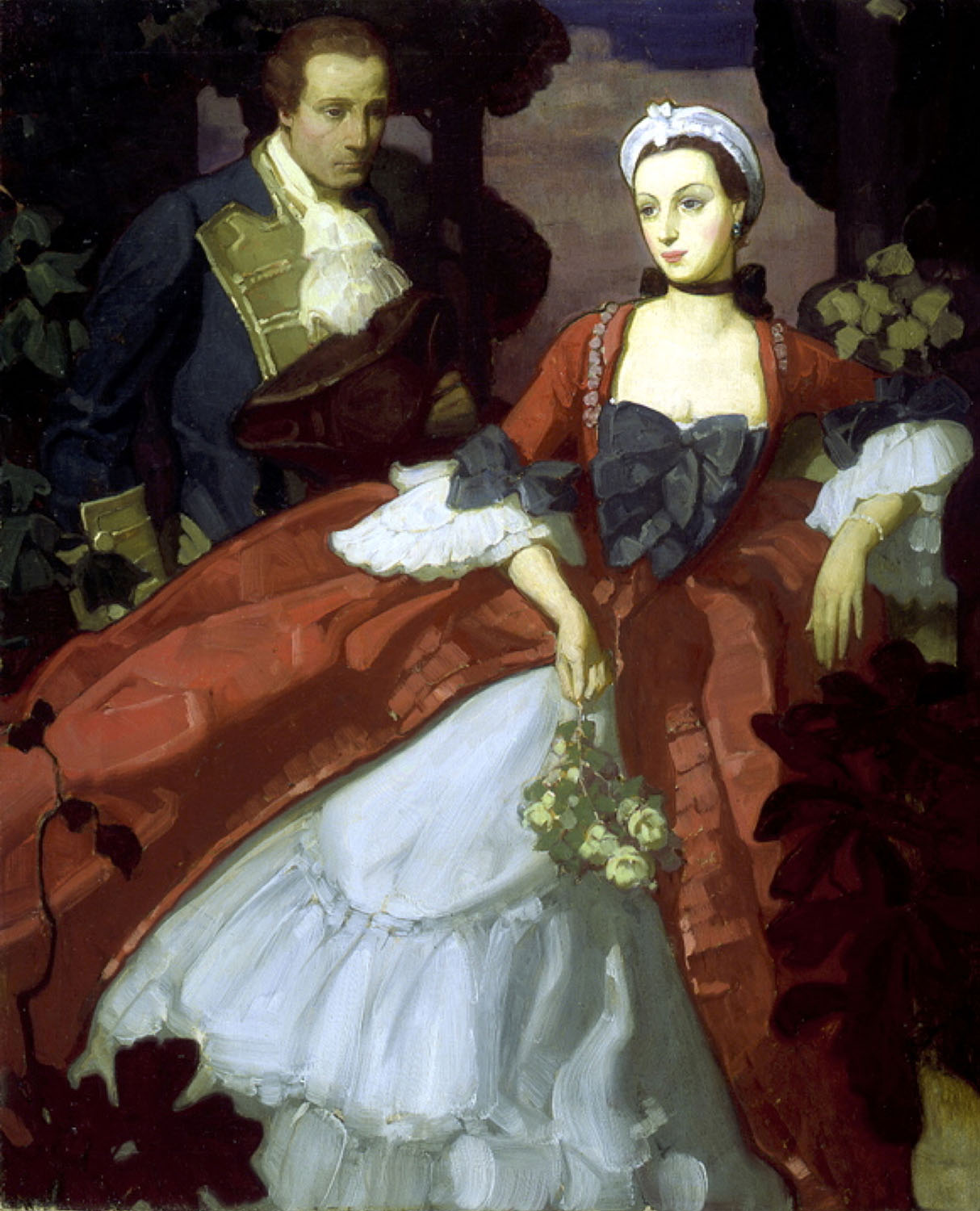
Mead Schaeffer (1898-1980)
George Washington with Sally Fairfax
1931, oil on canvas
32" x 26 1/2"
Everybody's Washington, by Alden Knipe, Dodd Mead & Company, NY, 1931
Mead Schaeffer’s intimate portrayal of a young George Washington with Sally Fairfax reveals the future president long before he became a national symbol. Sally Fairfax was a close friend and confidante of Washington during his early adulthood and is widely believed to have been his first great love. Rather than depicting Washington as a distant statesman or military hero, Schaeffer presents him as a thoughtful, emotionally complex man shaped by personal relationships and private longings. Created to illustrate Alden Knipe’s Everybody’s Washington, the image reflects a broader effort to humanize America’s first president for a modern audience—reminding viewers that the ideals of leadership are forged not only through public achievement, but through lived experience and personal growth.
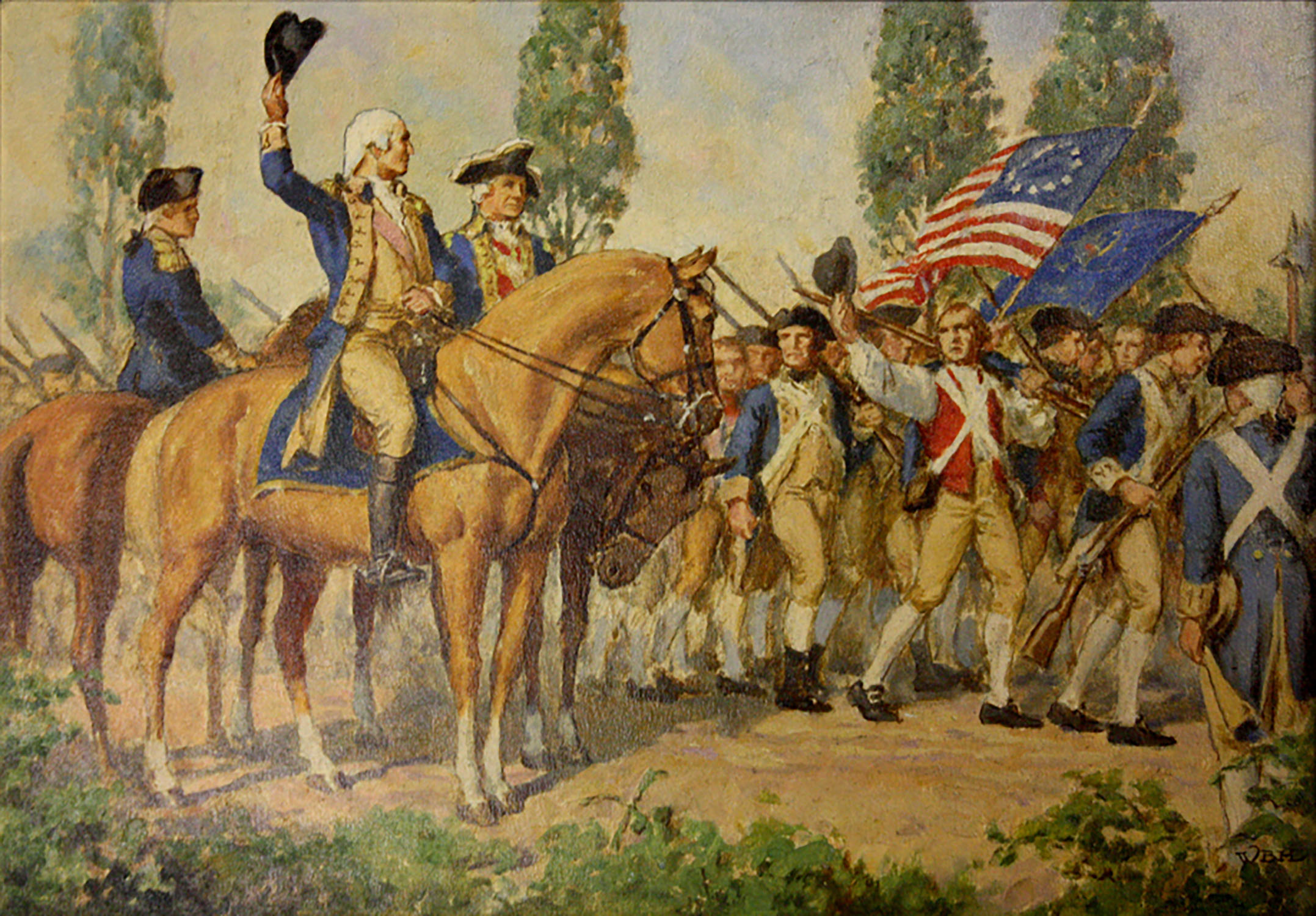
Walter Beach Humphrey (1892-1966)
Washington and His Troops
Oil on paper
9" x 12", initialed lower left
In A New Spring, Walter Beach Humphrey presents George Washington at a defining moment of triumph and renewal. Mounted on horseback and raising his hat in salute, Washington acknowledges his troops as they march past carrying an early American flag emblazoned with a circle of stars—a powerful symbol of unity among the newly formed states. Humphrey’s title reinforces the sense of rebirth, suggesting not only the end of conflict, but the hopeful beginning of the American presidency and the democratic experiment it would soon lead.
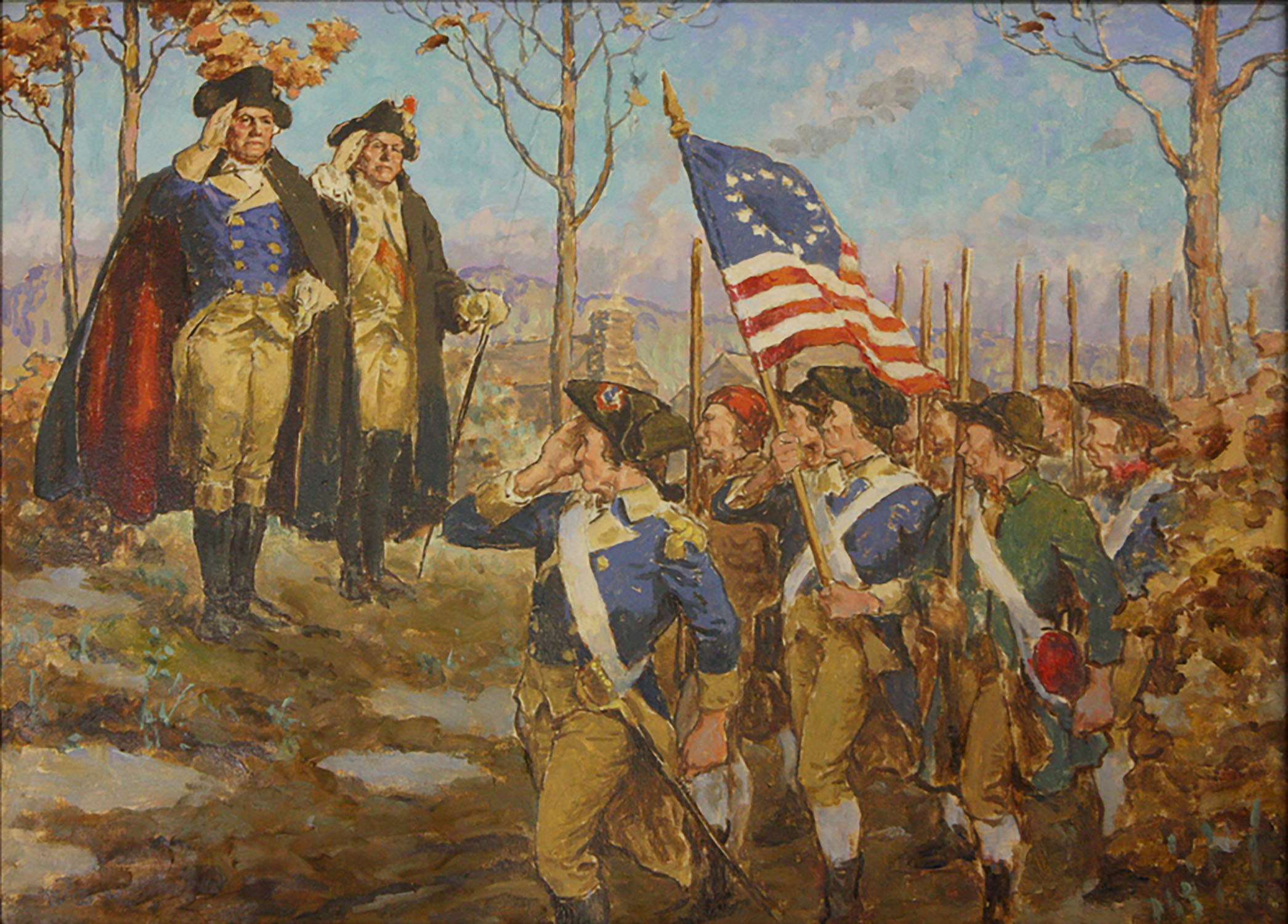
Walter Beach Humphrey (1892-1966)
A New Spring
Oil on paper
8 3/4" x 11 1/2", initialed lower left
In this companion image, George Washington is shown standing rather than mounted, formally saluting his troops as they march past bearing the early American flag with its circle of stars. Together with earlier triumphal depictions, this scene underscores Washington’s enduring legacy as both a victorious military leader and a principled steward of the republic.
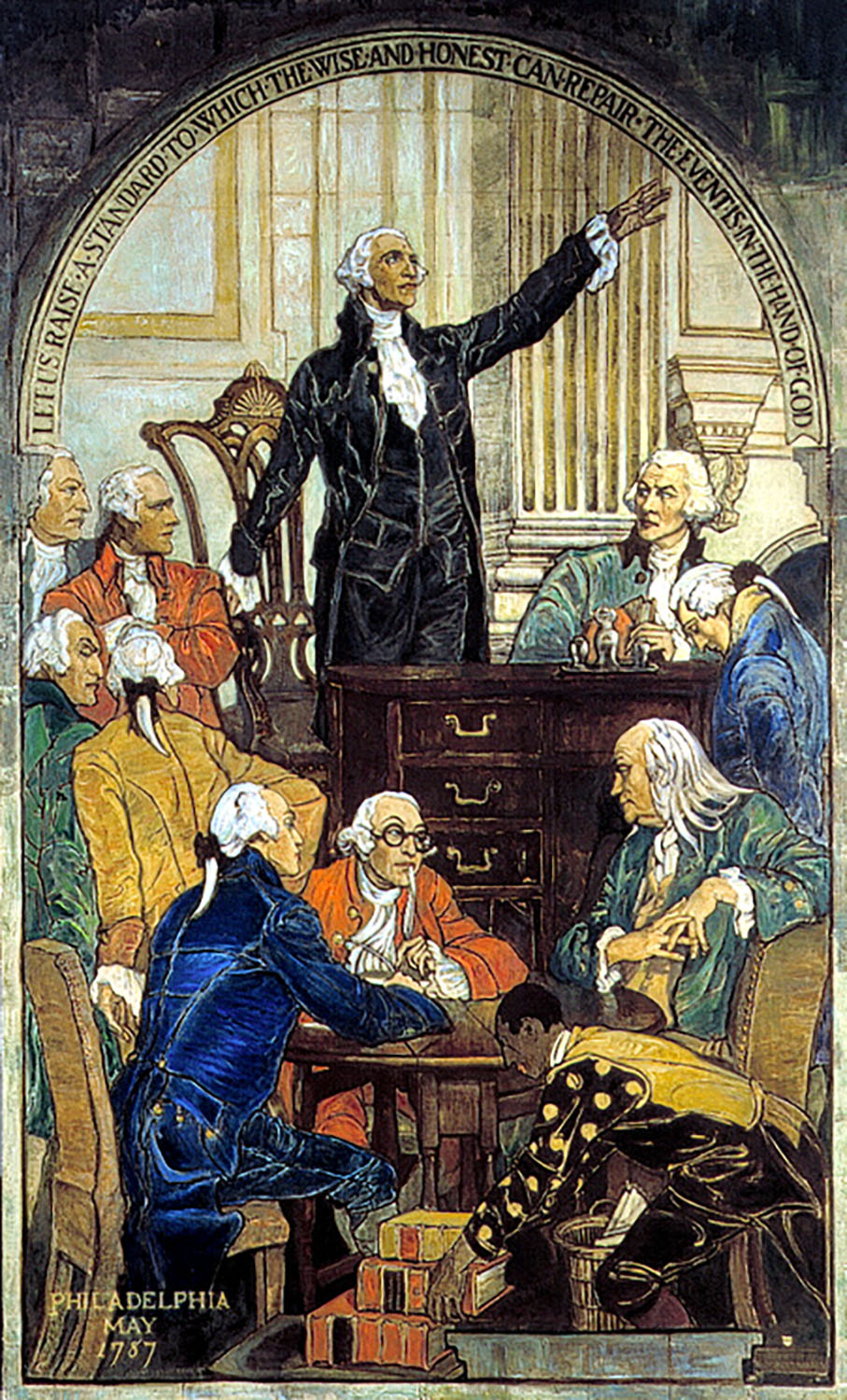
Violet Oakley (1874-1960)
The Creation and Preservation of the Union - George Washington at the Constitutional Convention
1911, oil on printed base
39 3/4” x 24”
Study for murals at the Pennsylvania State Capitol, Harrisburg, PA
In this study for her monumental murals at the Pennsylvania State Capitol, Violet Oakley presents George Washington not as a warrior, but as a unifying statesman at the Constitutional Convention of 1787. Standing boldly over the room, Washington presides over the debates that would shape the framework of American democracy. Oakley’s interpretation emphasizes moral leadership, a quality essential to the fragile task of forging a new nation. Created as part of a larger civic program, the image reflects Oakley’s belief in art as a public force, capable of educating citizens about the ideals, responsibilities, and enduring significance of constitutional government.
Howard Pyle (1853-1911)
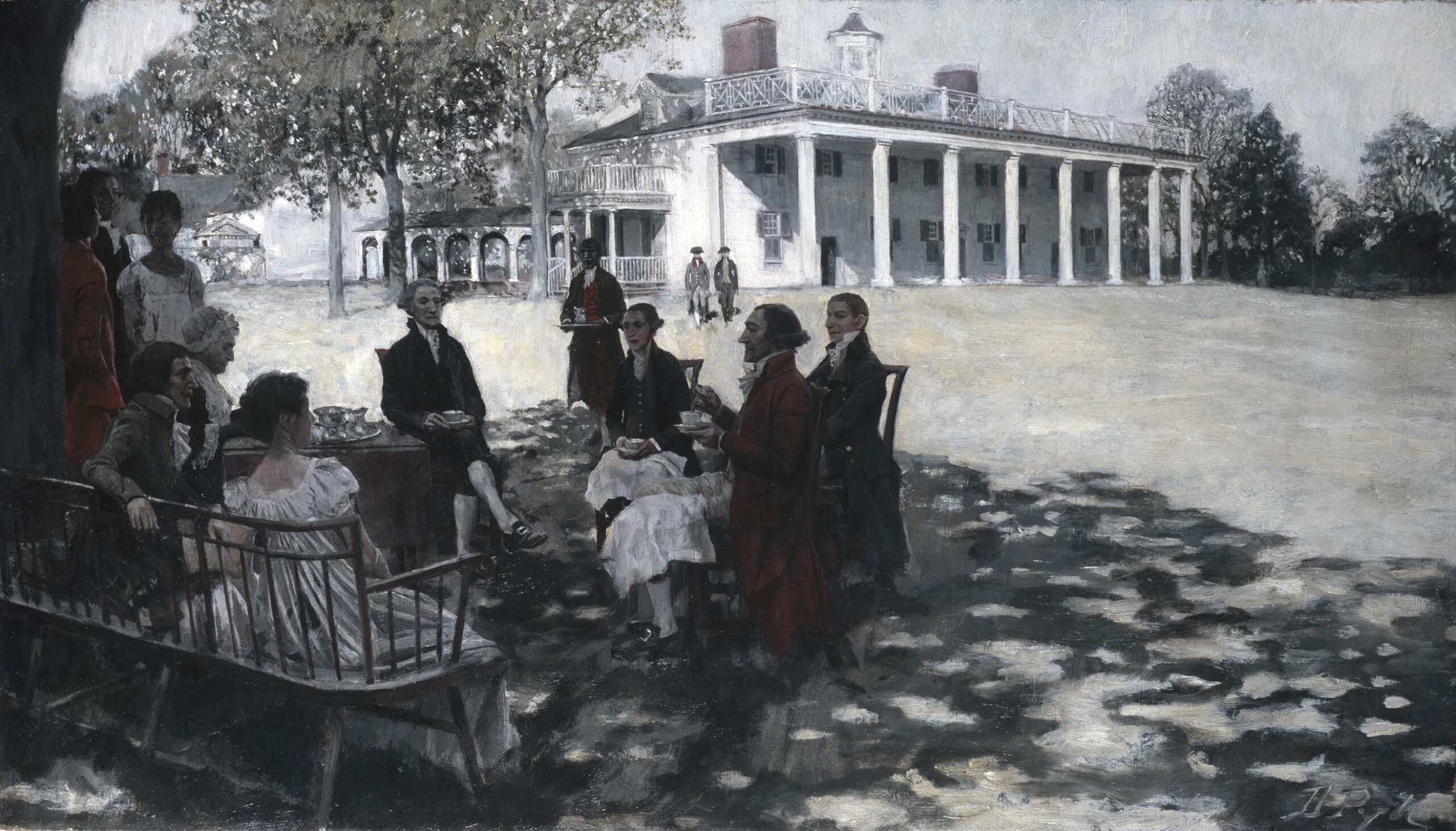
George and Martha Washington Entertaining Their Friends on the Lawn at Mount Vernon
1899, oil on canvas
16” x 28”, signed lower right
"The Last Years of Washington's Life," by William Perrine, The Ladies' Home Journal, October 1899
Howard Pyle’s painting George and Martha Washington Entertaining Their Friends on the Lawn at Mount Vernon reshapes how the nation’s founding figures were imagined at the turn of the twentieth century. Created to illustrate “The Last Years of Washington’s Life”by William Perrine for The Ladies' Home Journal, the image reflects Pyle’s larger mission to humanize history and make the past emotionally legible to a modern audience. Rather than presenting George Washington as a distant hero or monumental icon, Pyle situates him within the rhythms of domestic life at Mount Vernon. Washington appears not as commander or statesman, but as host—gracious, relaxed, and deeply embedded in his community. Beside him, Martha Washington presides with warmth and dignity.
Norman Rockwell (1894-1978)
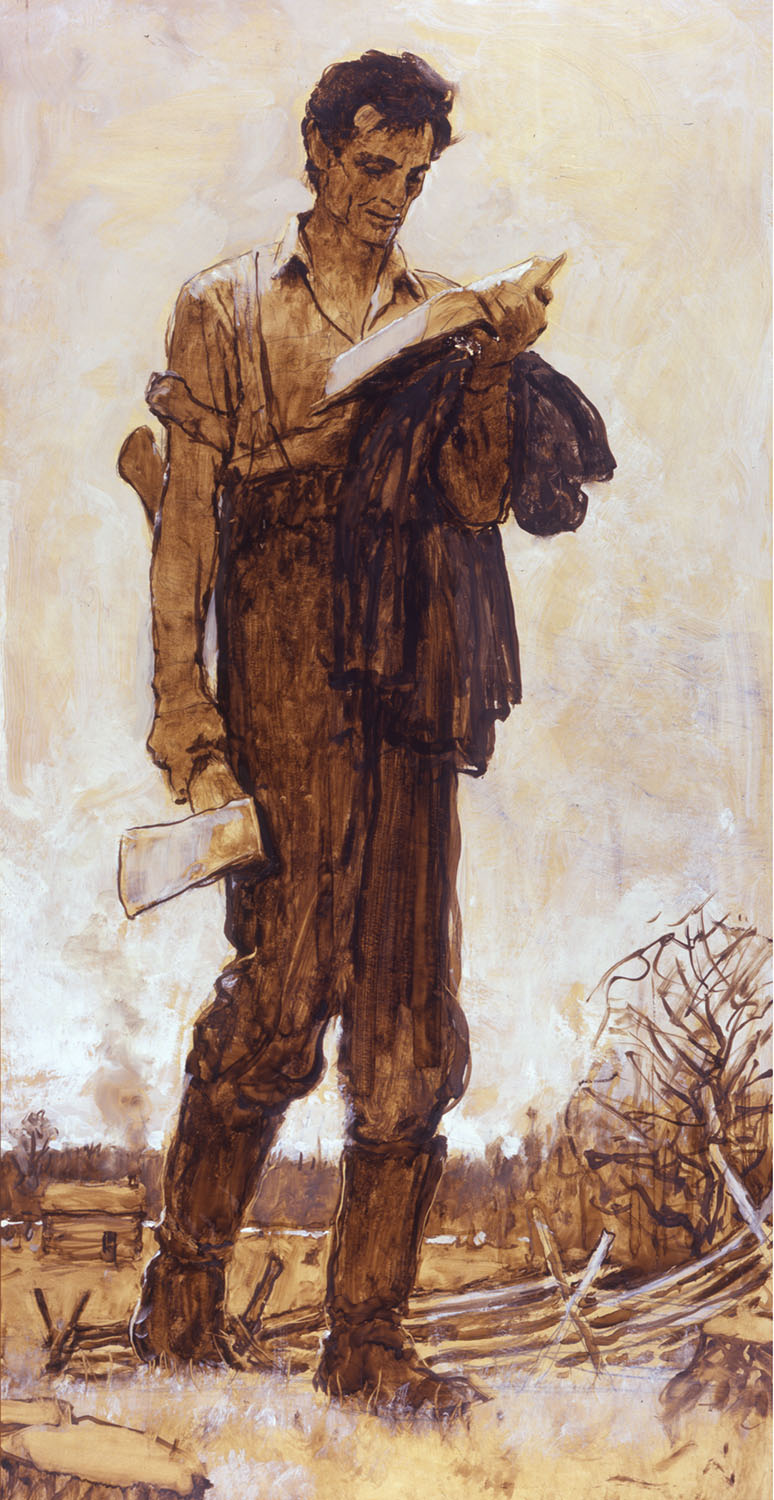
Lincoln the Railsplitter - Study
1962, oil and tempera on panel
40" x 20"
Study for Lincoln Savings advertisement, 1964
Rockwell poured his thought and energy – for quite a long time – into realizing his vision for this portrait of Lincoln as a figure of dependability and true integrity. As an advertisement for Lincoln Savings Bank, Rockwell completely invested himself in the seriousness of his subject, highlighting the development of Lincoln from this young railsplitter into ‘Honest Abe,’ the celebrated American politician. Engrossed in the book grasped in his left hand, Lincoln seems to transform before the viewer.
“Undoubtedly, Rockwell was familiar with [Carl] Sandburg’s account of Lincoln as a surveyor and most likely he based his now famous literary image of the young Abraham Lincoln from the biography. Lincoln the Railsplitter illustrates Lincoln engrossed in reading a surveying text held in one hand while bearing an axe in the other. There is no mistaking that the scene is a reflection of that moment of transition in the maturity of Lincoln from woodman to statesman… Viewed from below, Lincoln appears larger than life, with the expanse of farmland not yet developed serving as a background to the iconic president.” From Laurie Norton Moffat’s catalogue entry for Lincoln the Railsplitter.
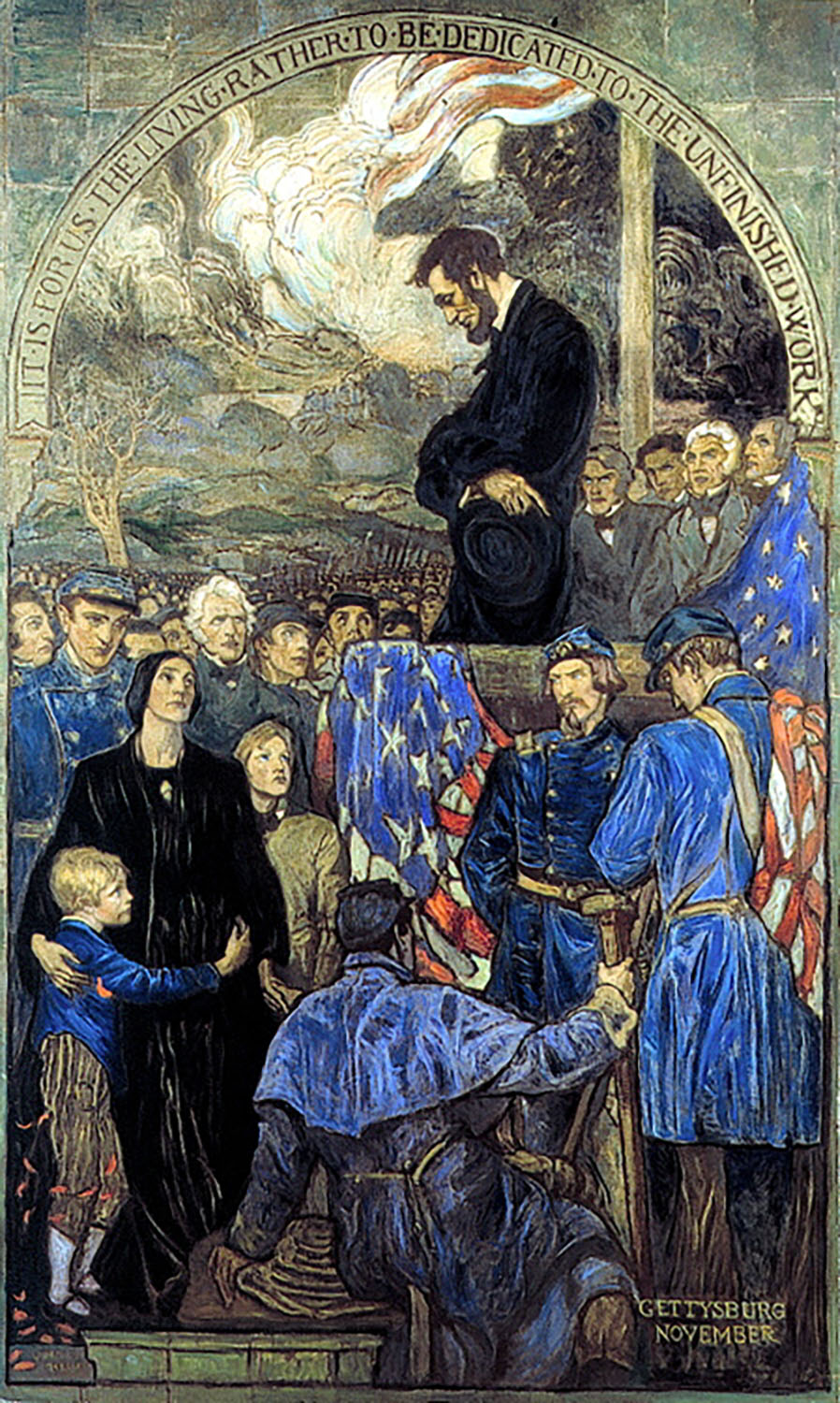
Violet Oakley (1874-1960)
The Creation and Preservation of the Union - Abraham Lincoln Delivering the Gettysburg Address
1911, oil on printed board
40” x 24”
Study for murals at the Pennsylvania State Capitol, Harrisburg, PA
In this powerful study, Violet Oakley depicts Abraham Lincoln delivering the Gettysburg Address, one of the most consequential speeches in American history. Standing on a simple podium, Lincoln addresses a somber assembly of Union soldiers, while a mother embracing her child in the foreground underscores the profound human cost of the Civil War. Oakley’s composition balances grief and resolve, presenting Lincoln as a moral voice rising above devastation to reaffirm the nation’s founding ideals. Created for her Pennsylvania State Capitol murals, the work reflects Oakley’s conviction that illustrated history could honor sacrifice, educate the public, and illuminate the enduring principles of unity, equality, and national purpose.
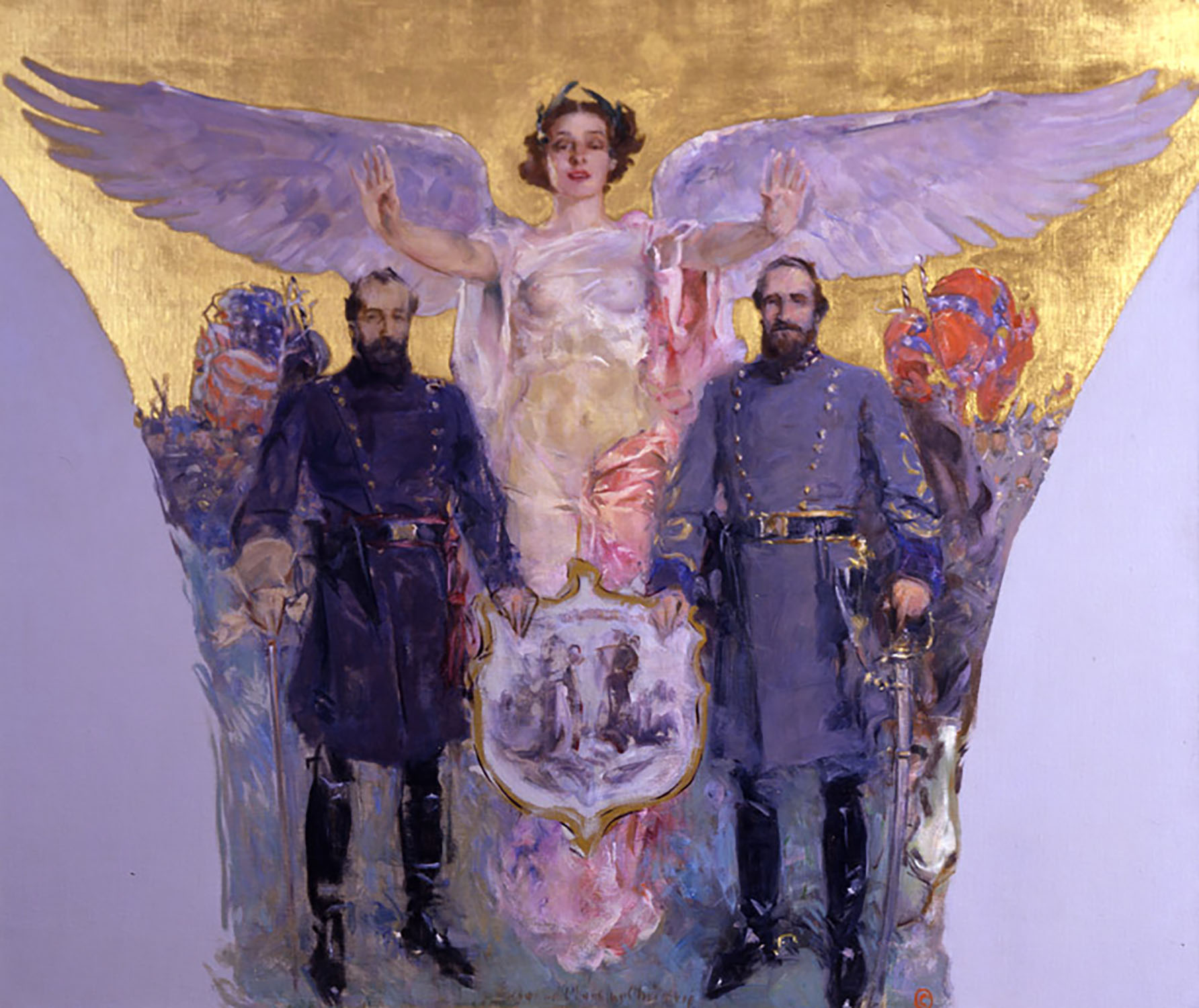
Howard Chandler Christy (1872-1952)
Patriotic Civil War Memorial
Oil on canvas
39 1/4" x 46 1/4", signed lower center
In this unrealized study, Howard Chandler Christy envisions a powerful allegory of reconciliation and leadership in the Civil War. An angelic figure with outstretched arms, representing peace and unity, hovers above Ulysses S. Grant, who stands before the Union flag, and Robert E. Lee, positioned before the Confederate banner. Christy underscores how the Civil War defined Grant’s path to the presidency. His leadership during the conflict established him as a symbol of resolve, unity, and victory—qualities that propelled him to the White House and shaped his presidency during the fraught era of Reconstruction.
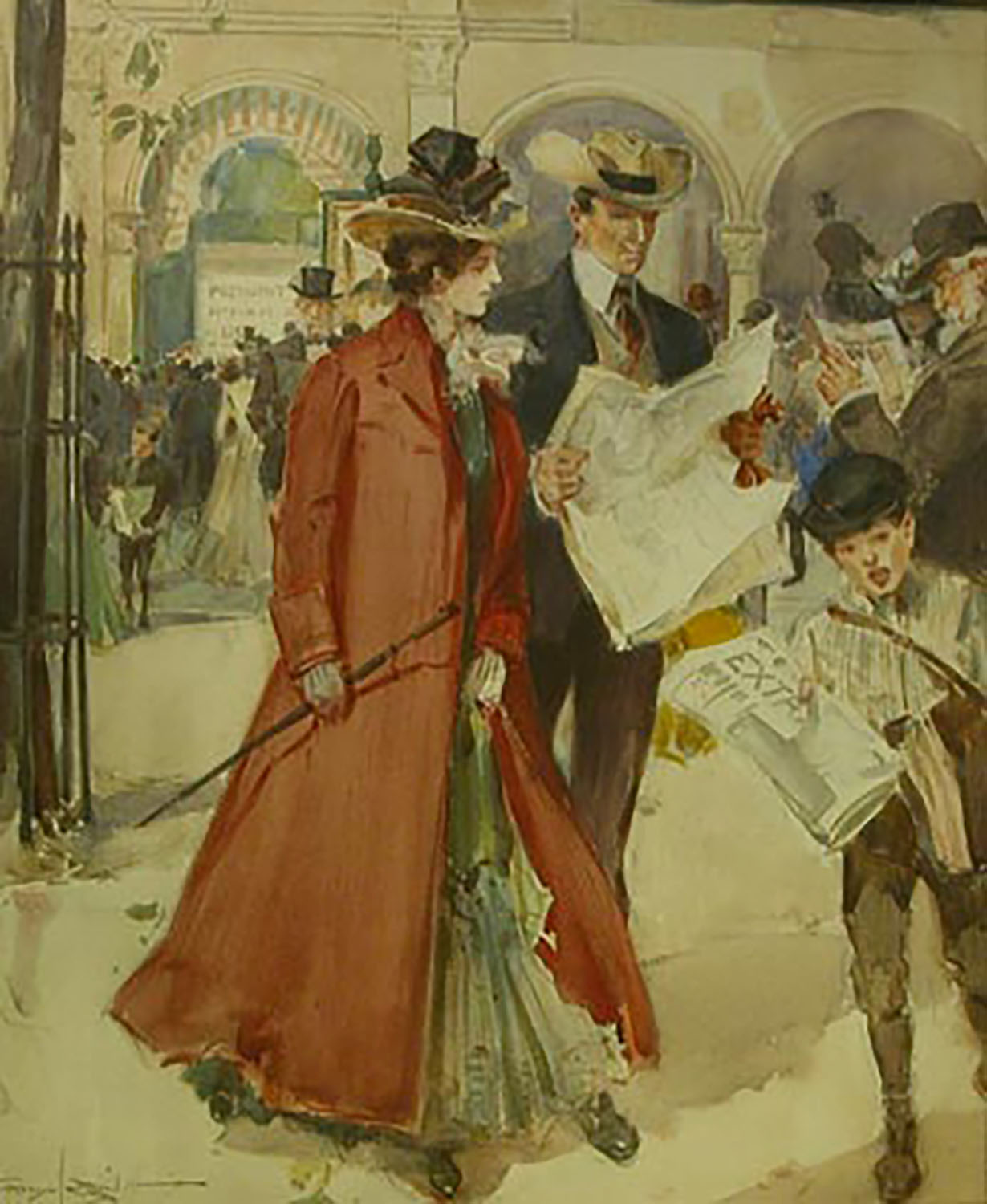
Walter Granville Smith (1870-1938)
Extra! President McKinley is Dead
Watercolor on board
21 1/2” x 15”, signed lower left
Truth Magazine, cover
Walter Granville Smith’s striking magazine cover captures the shock and immediacy of a nation in crisis following the assassination of President William McKinley in 1901. Set on a crowded city street, a paperboy thrusts newspapers toward the viewer, the devastating headline—“Extra! President McKinley Is Dead!”—cutting through the everyday bustle of American life. The surrounding figures, dressed in the typical attire of the era, freeze the moment in time, emphasizing how suddenly tragedy intruded upon the ordinary rhythms of the nation.
The illustration underscores the growing power of mass media at the turn of the 20th century and its role in shaping public awareness of presidential events. Smith’s image reminds viewers that the presidency is not only defined by leadership and achievement, but also by moments of national grief—events that can instantly alter the course of history and usher in new eras of American political life.
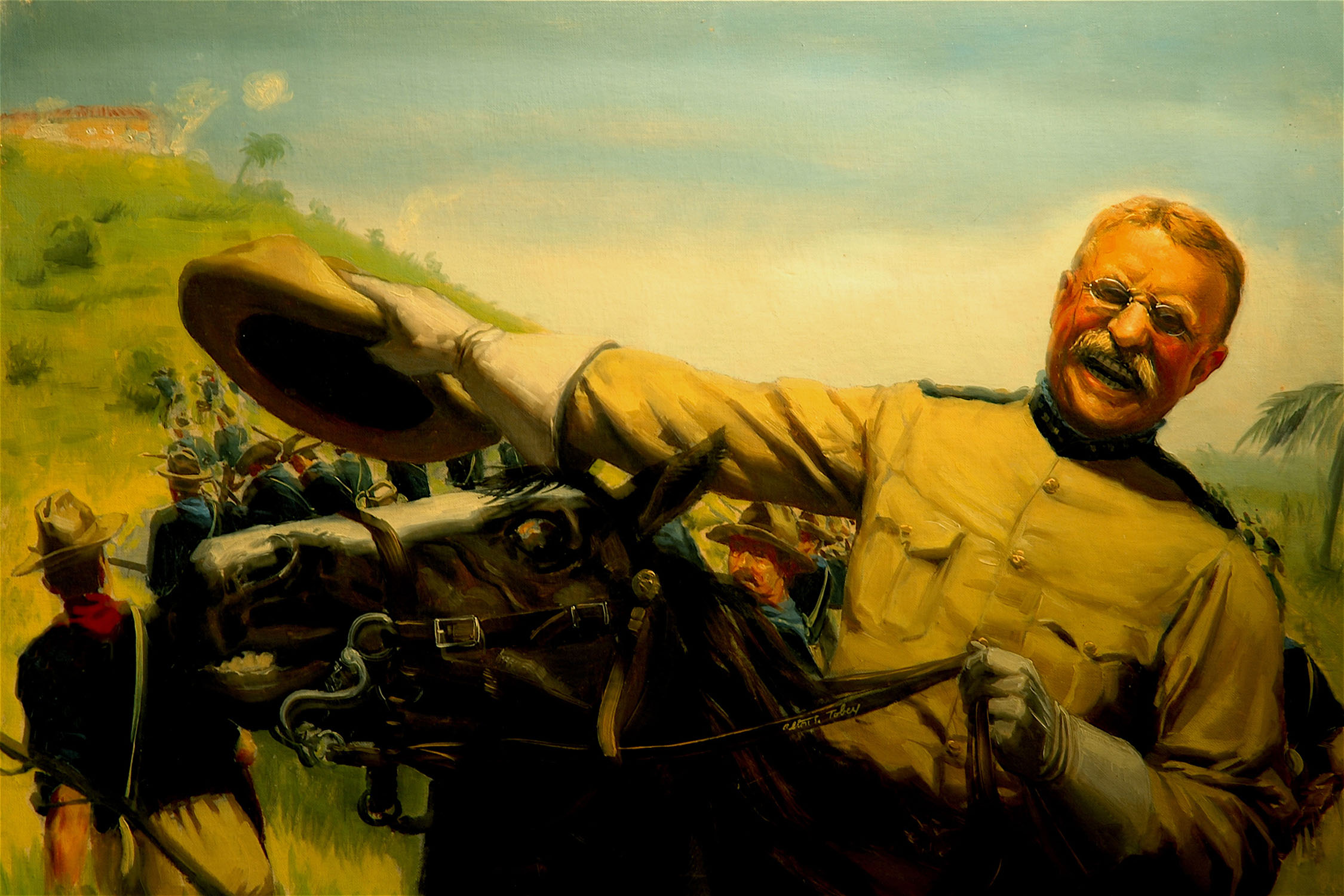
Alton Stanley Tobey (1914-2005)
Teddy Roosevelt and the Rough Riders
Oil on canvas
18 1/2” x 26 1/2”, signed lower center
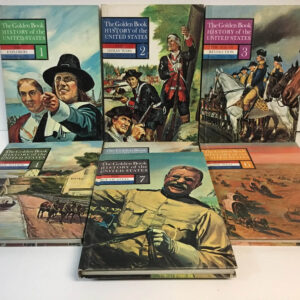
History of the United States, Vol. 7, Golden Books, 1963, cover
Painted for the cover of a Golden Books edition of History of the United States, Alton Stanley Tobey’s dynamic illustration captures Theodore Roosevelt’s transformation from politician to national hero during the Spanish-American War. Roosevelt dominates the foreground on horseback, confidently smiling toward the viewer, while the Rough Riders charge uphill behind him—a visual metaphor for momentum, courage, and ascent.
The image reflects how Roosevelt’s wartime leadership helped forge his larger-than-life public persona and fueled his rapid rise to the presidency. By presenting Roosevelt as both charismatic and commanding, Tobey’s illustration demonstrates how popular imagery played a key role in shaping the public’s understanding of presidential leadership—celebrating action, optimism, and the idea of America as an emerging global power.
J.C. Leyendecker (1874-1951)
Theodore Roosevelt: Two Views of Him
1904, oil on canvas
17” x 17 1/4”
Collier's, October 22, 1904 cover
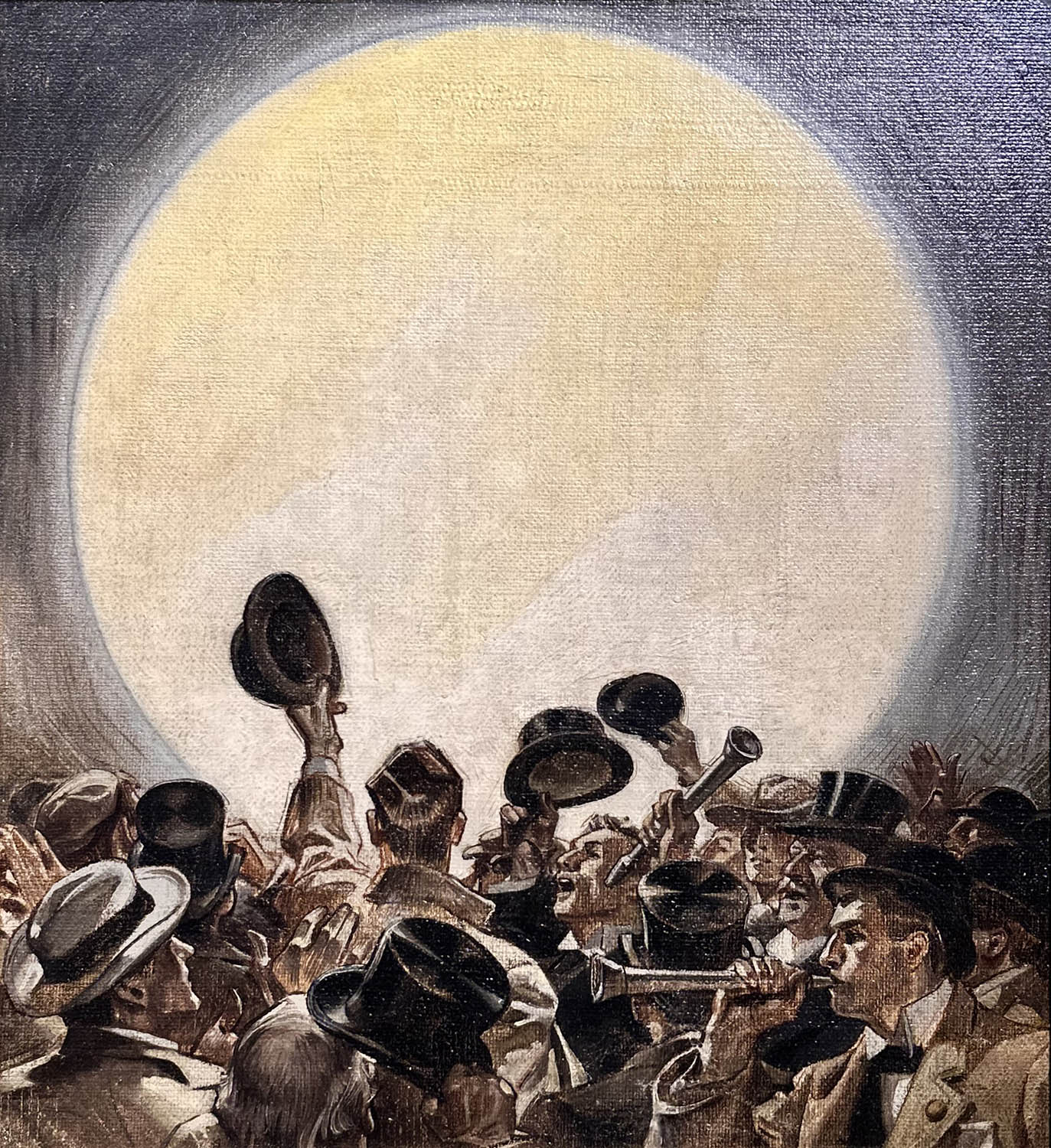
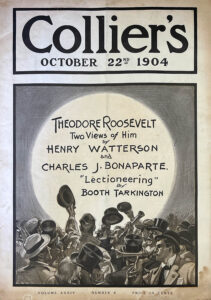
J.C. Leyendecker’s compelling cover for the October 22, 1904 issue of Collier’s captures the charged political atmosphere surrounding Theodore Roosevelt’s bid for re-election. Published just two weeks before the presidential vote, the image appeared beneath the headline “Theodore Roosevelt: Two Views of Him,” which introduced dueling articles by Henry Watterson and Charles J. Bonaparte—each offering sharply different assessments of Roosevelt’s leadership and policies.
Harry Anderson (1906-1996)
The Chief Executive Goes For A Spin (President William Howard Taft in a 1909 White Steamer)
1967, gouache on board
22” x 28”, signed lower left
Great Moments in Early American Motoring calendar illustration, November 1967
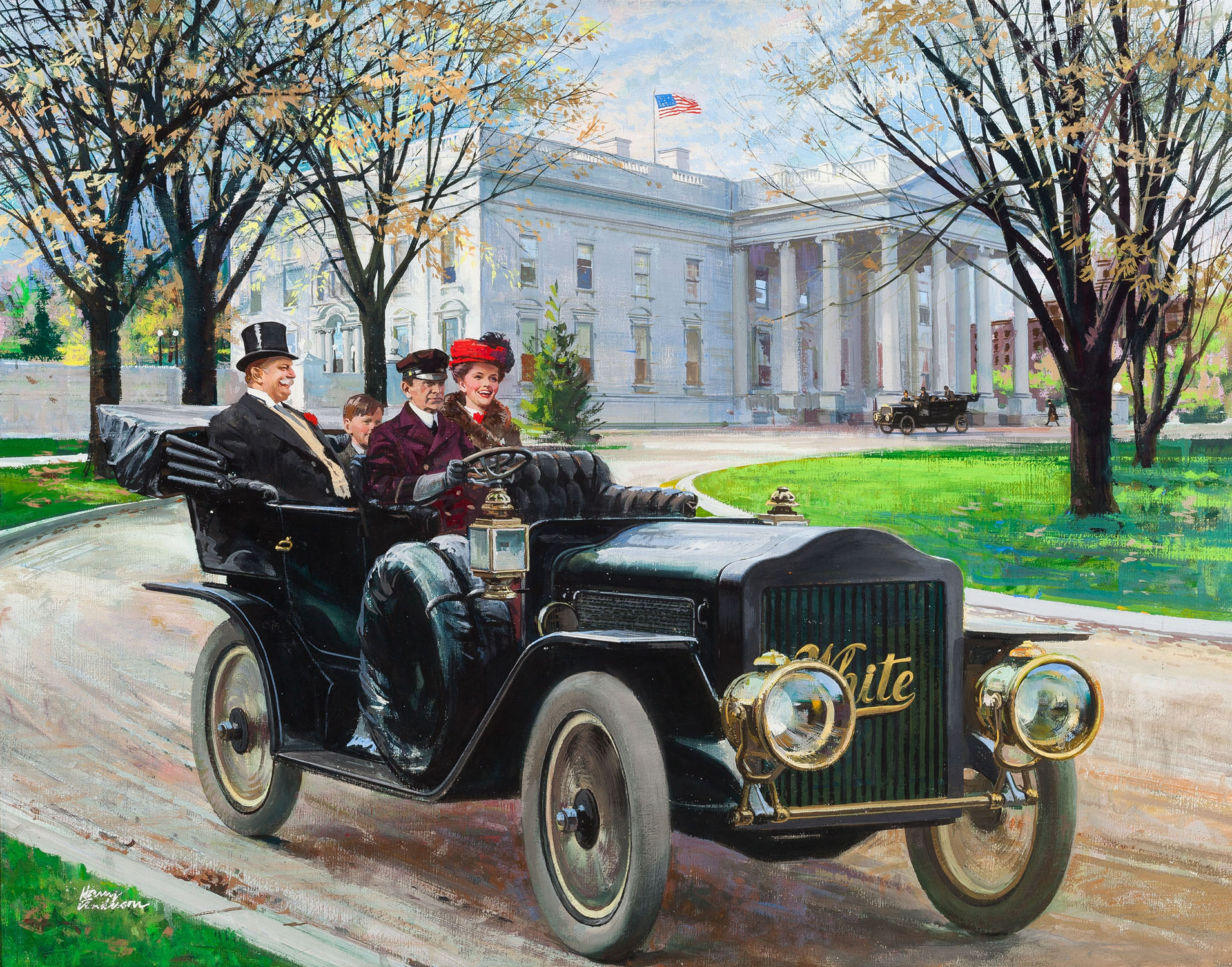
Harry Anderson’s The Chief Executive Goes for a Spin presents President William Howard Taft in a moment of lighthearted modernity, departing the White House in a 1909 White Steamer automobile alongside his wife and son. Smiling and relaxed, Taft is shown not as a distant political figure, but as a husband, father, and participant in a rapidly changing world.
The illustration highlights the early embrace of the automobile by the presidency, symbolizing America’s entry into a new, mechanized era. By pairing presidential authority with domestic warmth and technological progress, Anderson’s image reflects how illustration helped humanize the office—showing the president as both national leader and private citizen at a time when the pace of American life was accelerating.
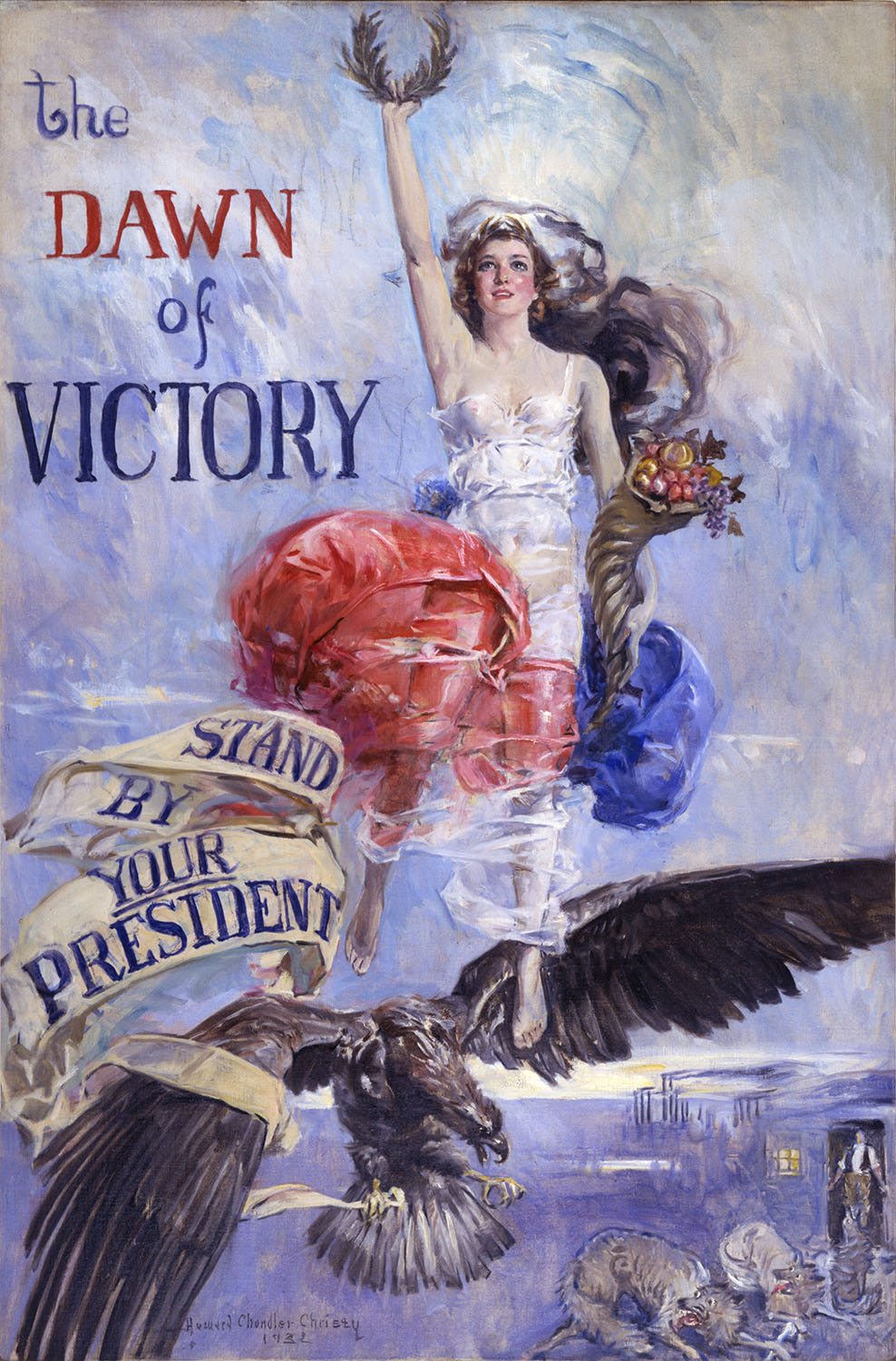
Howard Chandler Christy (1873-1952)
Stand By Your President - Dawn of Victory
1933, oil on canvas
60” x 40”, signed and dated lower left
Re-Elect Herbert Hoover campaign poster illustration
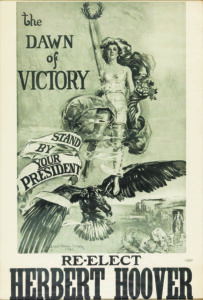
Painted for a Herbert Hoover's re-election campaign poster, Howard Chandler Christy's allegorical image memorializing significant historical events asks voters to "Stand By Your President" in the midst of the Great Depression. An angelic woman draped in red, white, and blue fabric rides on the wings of an eagle, carrying a plentiful horn of fruit symbolizing prosperity in one arm and raising a crown of victory above her head. In the lower right corner scared, hungry wolves are cowering away from the powerful blue-gray eagle (a symbol of the National Recovery act) readying to fight them off. On the other side of the wolves, a man stands in the doorway of American industry. Behind him in the distance are fully operational smoke stacks representing the booming commercial production and economic activity. Christy's use of symbolism in this poster made it an enduring image of Hoover's campaign and of the struggles of the Great Depression. Hoover ultimately lost the election to Franklin D. Roosevelt, who served as President until 1945.
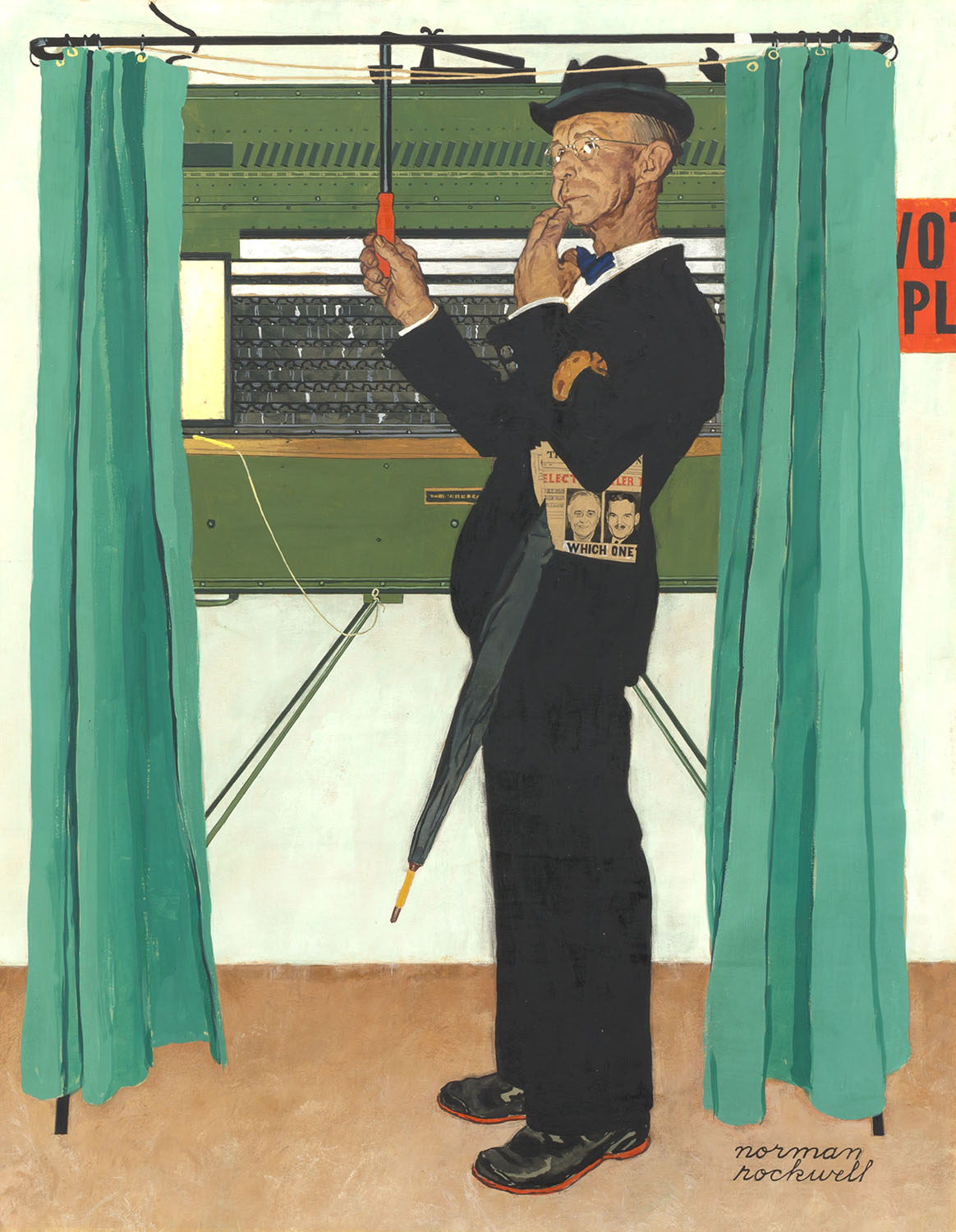
Norman Rockwell (1894-1978)
Which One? - Study
1944, mixed media on paperboard
20 1/2" x 16", signed lower right
Study for Saturday Evening Post, November 4, 1944 cover
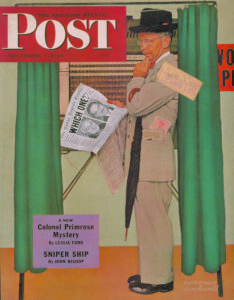
In the wake of the 1944 election between incumbent Democratic President Franklin D. Roosevelt and Republican candidate Thomas E. Dewey, Rockwell, along with the rest of the country, eagerly anticipated the results in the midst of World War II. To mark this time of political tension, he painted a gentleman entering the voting booth just before the curtain is drawn, debating his decision. The newspaper folded in his pocket shows a portrait of each candidate above the heading “Which One?” Ultimately, Roosevelt won his record-breaking fourth Presidential election with 53.39% of the popular vote, although he would die just three months into the term, leaving the office to his Vice President, Harry S. Truman.
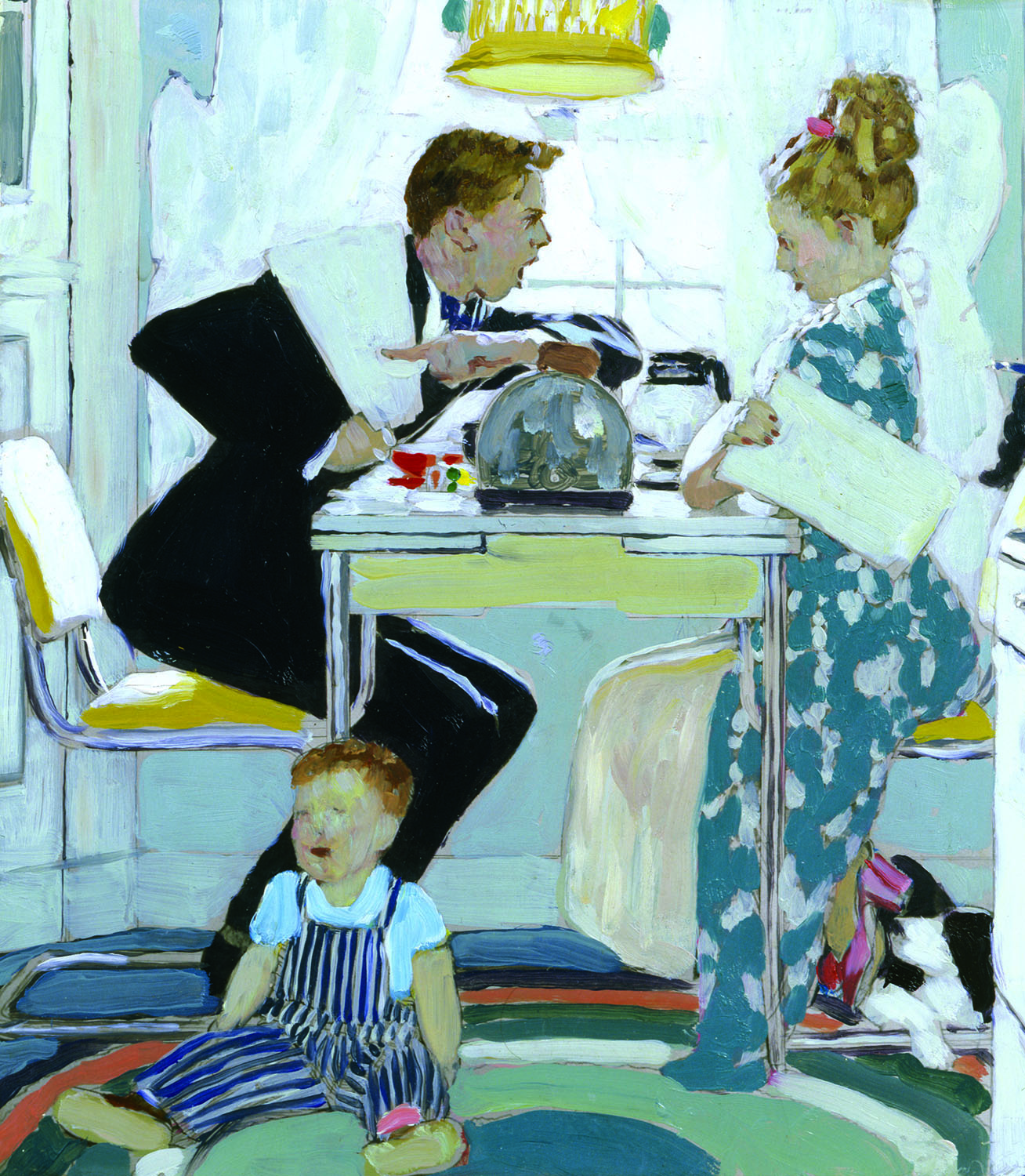
Norman Rockwell (1894-1978)
Breakfast Table Political Argument - Study
1948, oil on board
11” x 10 1/4”, signed lower right
Study for Saturday Evening Post, October 30, 1948 cover
The 1948 Presidential Election was to mark a turning point for the Republican Party, as the Democratic Party seemed weak and unstable. Rockwell's Breakfast Table Political Argument reflects the battle between Thomas Dewey and Harry Truman for the Presidency of the United States. The husband, dressed in a suit for work, shouts fiercely at his wife seated across from him, who pouts sullenly and stubbornly with folded arms. The husband points at the magazine cover showing his support for Dewey, while his wife holds a publication showing her support for Truman. Both are so involved in the debate over their respective candidates that neither notices the upset child at their feet or the hungry dog in the corner. Breakfast Table Political Argument is witty and charming in their depiction of a suburban American lifestyle, a classic example of Rockwell’s traditionally entertaining approach to the world around him.
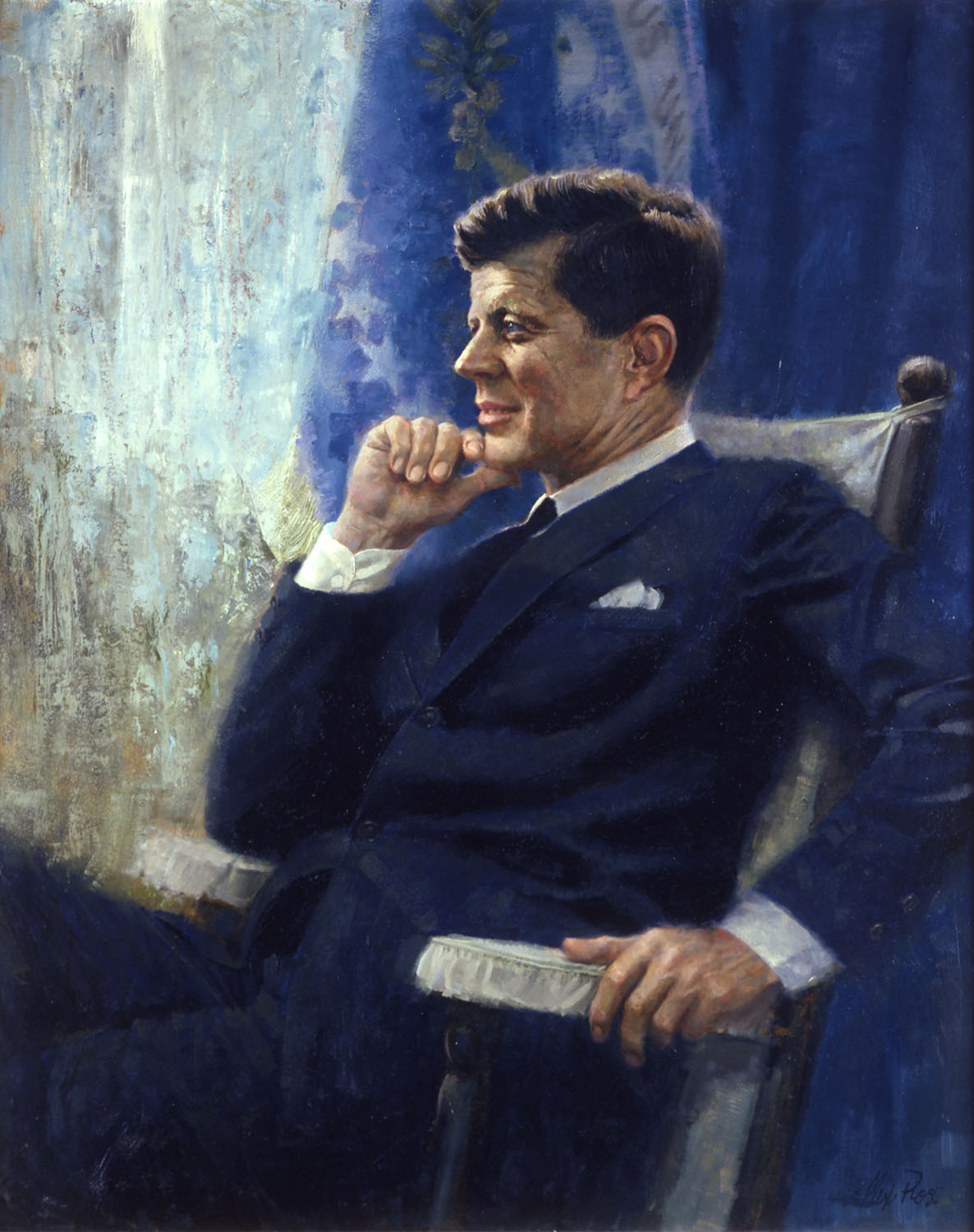
Alex Ross (1908-1990)
John F. Kennedy
Oil on board
39 1/4" x 31 1/4", signed lower right
Possible TV Guide illustration, c. 1960
In this contemplative portrait, Alex Ross depicts President John F. Kennedy seated in profile within the Oval Office, the presidential flag standing quietly behind him. Rendered with restraint and clarity, the composition emphasizes reflection rather than spectacle, presenting Kennedy as a thoughtful leader bearing the weight of history and responsibility. The painting invites viewers to consider leadership not only as public performance, but as a deeply private act of decision-making—one that would define an era and resonate long beyond Kennedy’s lifetime.
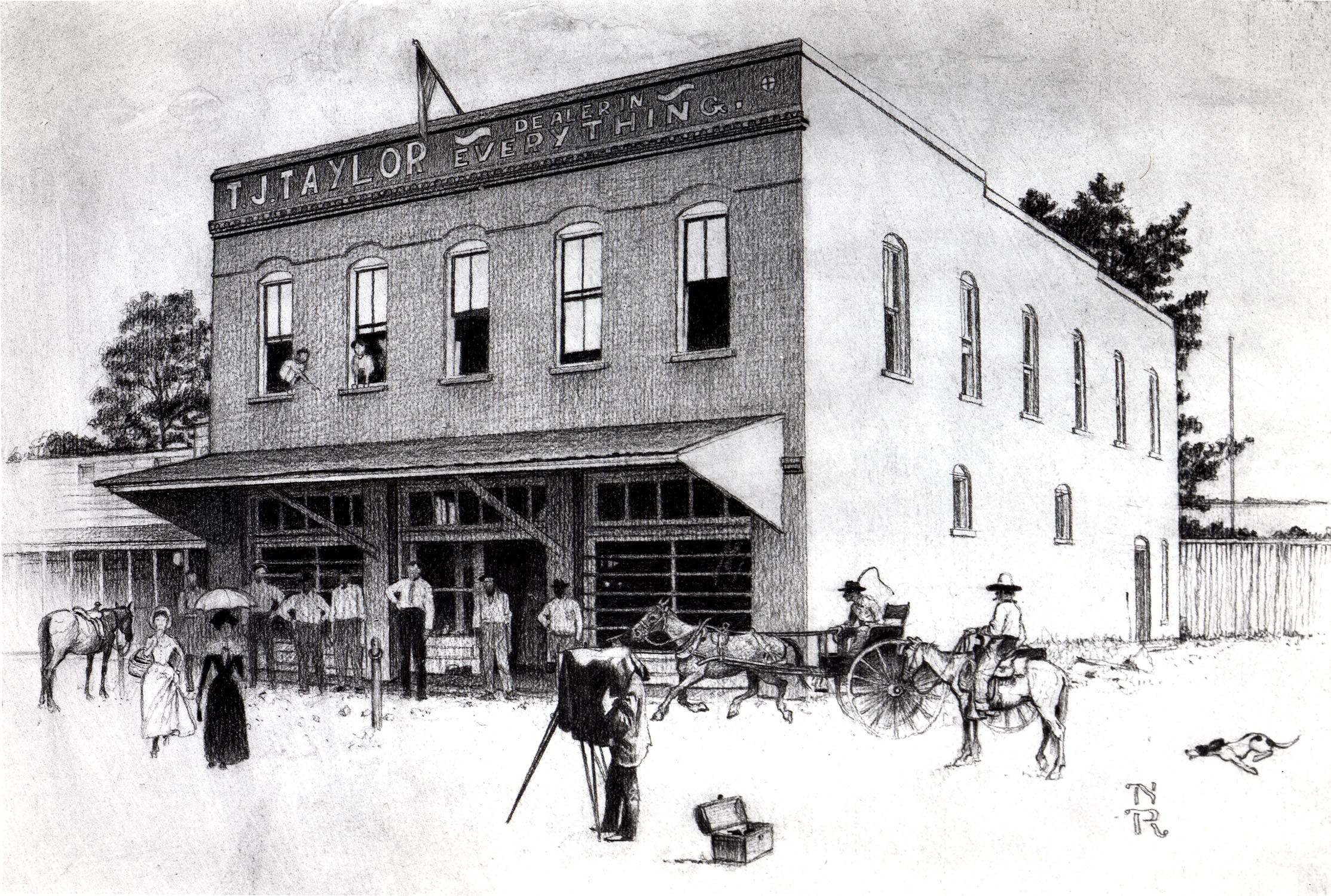
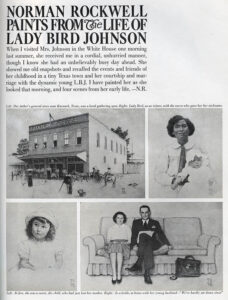
Norman Rockwell (1894-1978)
Lady Bird Johnson
1964, pencil on board
13" x 17", initialed lower right
McCall's Magazine, November 1964, pg. 103
"Her father's general store near Karnack, Texas, was a local gathering spot."
As part of the 1964 Presidential elections, Norman Rockwell interviewed the First Lady candidates, Lady Bird Johnson and Peggy Goldwater, and illustrated several images from each of their lives for McCall’s. Here, Rockwell has painted Lady Bird Johnson’s “father’s general store near Karnack, Texas… a local gathering spot.” These illustrations, along with a short paragraph about his interaction with the women allowed the public to understand the background of each of the potential First Ladies. In addition to her father’s store, Rockwell portrayed Lady Bird as an infant with her nurse, a mourning child over the loss of her mother, and as a young newly wed. Ultimately, Lyndon B. Johnson won the election by a landslide, only losing in 6 states, and the couple remained in the White House until 1969.
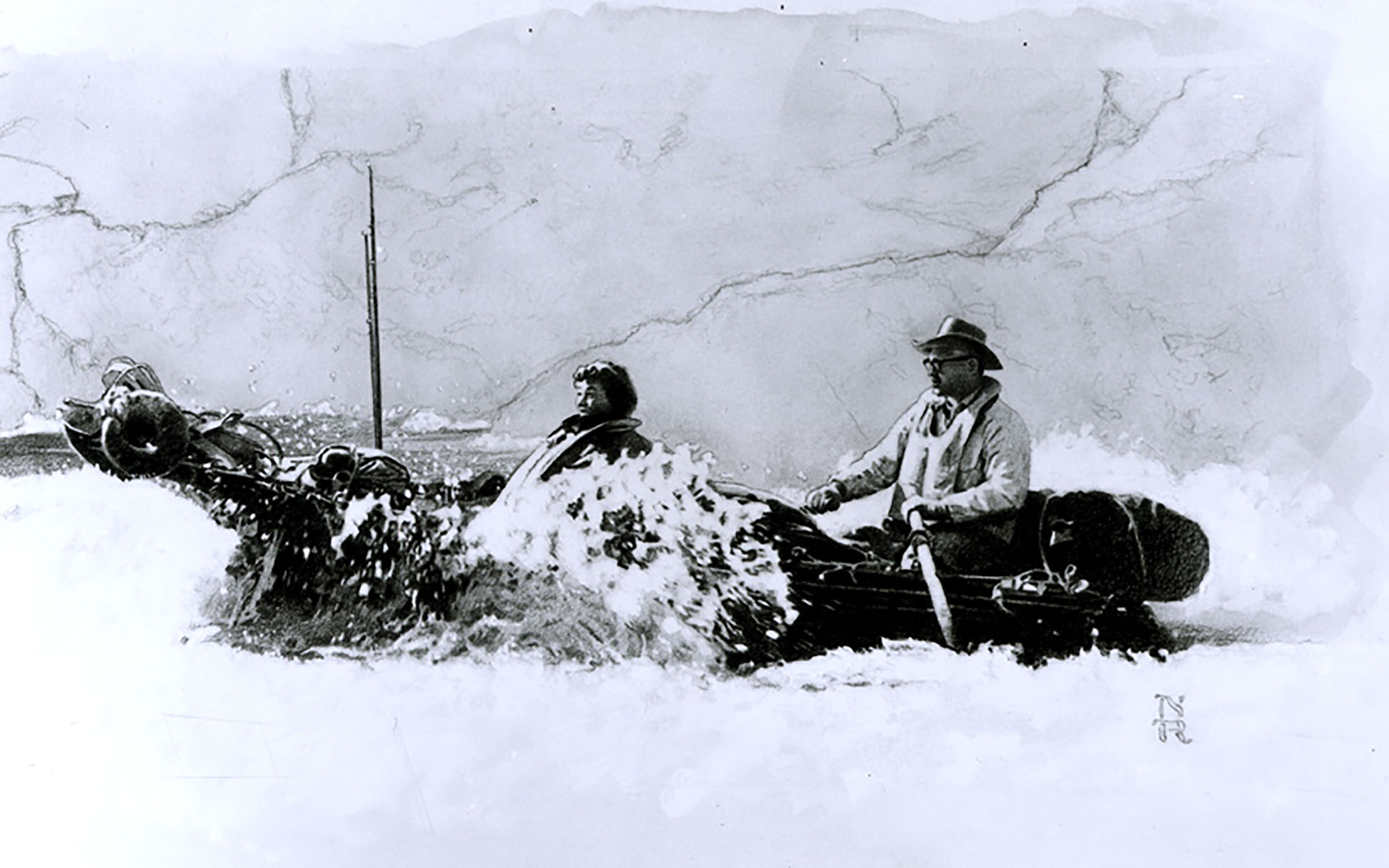
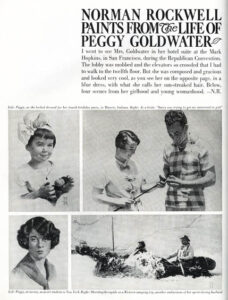
Norman Rockwell (1894-1978)
Peggy Goldwater
1964, charcoal, watercolor and gouache on board
13” x 17”, initialed lower right
McCall's Magazine, November 1964, pg. 104
"Shooting the rapids on a Western camping trip, another enthusiasm of her sports-loving husband."
In the 1964 Presidential election, Barry Goldwater, known as a very conservative senator from Arizona, ran against Lyndon B. Johnson, who was running for his first term after assuming the Presidency following President John F. Kennedy’s assassination. Norman Rockwell interviewed the First Lady candidates, Lady Bird Johnson and Peggy Goldwater, and illustrated several images from each of their lives for McCall’s. Here, Rockwell illustrates Peggy and her husband, Barry, “shooting the rapids on a Western camping trip.” Other images showed Peggy as a girl on her fourth birthday, a beautiful young woman, and learning to play sports with her husband. These illustrations, along with a short paragraph about his interaction with the women allowed the public to understand the background of each of the potential First Ladies. Ultimately Barry Goldwater lost the election in a landslide to Lyndon B. Johnson and resumed his position as Arizona State Senator in 1969.
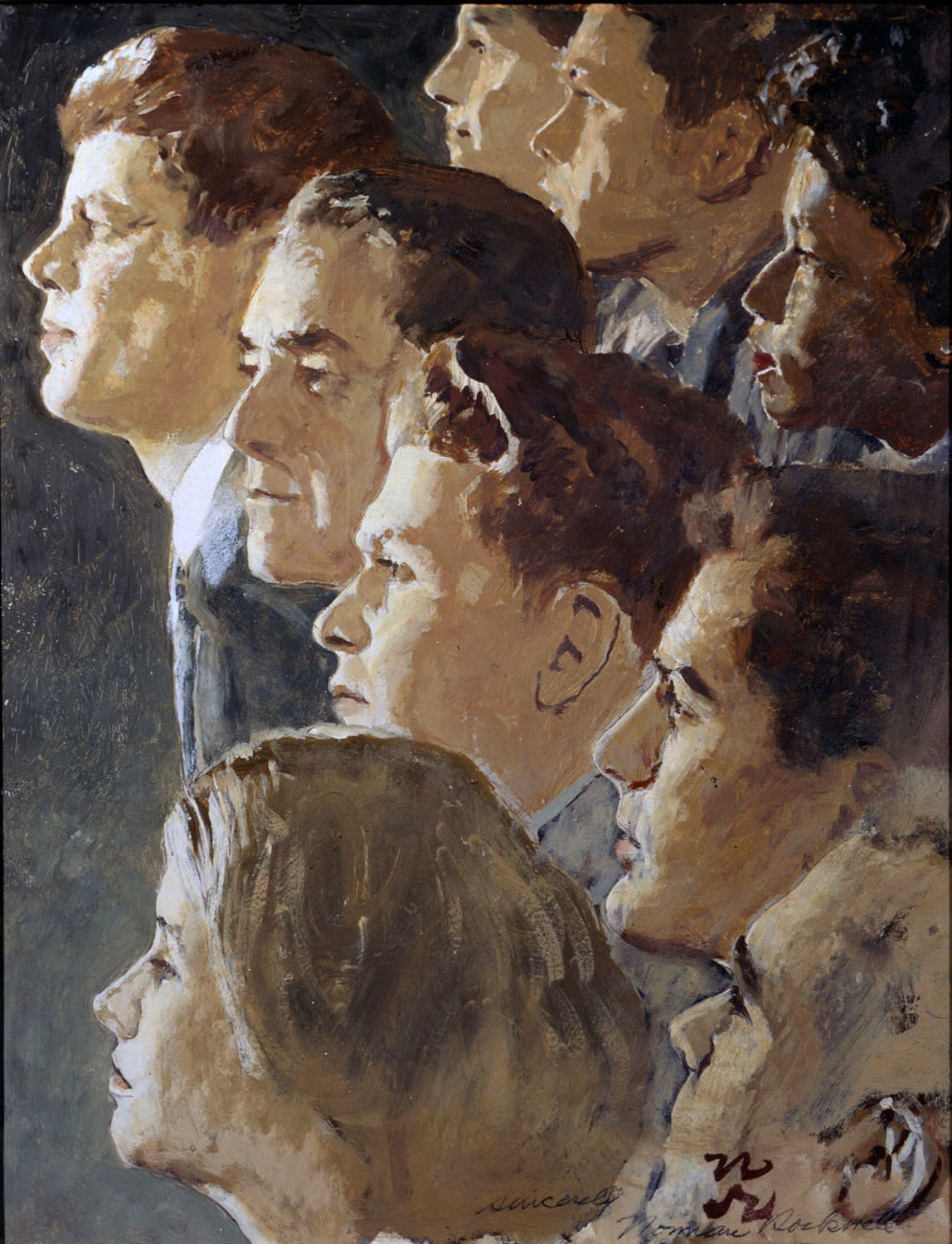
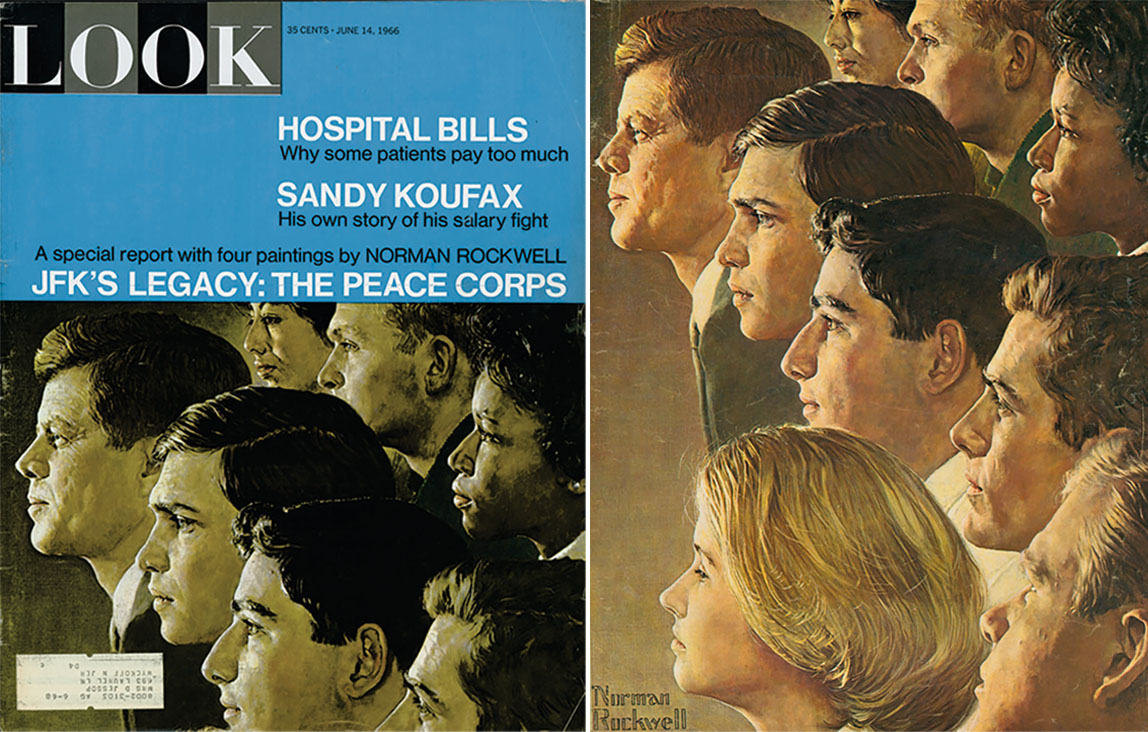
Norman Rockwell (1894-1978)
The Peace Corps - Study
1966, oil and charcoal on photographic base
16” x 13”, signed lower right
Study for Look magazine, June 14, 1966, cover and pg. 35
“Other men dreamed it, formed it and made it work. Yet the Peace Corps will always belong to John F. Kennedy and share the splendor of his memory. It was an adventure so like the man, bold and young, warm and gallant… [From] his Inaugural promise: ‘The energy, the faith, the devotion which we bring to this endeavor will light our country and all who serve it–and the glow from that fire can truly light the world.’”
Look magazine highlighted the accomplishments of Peace Corps volunteers in the program’s first five years through four illustrations of actual volunteers at work. Rockwell struggled with this important commission, writing to Allen Hurlburt, Look’s art director: “Every so often I find I have a subject that I wholeheartedly want to paint but I can’t make up my mind just how to paint it, and this is one… I want to say that these young people, led by Mr. Kennedy, are unselfishly going on a crusade.” For the magazine’s cover and article’s first image, Rockwell painted this group portrait of John F. Kennedy leading actual Peace Corps volunteers steadfastly forward into a warm, unseen light, as Kennedy’s inaugural speech described. Similar to his Freedom of Worship layout, Rockwell found success depicting a diverse group of people coming together for one central cause by showing each person in profile, focused on the same point ahead. The viewer is able to read and reflect upon the individual emotions of each character while not losing focus on the larger issue being addressed. Next to Kennedy is his brother-in-law Sargent Shriver, the first director of the Peace Corps.
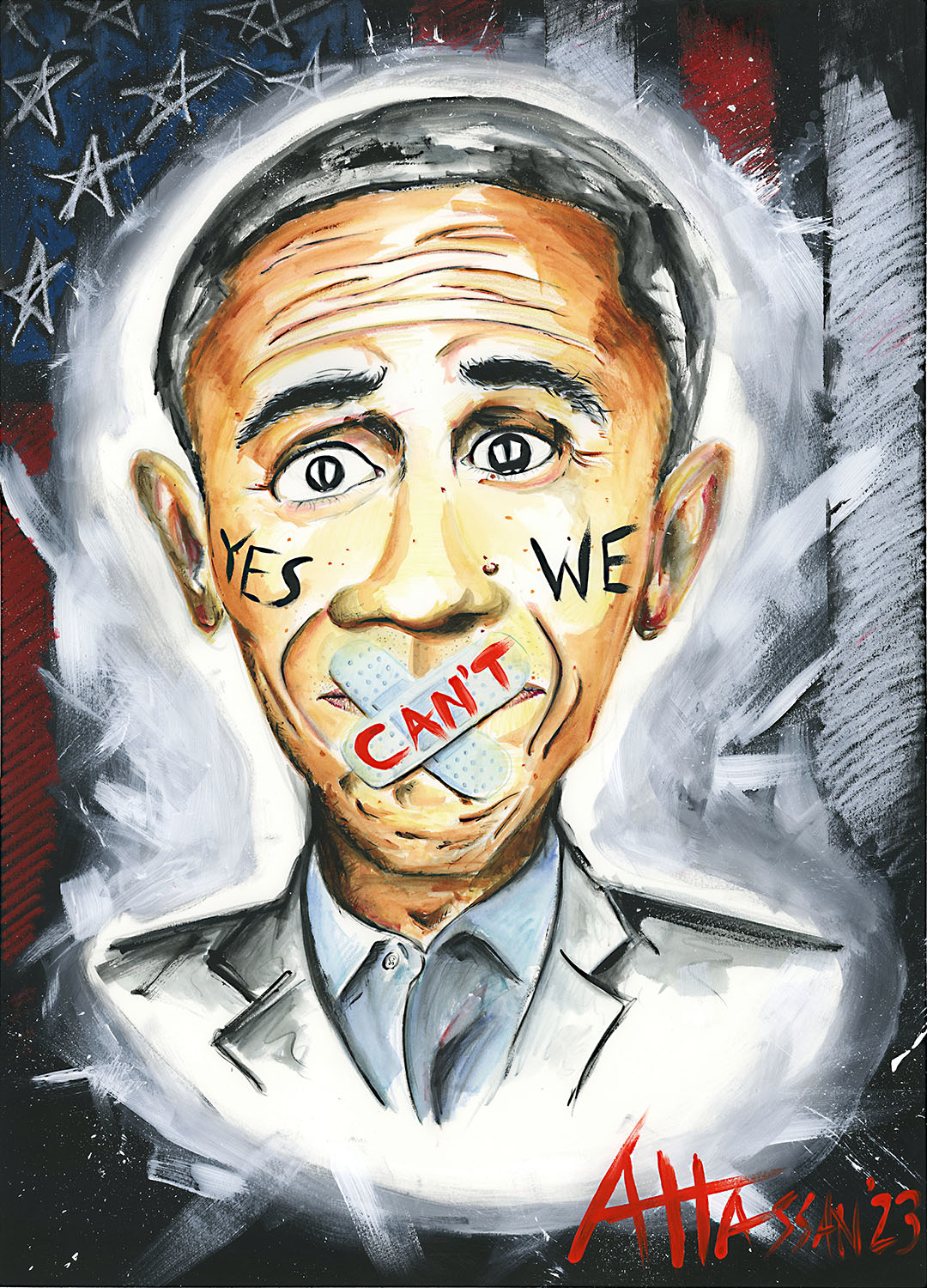
Ahmad Taylor (b. 1980)
Yes, We Can't (Barack Obama)
2023, acrylic and pastel on paper
30” x 22”, signed lower left
Atlanta-based visual artist, Ahmad Hassan Taylor is a storyteller. His immediately recognizable portrait paintings challenge conventional narratives within art history. “My heritage is the main influence for this body of work, as I come from a long line of creatives and educators that have positively contributed to this narrative. Though many prominent portraitures throughout history are well-known to the public, I could not think of any that looked quite like me. I often wonder what will happen to our language, history, and culture as we adapt to technology and the persistent flux within our world. My goal is to help alleviate this potential loss of information by creating thoughtful pieces of artwork that educate the world about these influencers of positive change.”