

Illustrated
In honor of Women’s History Month, the NMAI is proud to present a special chapter in our year-long Semisesquintennial virtual exhibition:
The American Woman Illustrated.
Throughout the past 250 years, women have played a vital role in shaping the character, progress, and spirit of the United States. From the founding era to the modern age, American illustrators have captured their strength, intelligence, resilience, and influence—reflecting not only the achievements of remarkable individuals, but also the evolving place of women in American life.
This month’s virtual exhibition celebrates women as leaders, pioneers, workers, artists, and reformers, while also honoring their enduring role as mothers, caregivers, and the steady foundation of families and communities. Through illustration, we see how women’s lives have been portrayed across generations—sometimes idealized, sometimes constrained, and often transformed by changing cultural expectations and historic events.
Together, these works offer a powerful tribute to the women who helped build America, both in public life and in the private moments that shape a nation’s future. We invite you to explore this inspiring collection and reflect on the women whose stories continue to define the American experience.
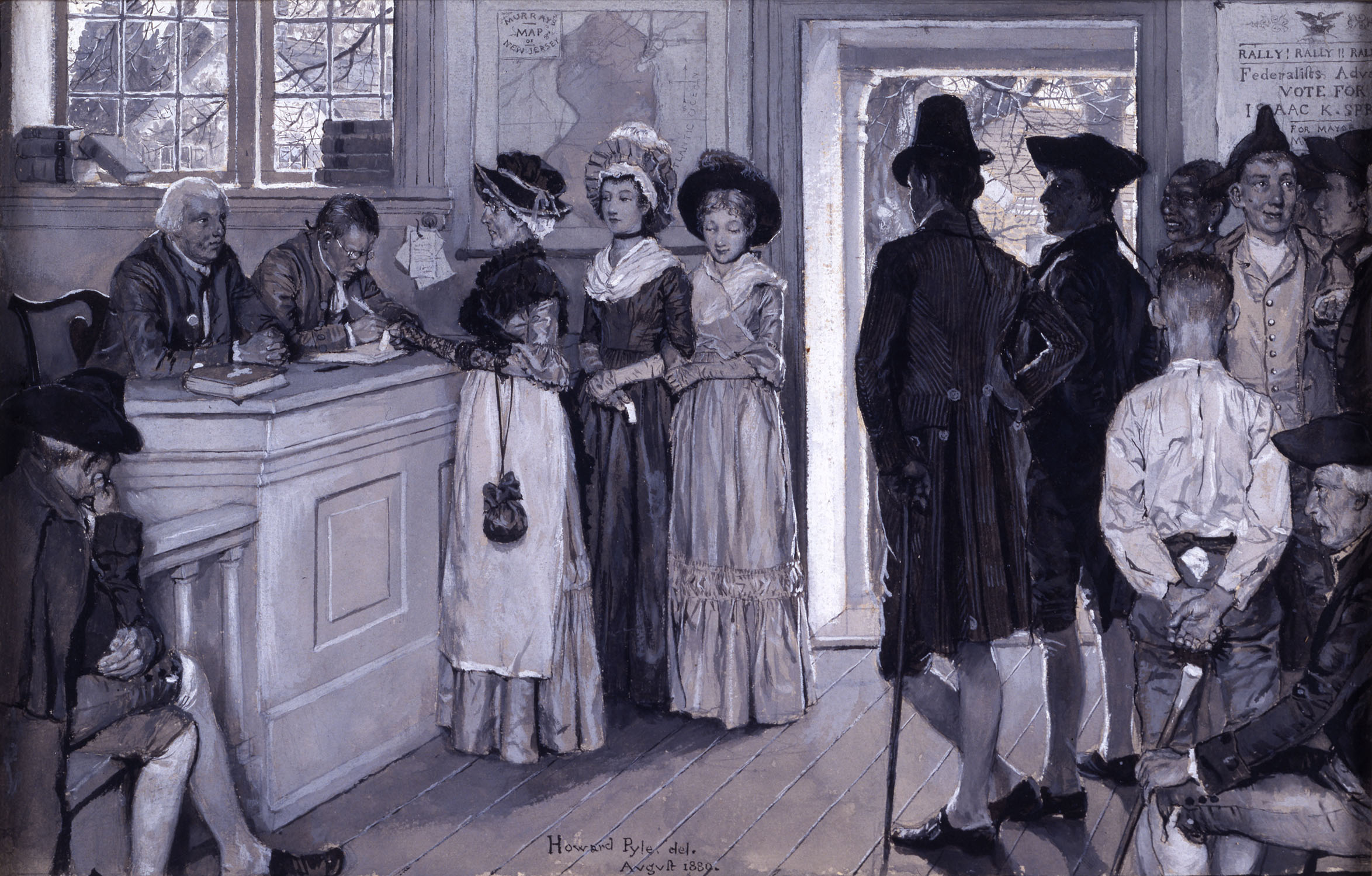
Howard Pyle (1853-1911)
Women at the Polls in New Jersey in the Good Old Times
1880, gouache on paper
10 3/4" x 17", signed lower center
Harper's Weekly, November 13, 1880
In this remarkable work, Howard Pyle illustrates a little-known chapter of early American democracy: a time when unmarried, property-owning women in New Jersey were legally permitted to vote. In 1790, the state’s election law was written in gender-neutral language, extending suffrage to both men and women who met property requirements.
That progress proved temporary. In 1807, voting rights were restricted to white men only, disenfranchising women and Black property holders alike. Pyle’s scene serves as a powerful reminder that women’s participation in American civic life began at the nation’s founding—and that the path toward equality has never been linear.
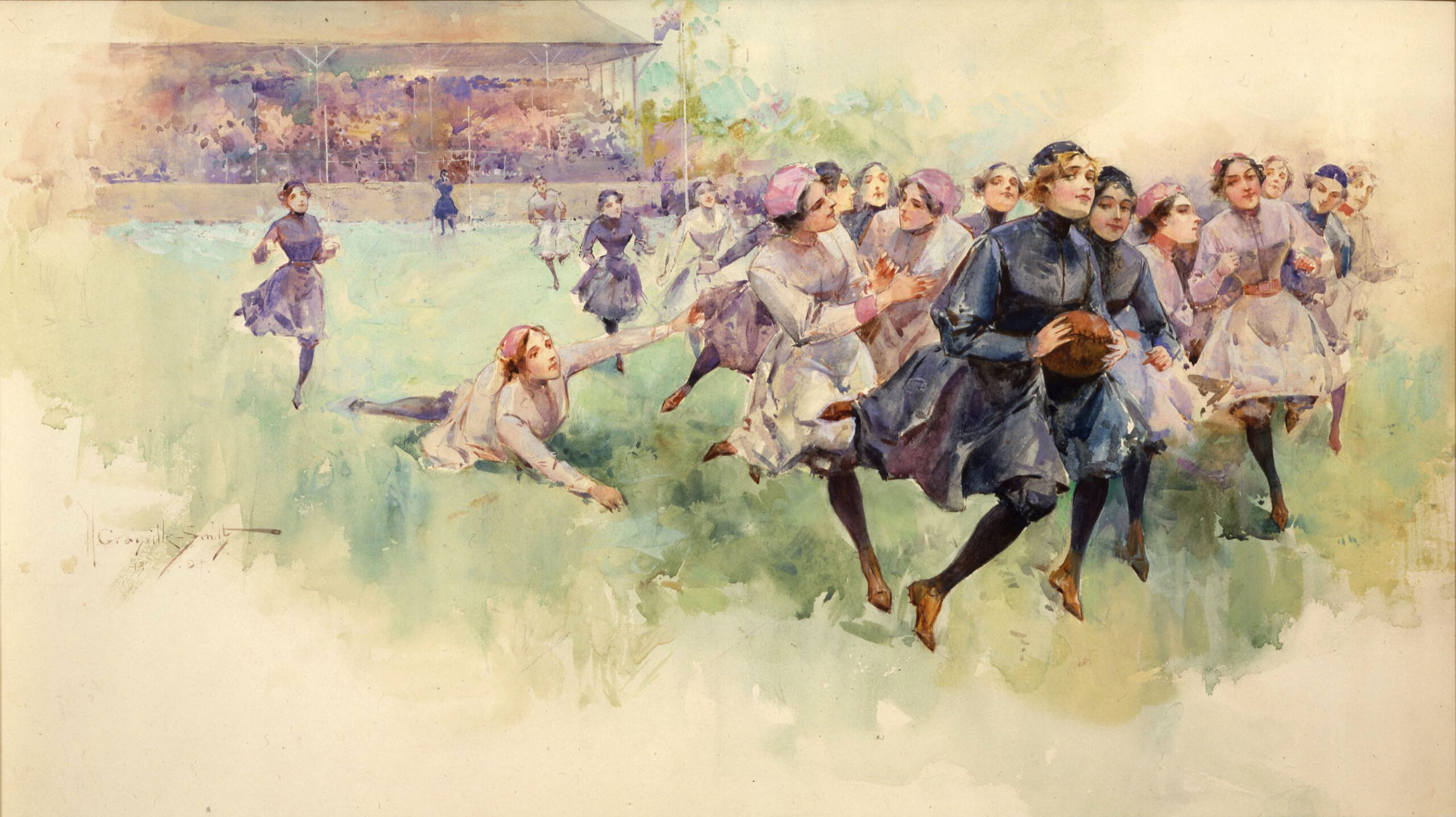
Walter Granville Smith (1870-1938)
Girls Rugby
1894, watercolor on board
15 1/2" x 26 1/2", signed center left
Truth Magazine, 1894 centerfold
Painted in 1894, Girls’ Rugby captures a striking image of women athletes at a moment when organized sports were beginning to reshape female identity in America. At the turn of the twentieth century, women’s participation in athletics was both celebrated and debated. Physical activity was increasingly promoted for health and vitality, yet competitive sport still challenged prevailing expectations of modesty and restraint.
Scenes such as this reflect a cultural shift: women stepping into public life with greater confidence, strength, and visibility. As colleges and schools introduced organized athletics for women, sports became a powerful symbol of independence and modern womanhood. Granville-Smith’s dynamic composition records not only a spirited game, but a turning point in how American society envisioned women’s capabilities—on the field and beyond.
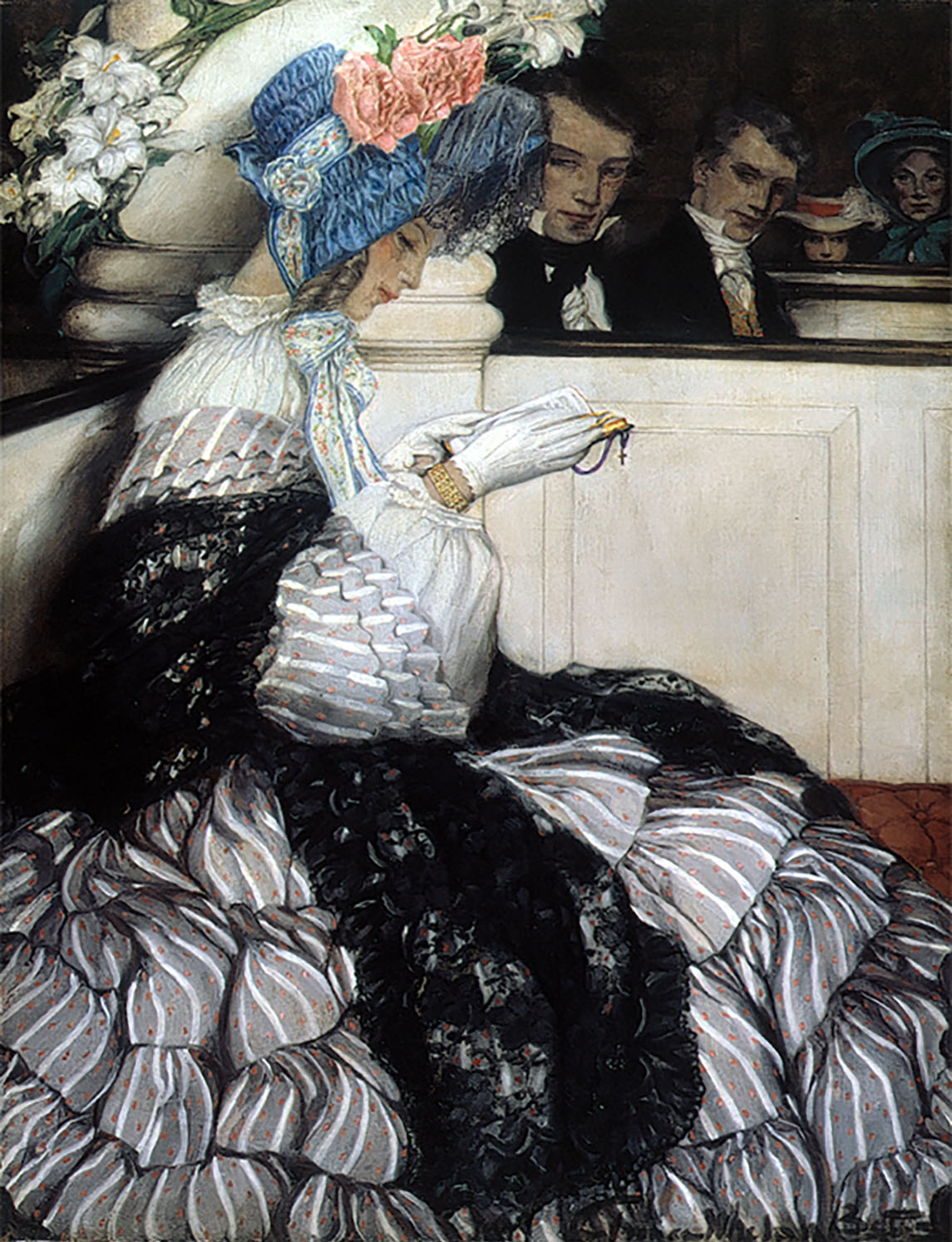
Anna Whelan Betts (1873-1959)
The Easter Bonnet
1904, oil on canvas
21 1/4" x 16 1/2", signed lower right
Century Magazine, April 1904
In The Easter Bonnet, Anna Whelan Betts captures the grace and refinement expected of women at the turn of the twentieth century. Seated in her church pew, absorbed in her prayer book, the elegantly dressed figure embodies the era’s ideals of modesty, decorum, and feminine beauty. Her ruffled gown, white gloves, and elaborate floral bonnet signal both social standing and moral virtue, while the admiring glances from nearby gentlemen reinforce the period’s cultural script of womanhood.
At a time when women’s public roles were expanding, church remained an important stage for displaying propriety and respectability. Betts’ luminous illustration reflects not only fashion, but the powerful social expectations placed upon women—where modesty, faith, and presentation were seen as defining measures of character.
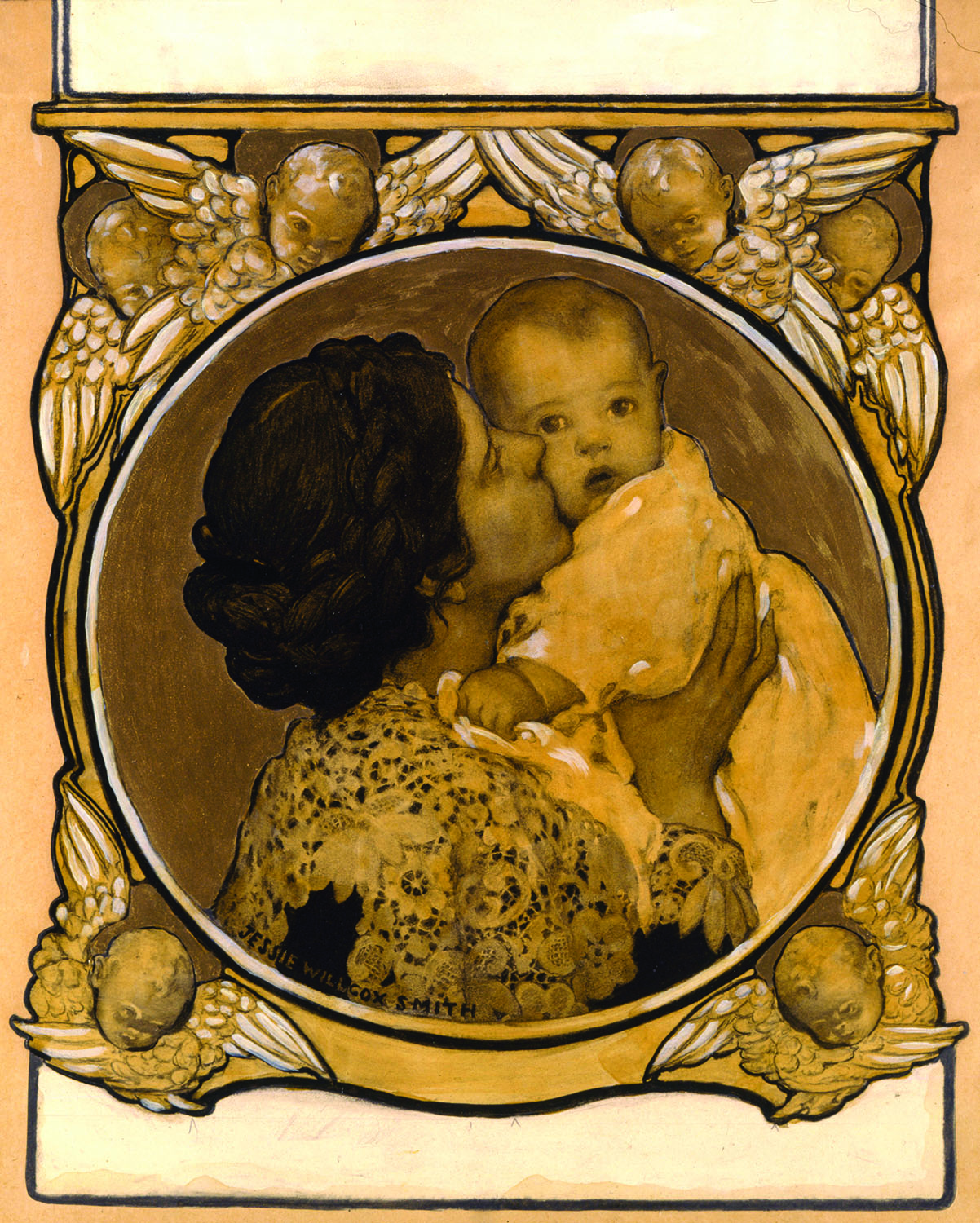
Jessie Willcox Smith (1863-1935)
Mother Kissing Baby
1904, charcoal and oil on board
21 3/4" x 20", signed lower left
Ladies' Home Journal, October 1904 cover
Few artists shaped the visual language of American motherhood more profoundly than Jessie Willcox Smith. In this tender 1904 cover for Ladies’ Home Journal, a mother bends gently to kiss her child—an intimate moment rendered with warmth, softness, and reverence.
Smith’s luminous depictions of mothers and children became deeply influential in the early twentieth century, helping to define the ideal of domestic tranquility and maternal devotion. Her imagery did more than illustrate magazine covers; it shaped the look and feeling of the American nursery itself, inspiring generations of prints, décor, and visual culture centered on innocence, protection, and love. Through scenes such as this, Smith elevated everyday motherhood into an enduring symbol of comfort and national identity.
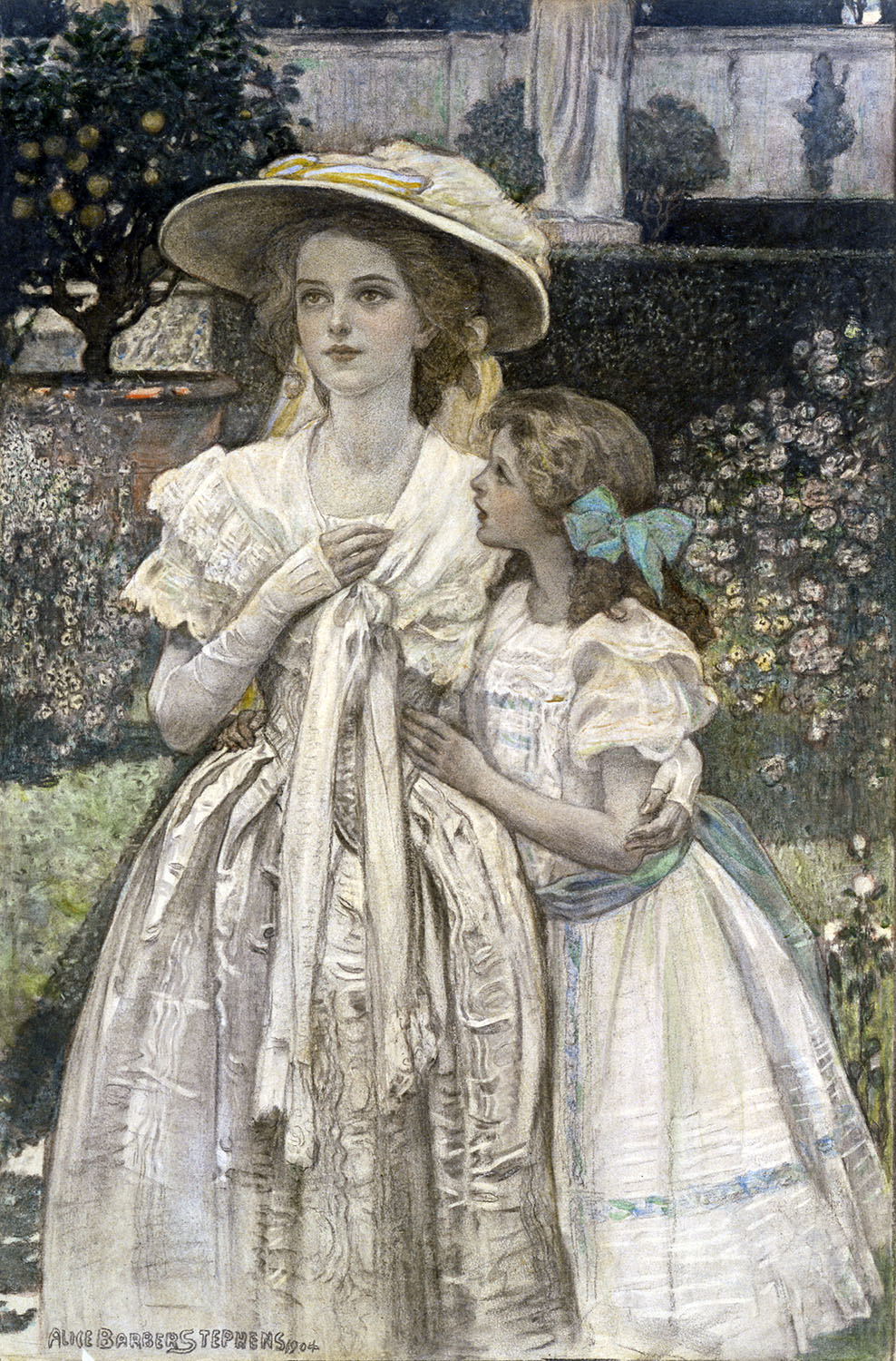
Alice Barber Stephens (1858-1932)
Maidenhood
1904, pencil and pastel
23 1/4" x 15 1/4", signed lower left
"Maidenhood," by Henry Wadsworth Longfellow
In Maidenhood, Alice Barber Stephens visually interprets Henry Wadsworth Longfellow’s meditation on youth and the passage into adulthood. The composition centers on a young woman poised at the threshold of maturity, while a younger girl gazes upward—an elegant metaphor for growth, aspiration, and the inevitability of change.
At the turn of the twentieth century, such imagery reflected society’s deep interest in defining the stages of a woman’s life. Maidenhood was often portrayed as a moment of purity, promise, and quiet transformation. Stephens’ sensitive rendering captures both innocence and awakening, illustrating not only Longfellow’s verse but the cultural ideals surrounding femininity and becoming.
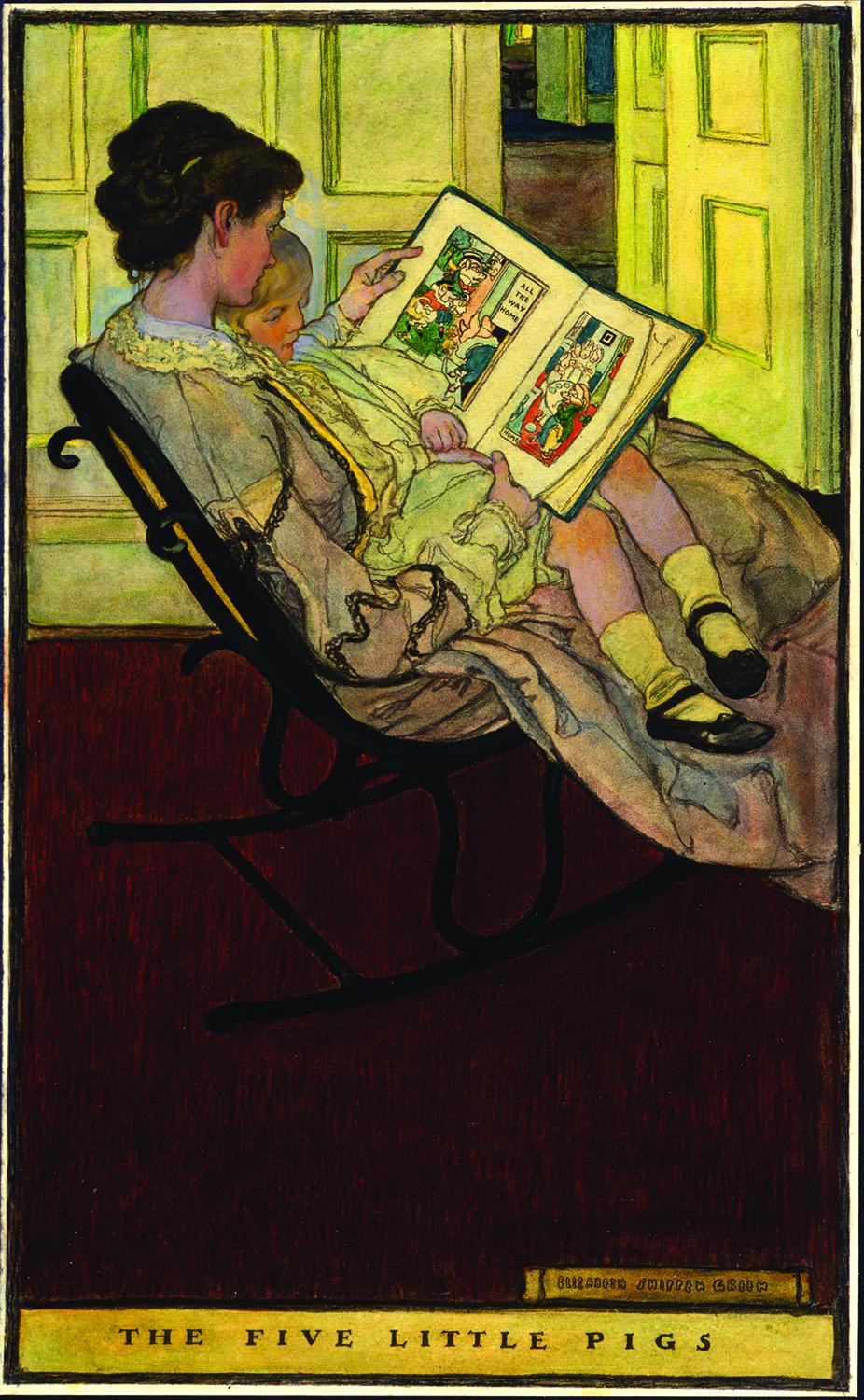
Elizabeth Shippen Green (1871-1954)
The Five Little Pigs
1905, watercolor and charcoal on board
27" x 16 1/2", signed lower right
"Mistress of the House," August 1905
"A Song Set to Five Fingers," One Thousand Poems for Children, edited by Roger Ingpen, 1920
In The Five Little Pigs, Elizabeth Shippen Green captures a quiet, intimate moment: a mother seated in a rocking chair, her daughter nestled in her lap as they share a book of nursery rhymes. The scene radiates warmth, security, and devotion—an image that elevates everyday motherhood into something tender and enduring.
At the turn of the twentieth century, illustrations in children’s books played a powerful role in shaping childhood itself. Artists like Green helped define the visual world of American youth, creating images that nurtured imagination while reinforcing the emotional bond between parent and child. Her work reflects not only the central role of mothers as caregivers and first teachers, but also the profound cultural importance of illustrated stories in forming memory, identity, and affection across generations.
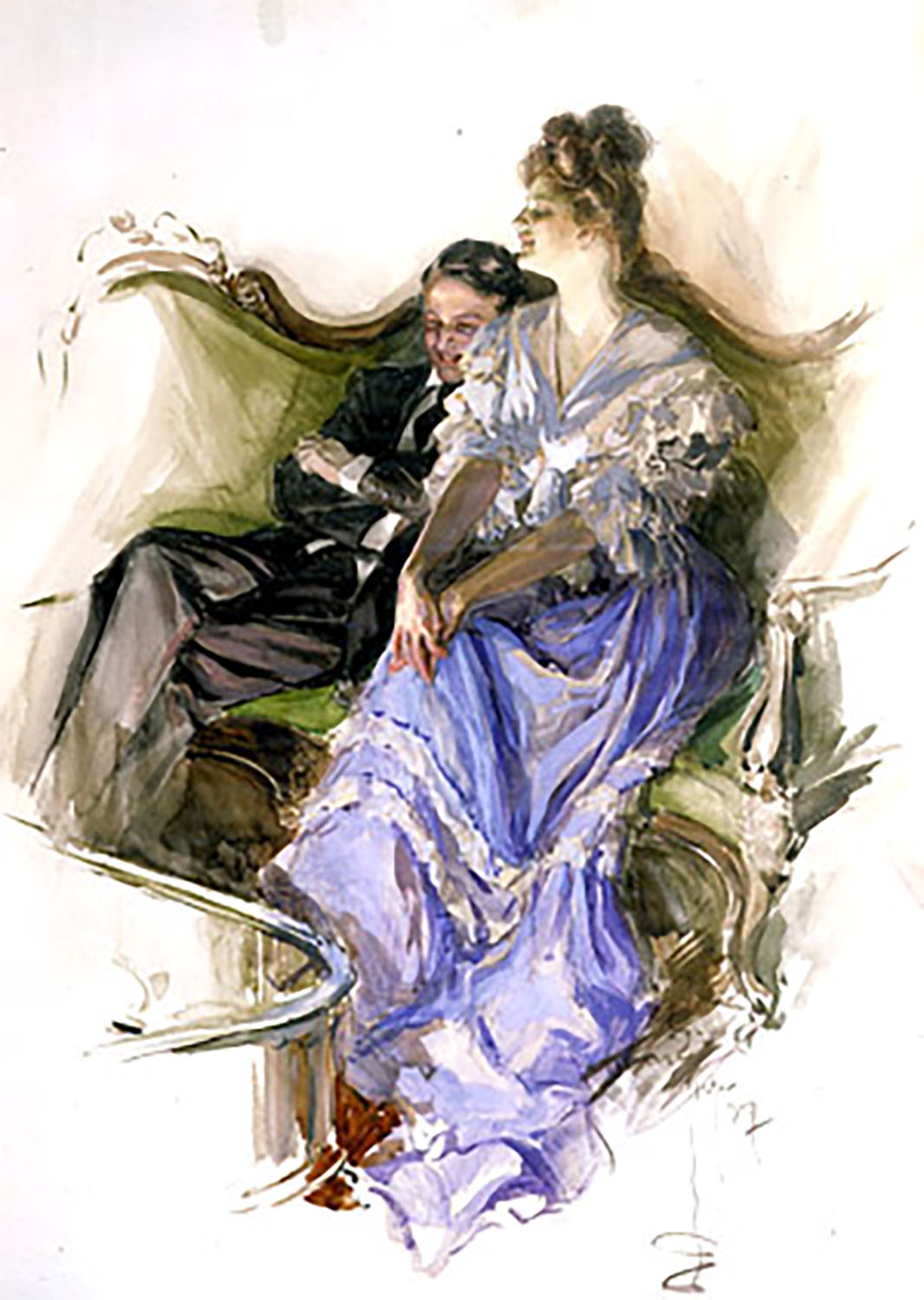
Harrison Fisher (1875-1934)
The Light of Love
1907, watercolor on board
28" x 20", signed lower right
A Dream of Fair Women, by Harrison Fisher, Bobbs-Merrill Co., October 1907
In The Light of Love, Harrison Fisher presents one of his most iconic “Fisher Girls”—a luminous, idealized vision of early twentieth-century American femininity. With her soft features, flowing hair, and radiant expression, she embodies romance, grace, and quiet confidence.
Fisher’s illustrations were enormously influential. At a time when magazines shaped national taste and aspiration, the “Fisher Girl” became a defining standard of beauty and womanhood. She was modern yet refined, fashionable yet wholesome—an image that resonated deeply with American audiences. Fisher himself famously declared that “the American Girl is the best product of this country,” reinforcing her symbolic status as a national ideal.
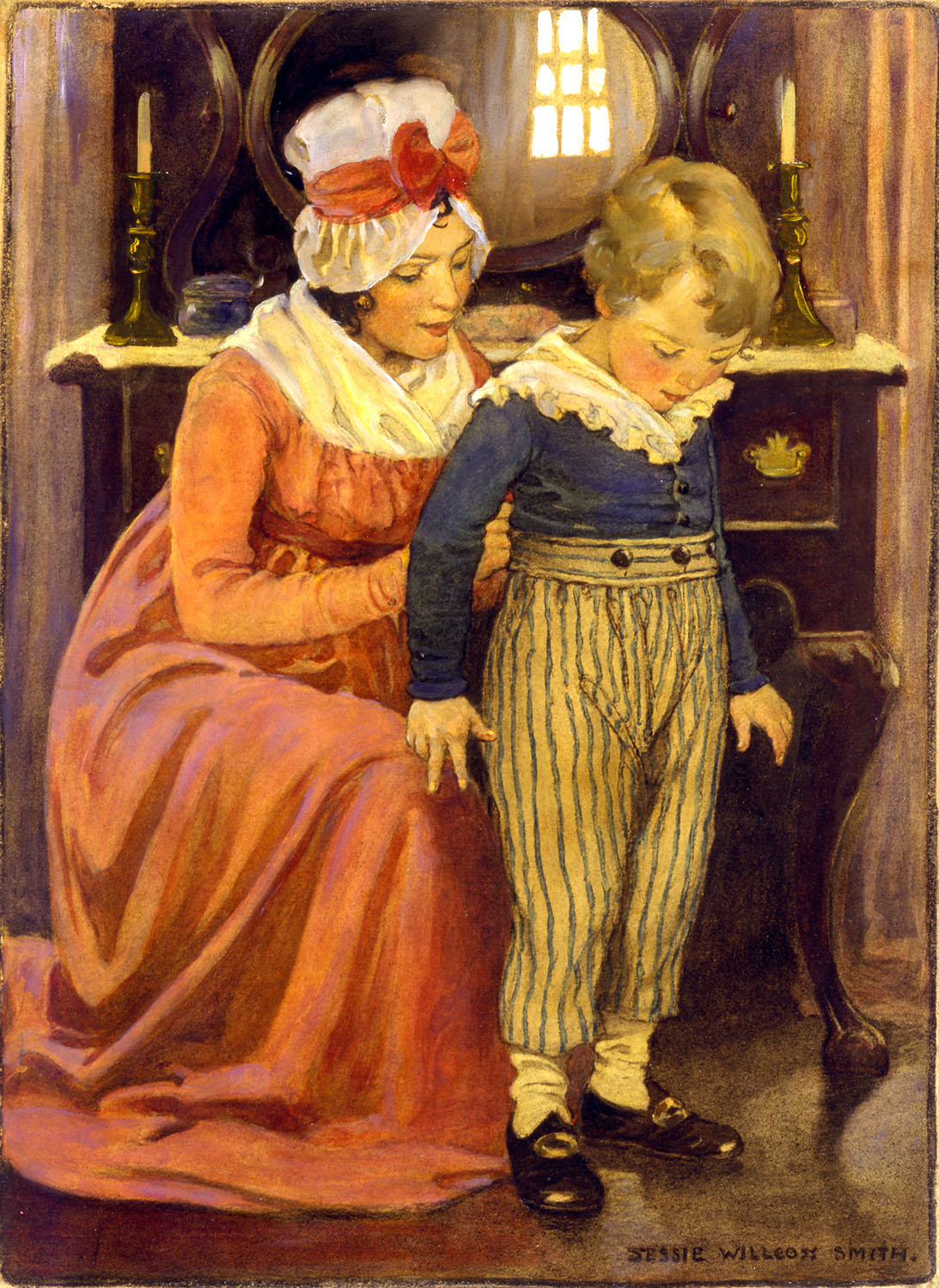
Jessie Willcox Smith (1863-1935)
Going Into Breeches
1910, oil and charcoal on paper
22 1/2" x 16 1/2", signed lower right
A Child's Book of Old Verses, by Jessie Willcox Smith, Duffield & Co., 1910
In Going into Breeches, Jessie Willcox Smith tenderly portrays a childhood milestone: a mother helping her young son dress in proper breeches for the first time. Once a symbolic rite of passage, the moment marked a boy’s transition from early childhood into the beginnings of boyhood independence. Like many of Smith’s beloved illustrations, this image helped define the emotional landscape of American childhood in the early twentieth century, reinforcing the bond between parent and child while honoring the small ceremonies that shape growing up.
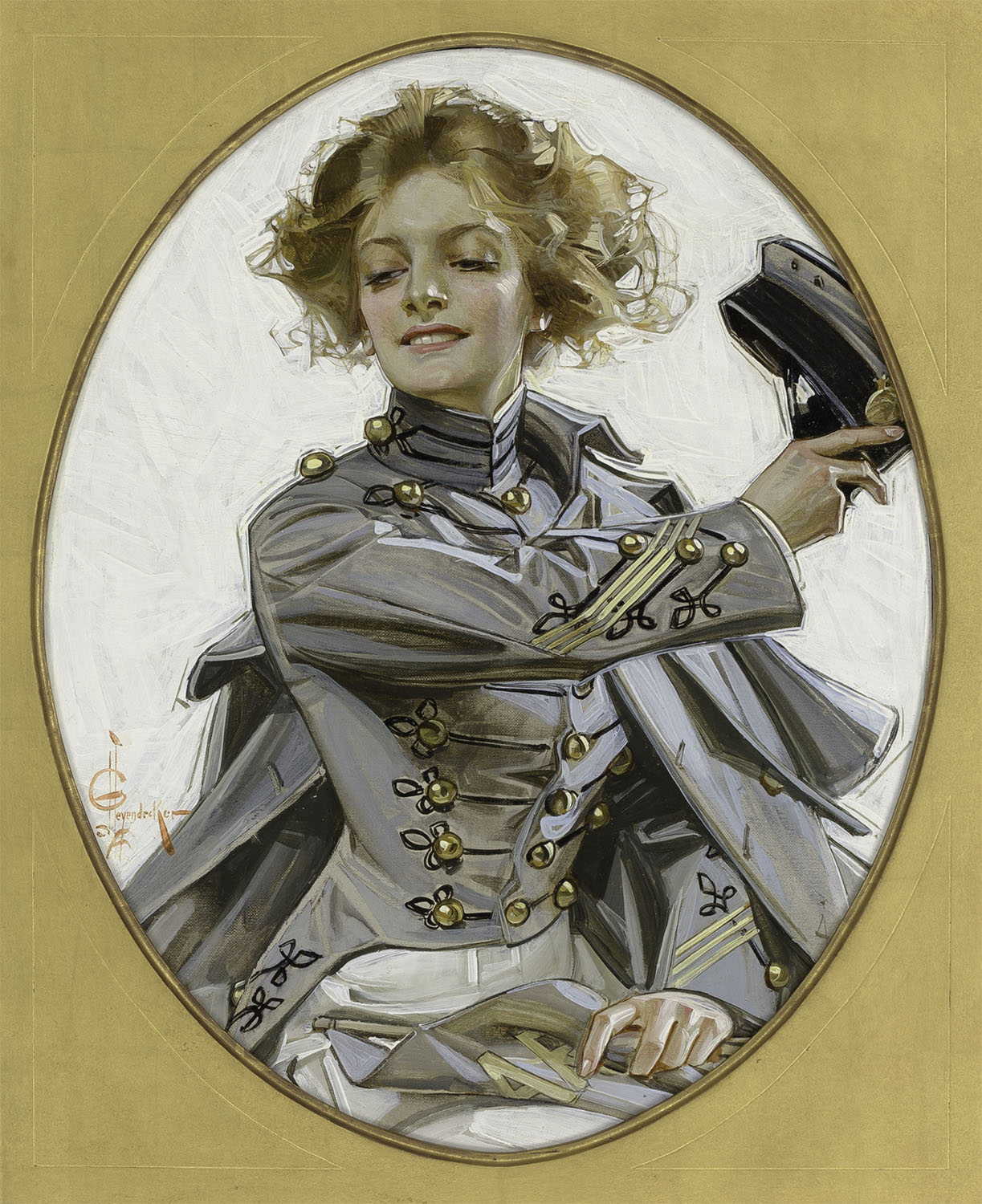
J.C. Leyendecker (1874-1951)
Corps of Cadets: The Howitzer
1911, oil on canvas
21" x 16 3/4", signed center left
The Howitzer: Being the Year Book of the United States Corps of Cadets, published by the First Class, West Point, New York, 1911
In Corps of Cadets: The Howitzer, J. C. Leyendecker presents an arresting and unexpected image: a poised, confident woman dressed in the cadet uniform, blending elegance with military symbolism. At a time when women were not permitted to attend the academy, Leyendecker’s portrayal is both idealized and symbolic. The figure embodies patriotism, strength, and youthful vitality—qualities traditionally associated with military service—while reflecting the era’s fascination with modern womanhood.
Within the context of The American Woman Illustrated, the work speaks to aspiration and representation. Even before women formally entered military institutions, illustration allowed artists to imagine expanded roles for women, projecting confidence and capability into spaces where reality had yet to follow.
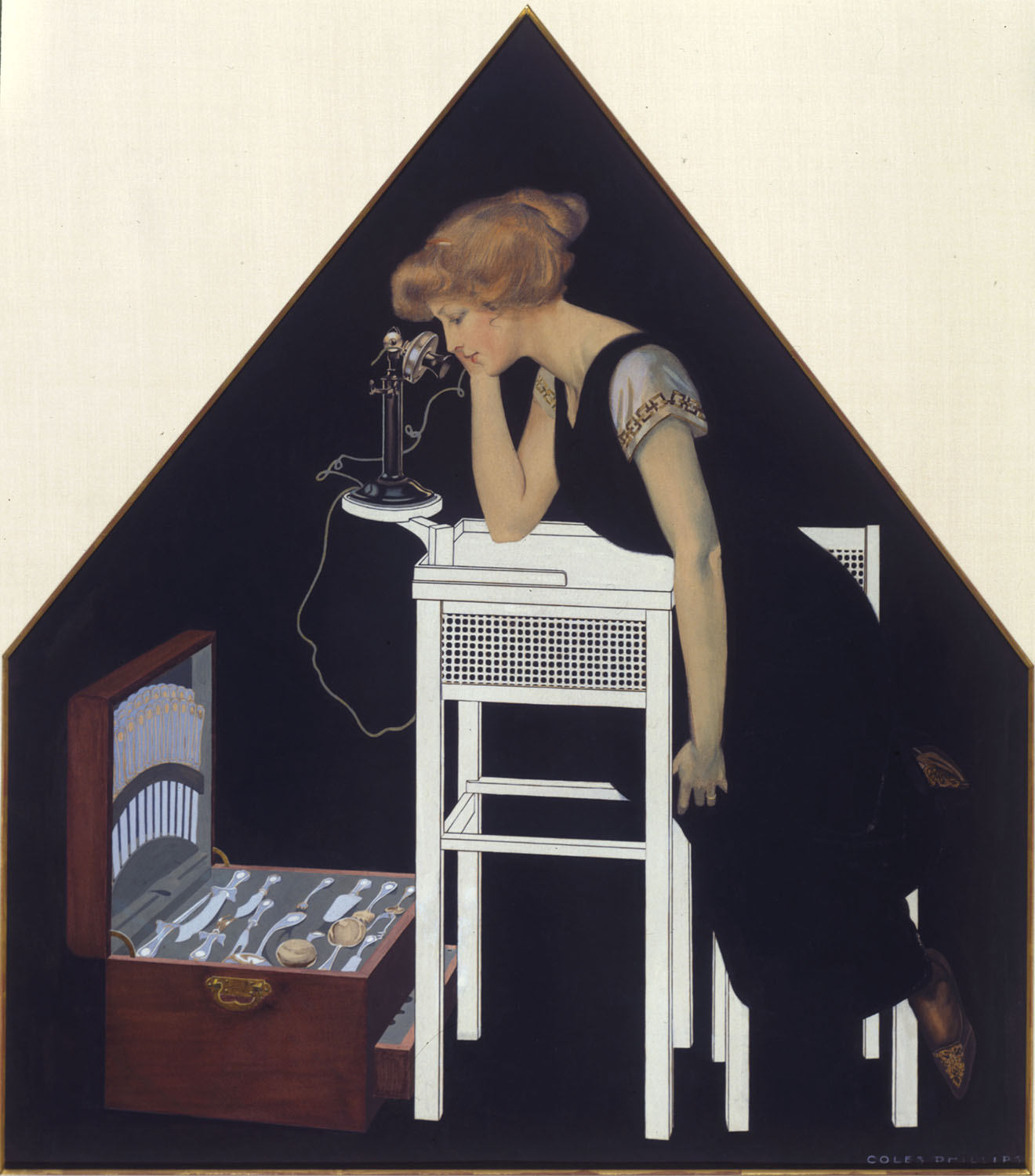
C. Coles Phillips (1880-1927)
Wedding Gift
1915, gouache on board
24 3/4" x 23", signed lower right
Oneida Community Silver advertisement, 1915
In Wedding Gift, created as an advertisement for Oneida Community Silver, Coles Phillips presents a charming scene of a newly married woman admiring her elegant silver service while chatting on the telephone. The image captures the excitement of modern domestic life in the early twentieth century, where tradition and new technology comfortably coexist. It also reflects how illustration shaped cultural expectations of womanhood—celebrating beauty and elegance while subtly defining the social role of the modern American bride.
Phillips employs his celebrated “fadeaway” or “black-out” technique, seamlessly blending the color of the woman’s gown into the background so that portions of her figure dissolve into the composition. This striking visual innovation not only defined his signature style, but also elevated commercial illustration into a sophisticated art form.
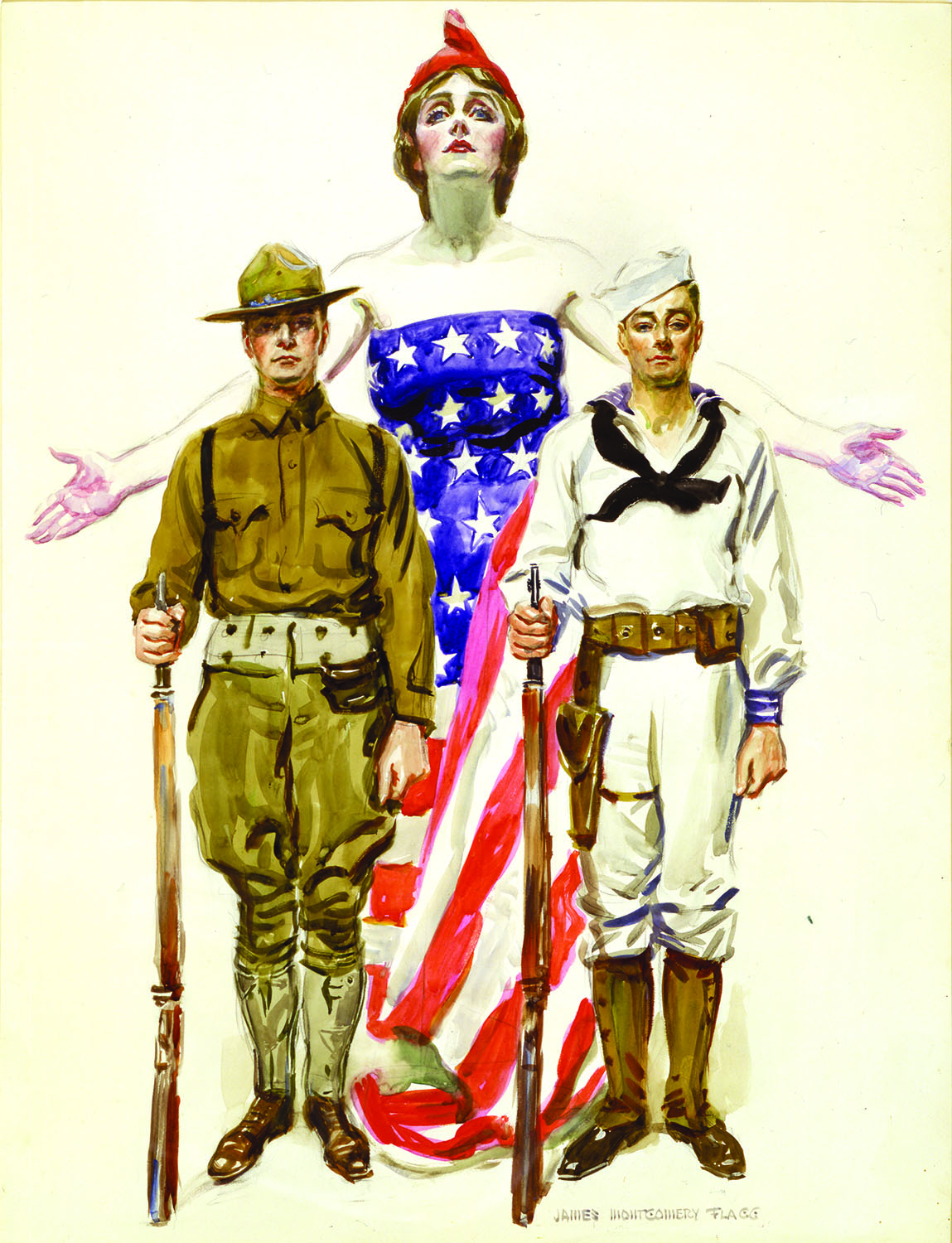
James Montgomery Flagg (1877-1960)
Columbia
c. 1916, watercolor on paper
28" x 21", signed lower right
Leslie's Magazine cover
In Columbia, James Montgomery Flagg presents the enduring female personification of the United States. Standing as the embodiment of the nation itself, Columbia is portrayed with dignity and strength, while an Army soldier and Navy sailor stand ready before her—prepared to defend the country during the First World War.
For generations, artists used Columbia as a symbolic figure of liberty, unity, and national purpose. In this powerful wartime image, the female form becomes the moral and spiritual center of the nation, worthy of protection and sacrifice. It reminds us that women were not only participants in history, but also powerful symbols of the nation’s ideals. Through illustration, the image of America herself was envisioned as a woman—resilient, commanding, and worth fighting for.
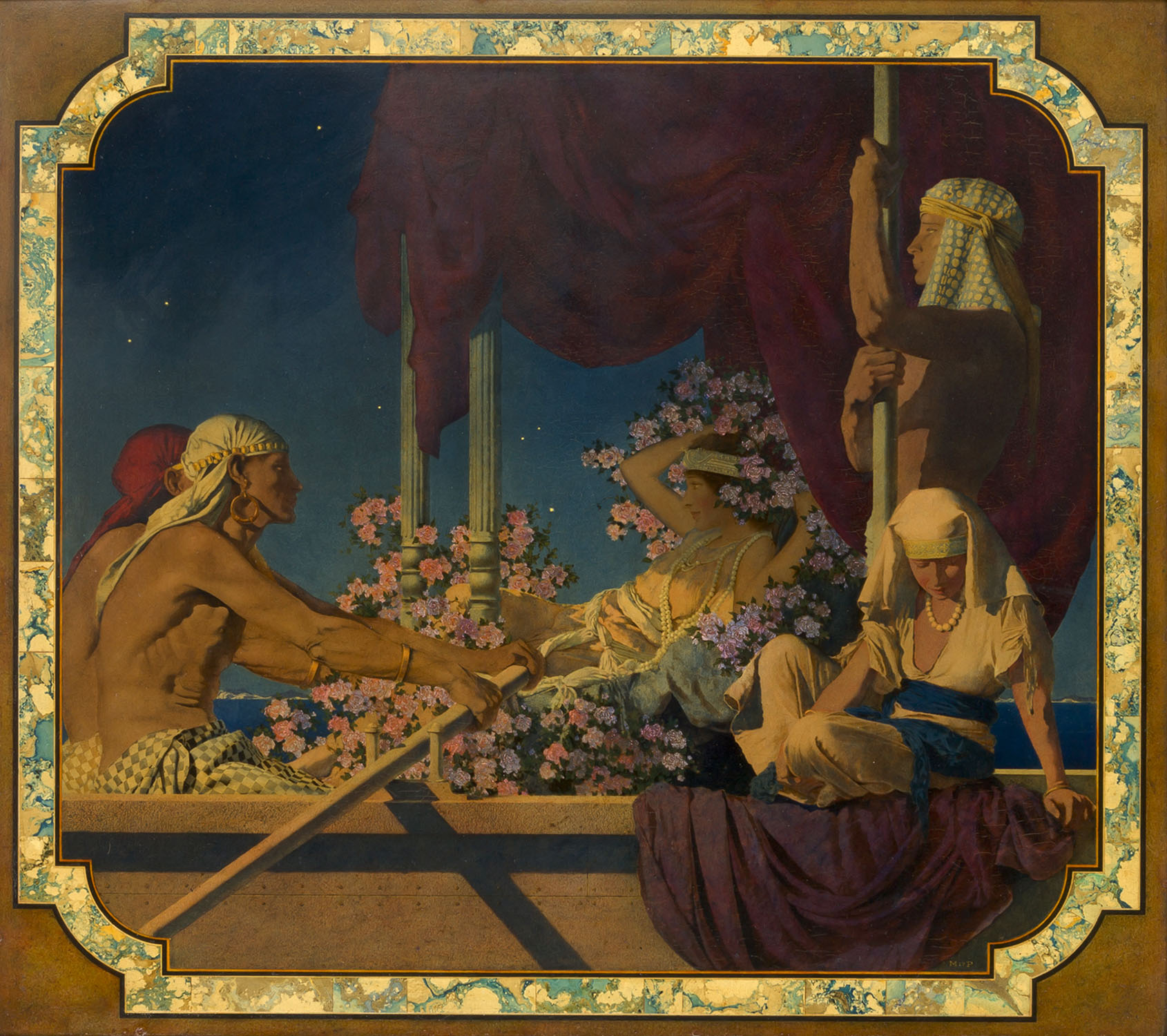
Maxfield Parrish (1870-1966)
Cleopatra
1917, oil and collage on paper
30 1/2" x 34", initialed and dated lower right
Christmas gift box illustration for Crane's Chocolates, 1917
In 1917, Maxfield Parrish brought his luminous color and theatrical imagination to Cleopatra, a design created to adorn a Christmas gift box for Crane’s Chocolates. Transforming commercial packaging into high art, Parrish elevates the legendary Egyptian queen into a vision of elegance, mystery, and timeless beauty. Though rooted in classical antiquity, the image reflects early twentieth-century ideals of glamour and femininity. Parrish’s Cleopatra is poised and commanding—an embodiment of allure and power rendered in his signature radiant hues.
Within The American Woman Illustrated, the work reminds us that illustration did not merely record history; it shaped popular visions of womanhood. Even in commercial design, artists like Parrish projected images of strength, sophistication, and cultural fascination that influenced American taste and imagination.
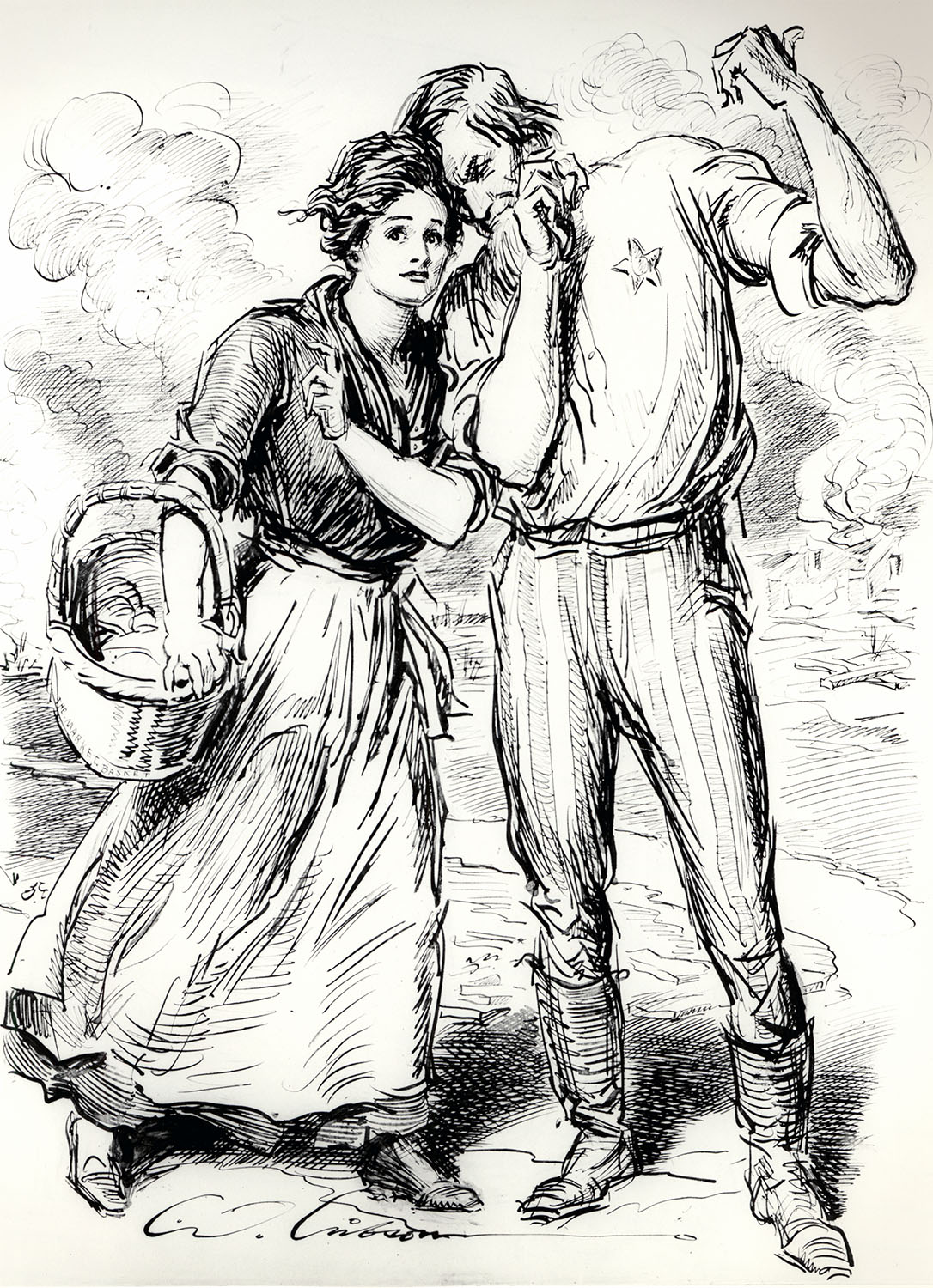
Charles Dana Gibson (1867-1944)
A Word to the Wives: Save! (Market Basket)
1918, pen and ink
29 7/8" x 24", signed lower left
Red Cross magazine, January 18, 1918 frontispiece
In A Word to the Wives: Save, created for the January 18, 1918 cover of the Red Cross magazine, Charles Dana Gibson brings the war effort to the American home. Uncle Sam leans in to whisper to a woman on her way to market, her basket in hand—a quiet but powerful reminder that rationing and household economy were essential acts of patriotism.
During World War I, women on the home front were called upon to conserve food, manage resources, and support troops overseas. Gibson’s image elevates domestic responsibility into national service, placing women in a position of direct importance to the outcome of the war.
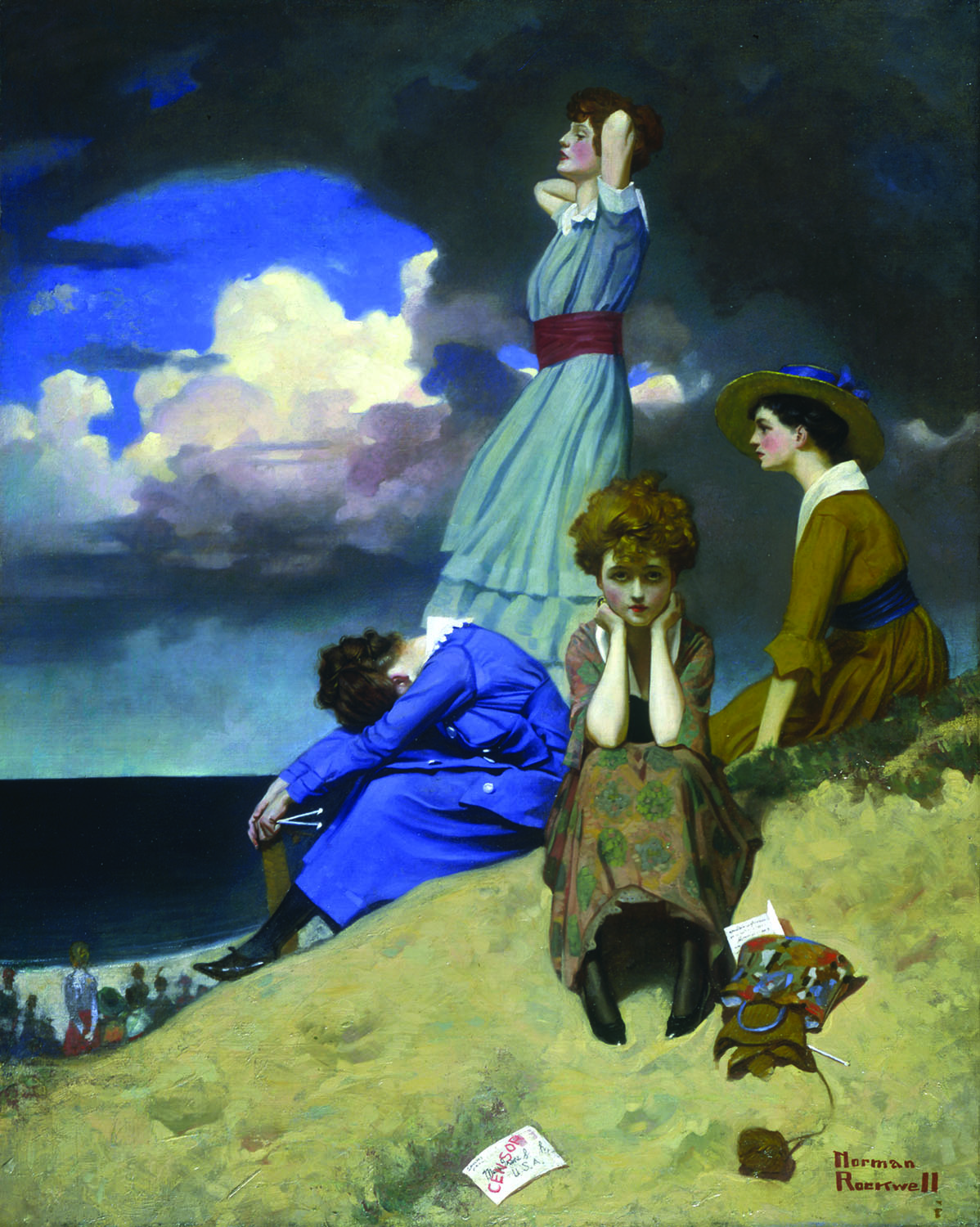
Norman Rockwell (1894-1978)
Till the Boys Come Home
1918, oil on canvas
29 1/2" x 23 1/2", signed lower right
Life Magazine, August 15, 1918 cover
Painted at the height of World War I, Till the Boys Come Home reveals Norman Rockwell’s gift for honoring those often overlooked. While many illustrators focused on the heroism of soldiers overseas, Rockwell turned his attention to the women left behind. Four young women sit together—knitting, reading, and lost in thought—yet their expressions reveal that their minds are far from idle. They are waiting.
Every detail deepens the narrative. A piece of censored mail from a soldier rests near the bottom of the composition, a quiet but powerful reminder of the uncertainty and emotional strain endured by families at home. In an era when news traveled slowly and information was limited, absence and silence weighed heavily.
Within The American Woman Illustrated, Rockwell’s painting stands as a tribute to the quiet endurance of women during wartime—acknowledging that courage is not found only on the battlefield, but also in patience, loyalty, and hope.
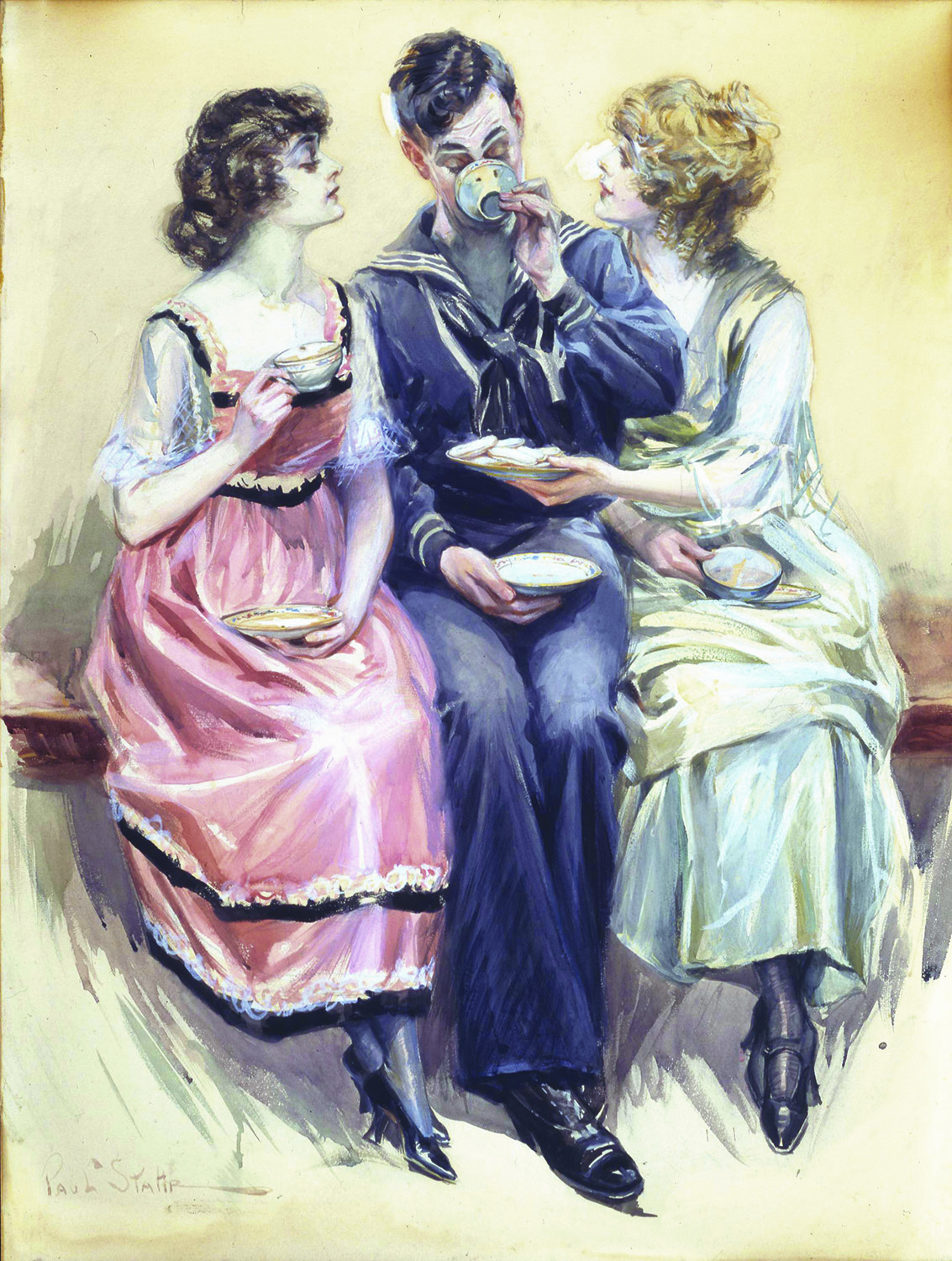
Paul Stahr (1883-1953)
The Lost Man of War
1918, watercolor with opaque white highlights
30" x 22", signed lower left
Life Magazine, July 11, 1918 cover
A German American immigrant from New York City, Paul Stahr supported the American war effort with poster illustrations for Liberty Loans, Red Cross, National Defense, and the Hoover Food Administration. This July 11, 1918 cover for Life Magazine is a lighthearted depiction of a soldier who was lost in the war finally returning home. Two young women excitedly serve tea and biscuits to the young man, hoping to win the returned hero's favor.
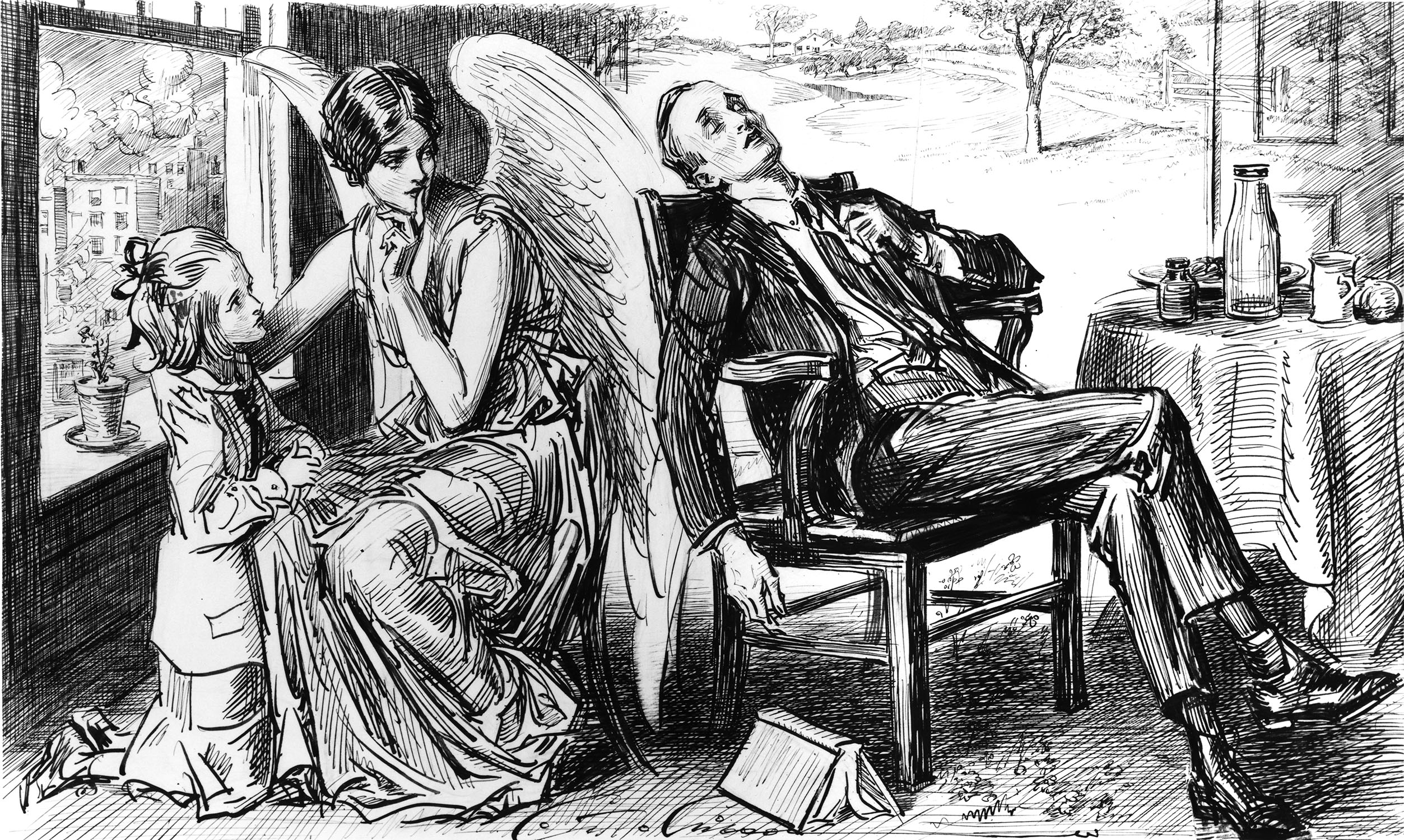
Charles Dana Gibson (1867-1944)
The Muse of Sleep
c. 1920, ink on paper
16" x 26", signed lower center
Gibson often elevated women into allegorical forms—symbols of beauty, thought, inspiration, and emotional depth. In The Muse of Sleep, Charles Dana Gibson presents sleep as not merely physical rest, but a metaphor for imagination and inner life, a serene and contemplative vision of womanhood. The composition reflects the era’s fascination with feminine refinement while also suggesting a woman’s private world beyond public performance.
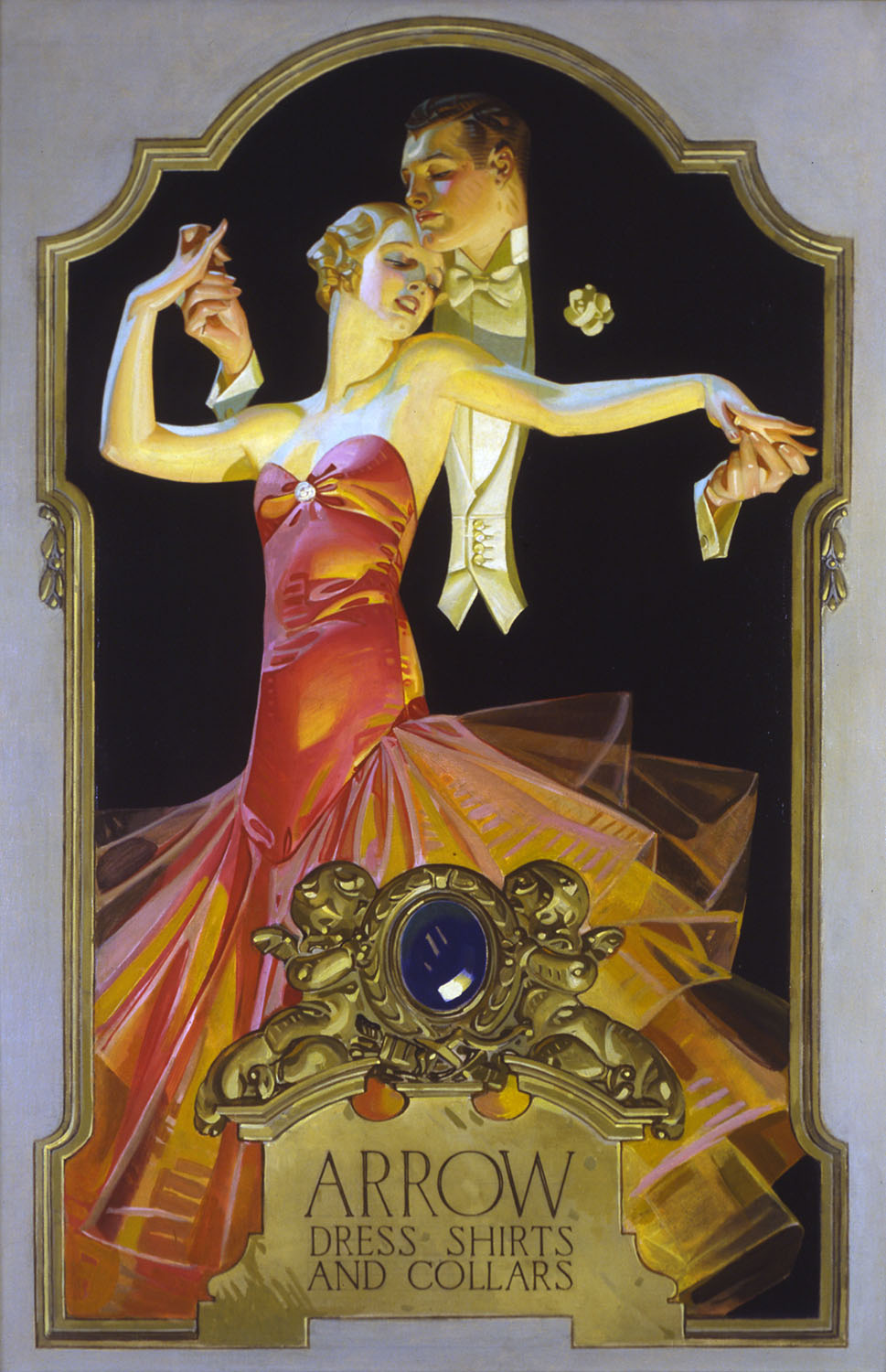
J.C. Leyendecker (1874-1951)
Dancing Couple
1930, oil on canvas
38" x 24"
Arrow Collar advertisement, printed in Saturday Evening Post, November 8, 1930
In his celebrated Arrow Collar advertisements, J. C. Leyendecker presented the “Arrow Collar Man” as the ideal—confident, refined, impeccably dressed—someone every man aspired to be and every woman admired. In this dynamic dancing scene, the Arrow Collar Man moves gracefully with an elegant partner, her beauty and poise reinforcing his desirability. The woman’s presence is central to the advertisement’s message: by associating the product with romance, sophistication, and social success, Leyendecker transformed a simple shirt collar into a symbol of status and aspiration.
Within The American Woman Illustrated, the image reveals how women were often used in advertising not merely as figures of fashion, but as powerful cultural signifiers—embodying taste, elegance, and social approval in a rapidly modernizing America.
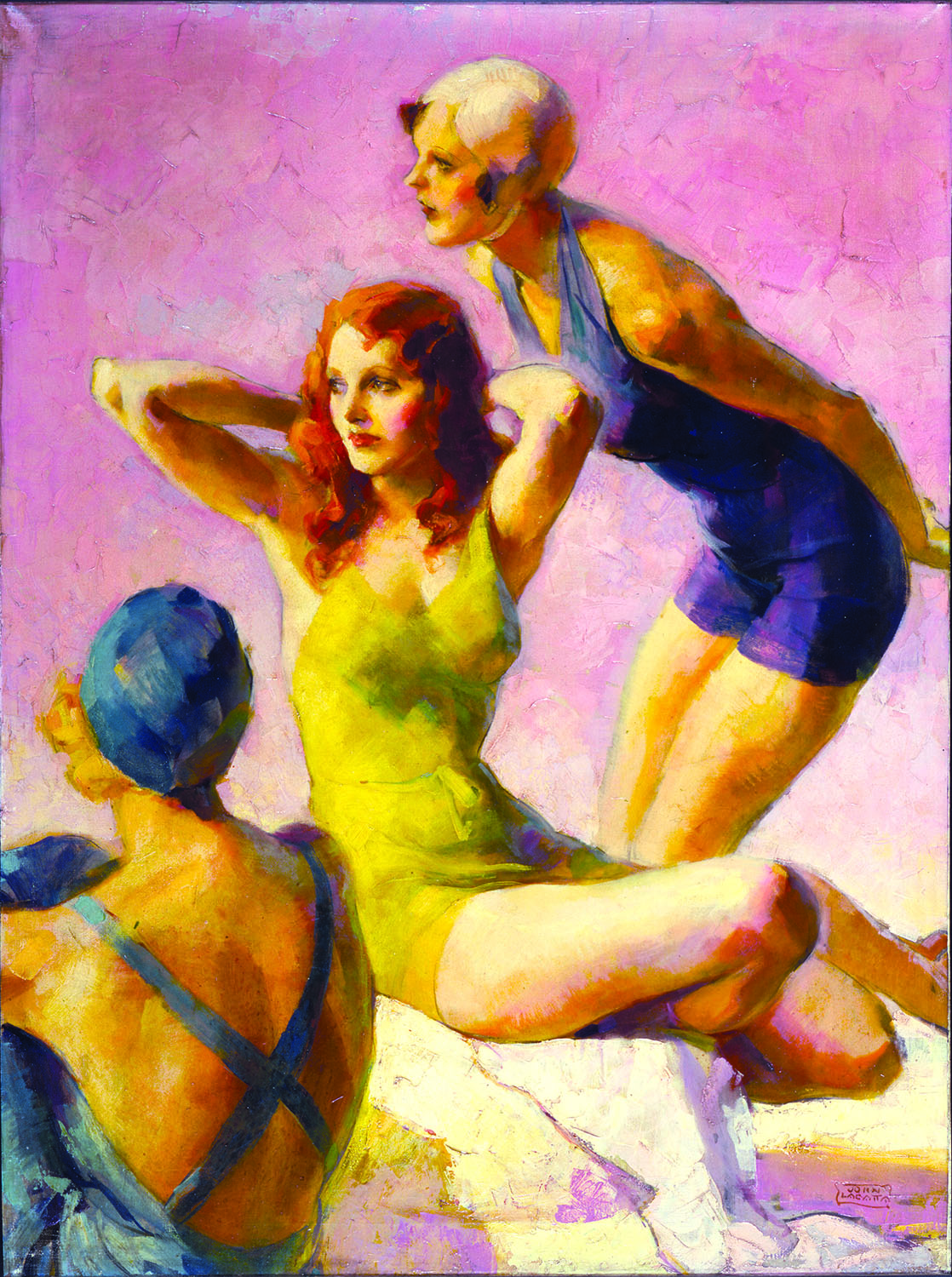
John Lagatta (1894-1977)
Bathing Beauties
1933, oil on canvas
37" x 28", signed lower right
Saturday Evening Post, July 8, 1933 cover
John LaGatta was celebrated for his glamorous depictions of women—often featuring his signature trio of blonde, brunette, and redhead. In Bathing Beauties, created for the July 8, 1933 cover of The Saturday Evening Post, he presents three stylish women enjoying the height of summer fashion and leisure.
Originally, however, the painting was deemed too risqué for publication. The Post returned the canvas to LaGatta, who lengthened the hemlines of the women’s bathing suits to make the image acceptable for its readership. The revision itself tells a revealing story about shifting standards of modesty, censorship, and commercial sensibilities during the early 1930s.
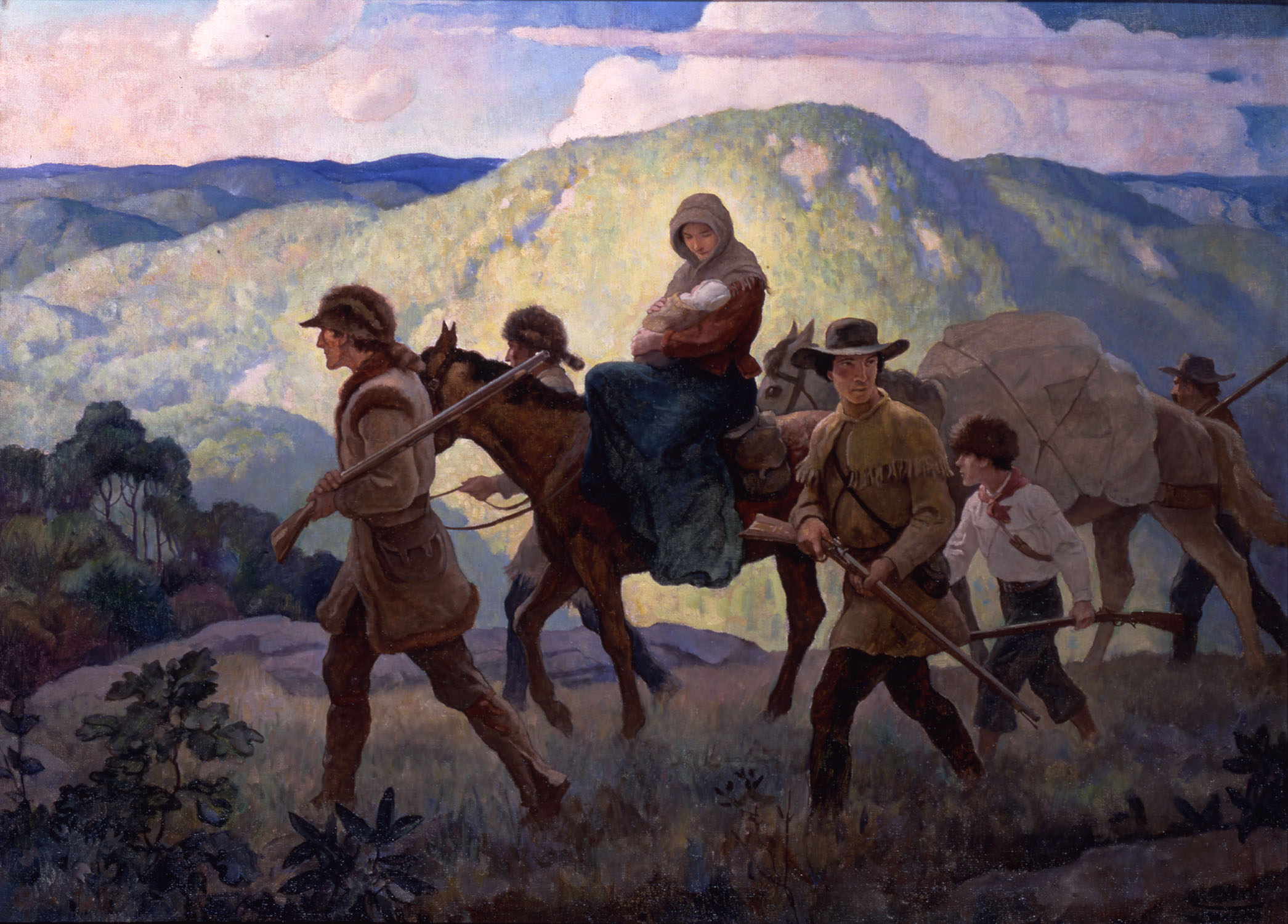
N.C. Wyeth (1882-1945)
Daniel Boone, The Home Seeker - Cumberland Valley
1936, oil on canvas
30" x 41", signed lower right
The Home Insurance Company calendar, 1938
In Daniel Boone, The Home Seeker, N. C. Wyeth portrays the legendary frontiersman guiding settlers through the Cumberland Valley toward new opportunity. While Boone leads the way, Wyeth places a mother holding her baby on horseback at the emotional center of the composition.
Her presence transforms the image from one of solitary exploration into a story of family, endurance, and the building of home. The westward journey was not undertaken by men alone; women and children carried the hopes of settlement, stability, and future generations.
Within The American Woman Illustrated, this powerful scene reminds us that the expansion of the nation depended not only on bold pioneers, but also on the courage and resilience of mothers who sustained family life on the frontier—literally carrying the next chapter of America forward.
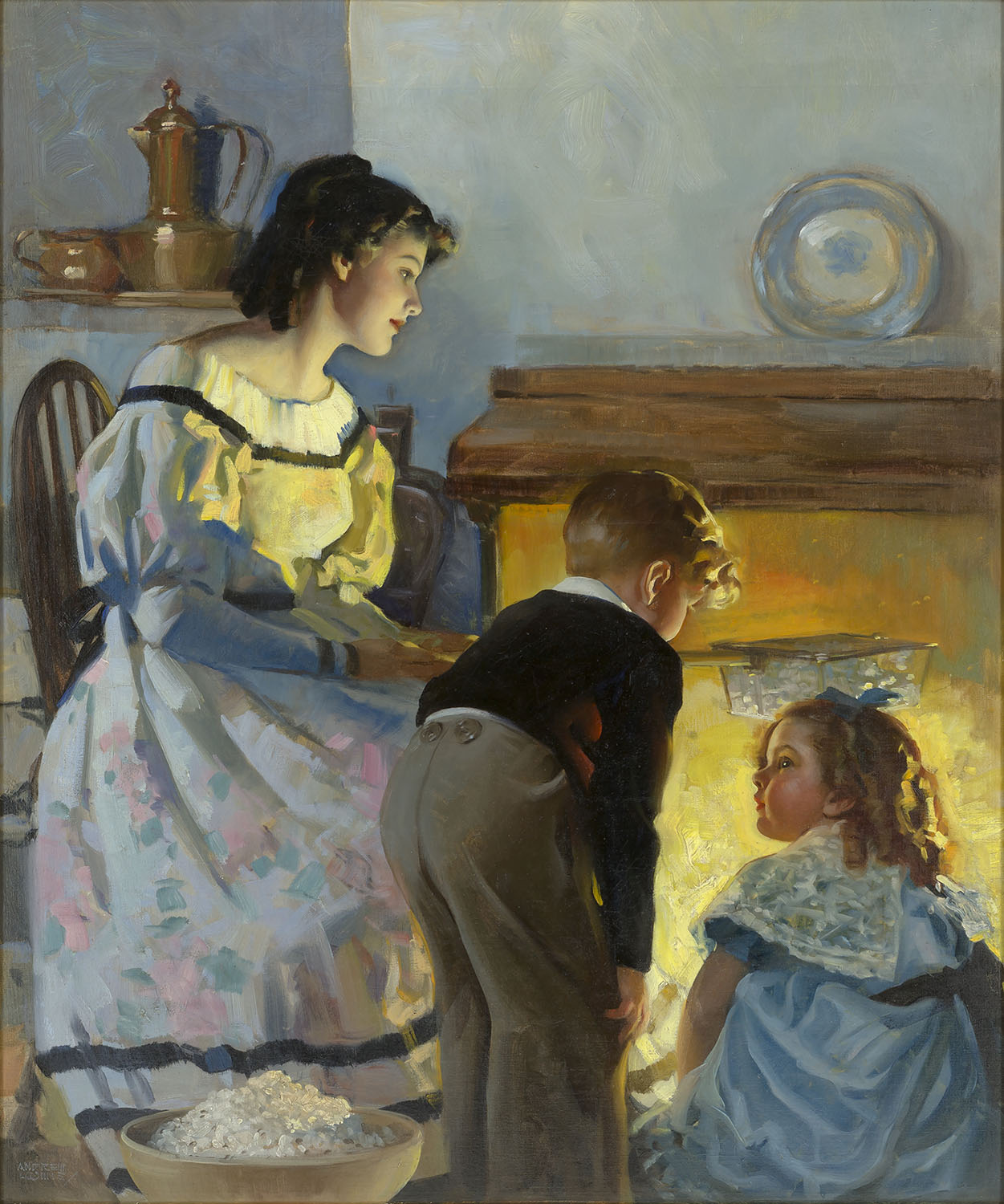
Andrew Loomis (1892-1959)
These Are My Jewels
1941, oil on canvas
37" x 30 3/4", signed lower left
Company illustration for The Thomas D. Murphy Co., Red Oak, Iowa, 1941
In These Are My Jewels, Andrew Loomis presents a tender domestic scene: a mother and her two children gathered by the fireplace, making popcorn over an open flame. The glow of the hearth illuminates their faces, transforming an ordinary evening into a moment of warmth, security, and shared joy.
The title itself speaks volumes. Rather than material wealth, the mother’s true “jewels” are her children. Loomis elevates motherhood and family life into something quietly heroic, suggesting that the emotional bonds forged in the home are as valuable as any treasure.
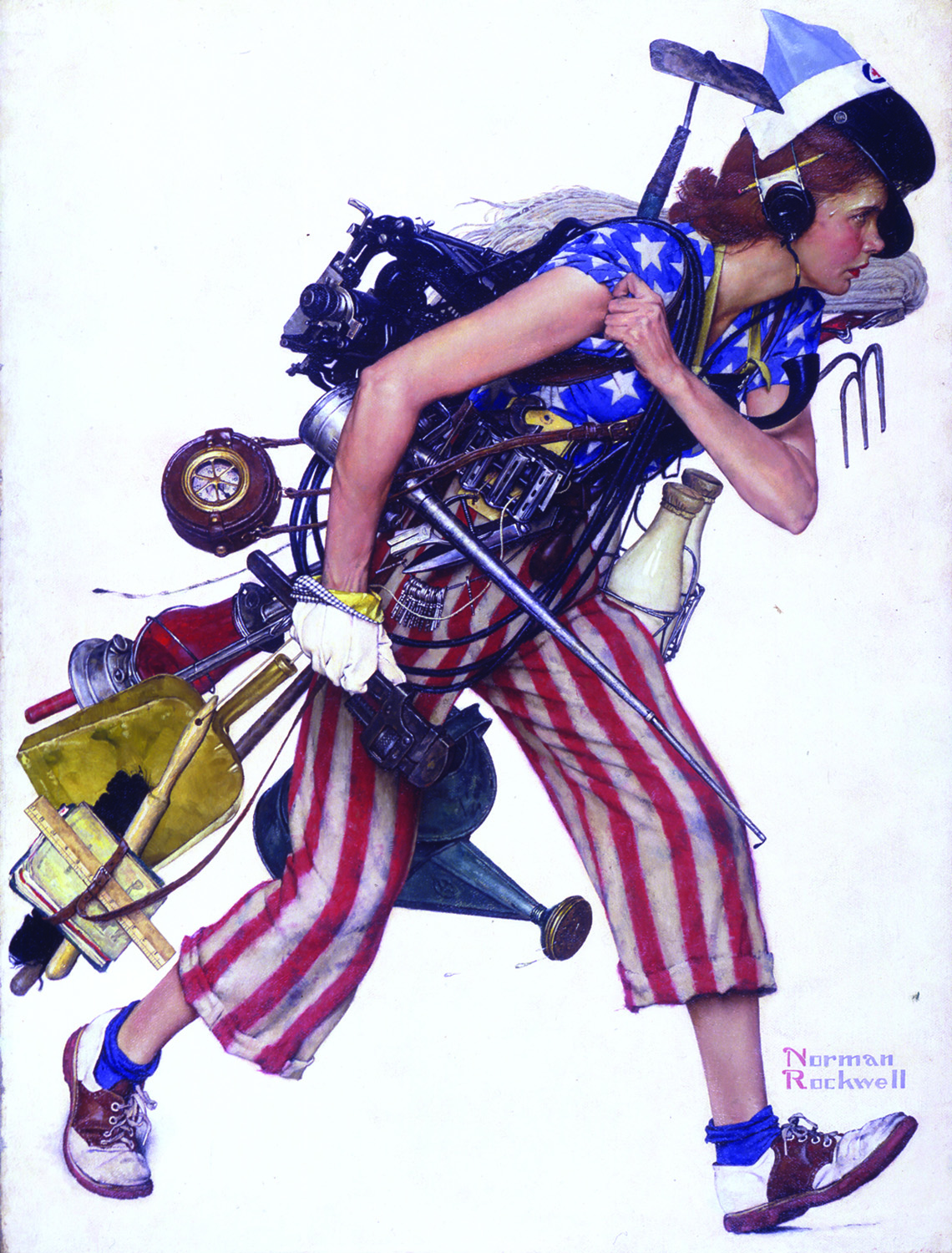
Norman Rockwell (1894-1978)
Miss Liberty
1943, oil on canvas
41 3/4” x 31 1/4”, signed lower right
Saturday Evening Post, September 4, 1943 cover
For this 1943 Saturday Evening Post Labor Day cover, Rockwell created a cultural icon of the time for America. Miss Liberty represents women of the 1940s who went to work for the first time taking over male-oriented jobs while the men fought overseas. Women suddenly fulfilled roles to which they never aspired, nor even envisaged before. In short, Miss Liberty is emblematic of her times and the liberation of women in the workplace. The Saturday Evening Post listed a number of occupations which were represented in Miss Liberty: gas station attendant, switchboard operator, grocery clerk, milk-woman, electrician, plumber, garage mechanic, stenographer, editor, reporter, baggage clerk, bus driver, railroad conductor, taxi driver, truck driver... Rockwell noted that "getting the props all together and arranging them on the model had presented quite a problem," perhaps the hardest part of creating this artwork for the master illustrator.
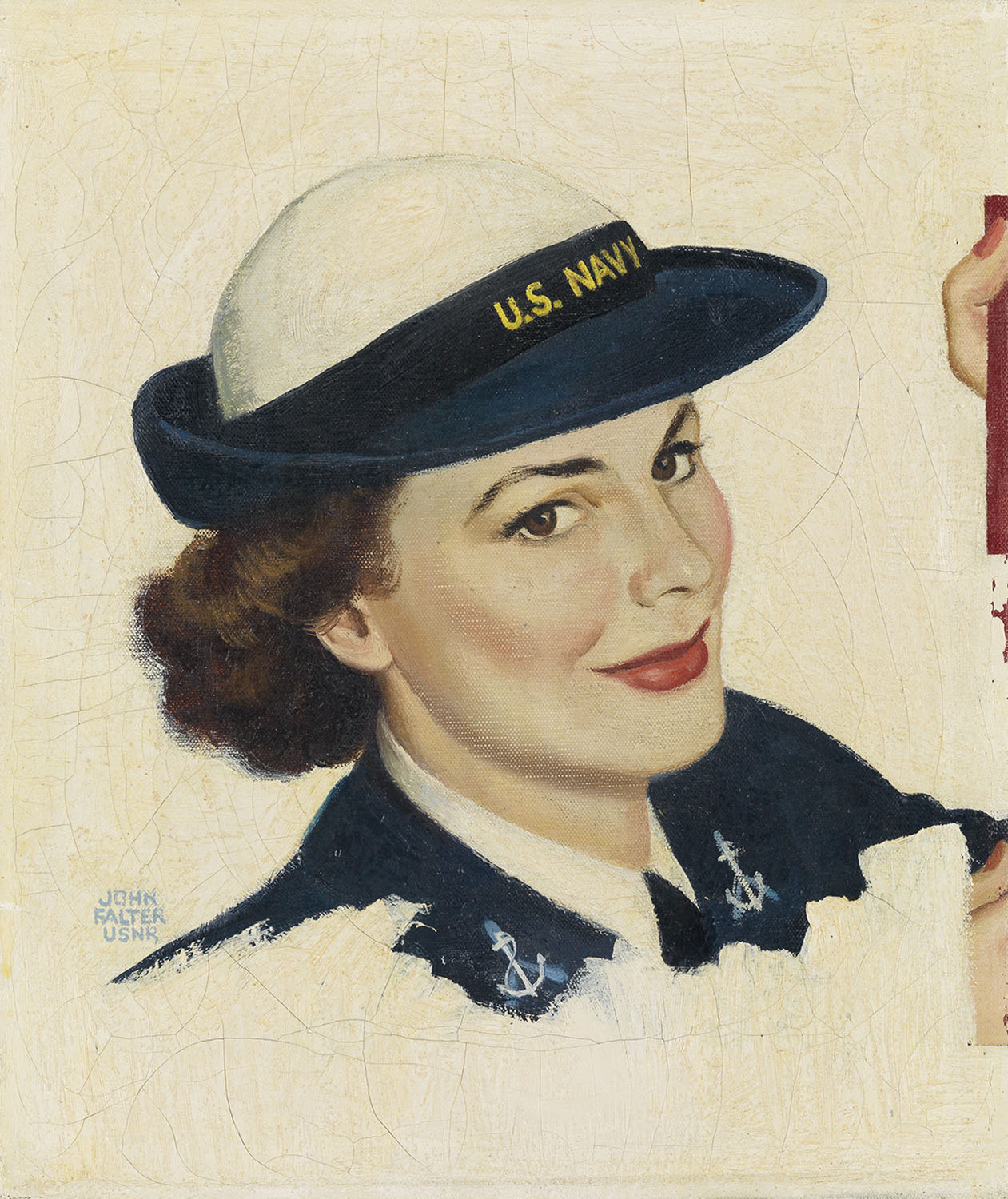
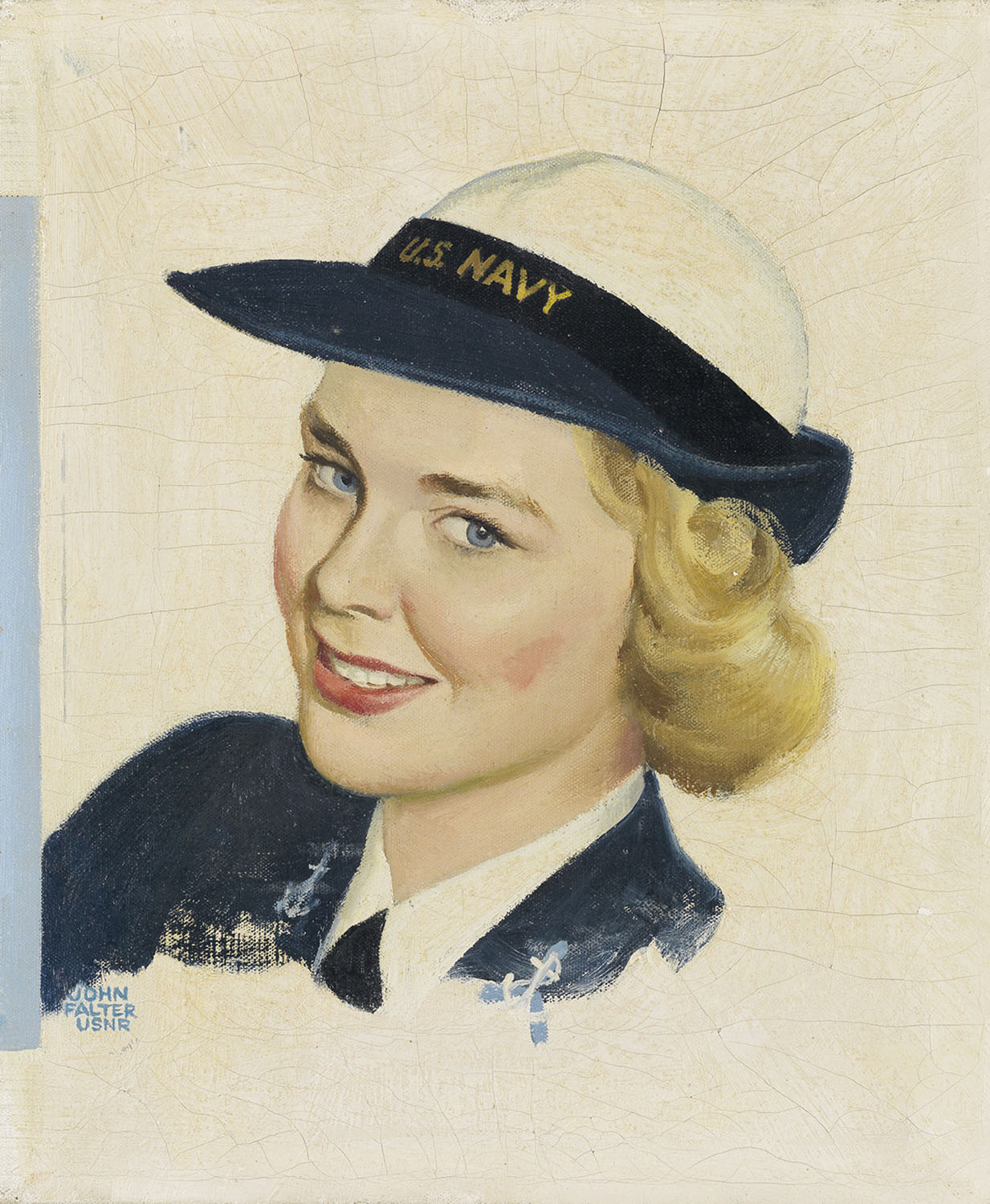
John Falter (1910-1982)
What Pay Does a Navy WAVE Get? - Brunette and Blonde Sailors
1944, oil on canvas
Each canvas measures 12” x 10”, signed lower left
Advertisement for the Navy WAVE campaign
In this striking advertising duo, John Falter portrays two confident young women—a blonde and a brunette—serving as members of the U.S. Navy WAVES (Women Accepted for Volunteer Emergency Service). Created to encourage enlistment during World War II, the images answer a practical question about pay while promoting a larger message of opportunity, patriotism, and independence. The WAVES program, established in 1942, allowed women to serve in active-duty roles within the Navy, freeing men for combat assignments overseas. Falter’s illustrations present these women as capable, stylish, and self-assured—modern Americans contributing directly to the war effort.
These works highlight the expanding public roles of women during World War II. No longer confined solely to the home front, women stepped into uniform, took on essential responsibilities, and helped redefine what service to country could look like.
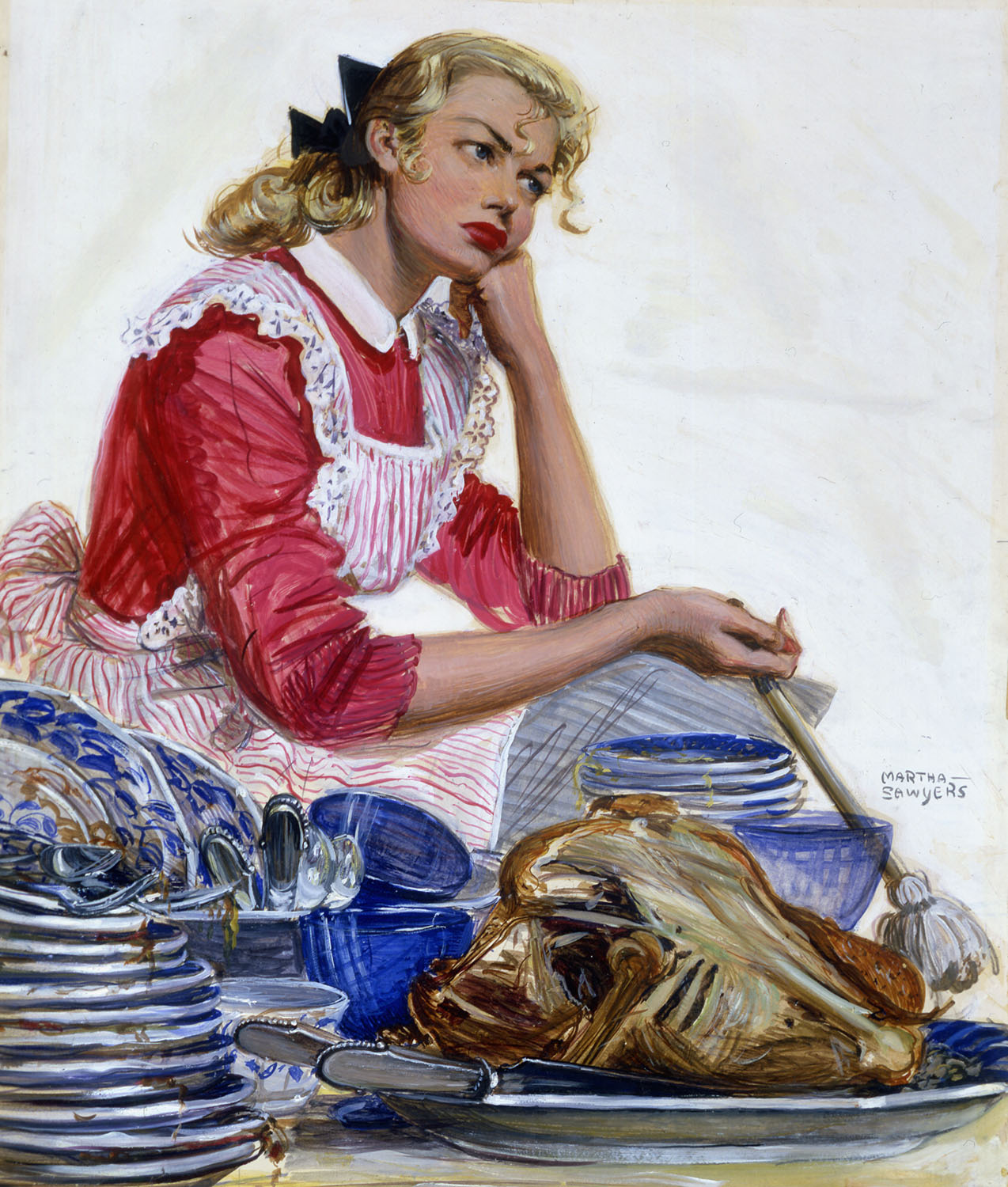
Martha Sawyers (1902-1987)
Thanksgiving
1947, oil on board
28” x 23”, signed lower right
Collier's Magazine, November 29, 1947 cover
In this humorous yet pointed Thanksgiving cover, Martha Sawyers captures a familiar post-holiday scene: a woman, utterly exhausted after preparing and hosting a grand dinner, left alone in the kitchen facing towering stacks of dishes.
Painted in 1947, the illustration reflects both celebration and reality. While Thanksgiving is depicted as a moment of abundance and family gathering, Sawyers gently exposes the unseen labor behind it—work traditionally carried by women. Her expressive composition blends comedy with social commentary, acknowledging the emotional and physical demands of domestic life in postwar America.
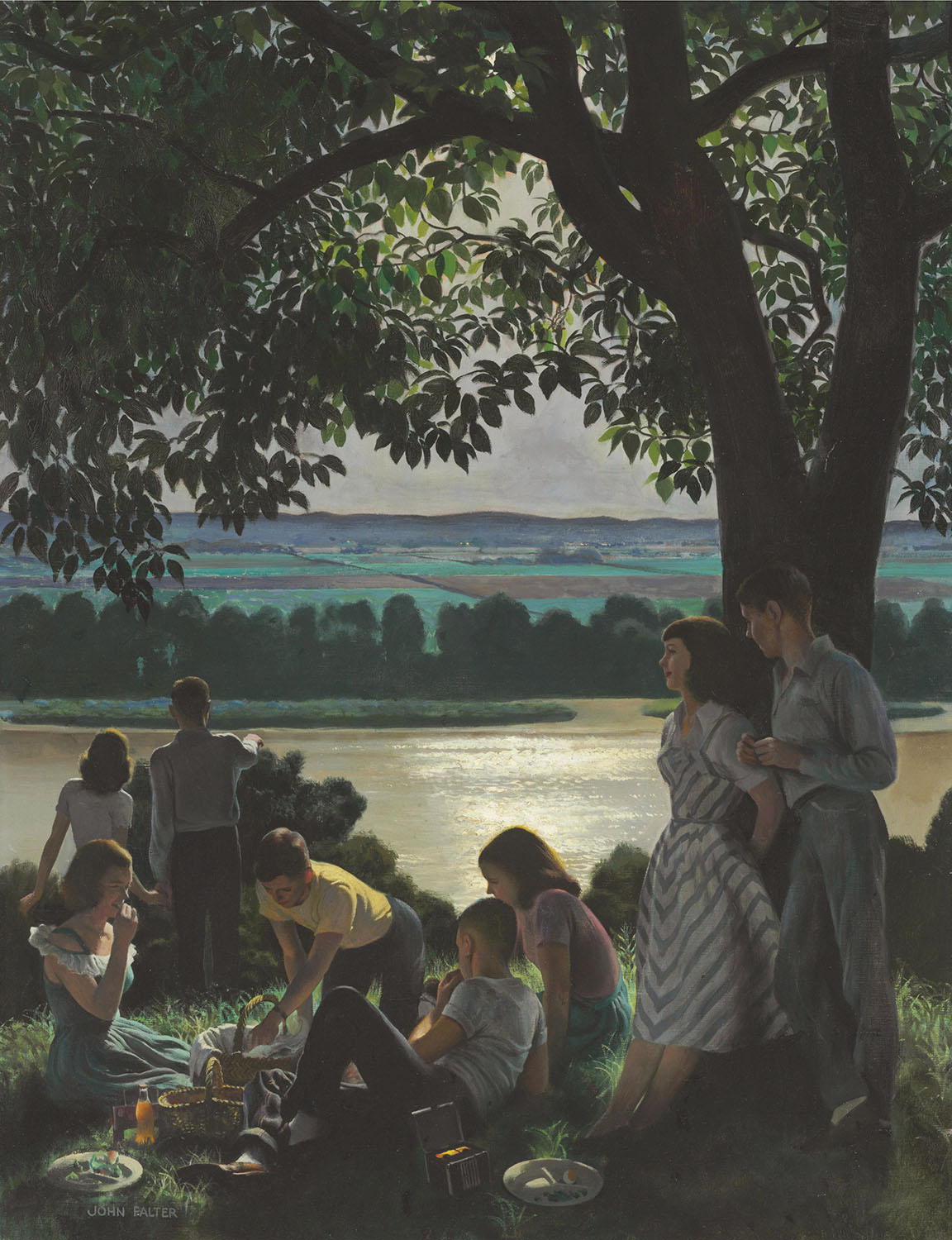
John Falter (1910-1982)
Evening Picnic
1949, oil on canvas
34” x 26 1/8”, signed lower left
Saturday Evening Post, June 4, 1949 cover
Painted after a visit to his hometown of Atchison, Kansas, Evening Picnic captures a carefree gathering of young people along the Missouri River. Falter persuaded local high school students to stage a riverside outing—only to watch them enthusiastically devour a surprising mountain of food despite having just eaten lunch. Transforming the scene into a moonlit evening, Falter bathed the countryside in soft light, the Missouri River shimmering in the background. The result is less documentary realism and more nostalgic ideal: wholesome youth, laughter, friendship, and the promise of summer.
Within The American Woman Illustrated, the image reflects postwar optimism and the social world young women inhabited—no longer defined solely by wartime sacrifice, but by leisure, community, and renewed possibility. As with many of Falter’s covers, everyday American life becomes a gentle celebration of national spirit.
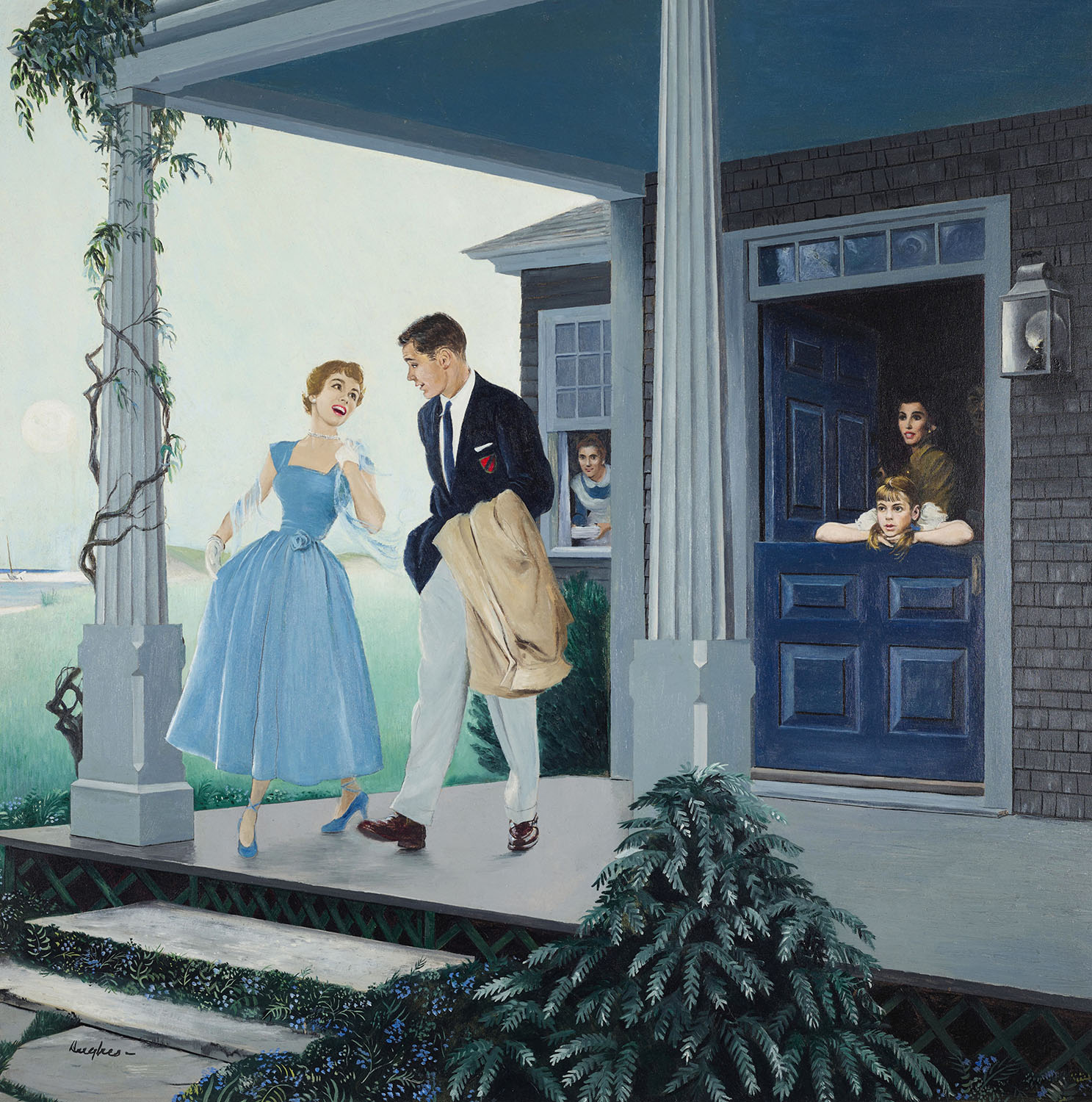
George Hughes (1907-1990)
The Critics Look On (Date for the Dance)
1950, oil on panel
28 1/2” x 28 1/4”, signed lower left
Saturday Evening Post, August 5, 1950 cover
In The Critics Look On, George Hughes captures a quintessential moment of mid-century American life: a young woman stepping out for an evening with her date, both impeccably dressed, while younger siblings peer eagerly from windows and doorways. Their watchful faces—curious, amused, perhaps a bit envious—serve as the painting’s affectionate “critics.”
Hughes had a gift for observing the small dramas of domestic life. Here, the focus is not only on romance, but on the rite of passage it represents. The young woman stands poised at the threshold—between childhood and adulthood, between family life and growing independence. Through humor and warmth, Hughes celebrates a milestone both personal and universal.
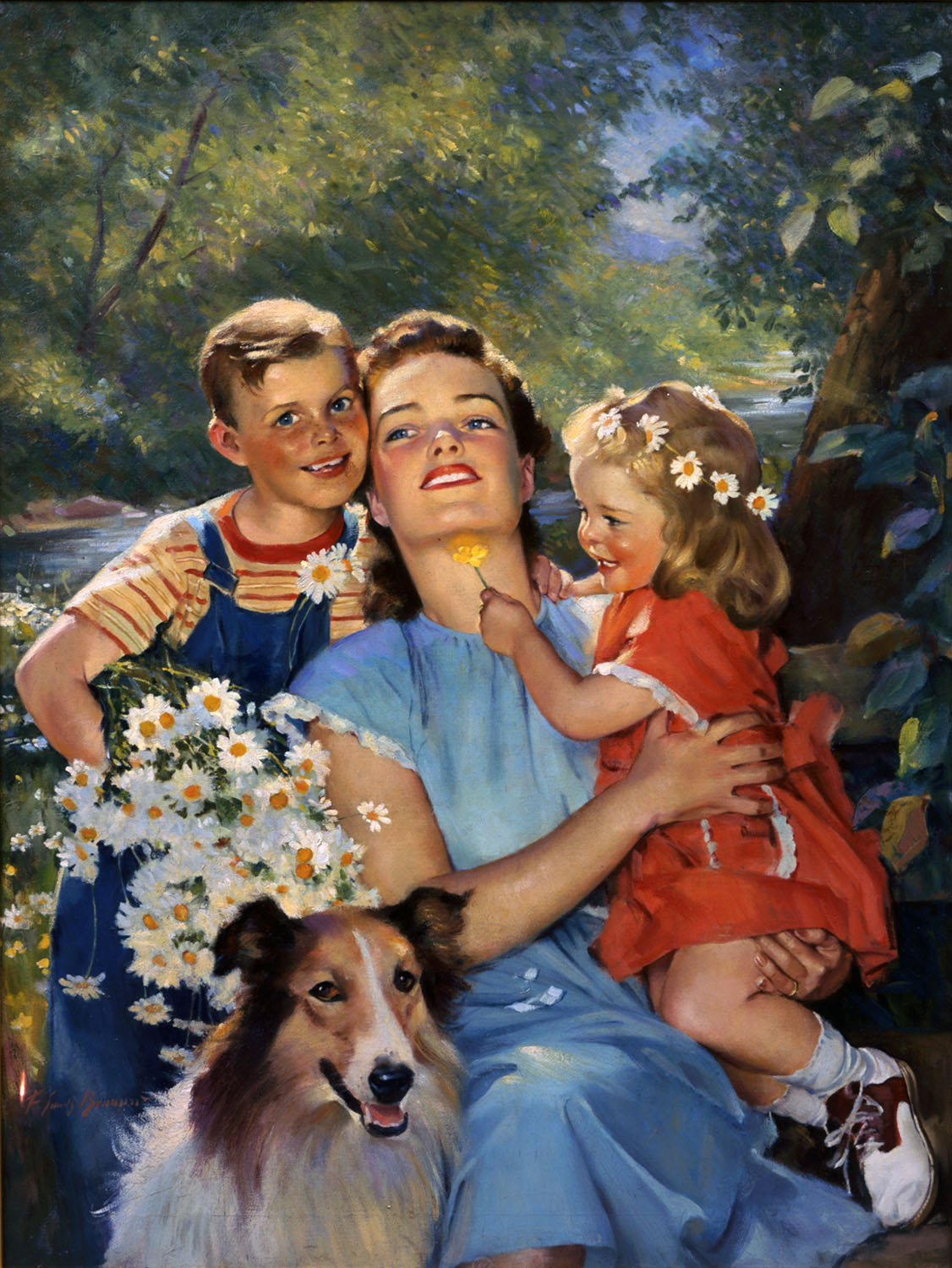
Frederick Sands Brunner (1886-1954)
Queen Bee
1954, oil on canvas
34” x 26”, signed lower left
Calendar illustration for Harold W. Chapin's Grocery, North Leverett, MA, 1955
In Queen Bee, Frederick Sands Brunner captures a tender and playful family moment: a mother and her two children, accompanied by the family dog, testing the age-old buttercup game—holding the bright flower beneath the chin to see if its golden glow reflects a fondness for butter. The scene radiates the warmth and optimism associated with mid-century America. The mother is at the center of family life—both playful participant and steady presence—while the children’s delight reinforces the ideal of harmony, innocence, and togetherness so often celebrated in 1950s illustration.
This image reflects the era’s vision of domestic fulfillment and maternal leadership. Brunner’s composition embodies the postwar ideal of family life, where the home was seen as the heart of national stability and the mother as its guiding light.
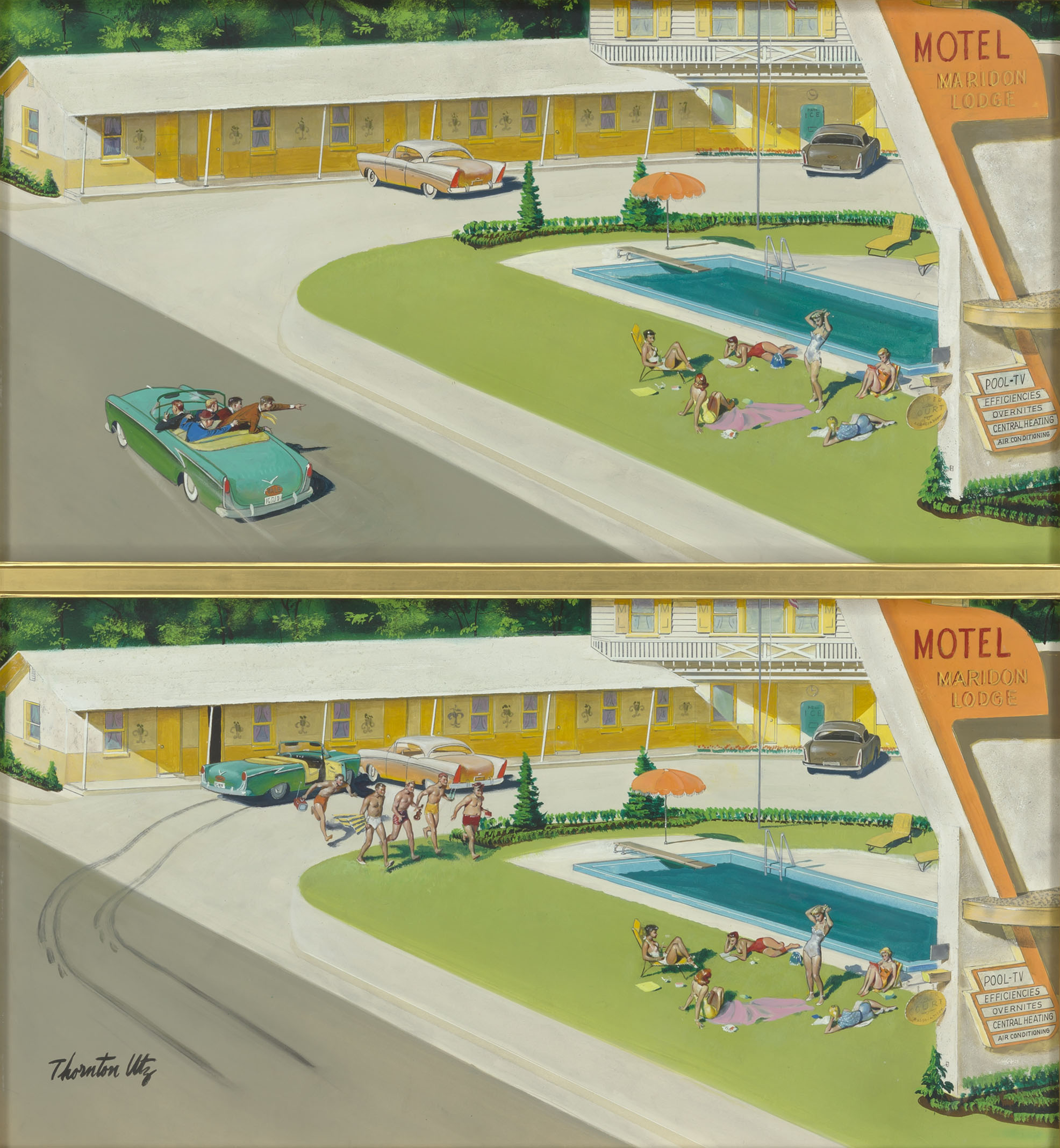
Thorton Utz (1914-1999)
Summer Madness
1957, oil on board
33 1/4” x 29 1/2”, signed lower left
Saturday Evening Post, August 17, 1957 cover
Painted at the Maridon Lodge in Sarasota, Florida, Summer Madness captures the carefree exuberance of teenage summers in mid-century America. With characteristic humor, Thornton Utz portrays the exaggerated enthusiasm of “girl-crazy” boys, their attention comically derailed by the women sun bathing at the motel pool. The scene is lively, sunlit, and filled with motion—an affectionate satire of youthful infatuation. Utz’s playful composition acknowledges both the growing confidence of American girls and the shifting dynamics of courtship in an era defined by prosperity, freedom, and fun.
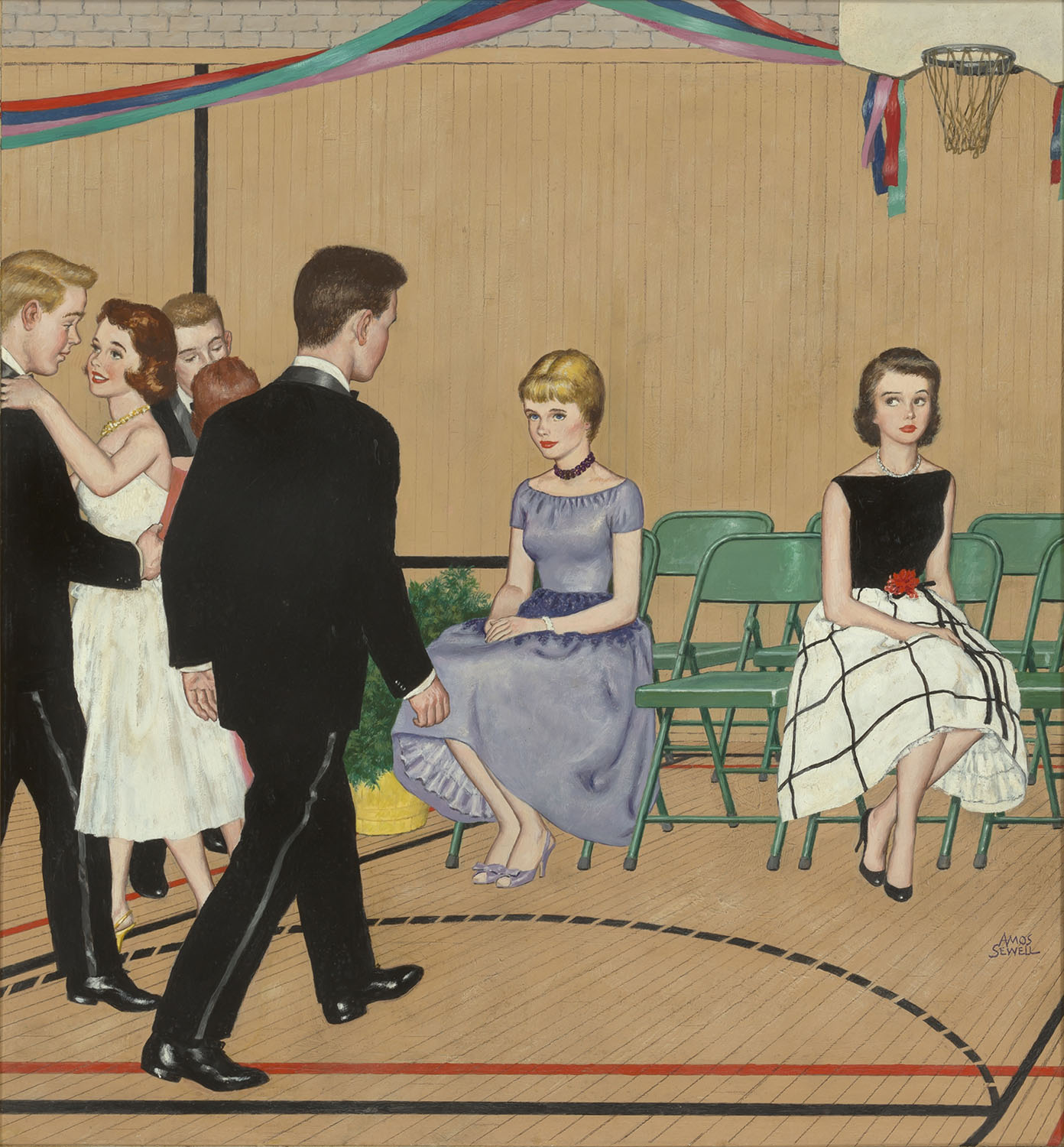
Amos Sewell (1901-1983)
The Dance (Who Will He Ask?)
1959, oil on board
26 1/2” x 24 1/2”, signed lower right
Saturday Evening Post, January 30, 1960 cover
In The Dance (Who Will He Ask?), Amos Sewell places the viewer directly into the charged anticipation of a high school gymnasium dance. Two young women sit along the wall, carefully composed yet quietly anxious, as a young man approaches. We see the moment from their perspective—sharing their suspense as we wonder which one he will choose.
Sewell was a master of capturing small but emotionally resonant moments in American life. Here, the drama is subtle yet universal: teenage uncertainty, social hierarchy, and the delicate rituals of courtship. The gymnasium setting—with its polished floor, basketball hoop, and watchful classmates—becomes a stage where identity and confidence are tested.
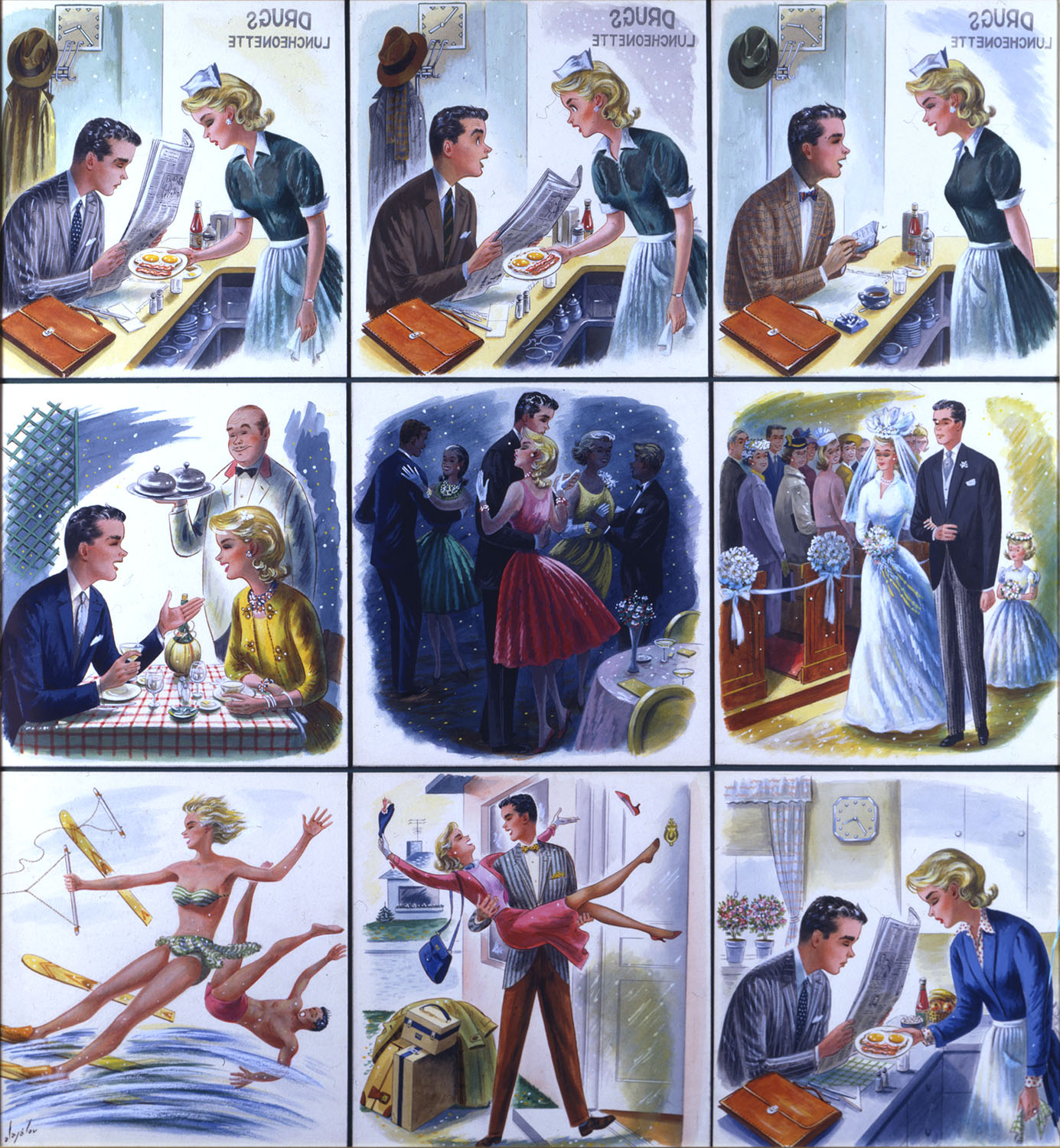
Constantin Alajalov (1900-1987)
Before and After (Circle of Love)
1961, tempera on board
36 1/4” x 34 1/4”, signed lower left
Saturday Evening Post, April 8, 1961 cover
In Before and After, Constantin Alajalov compresses the entire arc of young love into a single, witty composition. The story begins at a luncheonette counter, where a waitress and her customer exchange glances. Courtship follows—dating, marriage, honeymoon bliss, and the proud arrival at a newly purchased home. Yet the final scene brings us full circle: she once again stands behind a breakfast counter serving him—only now it is in their own kitchen.
With humor and keen observation, Alajalov offers a poignant reflection on mid-century expectations of marriage and domestic life. The illustration captures both romance and routine, aspiration and reality. This cover invites viewers to consider how love, partnership, and gender roles were often portrayed as a natural progression—suggesting that while circumstances changed, certain domestic patterns remained strikingly familiar.
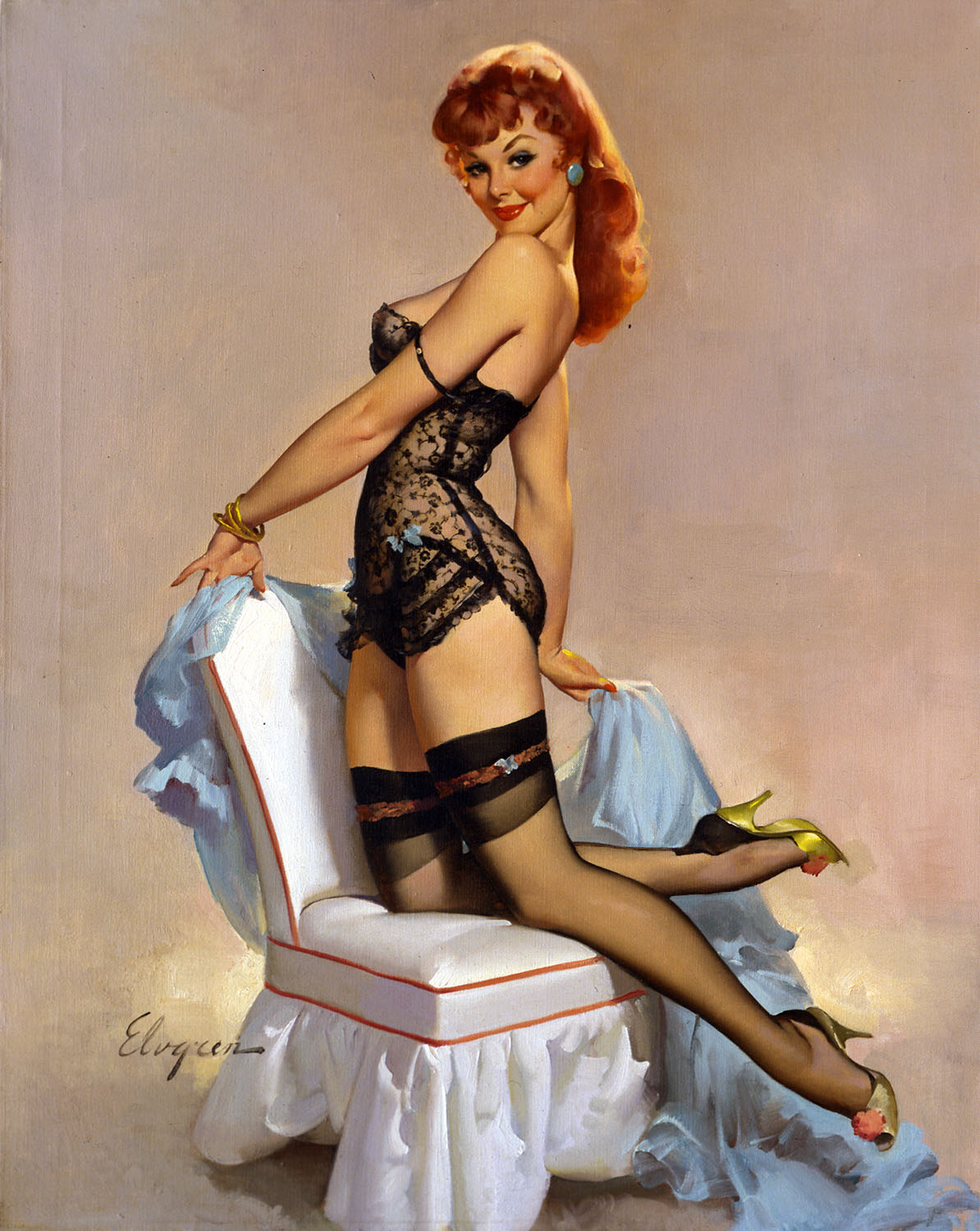
Gil Elvgren (1914-1980)
Jeanette
1962, oil on canvas
30” x 24”, signed lower left
Brown & Bigelow calendar, 1962
In Jeanette, Gil Elvgren—widely regarded as the premier American pin-up artist—presents a confident and playful vision of mid-century femininity. With luminous color, idealized beauty, and theatrical charm, Elvgren’s figure embodies glamour, self-awareness, and modern allure.
Emerging in the 1940s and 1950s, Elvgren’s pin-ups marked a new phase in the portrayal of women in American illustration. While earlier eras emphasized modesty and domestic virtue, the pin-up celebrated charisma, independence, and flirtatious confidence. Though often created for commercial purposes, these images became cultural touchstones—appearing in advertisements, calendars, and even military lockers during World War II.
Jeanette reflects a shifting visual language of womanhood—one that blended empowerment with performance, and glamour with consumer culture—capturing yet another chapter in the evolving image of the American woman.
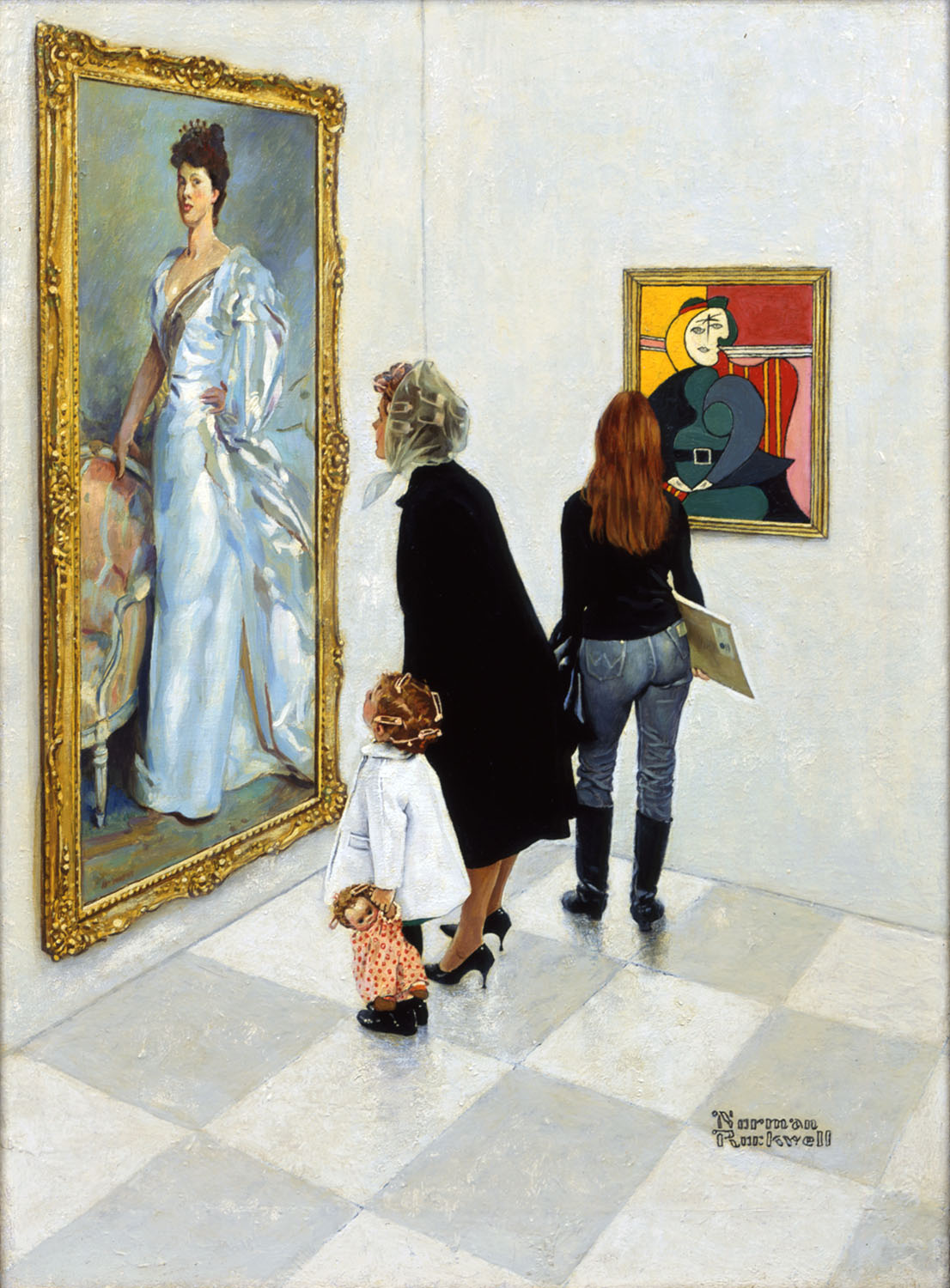
Norman Rockwell (1894-1978)
Picasso vs. Sargent
1966, oil on canvas
422” x 17”, signed lower right
"Rockwell and Rollers," Look magazine, January 11, 1966, pg. 25
In Picasso vs. Sargent, Norman Rockwell turns his keen observational humor toward the generational divide among American women, illustrated through a difference in hairstyles—roller-set curls versus sleek modern lines—set inside the Art Institute of Chicago.
On one side, a mother and daughter in pink plastic curlers (even the doll wears tiny rollers) gaze admiringly at a portrait by John Singer Sargent, embodying tradition, refinement, and conventional beauty. Across the gallery, a self-styled “mod” studies a painting by Pablo Picasso, aligning herself with modern rebellion and independence. Each woman’s hairstyle becomes a declaration—not merely of fashion, but of identity.
With characteristic wit, Rockwell captures more than a beauty trend; he reveals a cultural shift. Hair becomes shorthand for larger questions of conformity, generational change, and women defining themselves on their own terms. Picasso vs. Sargent underscores how even the most seemingly lighthearted subjects—curlers, straight hair, a trip to a museum—can reflect deeper conversations about autonomy, taste, and evolving womanhood in modern America.
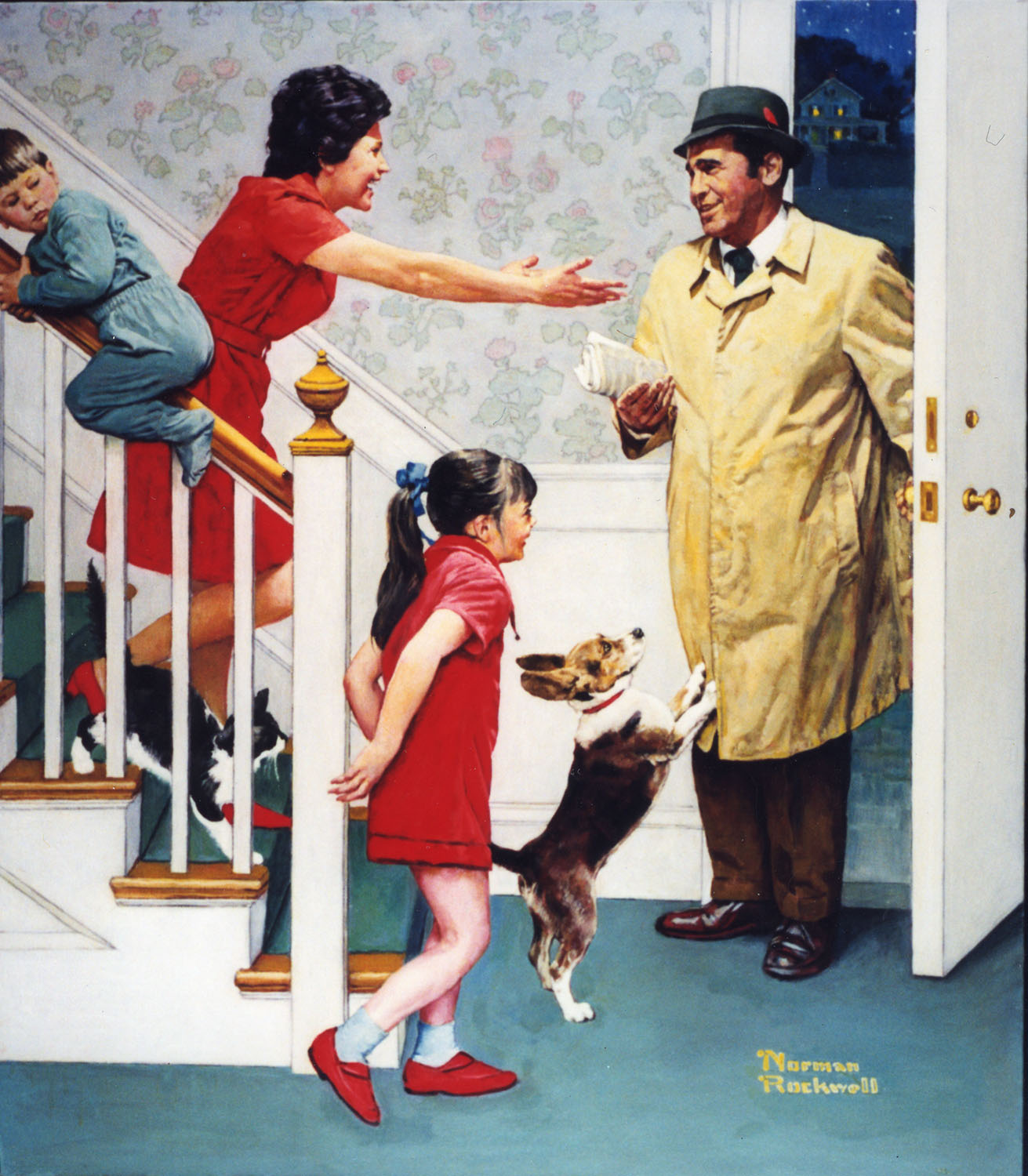
Norman Rockwell (1894-1978)
Father's Return Home
1973, oil on canvas
40” x 35”, signed lower right
American Mutual Insurance Company Christmas card, 1973
In Father’s Return Home, Norman Rockwell offers a quintessential vision of mid-century American family life. Created as a Christmas card for American Mutual Insurance Company, the illustration depicts a joyful reunion: mother, children, dog—and even the family cat—eagerly greeting the father at the door. The scene radiates warmth, stability, and affection.
Painted during a period when much of Rockwell’s work addressed global conflict and social issues, this image returns to the wholesome domestic ideal that made him beloved. Visitors often smile at the scene, joking that today “even the family dog doesn’t greet the father like that!” Yet beneath the humor lies a powerful nostalgia for a moment when the nuclear family symbolized security and optimism.
Rockwell’s careful composition reinforces that focus. A visual circle of red—from the mother’s dress and shoes to the daughter’s clothing and the father’s hat—draws the eye inward, concentrating attention on the tightly knit family unit. Set against a simplified background, the design elevates the family itself as the central subject.
As the concluding work in The American Woman Illustrated, this image underscores the enduring role of women as the emotional heart of the household—reminding us that the shaping of a nation often begins at its own front door.