

& Sacrifice
In honor of Memorial Day, this May’s virtual exhibition reflects on the profound legacy of American service and sacrifice through the lens of illustration. In Service and Sacrifice brings together a compelling selection of original artworks and vintage posters spanning the major conflicts of the 20th century, including World War I and World War II, alongside images from later periods of American military history.
From stirring recruitment posters and patriotic covers to deeply human scenes of departure, duty, and remembrance, these works reveal how artists shaped the visual language of wartime America. Illustration not only rallied a nation—it preserved the emotional realities of those who served and those who waited at home.
As we commemorate those who gave their lives in service to the United States, this exhibition invites viewers to reflect on the enduring power of images to honor memory, convey sacrifice, and tell the story of a nation forged through courage.
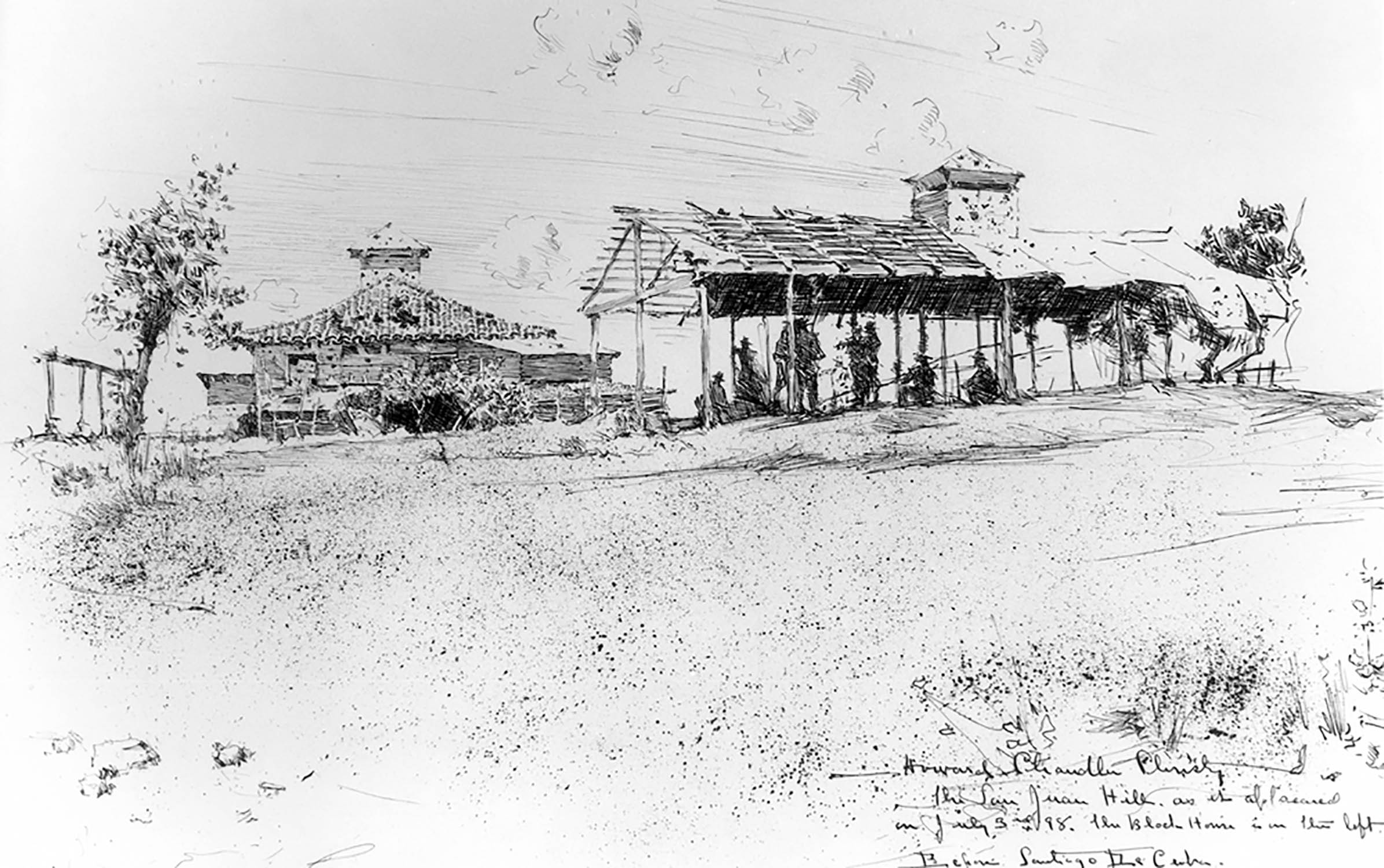
Howard Chandler Christy (1873-1952)
The San Juan Hills
1898, pen and ink on paper
10 5/8" x 16 5/8", signed, dated and inscribed lower right
Sent to the front lines of the Spanish-American War as a war correspondent, Christy became embedded with the Rough Riders under the command of Theodore Roosevelt, who took the young artist under his wing. Working directly from life, Christy recorded the chaos, movement, and energy of American troops advancing on Spanish positions in Cuba.
More than a document of war, The San Juan Hills helped shape the mythology surrounding Roosevelt and his regiment. Christy’s firsthand perspective allowed him to translate lived experience into a compelling visual narrative—one that balanced raw observation with a growing sense of heroism and national identity. The work stands as an early example of illustration’s power to both record history and define how it is remembered.
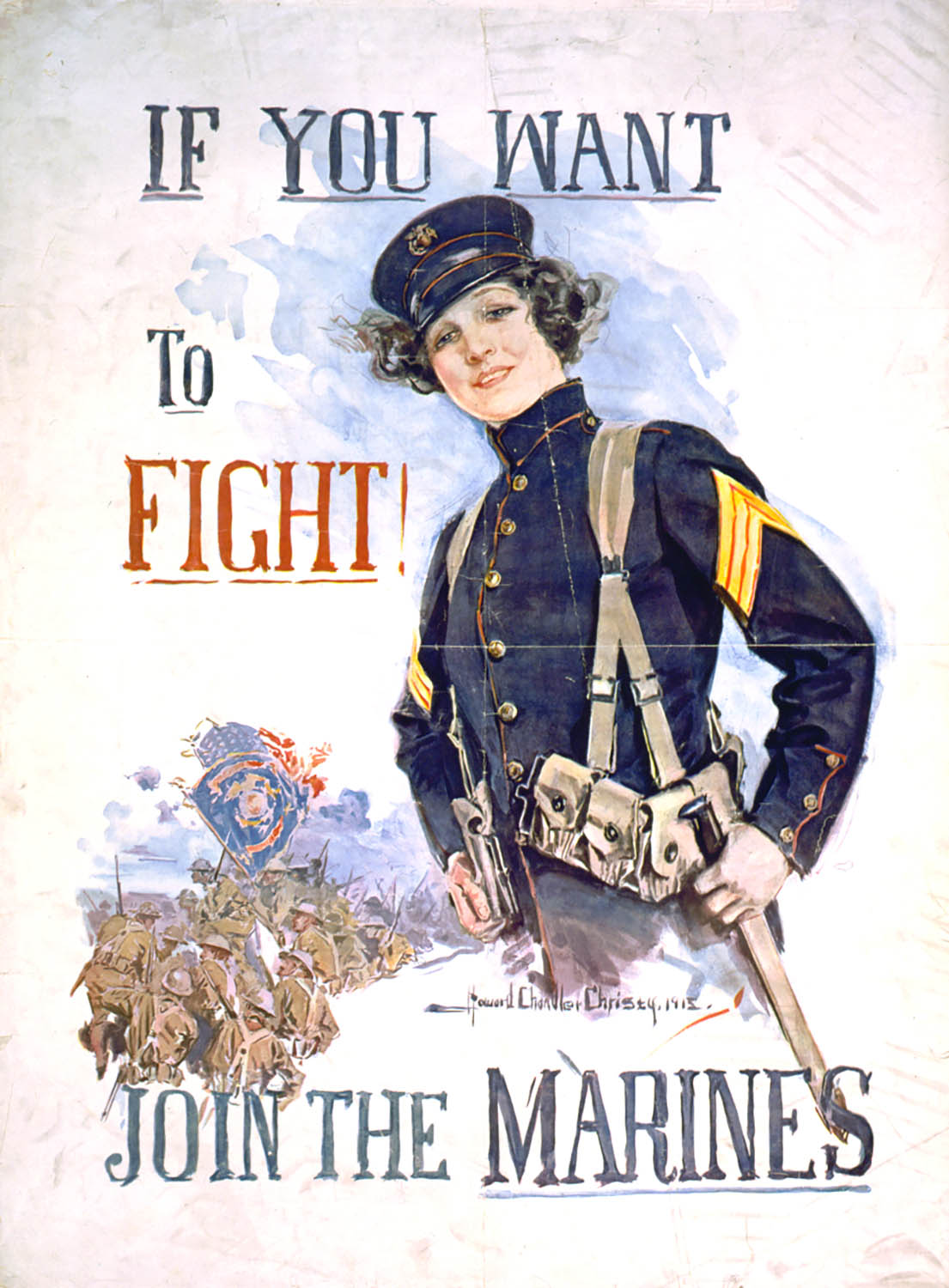
Howard Chandler Christy (1873-1952)
If You Want To Fight! Join the Marines
1915, lithograph
27" x 41", signed and dated lower right
The outbreak of World War I marked a turning point in the career of Howard Chandler Christy, whose talents were harnessed for one of the most ambitious visual propaganda campaigns in American history. Commissioned to create recruitment and fundraising imagery, Christy helped define the face of wartime persuasion. His posters did more than convey information—they stirred emotion, shaped public opinion, and mobilized millions. Central to this effort was the creation of the “Christy Girl,” a confident, modern American woman who became a powerful symbol of patriotic duty, appealing directly to men’s sense of honor while also engaging women as active participants in the war effort through support, sacrifice, and social influence.
Each of these four lithographs demonstrates Christy’s mastery of message and mood. If You Want to Fight! Join the Marines presents a direct and forceful call to action, pairing bold text with an assertive figure that channels urgency and masculine resolve.
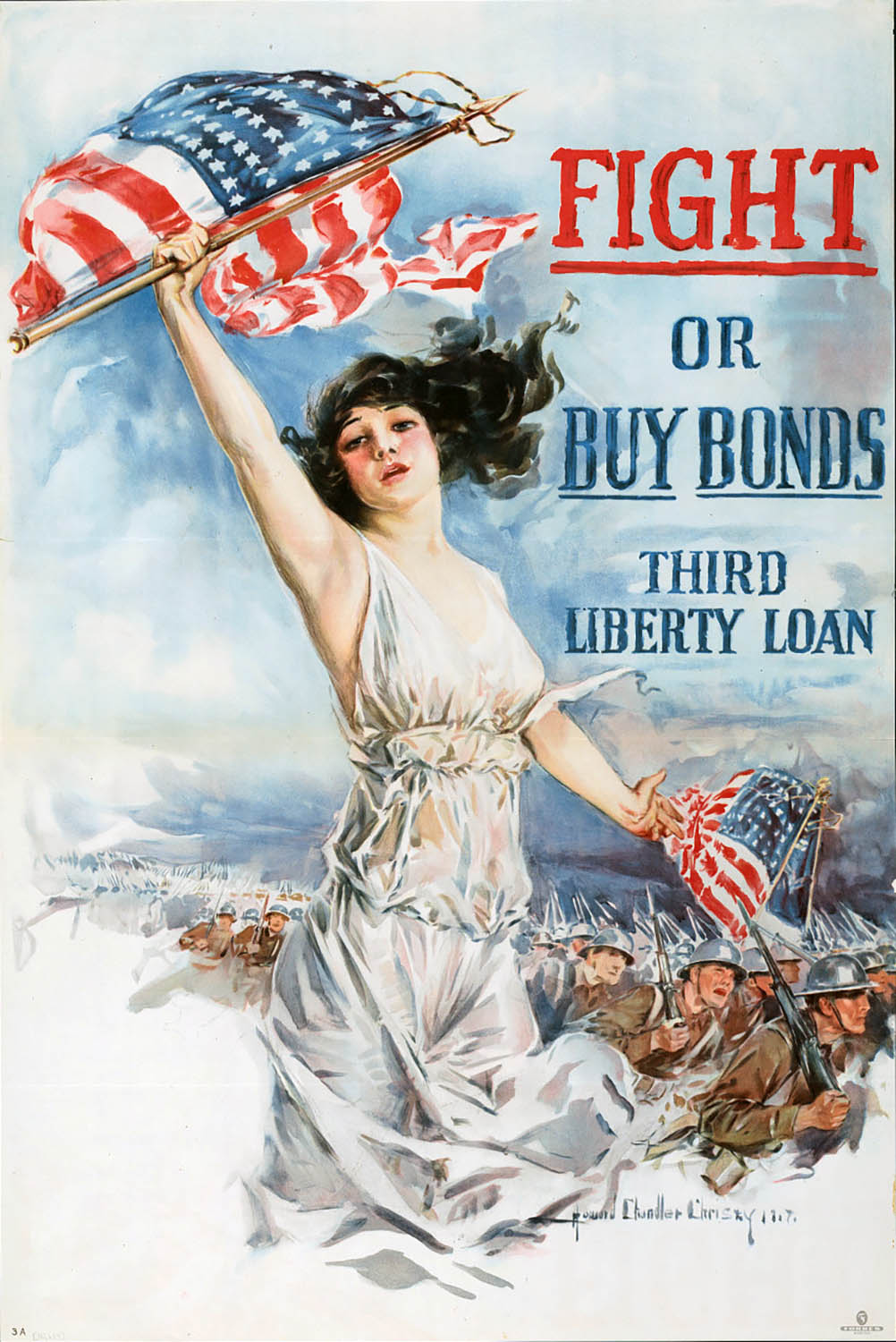
Howard Chandler Christy (1873-1952)
Fight Or Buy Bonds
1917, lithograph
20" x 30", signed and dated lower right
Fight or Buy Bonds. Third Liberty Loan broadens the appeal, reminding civilians that participation in the war extended beyond the battlefield—financial support was framed as a moral obligation.
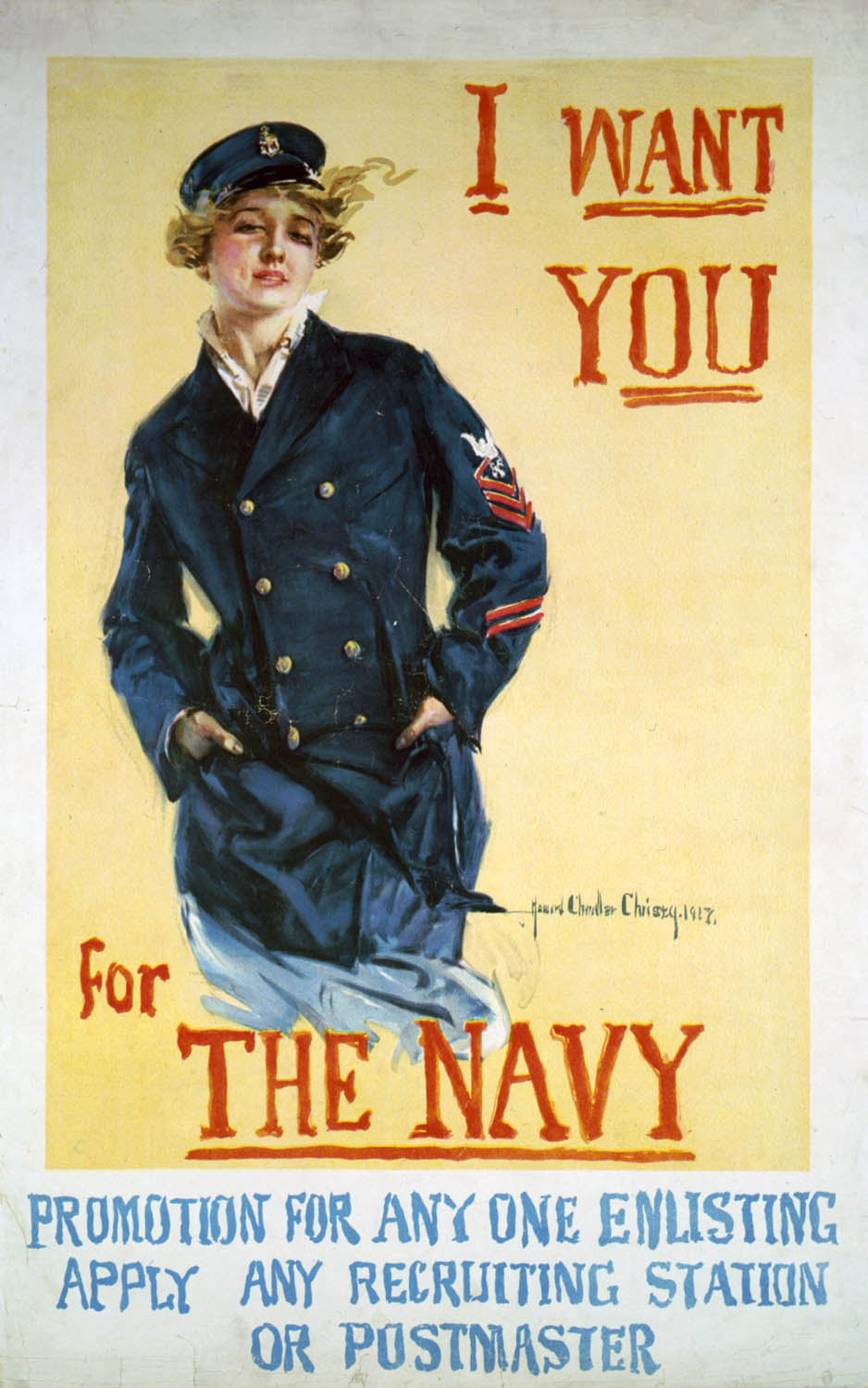
Howard Chandler Christy (1873-1952)
I Want You For The Navy
1917, lithograph
27" x 41", signed and dated lower right
In I Want You for the Navy, Christy adapts the iconic pointing gesture popularized by earlier recruitment imagery, using it to create a personal and immediate appeal to the viewer.
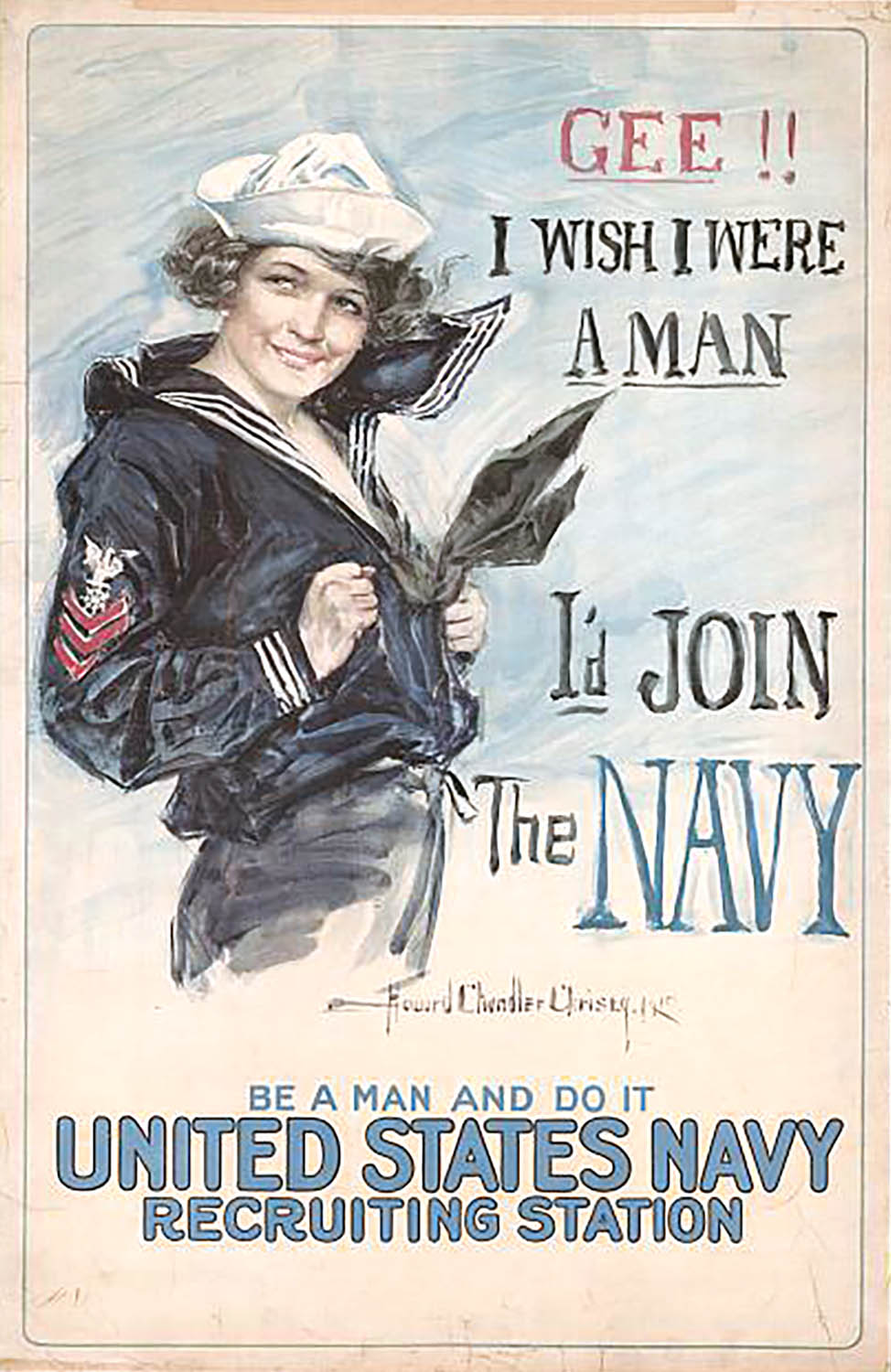
Howard Chandler Christy (1873-1952)
Gee!! I Wish I Were A Man. I'd Join the Navy. Be A Man and Do It.
1918, lithograph
27" x 41", signed and dated lower center
Finally, Gee!! I Wish I Were a Man I’d Join the Navy exemplifies the influence of the “Christy Girl,” whose spirited declaration both flatters and challenges male viewers, encouraging enlistment through a clever blend of admiration and social pressure.
Together, these works underscore the essential role of illustration in rallying a nation at war.
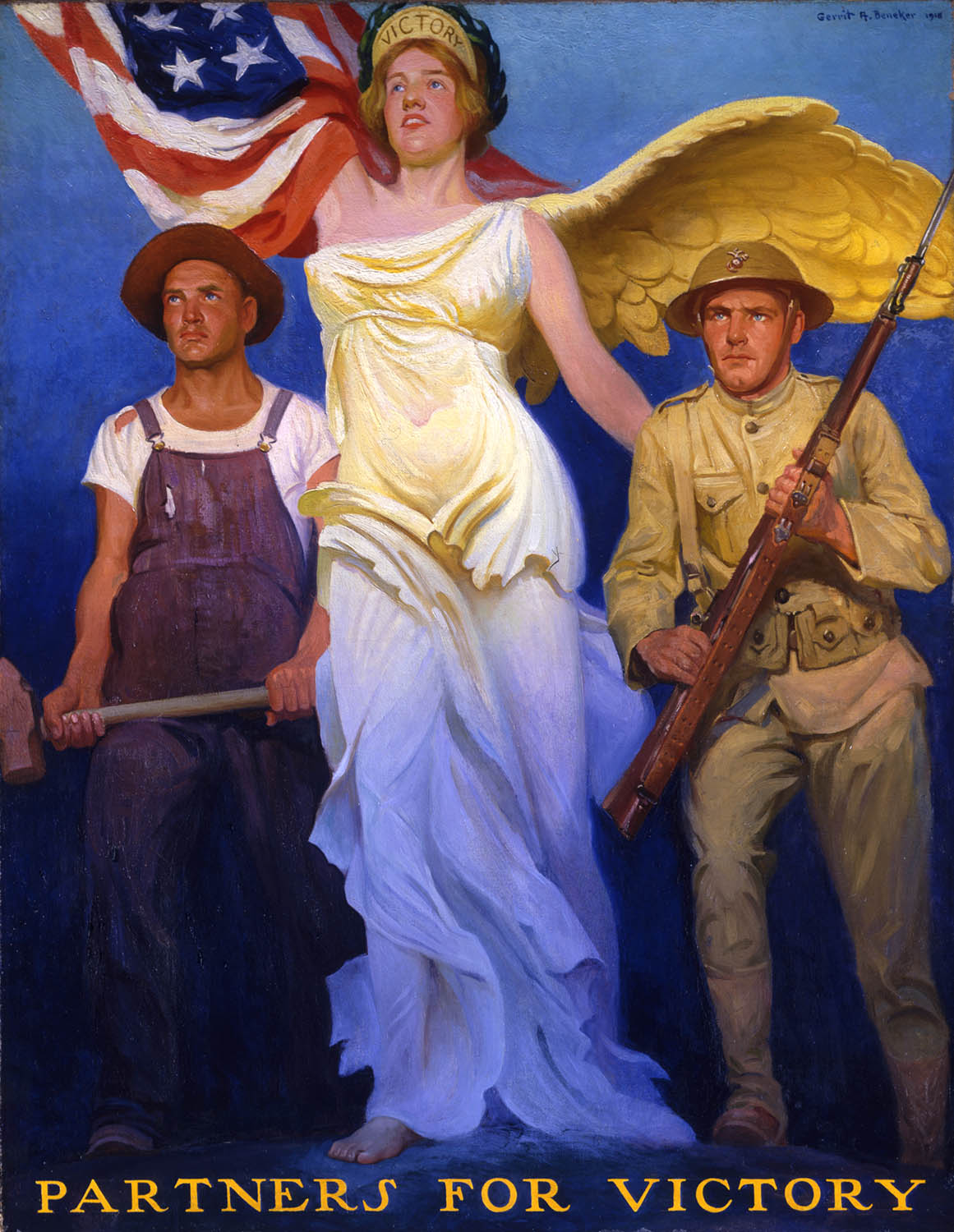
Gerrit A. Beneker (1882-1934)
Partners For Victory
1918, oil on canvas
50" x 40", signed upper right
Created during World War I, Partners for Victory embodies the spirit of national unity that defined America’s war effort. At the center stands Lady Liberty, crowned and advancing with the American flag, a commanding symbol of purpose and resolve. Flanking her are two essential figures: a soldier in uniform representing the fight abroad, and an industrial worker representing the labor force at home. Together, they form a powerful visual triad, unified in motion and mission.
Beneker’s composition delivers a clear and compelling message—victory depends not only on those who serve on the battlefield, but equally on those who support the war through industry and production. By placing the worker alongside the soldier, the image elevates domestic labor to the level of patriotic duty, reinforcing the idea that every American had a role to play. The result is a striking testament to the interconnected efforts required to sustain a nation at war.
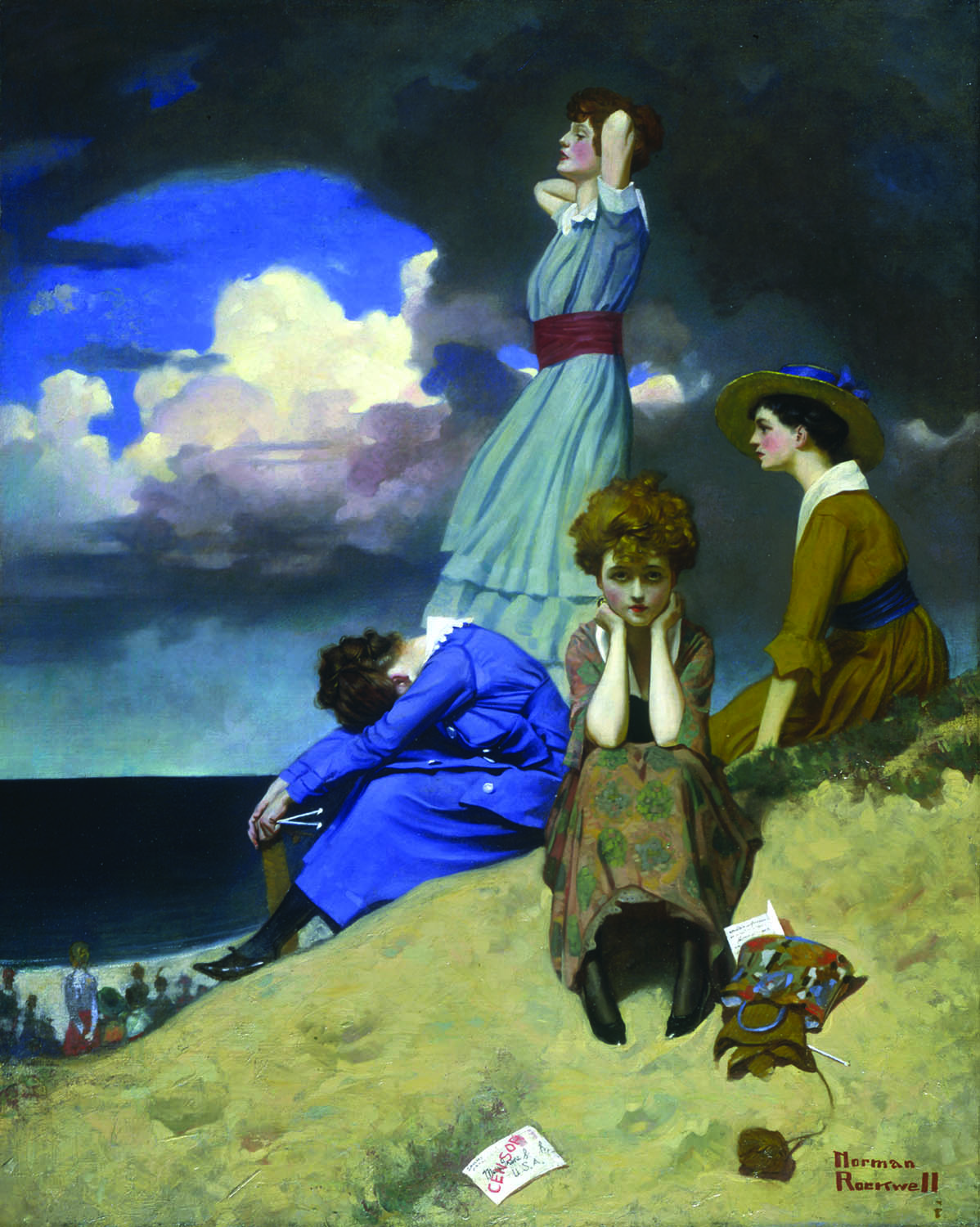
Norman Rockwell (1894-1978)
Till The Boys Come Home
1918, oil on canvas
29 1/2" x 23 1/2", signed lower right
Life Magazine, August 15, 1918 cover
While many artists of World War I focused on scenes of combat and heroism abroad, Rockwell turned his attention to those quietly enduring the war at home. In this poignant composition, four young women sit together, knitting and passing the time, their subdued expressions revealing a shared sense of longing. Though engaged in domestic activity, their thoughts are clearly elsewhere—with the men they love serving overseas.
Rockwell’s genius lies in his attention to intimate, telling details that deepen the emotional resonance of the scene. Most notable is the inclusion of a censored letter from a soldier, placed subtly within the composition—a powerful reminder of the uncertainty and limited communication faced by families during wartime. In honoring these women, Rockwell broadens the narrative of service and sacrifice, giving voice to the emotional toll of war on the home front and elevating those whose contributions were often overlooked.
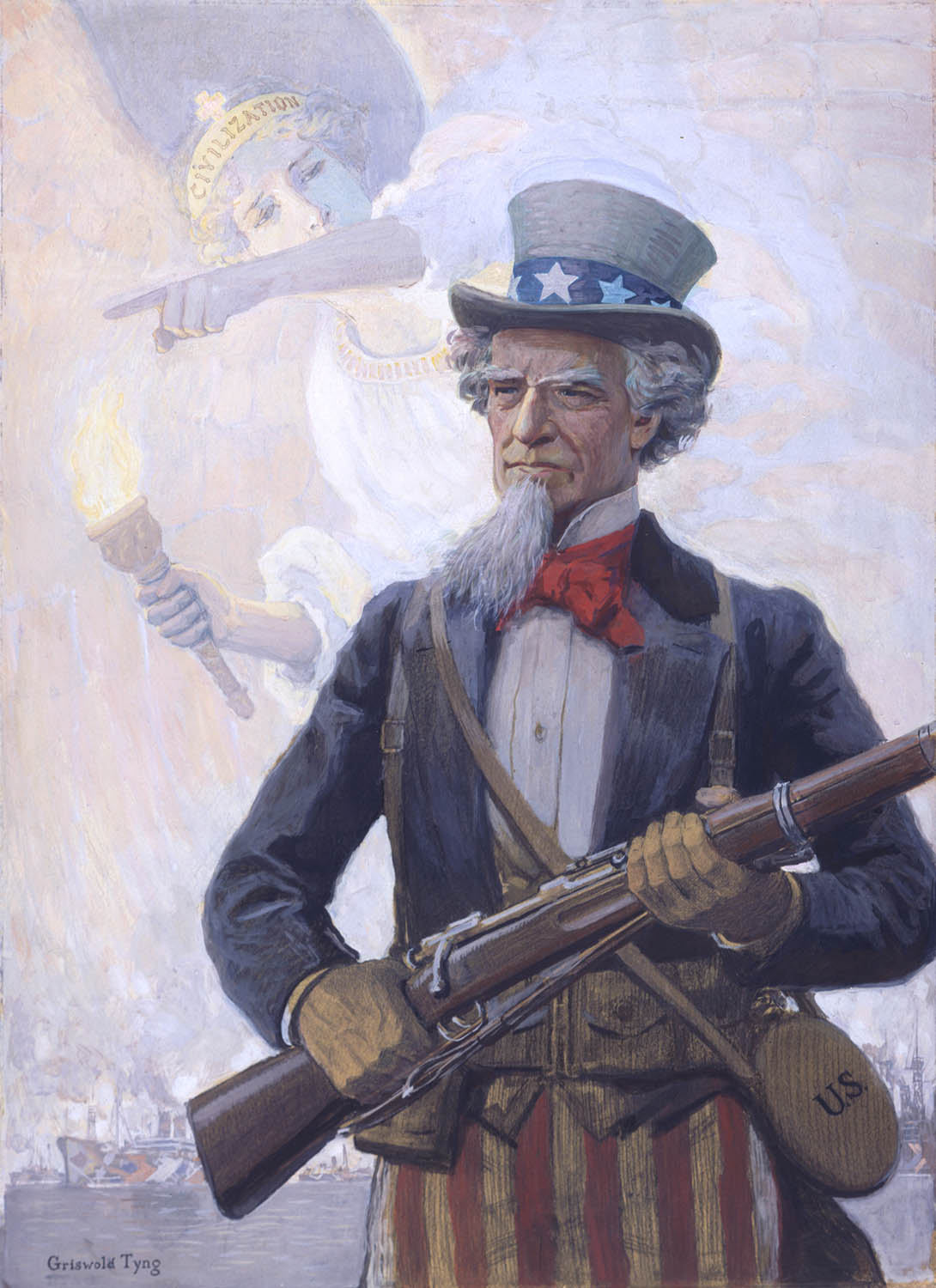
Griswold Tyng (1883-1960)
WWI - Uncle Sam
1918, crayon and gouache on board
38" x 28", signed lower left
In this dynamic wartime image from World War I, Tyng presents a forceful vision of American purpose and progress. Uncle Sam strides forward in his iconic attire, rifle in hand, embodying the nation’s readiness to defend its ideals on the global stage. Beside him, Lady Liberty advances with equal determination, crowned with the word “Civilization” and holding aloft a flame that symbolizes the guiding light of freedom, democracy, and opportunity.
Behind them, ships cut through the water and industrial smokestacks rise into the air, evoking the immense machinery of war and the nation’s industrial strength. These elements reinforce the idea of collective momentum—military, economic, and ideological—propelling the United States forward. Tyng’s composition unites symbolism and action, presenting the war not only as a conflict to be fought, but as a mission to advance the principles America claimed to represent.
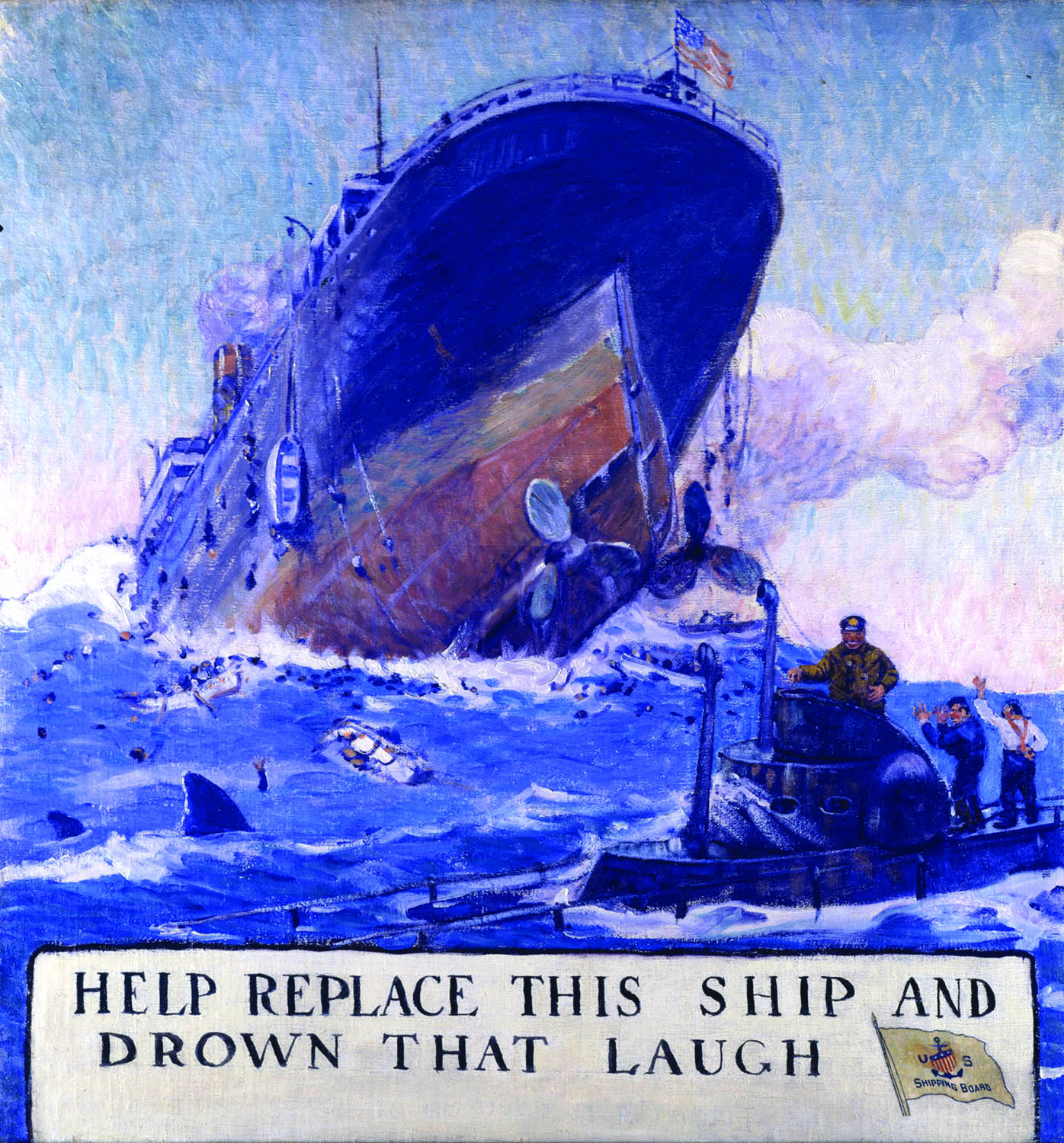
Clifford Ashley (1881-1947)
Sinking of the Lusitania
1918, oil on canvas
38" x 35 1/2"
This harrowing image draws upon one of the most shocking events of World War I—the sinking of the RMS Lusitania on May 7, 1915. Torpedoed without warning by the German U-boat U-20, the disaster claimed nearly 1,200 lives and helped shift public opinion against Germany. Ashley transforms this tragedy into a powerful piece of wartime propaganda, pairing the chilling slogan “Help replace this ship and drown that laugh” with a scene designed to provoke outrage and urgency. The great liner burns as sailors struggle in the open water, clinging to a few scattered rafts while ominous shark fins circle nearby.
In the foreground, the German submarine surfaces with sailors laughing and cheering—a deliberately inflammatory portrayal meant to heighten emotional response and galvanize support for the Allied cause. The composition amplifies both the vulnerability of the victims and the perceived cruelty of the enemy, reinforcing the moral imperative to act. Through vivid imagery and stark contrasts, Ashley’s work exemplifies how illustration was used not only to document events, but to shape public sentiment and rally a nation toward war.
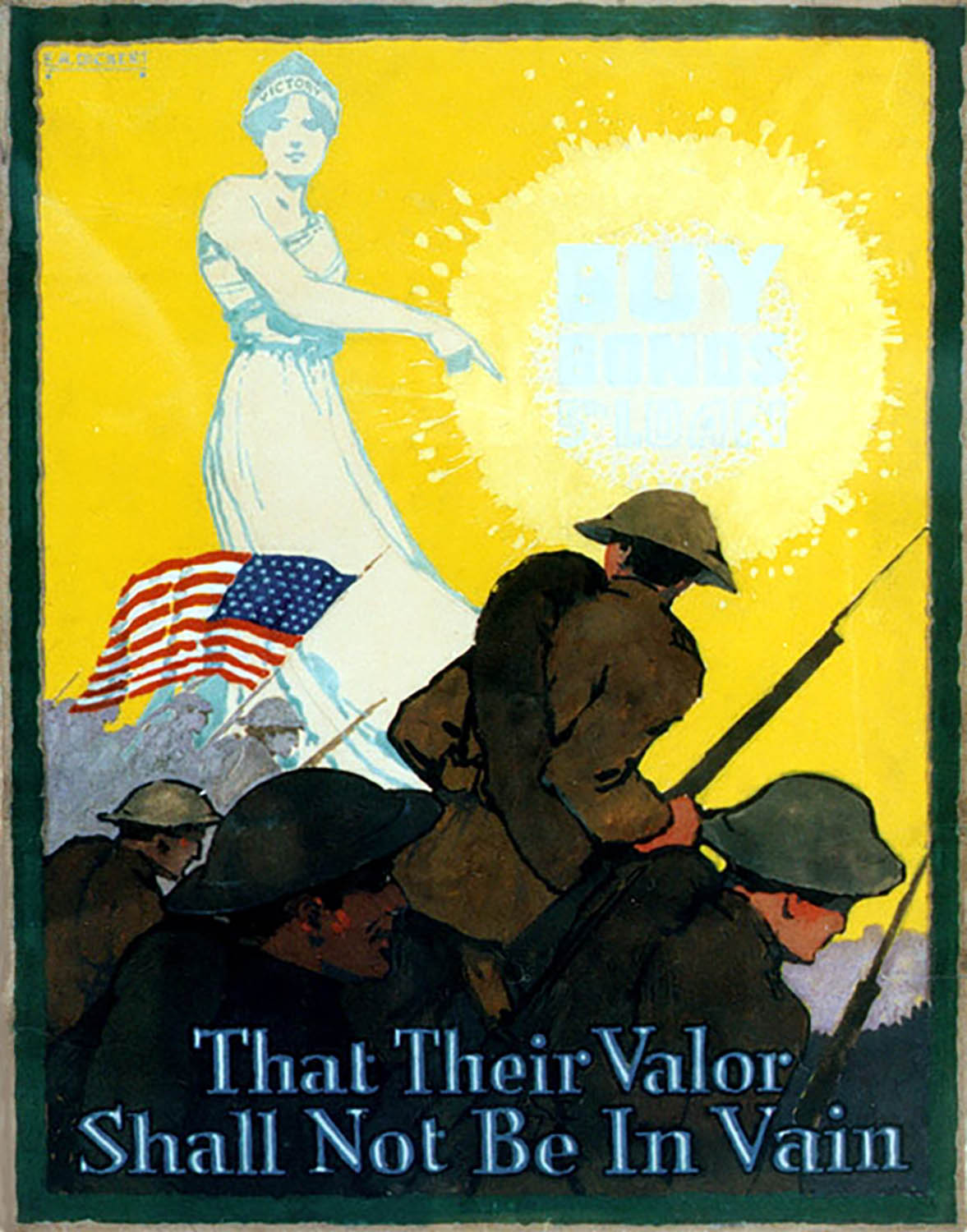
E.A. Dickert
That Their Valor Shall Not Be In Vain
1918, gouache on board
12 1/4" x 9 1/2", signed upper left
Study for WWI poster
In this stirring image from World War I, Dickert invokes the classical figure of Victory to lead American troops forward into battle. Radiant and commanding, she moves ahead of the soldiers as both guide and symbol, embodying the ideals for which they fight. Her presence elevates the scene beyond a depiction of war, framing the conflict as a noble and purposeful struggle driven by sacrifice and resolve.
Set within the sun are the words “Buy Bonds,” a powerful reminder that the responsibility for victory extended beyond the battlefield. As soldiers advanced overseas, civilians at home were called upon to support the war effort financially through the purchase of war bonds. Dickert’s composition unites these two fronts—military and civilian—into a single vision of shared duty, reinforcing the idea that only through collective commitment could the sacrifices of those who served truly be honored.
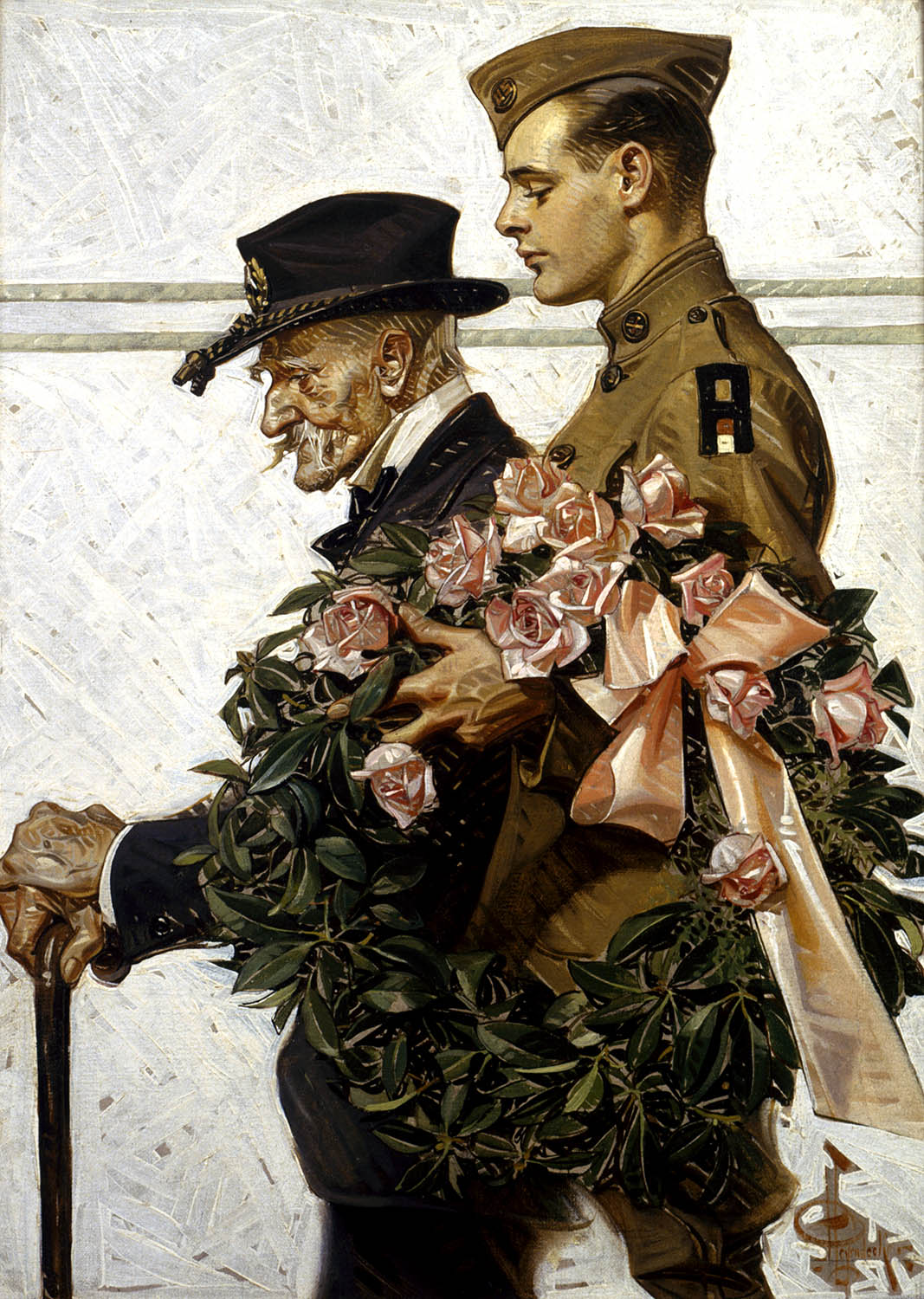
J.C. Leyendecker (1874-1951)
The War Veteran (Memorial Day)
1919, oil on canvas
25" x 18 3/4", signed lower right
Saturday Evening Post, May 31, 1919 cover
Created as the Memorial Day weekend cover for The Saturday Evening Post in 1919, this poignant image reflects on the continuity of sacrifice across generations of American soldiers. Leyendecker pairs an elderly veteran of a past conflict—distinguished by his insignia—with a younger soldier returning from World War I. Carrying a large wreath, a solemn symbol of remembrance, they stand united in honoring those who gave their lives in service to the nation.
The composition quietly bridges past and present, emphasizing that the cost of war is not confined to a single moment in history but endures across time. By placing these two figures side by side, Leyendecker underscores a shared legacy of duty, loss, and reverence. The image transforms Memorial Day from a singular act of remembrance into an ongoing tradition—one in which each generation inherits the responsibility to honor those who came before.
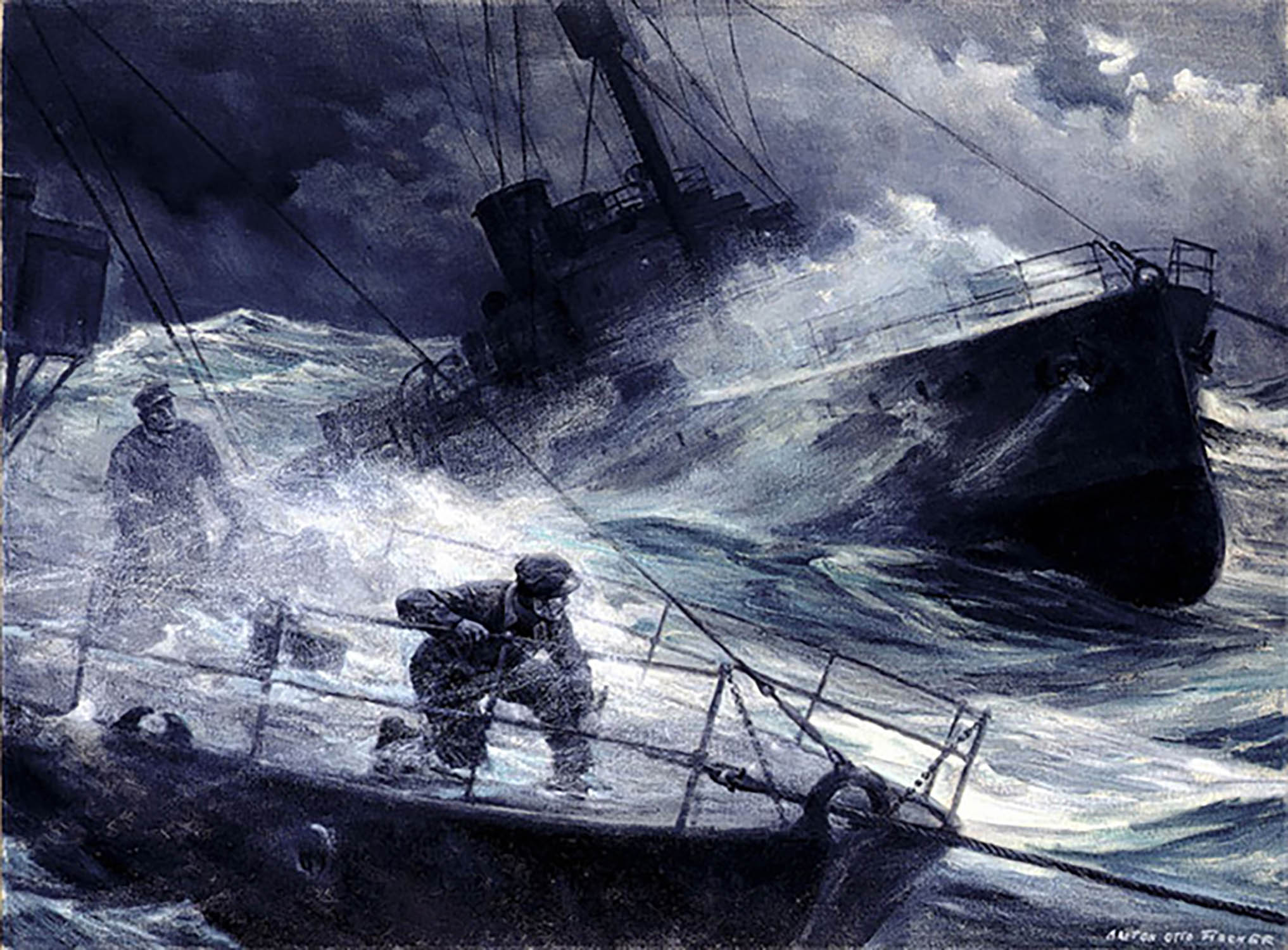
Anton Otto Fischer (1882-1962)
Wartime Encounter
c. 1940, oil on canvas
24" x 32", signed lower right
In Wartime Encounter, Fischer captures the drama and danger of naval conflict with a commanding sense of motion and atmosphere. Two ships emerge amid a turbulent sea, their forms partially obscured by crashing waves and heavy skies, suggesting both confrontation and uncertainty. Though spare in narrative detail, the scene conveys the tension of wartime navigation, where visibility, weather, and the ever-present threat of enemy contact shaped life at sea during World War II.
Fischer was one of the foremost maritime illustrators of the 20th century, celebrated for his ability to render the sea as both a physical force and an emotional presence. Having spent time as a sailor himself, he brought authenticity and authority to his work, depicting ships not as static objects but as living forms in constant dialogue with wind and water. His illustrations—frequently published in magazines such as The Saturday Evening Post and Harper’s—helped shape the public’s visual understanding of naval life and warfare. In works like this, Fischer elevates maritime illustration beyond documentation, transforming it into a powerful expression of endurance, isolation, and the vast scale of war at sea.
Norman Rockwell (1894-1978)
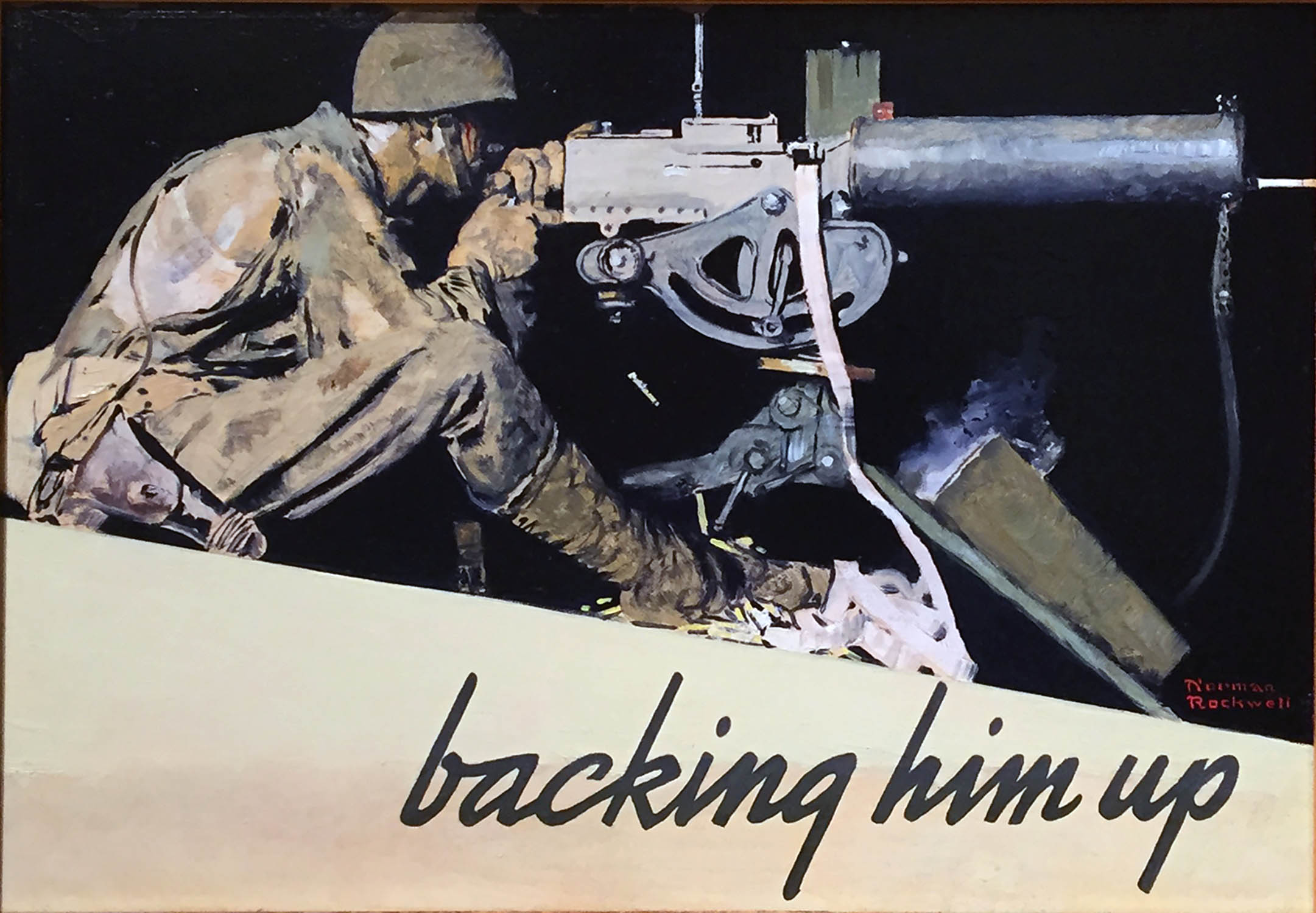
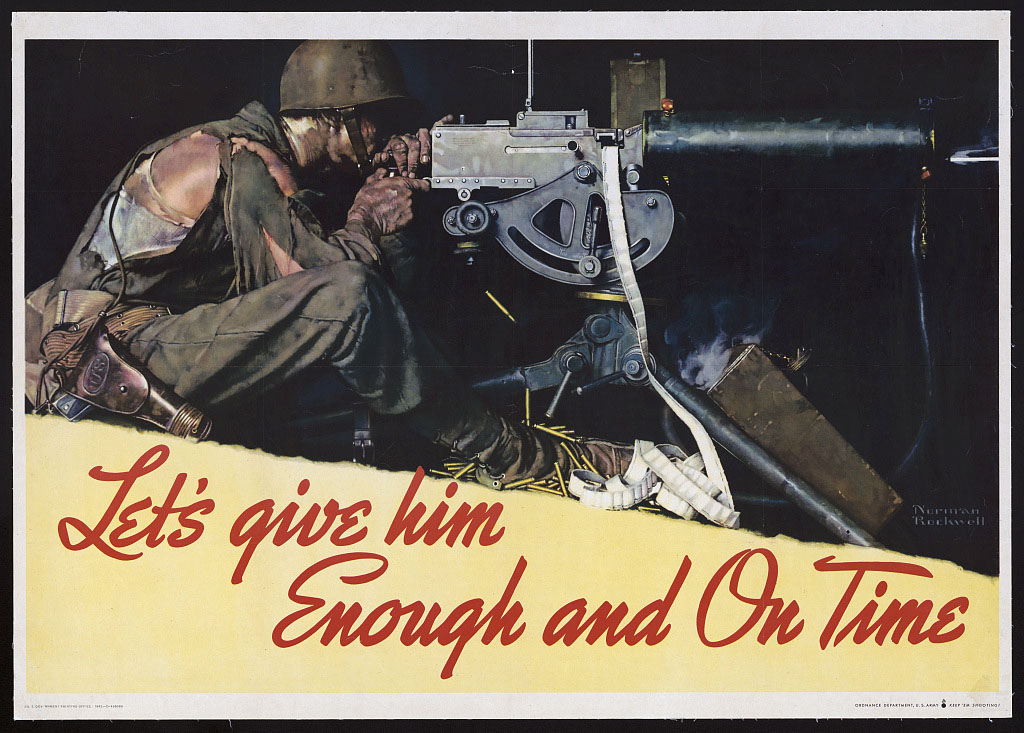
Let's Give Him Enough And On Time - Study
1942, oil on board
10" x 17", signed lower left
Study for United States Army Poster, 1942
Created during World War II, this study reveals the extraordinary care and precision behind Rockwell’s wartime imagery. Commissioned for a United States Army poster, the composition centers on a machine gunner locked in intense concentration, his tattered shirt and forward-leaning posture conveying both urgency and endurance. Spent bullet shells cascade from the smoking weapon, while every element—from the machinery itself to the soldier’s expression—has been rendered with striking accuracy.
Rockwell achieved this level of realism through a meticulous process. For this work, Colonel Fairfax Ayers, a retired Army officer and neighbor, arranged for a full gun crew and machine gun to be brought into the artist’s studio. Rockwell staged the scene with carefully selected models and props, photographing the arrangement before translating it into paint. This method allowed him to capture authentic detail while maintaining compositional control, resulting in an image that is both documentary in its precision and powerful in its emotional impact—reinforcing the urgent wartime message to support American troops with the resources they needed, when they needed them.
John Falter (1910-1982)
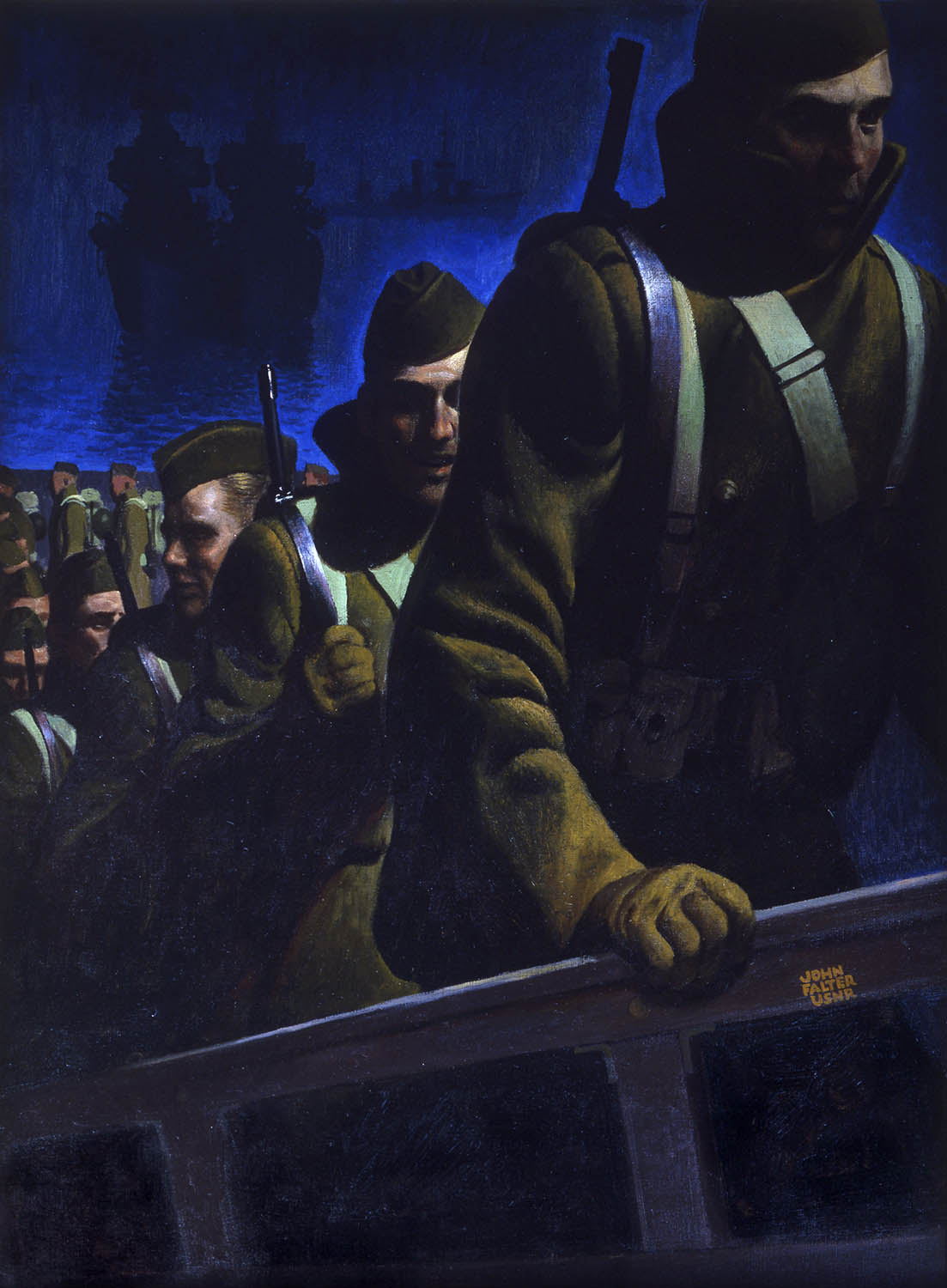
Put Them Across! The Toughest Job Is Still Ahead!
1943, oil on canvas
32" x 25", signed lower right
Official Navy Poster, U.S. Government Printing Office, 1943
Created during World War II, this powerful U.S. Navy poster exemplifies the urgent call to action directed at Americans on the home front. Printed alongside a message from Ernest J. King, Commander in Chief of the United States Fleet and Chief of Naval Operations, Falter’s image captures a moment of quiet intensity before the storm of battle. Soldiers move up a gangway under the cover of night, their figures silhouetted and illuminated only by the glow of the ship ahead—an atmosphere that conveys both determination and the unknown dangers that await them.
The accompanying message—“Put them across with ships, planes and guns… Stay on the job and deliver the goods—Gangway for Victory”—transforms the scene into a direct appeal to civilians. Falter’s composition reinforces the idea that victory depended not only on those boarding ships for combat, but on the relentless efforts of those supporting them from afar. The phrase “Gangway for Victory” became a rallying cry, urging Americans to clear the path for success by ensuring that troops were fully equipped and swiftly delivered to the front lines.
Harold Von Schmidt (1893-1982)
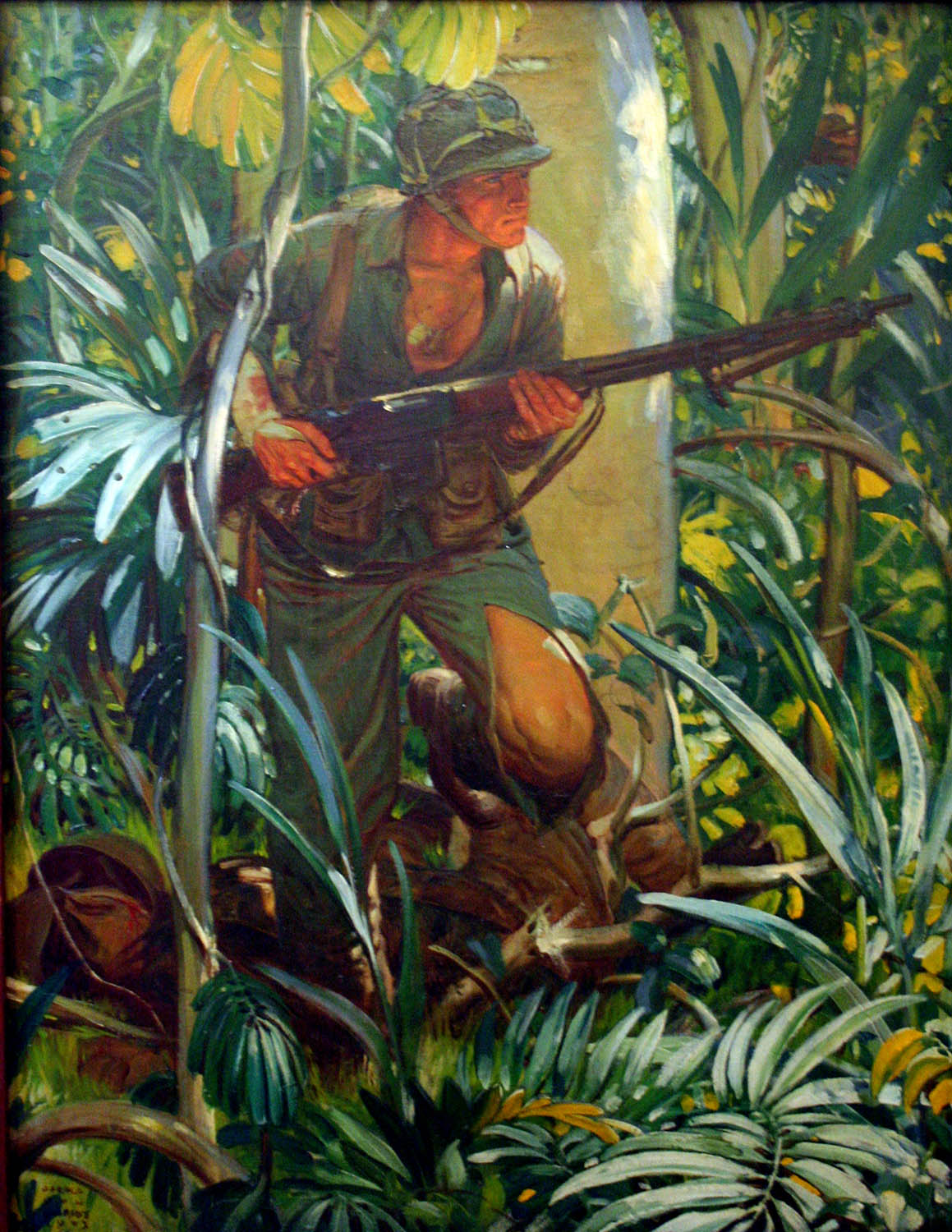
Soldier in Jungle
1943, oil on canvas
40" x 30", signed and dated lower left
Painted during World War II, this striking image shifts the focus from the more familiar European front to the dense, unforgiving terrain of the South Pacific. A lone soldier moves cautiously through thick jungle growth, his figure partially obscured by foliage, emphasizing both the physical and psychological challenges of this theater of war. The environment itself becomes an adversary—humid, claustrophobic, and unpredictable—capturing a side of the conflict that was often less visible in mainstream wartime imagery.
Von Schmidt’s composition highlights the isolation and intensity faced by soldiers fighting in remote regions far from home. By bringing attention to this overlooked front, the work broadens the narrative of World War II, reminding viewers that the war was fought across vastly different landscapes, each with its own hardships and demands. It stands as a tribute to those who served in conditions that were as dangerous as they were underrepresented in the public imagination.
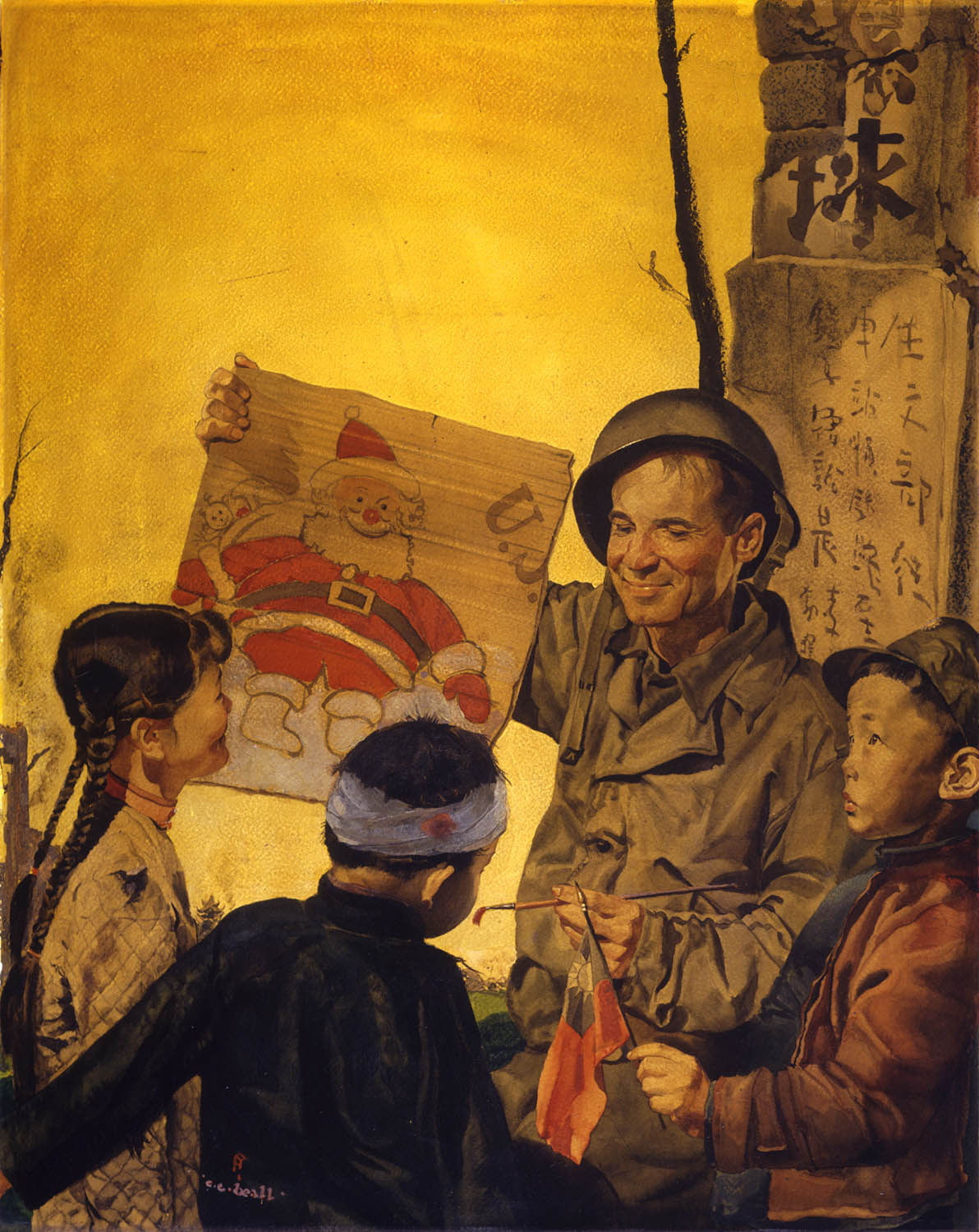
Cecil Calvert Beall (1892-1967)
G.I. Showing Portrait of Santa to Taiwanese Children
1944, watercolor
25 1/2" x 20 1/2", signed lower left
Collier's, December 30, 1944 cover
Created during World War II, this deeply human image presents a different vision of the American soldier—one defined not by combat, but by compassion. A U.S. serviceman kneels beside three children, gently sharing a portrait of Santa Claus. Among them, one child bears a head bandage, a quiet but powerful reminder of the war’s toll on civilians, while another holds the flag of the Republic of China (also known as Taiwan). Together, these details situate the scene within the broader global conflict while emphasizing its personal, emotional dimension.
Beall’s illustration reflects a carefully shaped narrative of American presence overseas, portraying soldiers as protectors and bearers of hope in war-torn regions. The act of introducing Santa Claus—an emblem of comfort, generosity, and childhood innocence—suggests the restoration of normalcy and humanity amid chaos. In doing so, the image reinforces the idea that American forces not only fought for victory, but also for the preservation and spread of ideals rooted in kindness, stability, and goodwill.
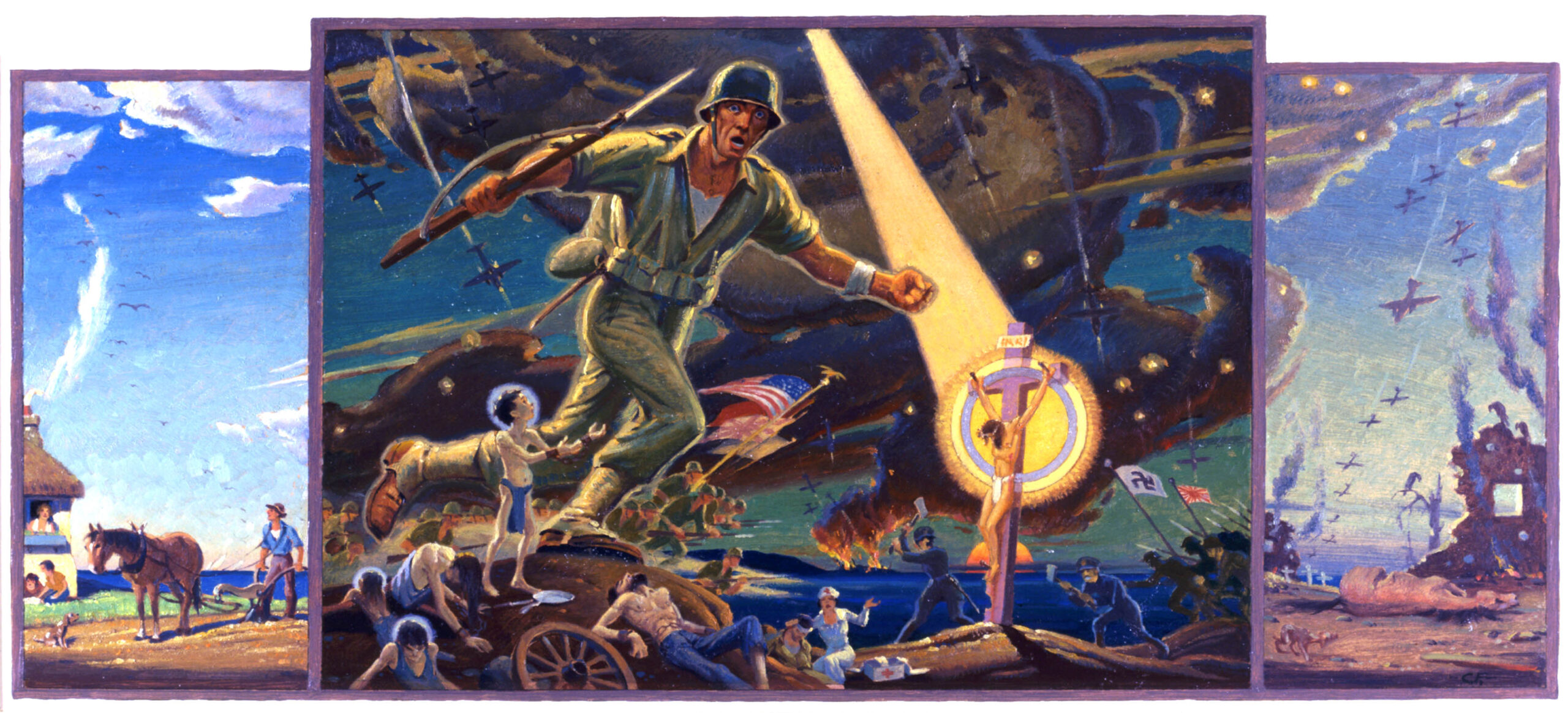
Victor Cylde Forsythe (1885-1962)
WWII Poster Art
c. 1944, oil on paper
12 1/2" x 28", initialed lower right
This powerful triptych by Victor Clyde Forsythe presents a sweeping narrative of war through three interconnected scenes, each representing a distinct moment in time. On the left, a farmer works his land in peace, embodying stability, productivity, and the quiet rhythms of everyday life before conflict. At the center, that same world is shattered by the violence of World War II, as chaos and destruction overtake the landscape. On the right, the aftermath reveals a devastated terrain—fields ruined, structures broken, and the human cost made painfully clear.
Forsythe’s composition uses this visual progression to underscore the full arc of war’s impact, from harmony to upheaval to ruin. By anchoring the narrative in the figure of the farmer, he emphasizes what is truly at stake: not abstract territory, but the lives and livelihoods of ordinary people. The triptych format reinforces this message with cinematic clarity, compelling viewers to confront both the immediacy of wartime suffering and its lasting consequences.
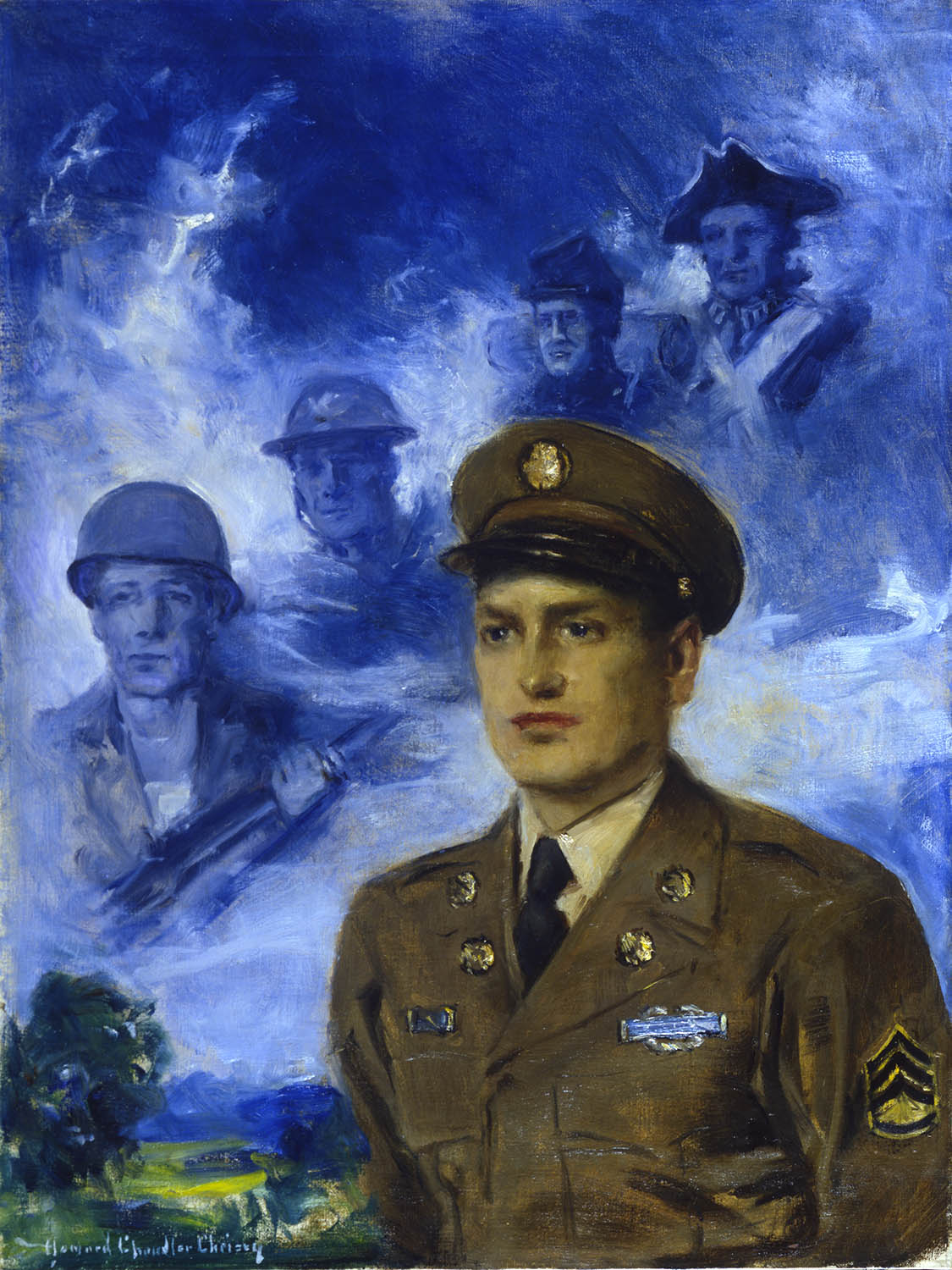
Howard Chandler Christy (1873-1952)
Freedom Is Your Business
c. 1950, oil on canvas
36" x 27", signed lower left
U.S. Army recruitment poster, 1950
Created in the early years of the Cold War, this U.S. Army recruitment poster reflects a shift from the immediacy of World War II to a broader, more enduring call to service. A modern American soldier stands firmly in the foreground, embodying readiness and resolve, while above him, emerging in the sky, are ghostlike figures representing generations of soldiers who came before—an unbroken lineage of sacrifice in defense of the nation and its ideals.
Christy’s composition powerfully connects past and present, suggesting that the responsibility to defend freedom is inherited as much as it is chosen. By placing the legacy of earlier soldiers literally over the shoulder of the present-day serviceman, the image reinforces the idea that history is always watching, and that each generation must rise to meet its moment. As the final work in the exhibition, it serves as a fitting conclusion—reminding viewers that the story of service and sacrifice is ongoing, carried forward by those who answer the call.