

As part of the National Museum of American Illustration’s year-long celebration of the United States’ Semiquincentennial, An American Summer explores the joys, freedoms, and rituals of the American summer through the Golden Age of Illustration. From crowded beaches and backyard baseball games to lazy afternoons, fishing trips, tennis matches, road trips, and glowing summer nights, these images capture the warmth and optimism that have long defined the season in the American imagination.
Featuring works by J.C. Leyendecker, Norman Rockwell, Jessie Willcox Smith, Maxfield Parrish, N.C. Wyeth, Howard Chandler Christy, and many others, the exhibition highlights how illustrators transformed everyday moments into enduring symbols of leisure, family, romance, and adventure. Published originally as magazine covers, advertisements, and book illustrations, the images in An American Summer reveal how illustration shaped the nation’s collective memory of the season for generations of readers. Together, they offer a vibrant portrait of summer as both a personal memory and a cultural ideal.
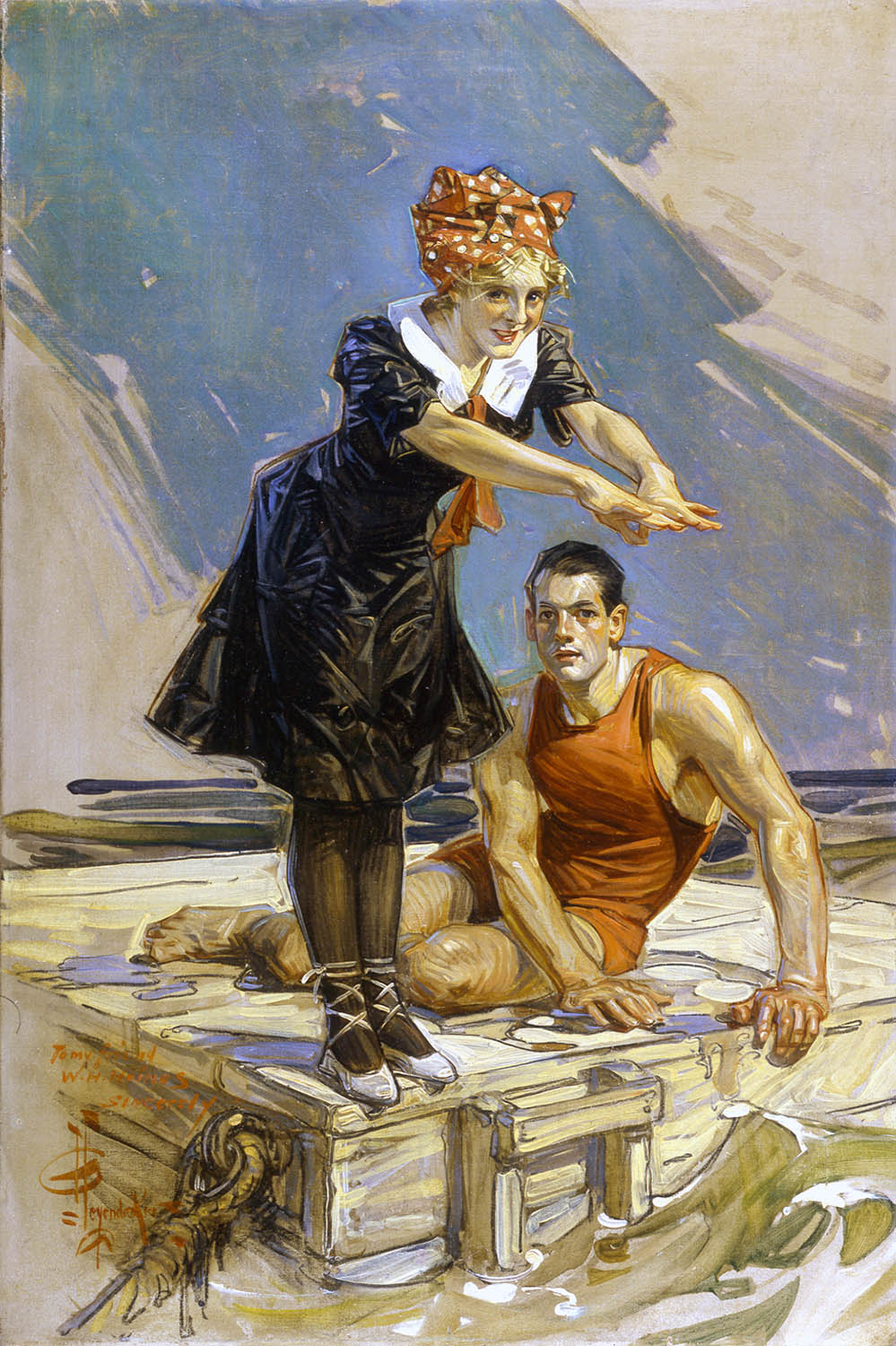
J.C. Leyendecker (1874-1951)
Couple on Raft
1909, oil on canvas
30" x 20", signed lower left
Popular Magazine, August 1909 cover
J. C. Leyendecker’s Couple on Raft, created for the August 1909 cover of Popular Magazine, is a striking example of the artist’s early magazine illustration work. The composition already displays many of the qualities that would define Leyendecker’s mature style—bold brushwork, sculptural modeling, and a dynamic sense of movement and design. The figures are arranged with remarkable elegance and drama, transforming a simple summer outing into a sophisticated and highly stylized image.
The painting also offers a fascinating glimpse into early twentieth-century leisure and fashion. The bathing suits, with their modest cuts and heavy fabrics, reflect the social conventions of the era while emphasizing how dramatically beachwear and recreation would evolve over the coming decades. Even in this early work, Leyendecker elevates contemporary life into an idealized vision of American summertime, blending romance, modernity, and design into one unforgettable image.
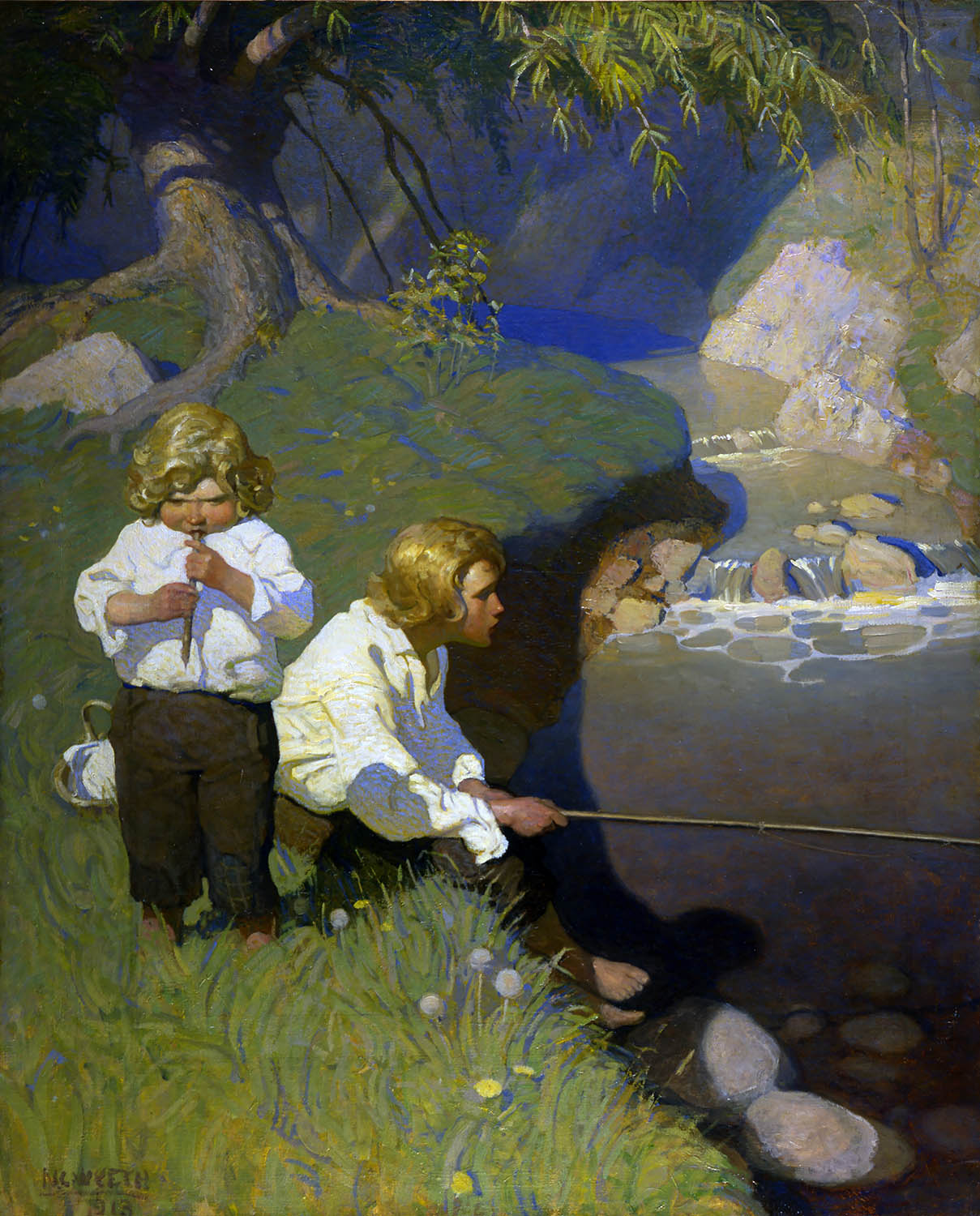
N.C. Wyeth (1882-1945)
He Never Caught a Thing and Ruined Jon's Reputation as a Fisherman (Along the Brandywine)
1913, oil on canvas
47" x 38", signed and dated lower left
War, or What Happens When One Loves One's Enemy, by John Luther Long, 1913, frontispiece
N. C. Wyeth’s He Never Caught a Thing and Ruined Jon’s Reputation as a Fisherman (Along the Brandywine) was created as the frontispiece for John Luther Long’s War, or What Happens When One Loves One’s Enemy in 1913. Set along the Brandywine River landscape so closely associated with Wyeth and his family, the painting captures a playful and deeply human moment of summertime recreation. Rather than focusing on heroic adventure, Wyeth presents an intimate scene filled with humor and personality, demonstrating his remarkable ability to bring narrative storytelling to everyday life.
The composition reveals Wyeth’s mastery of atmosphere and natural light. Dappled sunlight filters through the trees while the figures interact along the riverbank, creating a sense of warmth, movement, and immediacy. Although celebrated for his dramatic historical and adventure illustrations, works such as this show Wyeth’s equal talent for quieter moments of observation and character. The painting reflects an idealized vision of the American outdoors—where fishing trips, family stories, and summer afternoons become part of a larger national mythology shaped through illustration.
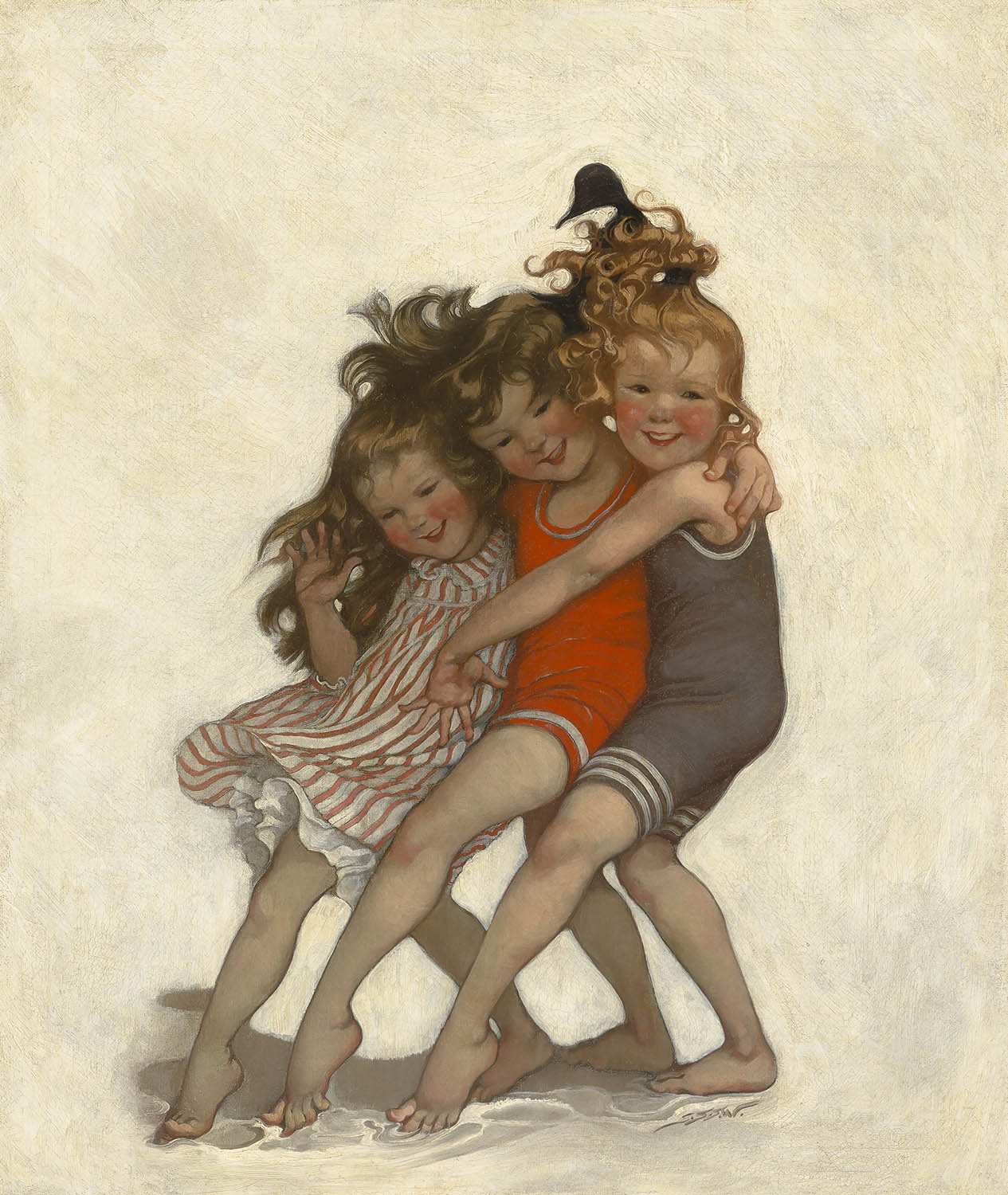
Sarah Stilwell Weber (1878-1939)
Three of Us
1917, oil on canvas
32" x 27", signed bottom center right
Saturday Evening Post, August 25, 1917 cover
Sarah Stilwell Weber’s Three of Us, created for the August 25, 1917 cover of The Saturday Evening Post, is a tender and deeply affectionate portrayal of childhood and companionship. Weber captures three children locked together in an embrace, their intertwined figures forming a unified composition that radiates warmth, trust, and innocence. The painting reflects the artist’s remarkable sensitivity to the emotional world of children, a quality that made her one of the most admired illustrators of her generation.
Painted during the years of the First World War, the image also carries a quiet sense of comfort and reassurance. While much of the world beyond the magazine cover was marked by uncertainty, Weber offered readers an idealized vision of familial love and youthful joy. Her soft modeling, delicate palette, and graceful draftsmanship lend the scene an almost timeless quality, transforming an everyday childhood moment into a universal image of closeness and summer happiness.
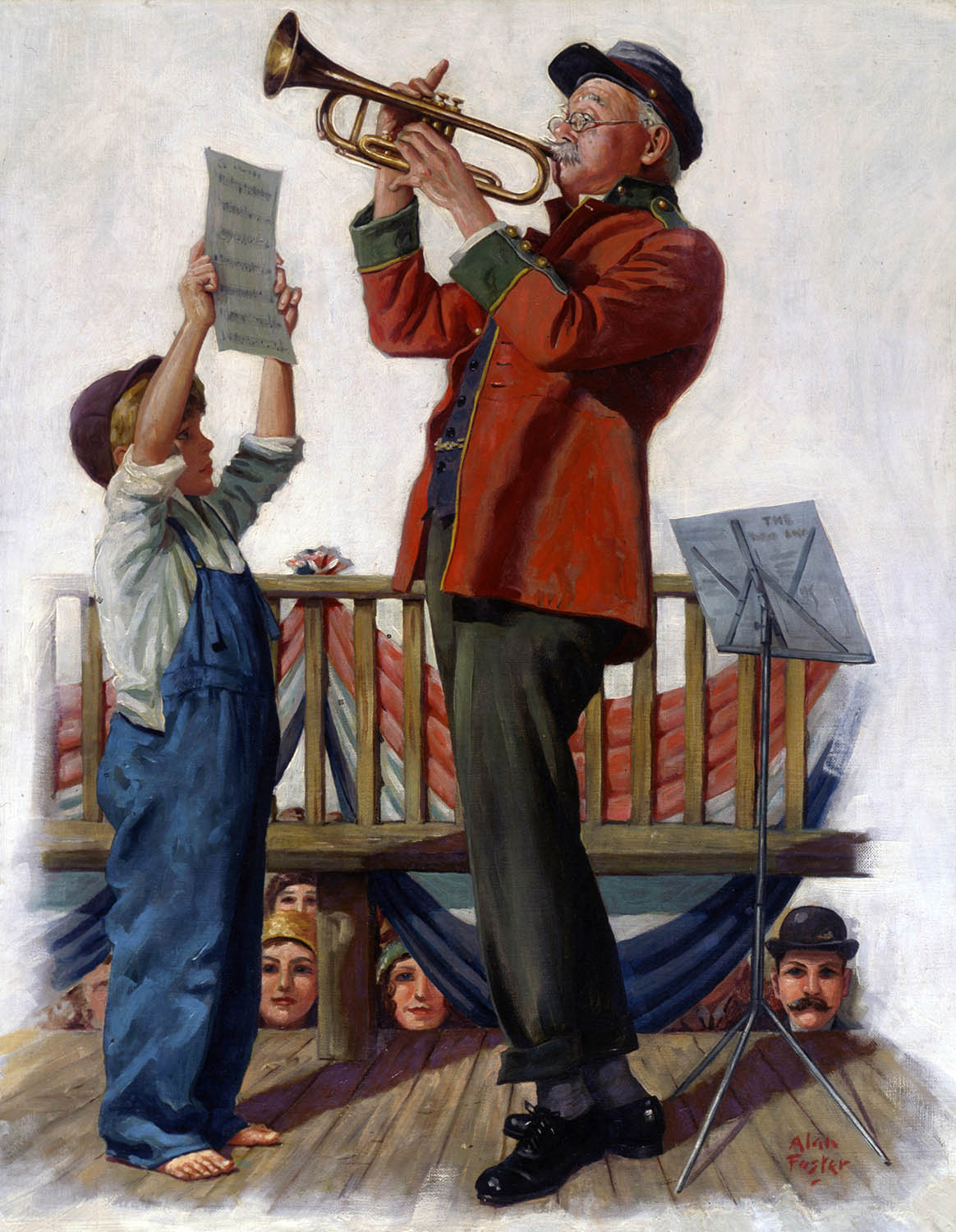
Alan Stephens Foster (1892-1969)
Memorial Day Celebration
c. 1920, oil on canvas
23" x 19", signed lower right
Alan Stephens Foster’s Memorial Day Celebration humorously captures the spirited charm of a small-town American Memorial Day celebration, a tradition that long marked the unofficial beginning of summer. At the center of the composition, Foster depicts an enthusiastic local bandleader proudly playing his trumpet, while the surrounding details emphasize the lighthearted energy and communal excitement of the occasion. The scene celebrates not only patriotism, but also the American rituals of gathering together for parades, festivities, and outdoor celebrations as the warm weather arrives.
Foster’s illustration reflects the nostalgic ideal of small-town America so often celebrated in early twentieth-century illustration. His lively characters, expressive gestures, and playful sense of storytelling transform an ordinary community event into a vivid and relatable summer memory. Works such as this demonstrate how illustrators preserved the humor, traditions, and everyday experiences that shaped American life, creating images that continue to evoke the warmth and optimism of summertime generations later.
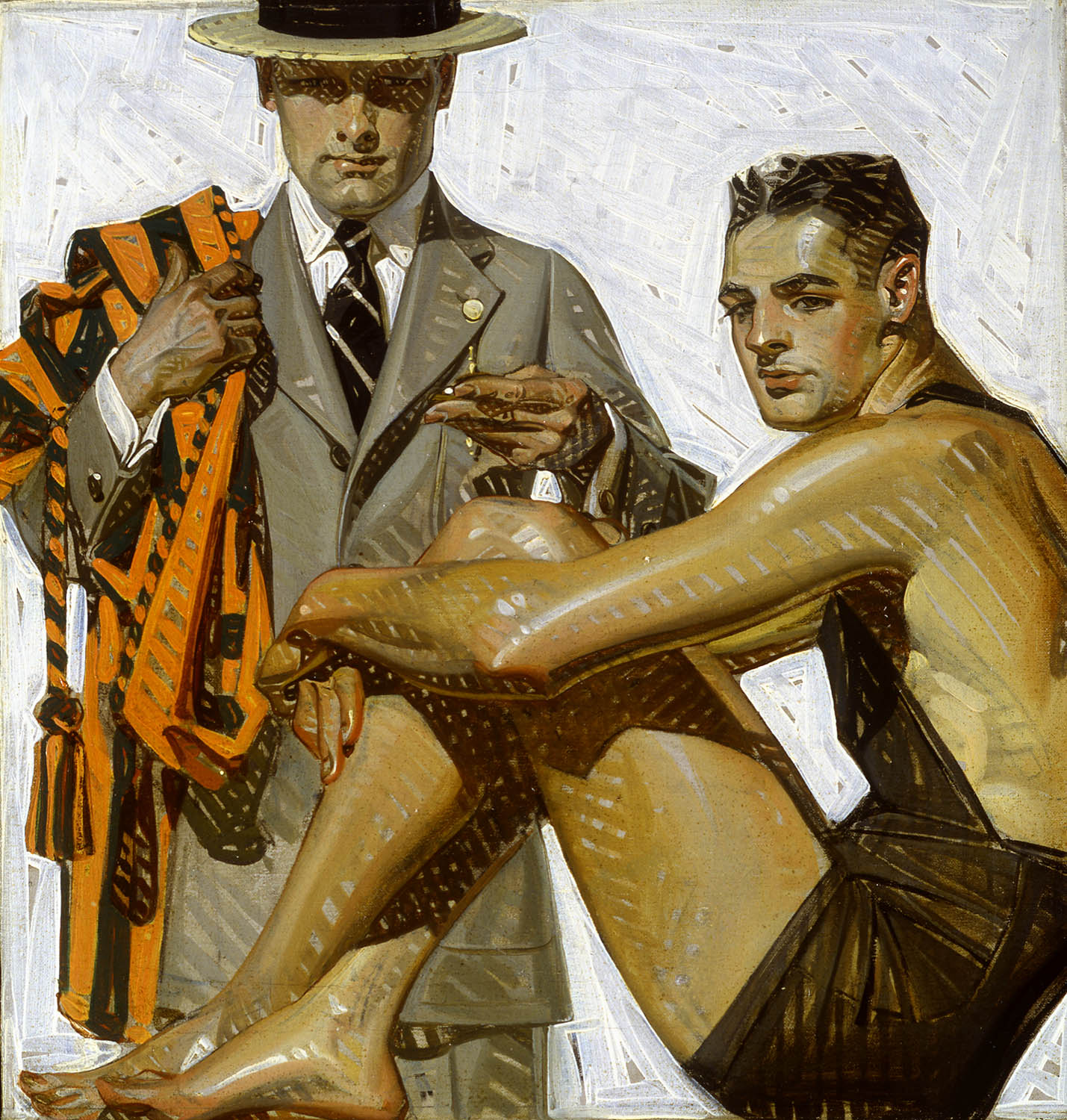
J.C. Leyendecker (1874-1951)
Record Time, Cool Summer Comfort
c. 1920, oil on canvas
21 1/2" x 20"
House of Kuppenheimer advertisement
J. C. Leyendecker’s Record Time, Cool Summer Comfort, created as an advertisement for the House of Kuppenheimer, perfectly demonstrates why the artist became one of the most influential illustrators of men’s fashion in the early twentieth century. Leyendecker transformed commercial advertising into sophisticated works of art, helping define ideals of modern masculinity, elegance, and athleticism for an entire generation. In this advertisement, the impeccably dressed standing figure—holding a stopwatch while observing the swimmer in the pool—showcases the fashionable summer suit being promoted by Kuppenheimer.
Equally compelling is the seated gentleman bather at the edge of the pool. His relaxed yet highly stylized pose creates a strikingly dynamic composition, revealing Leyendecker’s extraordinary sense of design and anatomy. The contrast between the crisp tailoring of the suited figure and the athletic ease of the swimmer captures the modern leisure culture emerging in America during the 1920s. Through bold brushwork, sculptural forms, and carefully orchestrated movement, Leyendecker elevates a simple clothing advertisement into an image of sophistication, summertime luxury, and effortless style.
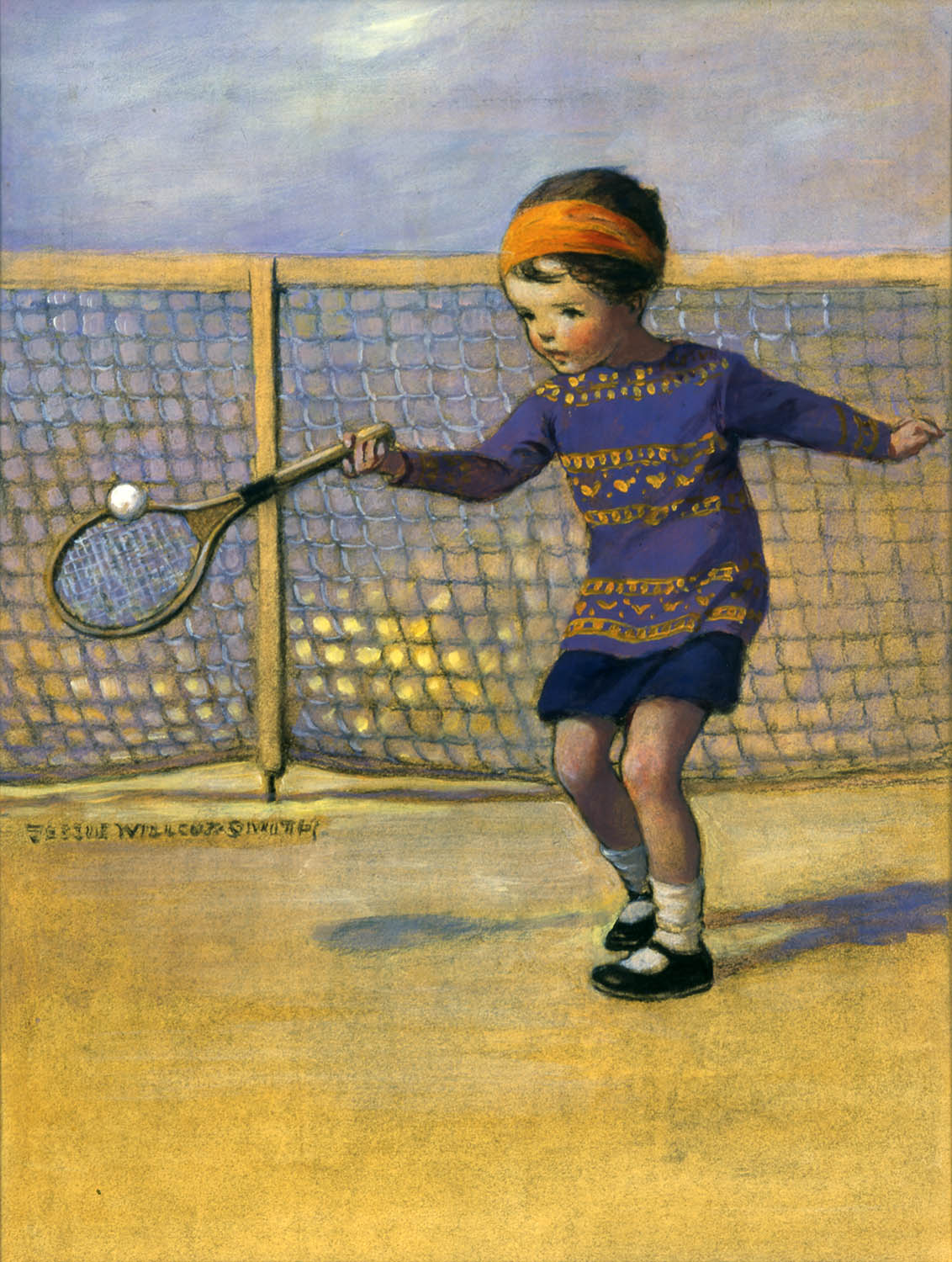
Jessie Willcox Smith (1863-1935)
Young Tennis Player
1929, oil, mixed media, and charcoal on board
22" x 16 1/4", signed center left
Good Housekeeping, September 1929 cover
Jessie Willcox Smith’s Young Tennis Player, created for the September 1929 cover of Good Housekeeping, beautifully captures the innocence, charm, and gentle optimism that made Smith one of America’s most beloved illustrators. The young girl, poised with racket in hand and dressed in fashionable tennis attire, reflects the growing popularity of recreation and organized sports for children during the early twentieth century. Smith transforms a simple childhood moment into an image of grace and youthful confidence, embodying the wholesome ideals so closely associated with her work.
From 1918 through 1932, Smith illustrated covers exclusively for Good Housekeeping magazine, and her images became deeply woven into American visual culture. Reproduced in magazines that reached households across the country, her illustrations influenced the appearance and atmosphere of American nurseries, family rooms, elementary schools, and playgrounds. Smith’s tender depictions of children helped shape an idealized vision of childhood for generations, emphasizing innocence, imagination, health, and emotional warmth. In Young Tennis Player, those qualities are perfectly paired with the carefree spirit of summer recreation.
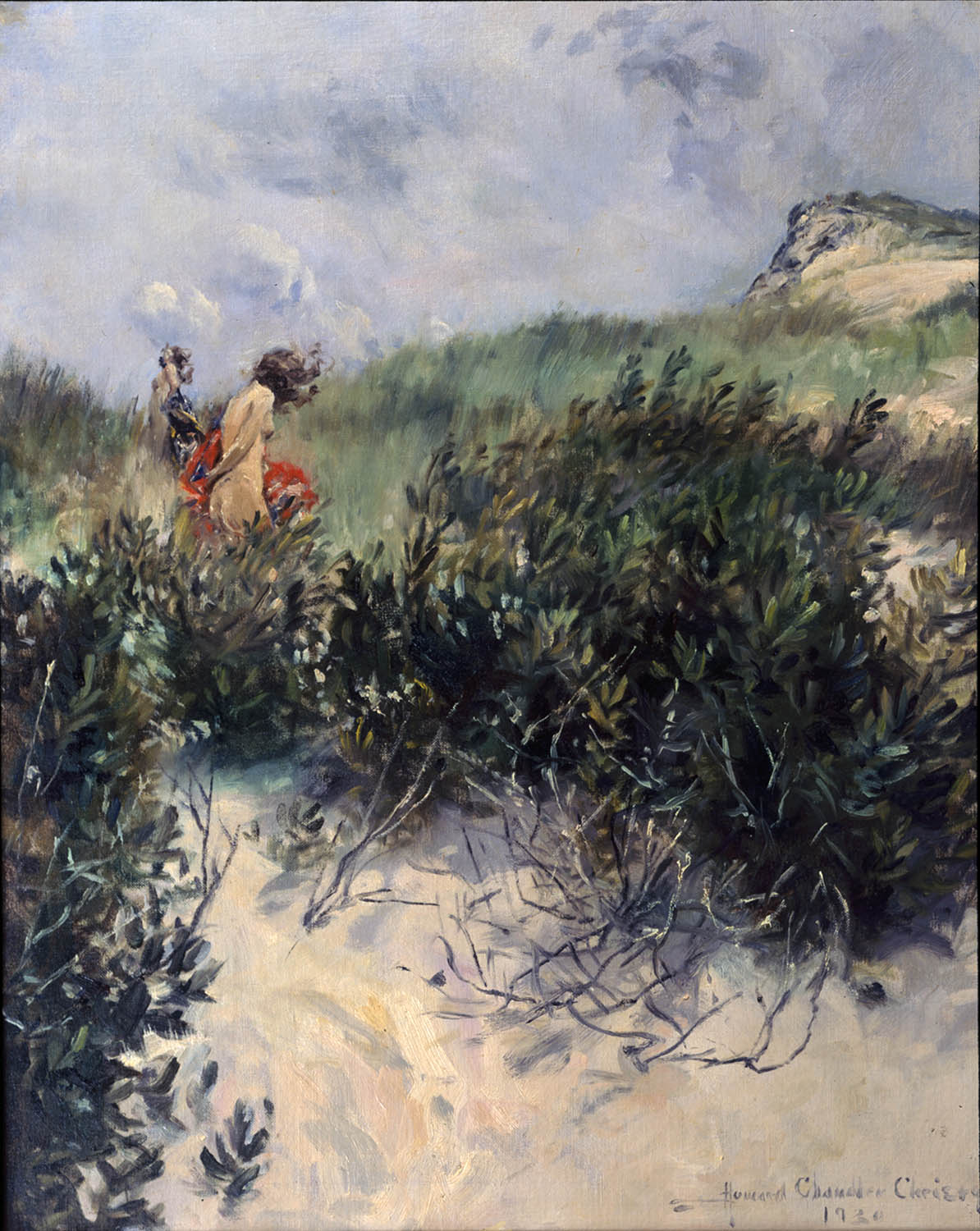
Howard Chandler Christy (1872-1952)
Nudes in Dunes
1930, oil on canvas
30" x 24", signed and dated lower right
Howard Chandler Christy’s Nudes in Dunes is a magnificent example of the artist’s later career, when he turned increasingly toward elegant easel paintings celebrating the female form. By the 1930s, Christy had already become one of the most famous illustrators in America through his iconic “Christy Girl,” a figure that came to define the idealized American woman of the early twentieth century. As one contemporary writer described her, the Christy Girl was “high bred, aristocratic and dainty though not always silken-skirted; a woman with tremendous self respect.” Christy created images of beauty, sophistication, and confidence that captivated the American public and established a powerful cultural ideal that shaped American standards of glamour and elegance for decades thereafter.
In Nudes in Dunes, Christy brings that same sense of beauty and refinement into the realm of fine art. The painting reflects his extraordinary command of the female figure, as well as his ability to blend sensuality with sophistication. Set against softly rendered dunes and open sky, the nude forms appear both monumental and graceful, bathed in warm natural light. The work captures the freedom and escapism associated with the seaside while demonstrating Christy’s mastery as a painter beyond the printed page.
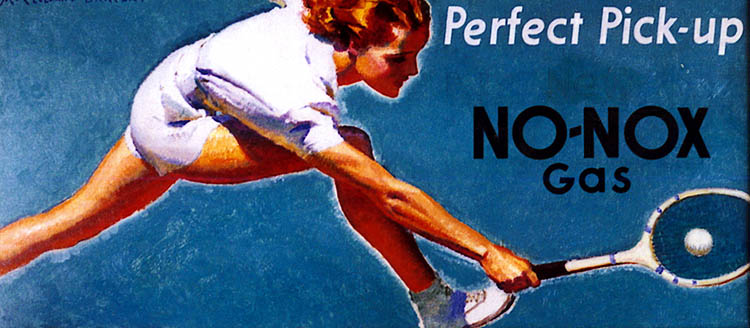
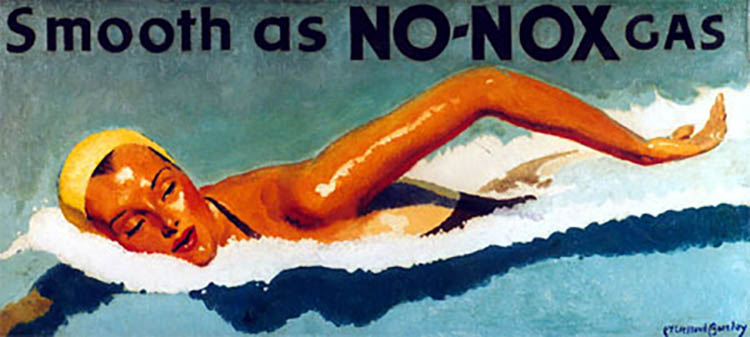
McClelland Barclay (1891-1943)
Young Woman Playing Tennis and Swimming
c. 1930, oil on canvas
Tennis: 20" x 30", signed upper left
Swimming: 22" x 38 1/2", signed lower right
Advertisements for Gulf Oil "No-Nox Gas"
McClelland Barclay’s Woman Playing Tennis and Woman Swimming, both created as advertisements for Gulf Oil’s “No-Nox Gas” campaign, perfectly capture the sleek modernity and glamour associated with American advertising during the 1930s. Barclay was celebrated for his ability to combine athleticism, elegance, and idealized beauty, and these paintings reflect the growing fascination with leisure culture, health, and outdoor recreation during the interwar years. The stylish female figures embody the confident, fashionable spirit of the modern American woman, while the vibrant summer settings reinforce the sense of energy and freedom associated with automobile travel and vacation culture.
The unusually wide horizontal format of the paintings suggests they were likely intended for billboard advertising, allowing the images to command attention on highways and city streets alike. Barclay’s dramatic compositions and polished realism were perfectly suited for large-scale commercial display, transforming advertisements into works of striking visual sophistication. By linking Gulf Oil’s “No-Nox Gas” with scenes of tennis, swimming, and summertime recreation, the campaign associated the automobile with speed, modern living, and carefree summer adventure—an increasingly important part of the American dream during the early twentieth century.
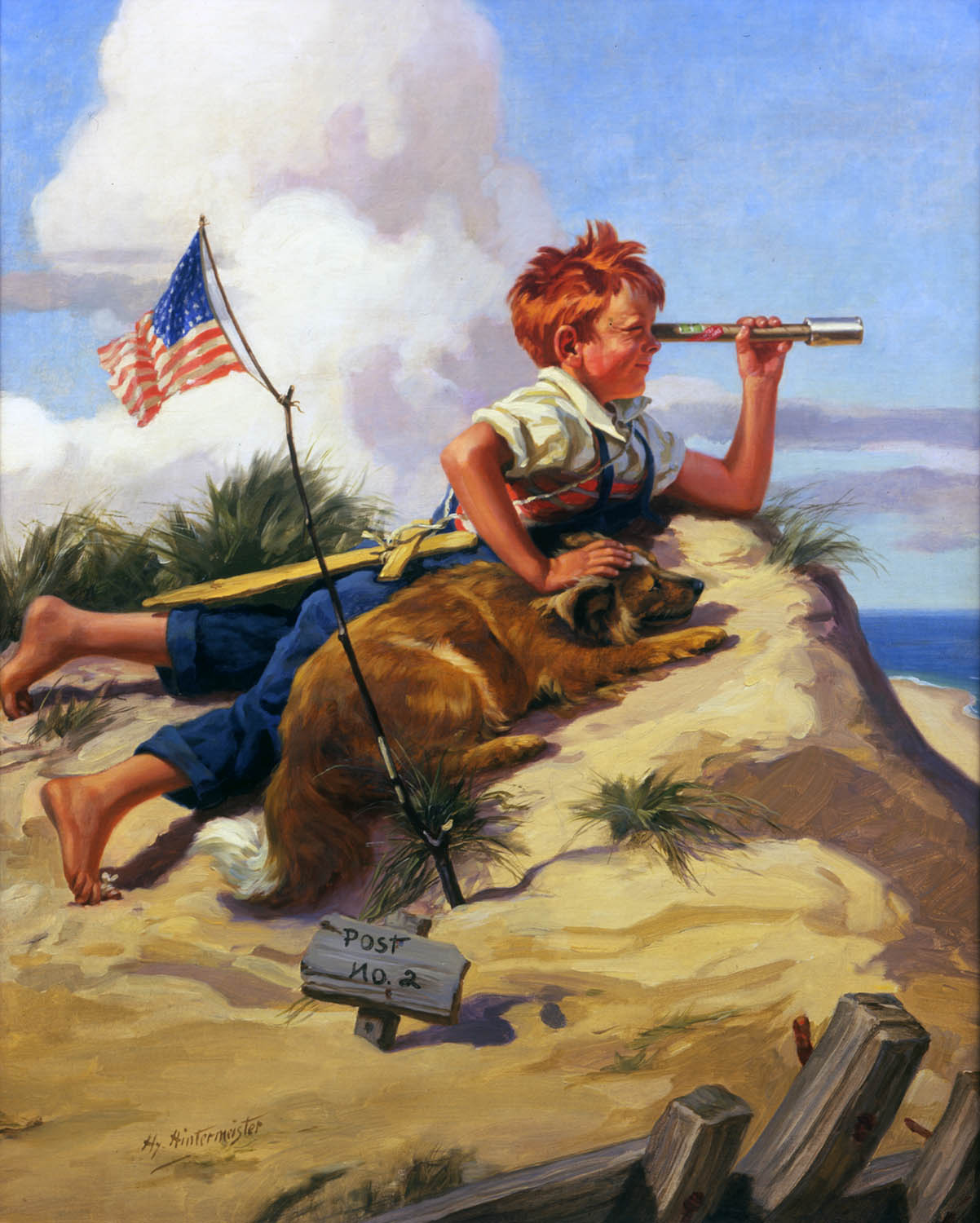
Hy Hintermeister (1897-1972)
Shore Patrol Post No. 2
c. 1930, oil on canvas
36" x 29", signed lower left
Hy Hintermeister’s Shore Patrol Post No. 2 is a charming example of the artist’s beloved depictions of childhood imagination and adventure. Renowned for his humorous and affectionate scenes of children at play, Hintermeister captures a young boy and his loyal dog transforming an ordinary day at the beach into an epic military mission. Armed with a handmade wooden sword, an American flag raised proudly on a stick, and a hand-lettered sign declaring “Post No. 2,” the boy assumes the role of a vigilant shore patrol officer defending his territory from imaginary enemy troops.
The scene perfectly reflects the boundless creativity and make-believe worlds of childhood. Hintermeister’s careful attention to gesture and expression brings warmth and humor to the composition, particularly in the protective way the boy shields his dog’s head while peering over the dunes in search of danger. The patriotic elements woven into the scene also reveal how children often absorbed and reenacted the heroic ideals celebrated in American culture during the early twentieth century. Through its playful storytelling and nostalgic charm, Shore Patrol Post No. 2 captures the carefree spirit of summer days spent outdoors, where a beach could instantly become a battlefield and imagination transformed ordinary moments into grand adventures.
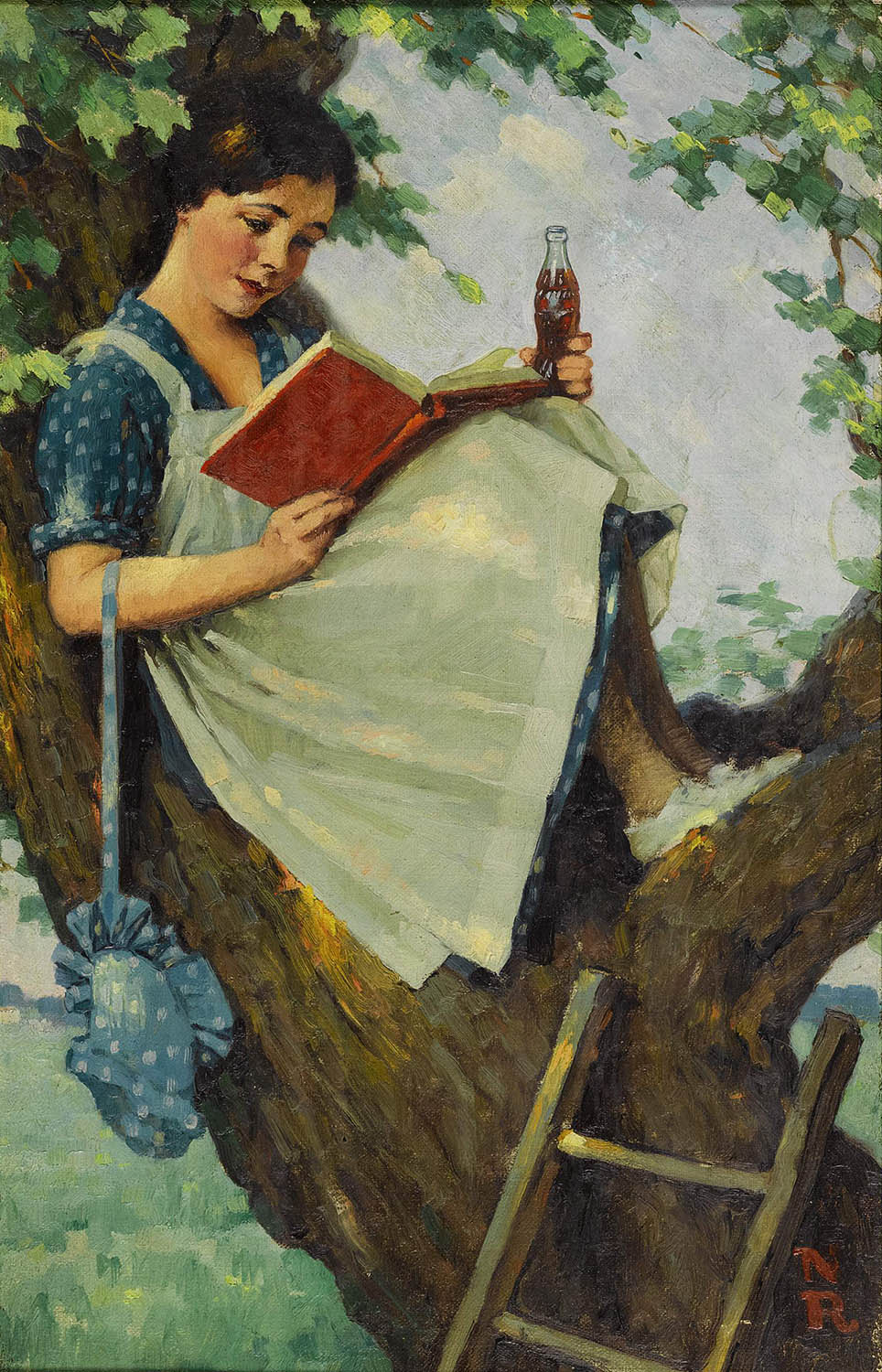
Norman Rockwell (1894-1978)
Young Girl Reading with a Coke
c. 1930, oil on canvas
17" x 11", signed lower right
Norman Rockwell’s Young Girl Reading with a Coke was created as a proposed advertisement for Coca-Cola, though the image was ultimately never used by the company. Like many of Rockwell’s finest works, the illustration transforms a quiet everyday moment into a deeply nostalgic vision of American life. Perched comfortably in the branches of a tree, the young girl has created her own private retreat high above the ground, accompanied only by her book and a bottle of Coca-Cola. The scene celebrates the simple pleasures of summertime—shade on a warm afternoon, a favorite story, and a refreshing drink enjoyed in peaceful solitude.
Rockwell fills the composition with charming narrative details that bring the scene to life. The wooden ladder leaning against the tree suggests the effort and imagination behind the girl’s secret hideaway, while her bonnet, carefully tied around her arm for safekeeping, adds both humor and authenticity to the moment. These small observations reveal Rockwell’s extraordinary ability to capture the habits and behaviors of everyday Americans with warmth and precision. Although never published as an advertisement, the painting remains a beautiful example of Rockwell’s talent for combining storytelling, nostalgia, and Americana into a single unforgettable image.
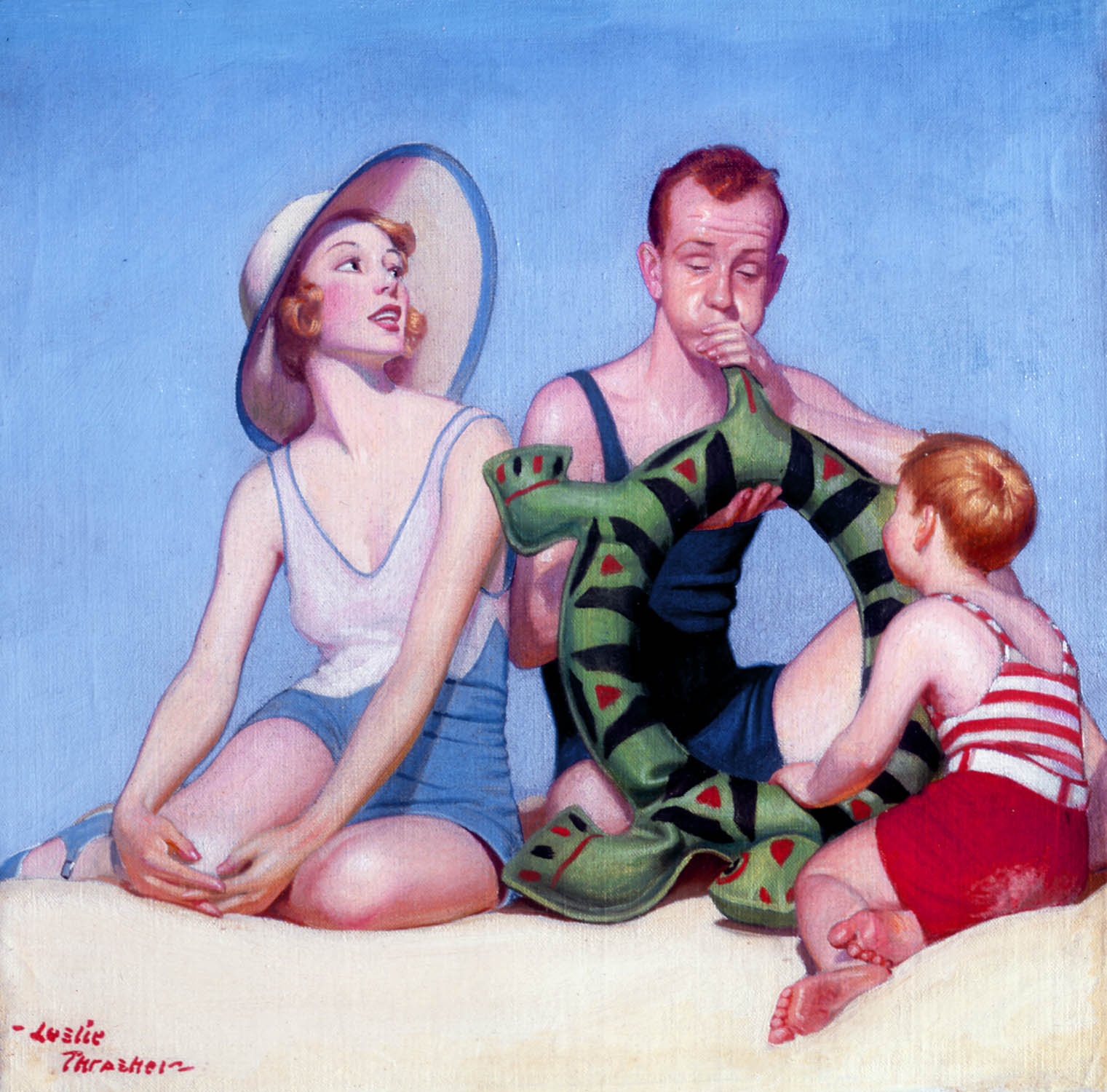
Leslie Thrasher (1889-1936)
Dad Blowing Up Green Turtle Tube
1931, oil on canvas
15 3/4" x 16", signed lower left
Liberty Magazine, September 5, 1931 cover
Leslie Thrasher’s Dad Blowing Up Green Turtle Tube, created for the September 5, 1931 cover of Liberty Magazine, is part of the artist’s enormously popular For the Love o’ Lil cover series. Beginning in 1926, Thrasher created weekly covers featuring recurring characters and an ongoing storyline centered around the everyday adventures of Lil Morse, Sandy Jenkins, and their family and friends. Liberty promoted the series as something entirely new for magazine publishing, allowing readers to follow the characters’ lives from issue to issue through humorous and relatable scenes.
In this cover, Thrasher captures the comedy and chaos of a family summer outing as a father struggles to inflate a child’s oversized turtle-shaped swim tube. Filled with warmth and humor, the illustration reflects the lighthearted spirit and recognizable family moments that made For the Love o’ Lil a beloved feature of the magazine for many years.
Leslie Thrasher (1889-1936)
Rowing
1931, oil on canvas
15 7/8" x 15 1/4", signed lower left
Liberty Magazine, August 15, 1931 cover
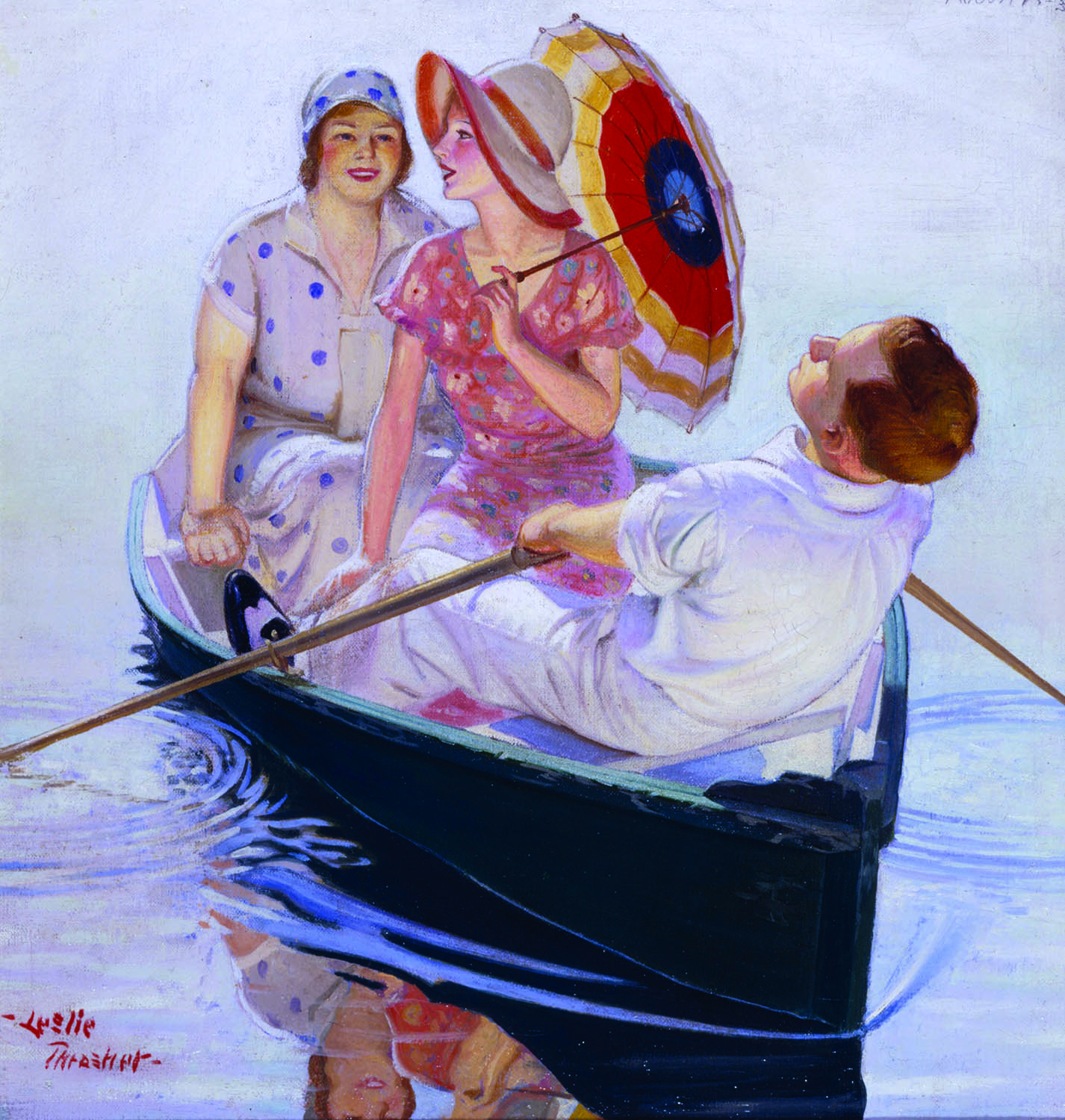
Leslie Thrasher’s Rowing, created for the August 15, 1931 cover of Liberty Magazine, is another delightful scene from his beloved For the Love o’ Lil series. Featuring the recurring cast of characters that readers followed week after week, the illustration captures the humor and charm of summertime recreation as the family embarks on a rowing adventure. Thrasher’s goal was to create a recognizable modern American family whose relatable eccentricities and domestic mishaps would keep readers emotionally invested each week. The artist even used himself as the model for Lil’s father, Robert E. Lee Morse, adding an autobiographical touch to the series.
Thrasher excelled at transforming ordinary moments into lively and relatable narratives filled with personality and gentle comedy. Like many covers from the series, Rowing celebrates the joys and mishaps of American family life, reflecting the warmth, humor, and everyday experiences that made For the Love o’ Lil one of the most popular illustrated serials of its era.
J.C. Leyendecker (1874-1951)
Labor Day at the Beach
1932, oil on canvas
32" x 24", signed lower right
Saturday Evening Post, September 3, 1932 cover
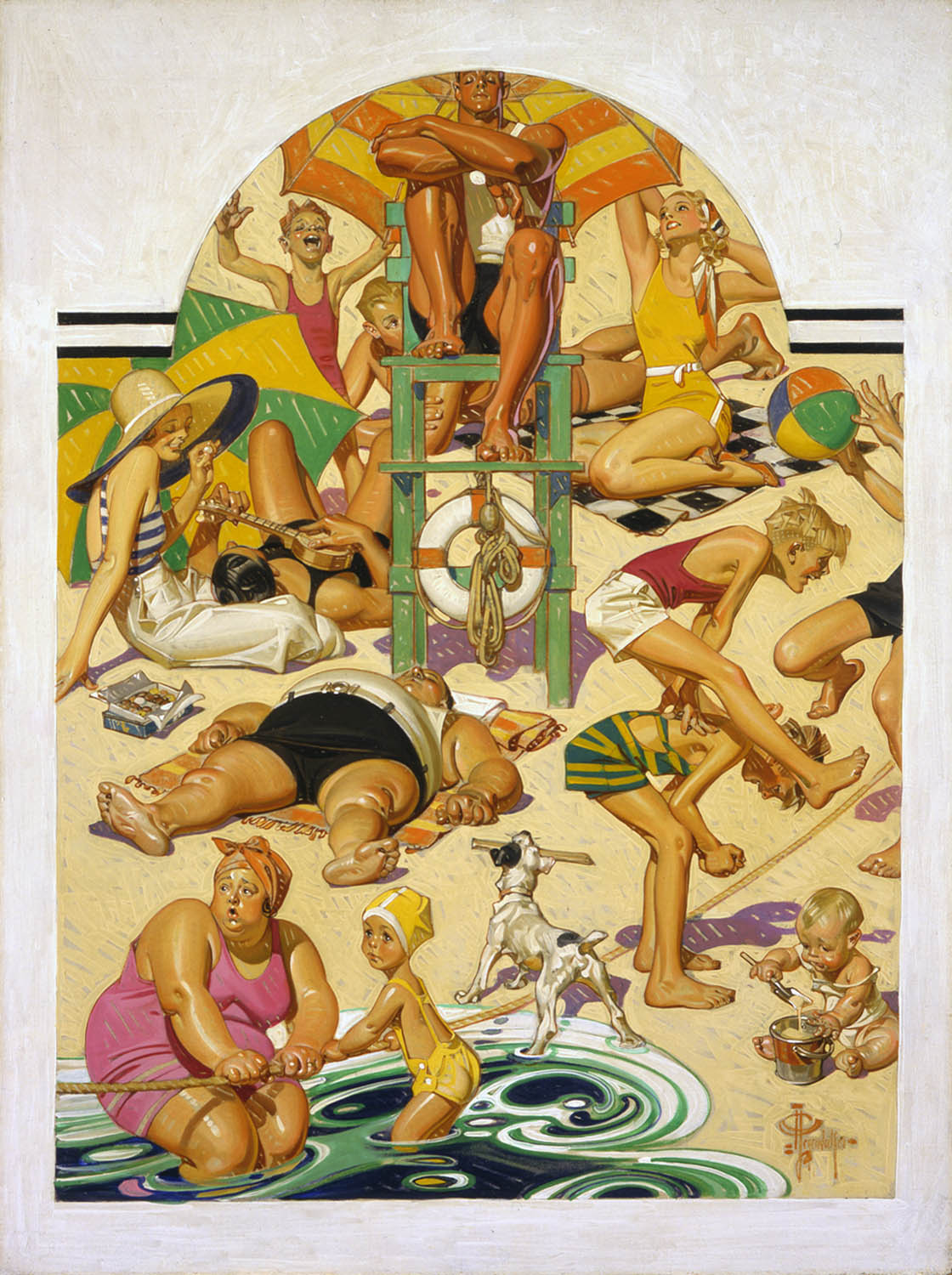
J. C. Leyendecker’s Labor Day at the Beach, created for the September 3, 1932 cover of The Saturday Evening Post, celebrates the final holiday weekend of summer with the sophistication and elegance that defined the artist’s work. Set against a lively beach scene, Leyendecker captures Americans enjoying the last carefree days of the season before the return to school and work routines.
As with many of his Post covers, Leyendecker combines contemporary fashion, leisure, and idealized beauty into a strikingly modern composition. The fashionable figures and polished design reflect the aspirational lifestyle imagery that made his illustrations enormously popular with American audiences. Published for Labor Day weekend, the cover perfectly evokes both the excitement and bittersweet feeling of summer’s end.
Jessie Willcox Smith (1863-1935)
Children at the Beach
1932, oil, mixed media and charcoal on board
22 1/4" x 16 3/8", signed lower left
Good Housekeeping, August 1932 cover
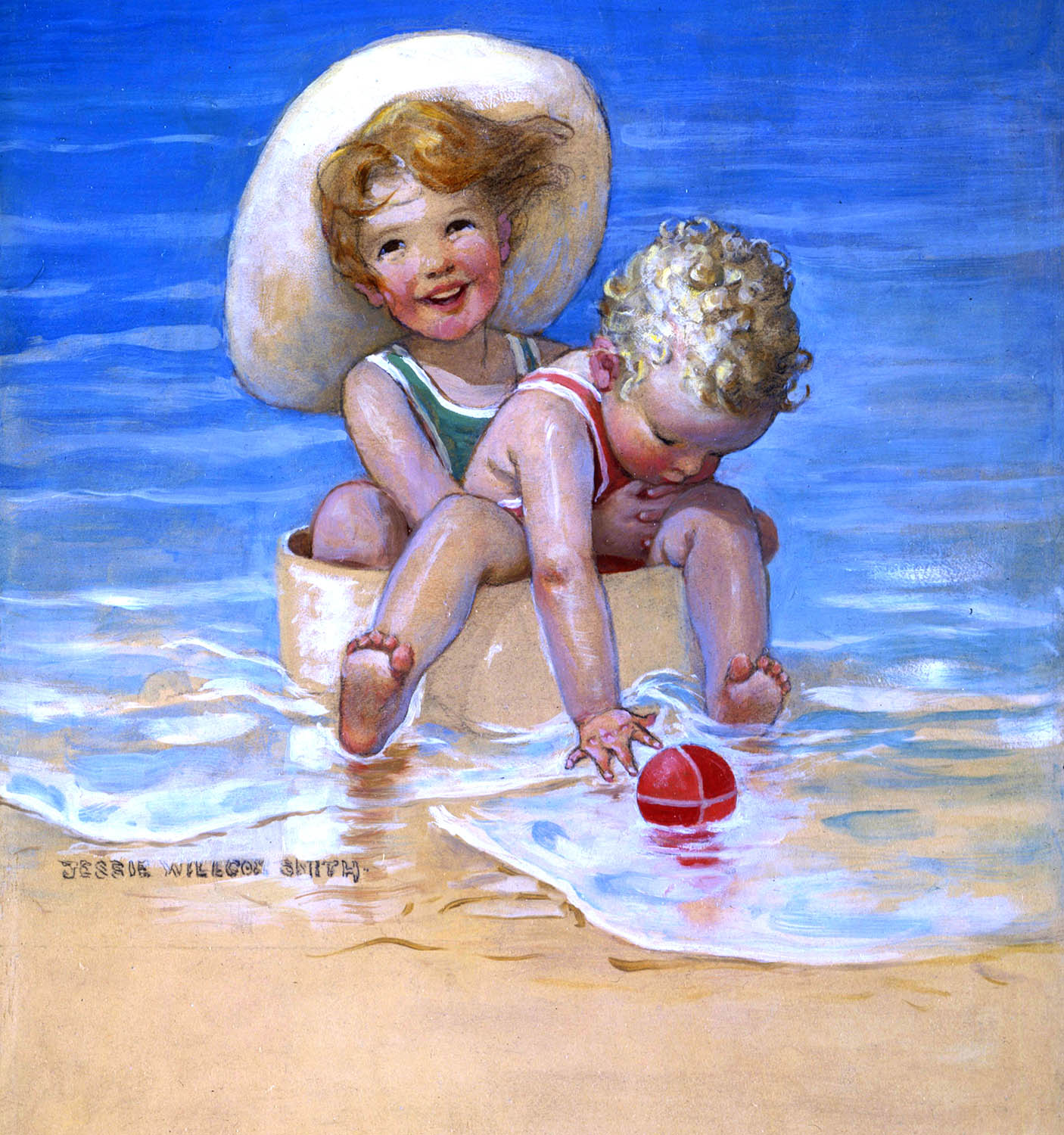
Jessie Willcox Smith’s Children at the Beach, created for the August 1932 cover of Good Housekeeping, beautifully captures the innocence and wonder of childhood during summertime. Smith portrays children absorbed in the simple joys of a day at the shore, emphasizing curiosity, playfulness, and companionship against the backdrop of sun, sand, and sea. Her gentle modeling and soft palette lend the scene a warmth and tenderness that became hallmarks of her work.
As one of America’s most beloved illustrators of children, Smith helped shape the nation’s idealized vision of childhood through her covers for Good Housekeeping. Images such as Children at the Beach celebrated healthy outdoor recreation and family life, while evoking the nostalgia and emotional comfort that made her illustrations so enduringly popular with American audiences.
Harrison Cady (1877-1970)
Boisterous Barbecue (Peter Rabbit)
1935, watercolor and ink on paper
24 1/2" x 17", signed lower left
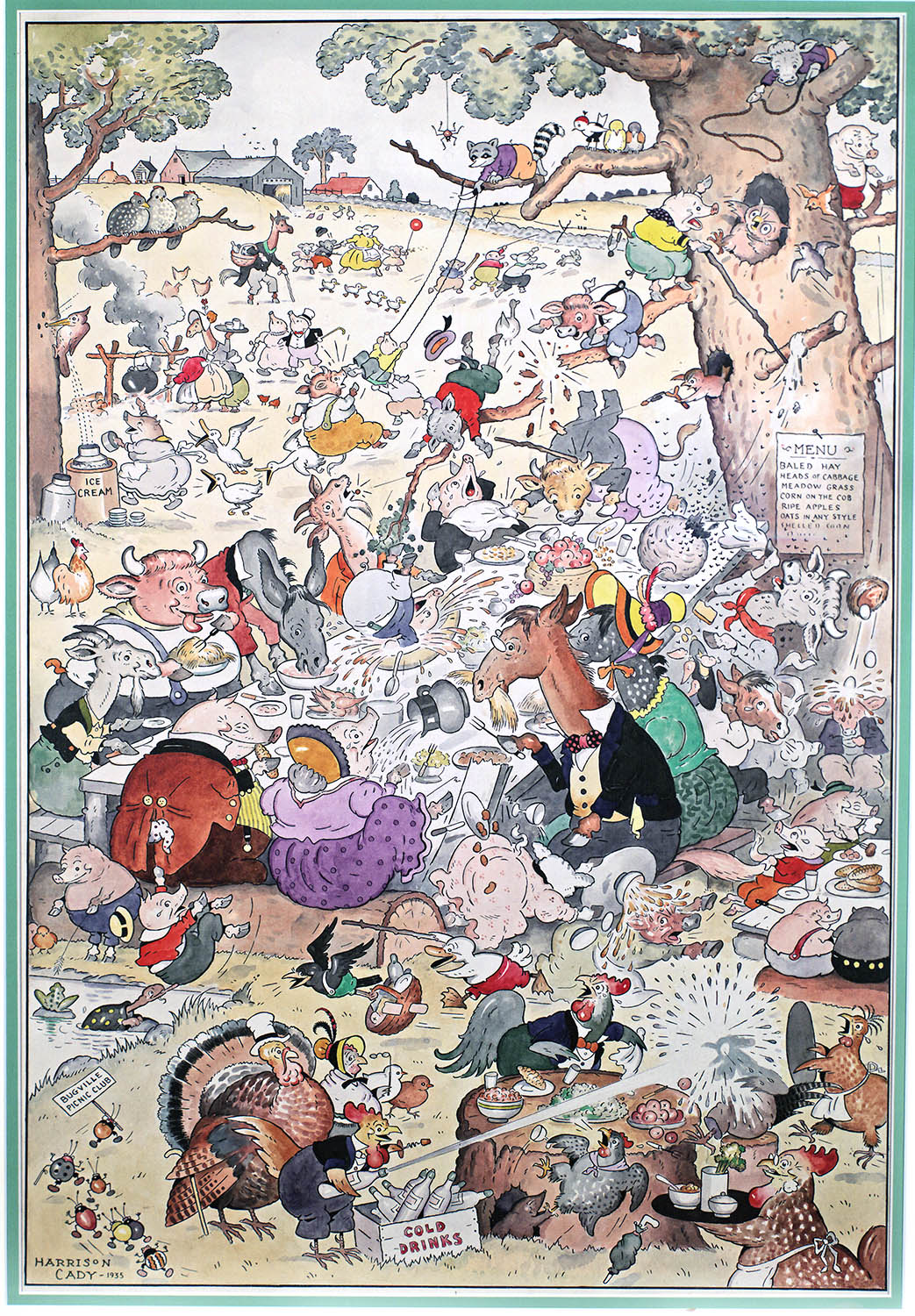
Harrison Cady’s Boisterous Barbecue, a lively 1935 Peter Rabbit illustration, is a wonderful example of the artist’s talent for creating energetic and delightfully crowded scenes filled with humor and personality. Best known for his long-running syndicated Peter Rabbit cartoons in the New York Herald Tribune, Cady built a highly successful career illustrating for major publications including Life, Boys’ Life, and Ladies’ Home Journal.
In Boisterous Barbecue, Cady is at his finest, orchestrating a whirlwind of activity as countless animals gather together for a chaotic outdoor feast. Every corner of the composition is animated with movement, comedy, and charming detail, encouraging viewers to linger and discover new humorous moments throughout the scene. The illustration perfectly captures the carefree spirit of summertime gatherings while showcasing Cady’s extraordinary gift for storytelling through bustling, imaginative compositions.
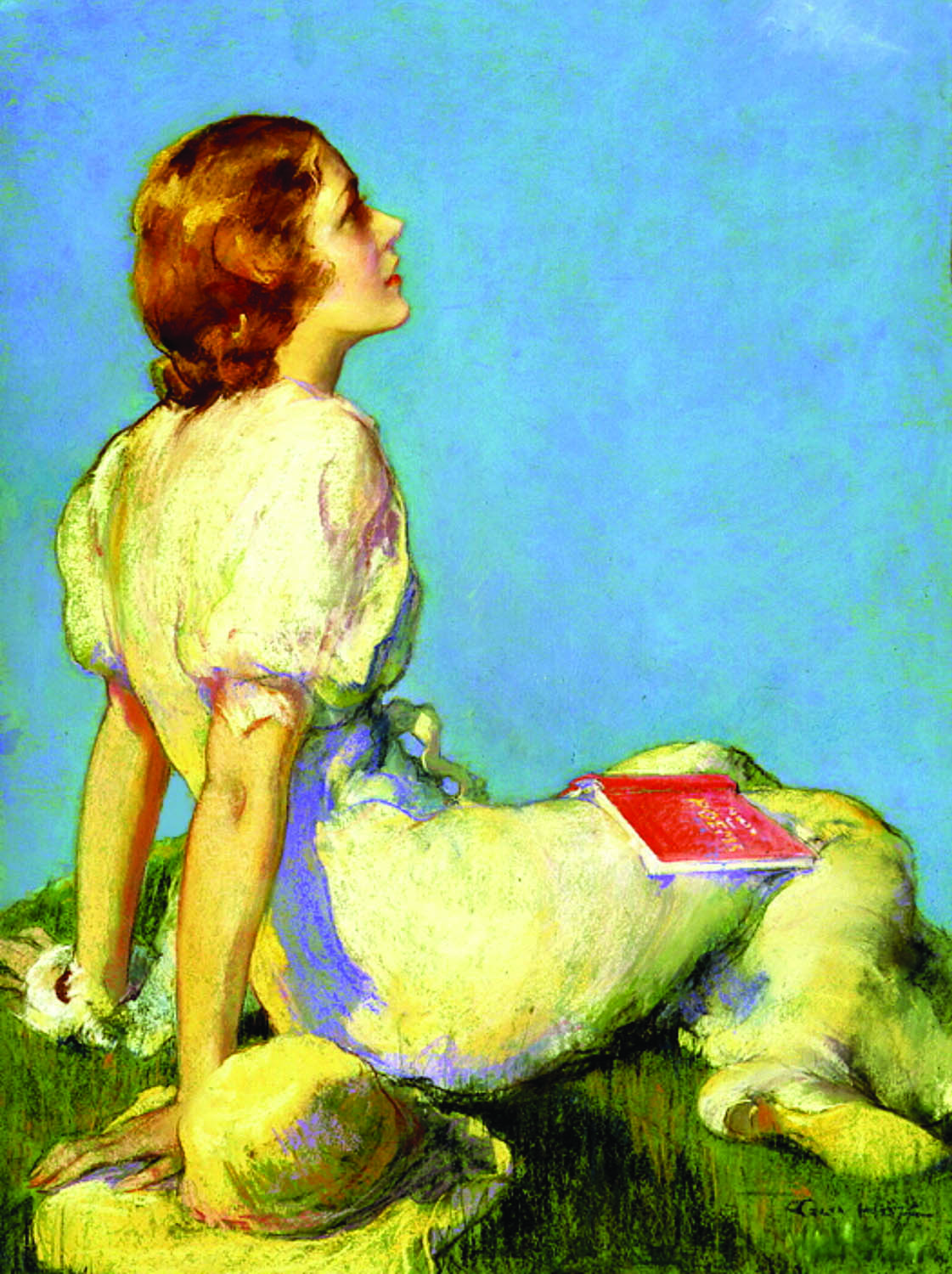
Guy Hoff (1889-1962)
Book of Poems
1935, pastel on board
38" x 28", signed lower right
Saturday Evening Post, August 24, 1935 cover
Guy Hoff’s Book of Poems, created for the August 24, 1935 cover of The Saturday Evening Post, is a beautiful example of the artist’s soft and elegant pastel style. The illustration depicts a woman seated quietly on the grass, holding her book of poetry while enjoying a peaceful summer afternoon. Hoff’s delicate handling of color and light creates an atmosphere of calm refinement and leisure.
Judging by her fashionable all-white ensemble, the woman has likely stepped away from watching a tennis match on a nearby grass court, recalling the genteel summertime traditions associated with resorts such as Newport’s famed Tennis Hall of Fame. The image captures a sophisticated vision of summer recreation during the 1930s, where sport, relaxation, and quiet contemplation blended together in an idealized portrait of American leisure.
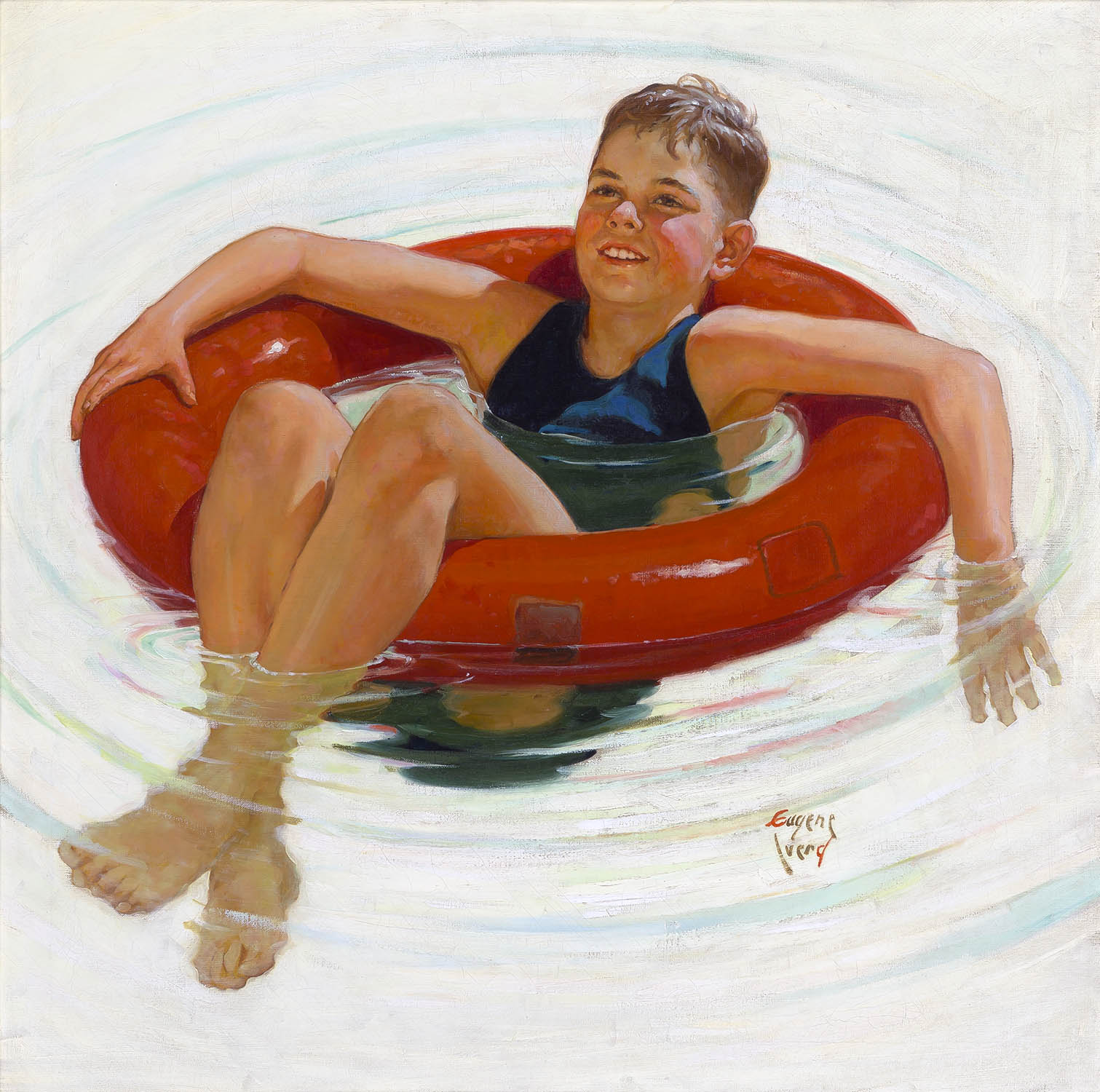
Eugene Iverd (1893-1936)
Boy on the Innertube
1936, oil on canvas
31" x 31", signed lower right
Saturday Evening Post, August 11, 1936 cover
Eugene Iverd’s Boy on the Innertube, created for the August 1, 1936 cover of The Saturday Evening Post, perfectly captures the carefree joy of childhood during summer vacation. Floating on the water, the young boy wears an expression of complete relaxation and delight, humorously conveying the unmistakable feeling that this is “the height of summertime fun!”
Iverd had a remarkable talent for depicting everyday American life with warmth and humor, and this cover transforms a simple summer pastime into a universal moment of happiness and escape. The oversized innertube, bright sunlight, and playful mood evoke the freedom and simplicity of childhood summers spent outdoors, making the image an enduring celebration of American leisure and recreation.

Maxfield Parrish (1870-1966)
June Skies (A Perfect Day)
1940, oil on panel
23" x 18 1/2", signed and dated lower right
Brown & Bigelow calendar, 1943
Maxfield Parrish’s June Skies (A Perfect Day), created for a 1943 Brown & Bigelow calendar, is a stunning celebration of the idyllic American landscape. Bathed in luminous sunlight beneath towering clouds and brilliant blue skies, the painting exemplifies the dreamlike beauty that made Parrish one of the most popular illustrators in America. His masterful use of glowing color, particularly the rich blues for which he became famous, transforms the scene into an almost magical vision of summer tranquility.
Parrish’s calendar illustrations reached millions of homes and offices across the country, helping to define the visual ideal of an American “perfect day.” In June Skies, the peaceful countryside, reflective water, and radiant atmosphere evoke a sense of serenity, escape, and optimism. The painting captures not only the beauty of summer, but also the nostalgic longing for a simpler and more harmonious world that became central to Parrish’s enduring appeal.
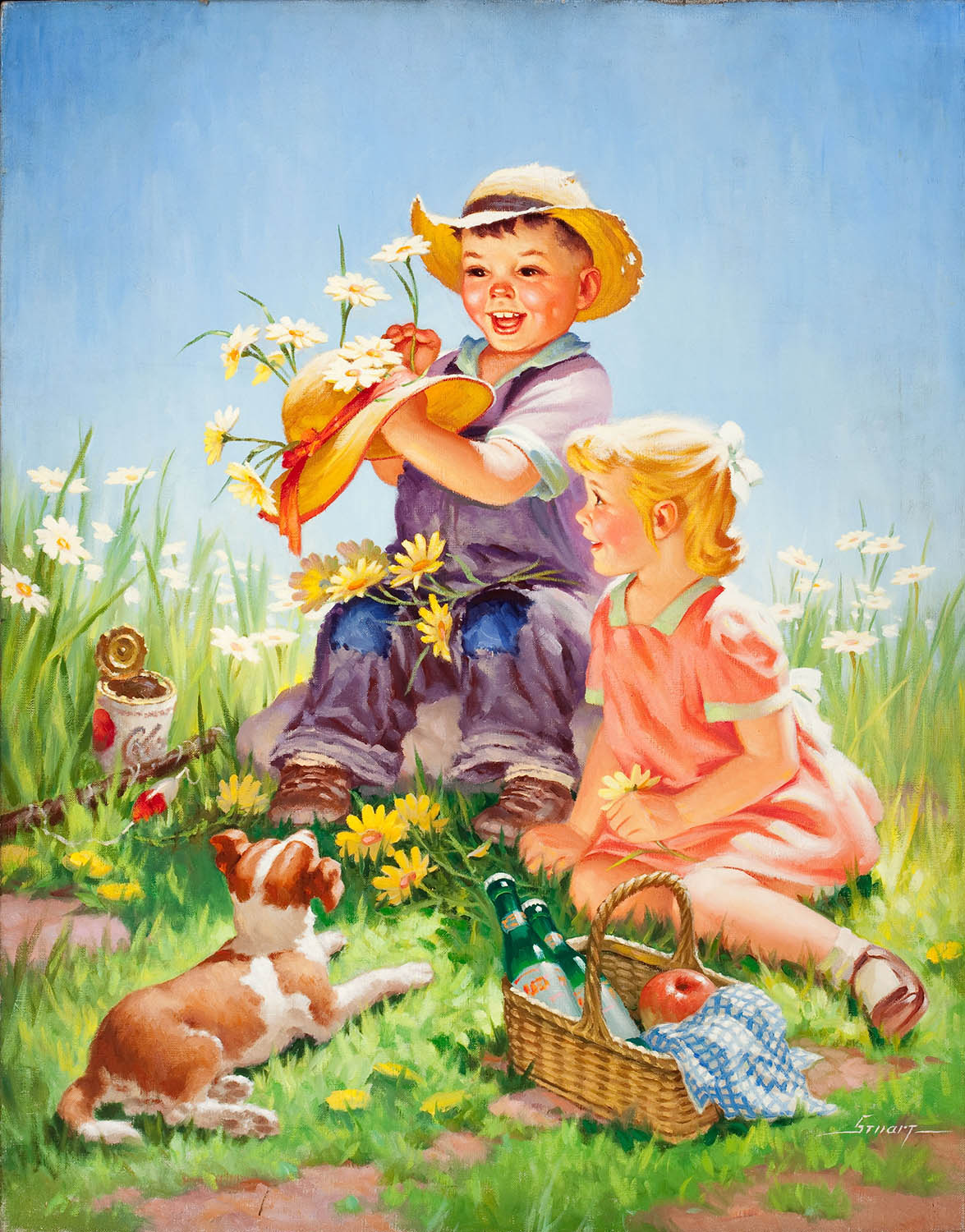
Raymond James Stuart (1882-1970)
A Daisy Hat
c. 1940, oil on canvas
28" x 22", signed lower right
Raymond James Stuart’s A Daisy Hat is a charming celebration of childhood, summertime, and the simple pleasures of nature. Seated in a field of daisies, two children happily decorate their straw hats with freshly picked flowers while their loyal dog rests nearby. A fishing rod laid in the grass beside them, along with a picnic basket with drinks and apples, suggests a carefree afternoon spent exploring the outdoors.
The illustration reflects the nostalgic ideal of childhood so often celebrated in early twentieth-century American illustration. Stuart captures the warmth and innocence of a summer day through soft color, playful details, and a gentle sense of companionship between the children. The scene evokes a world of unhurried leisure and imagination, where even the smallest moments—picking flowers, sharing a picnic, or resting in the sunshine—become treasured summer memories.
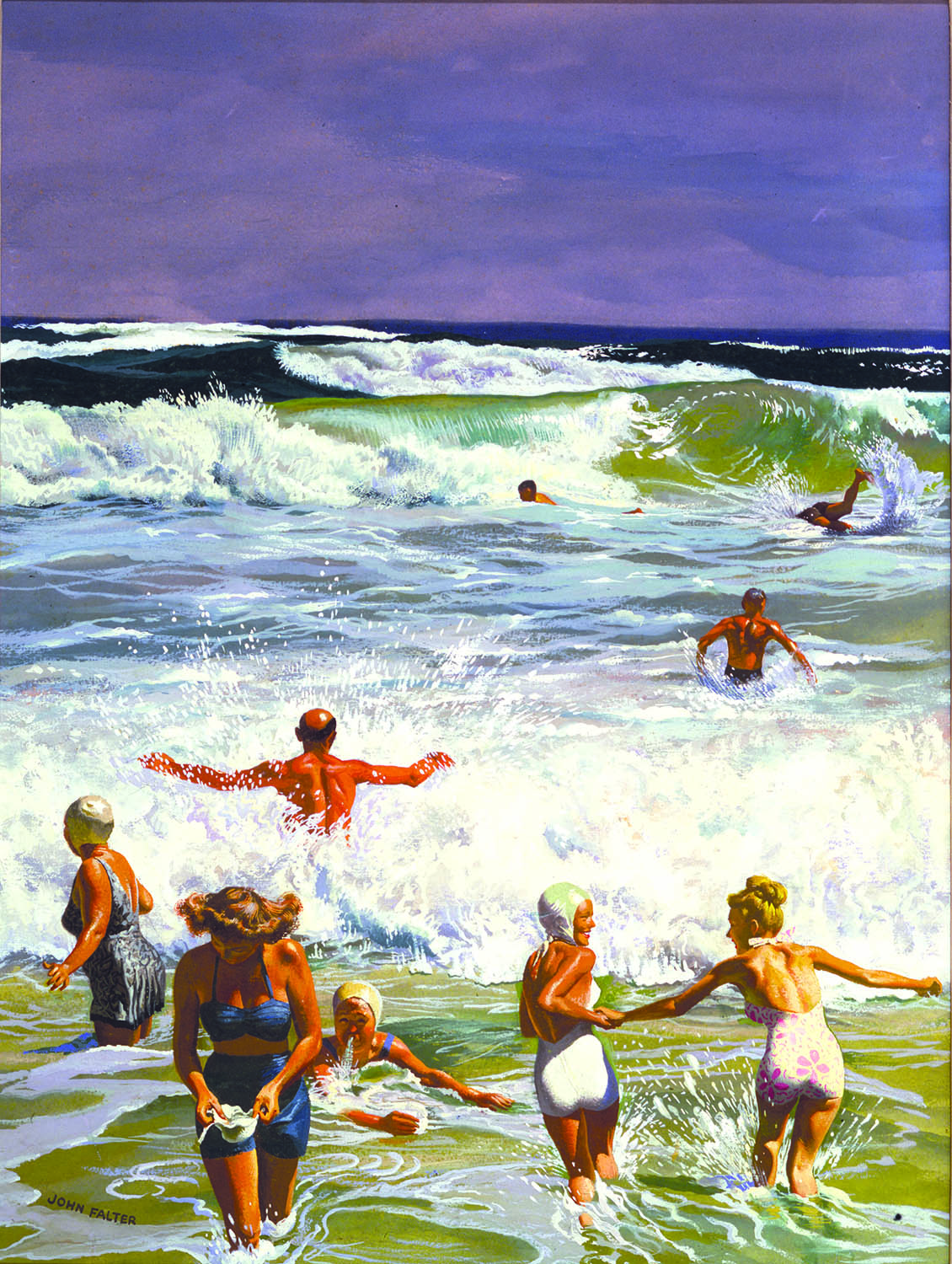
John Falter (1910-1982)
Maine Surf
1948, oil on canvas
23" x 17 1/4", signed lower left
Saturday Evening Post, August 14, 1948 cover
John Falter’s Maine Surf, created for the August 14, 1948 cover of The Saturday Evening Post, is a vibrant and deeply personal depiction of summertime at the shore. Falter painted himself in the composition—recognizable by his signature bald spot—struggling playfully against the force of the crashing surf. His wife, Maggie, is painted exiting the water and removing her swimming cap. The artist brilliantly captures the energy and unpredictability of the ocean as waves break against him and foamy water swirls around Maggie's knees, immersing the viewer in the excitement of a summer day at the beach. The painting reflects Falter’s gift for combining realism, humor, and movement, while also offering a glimpse into his own personal life and experiences along the Maine coast; it is a lively celebration of postwar American leisure and recreation.
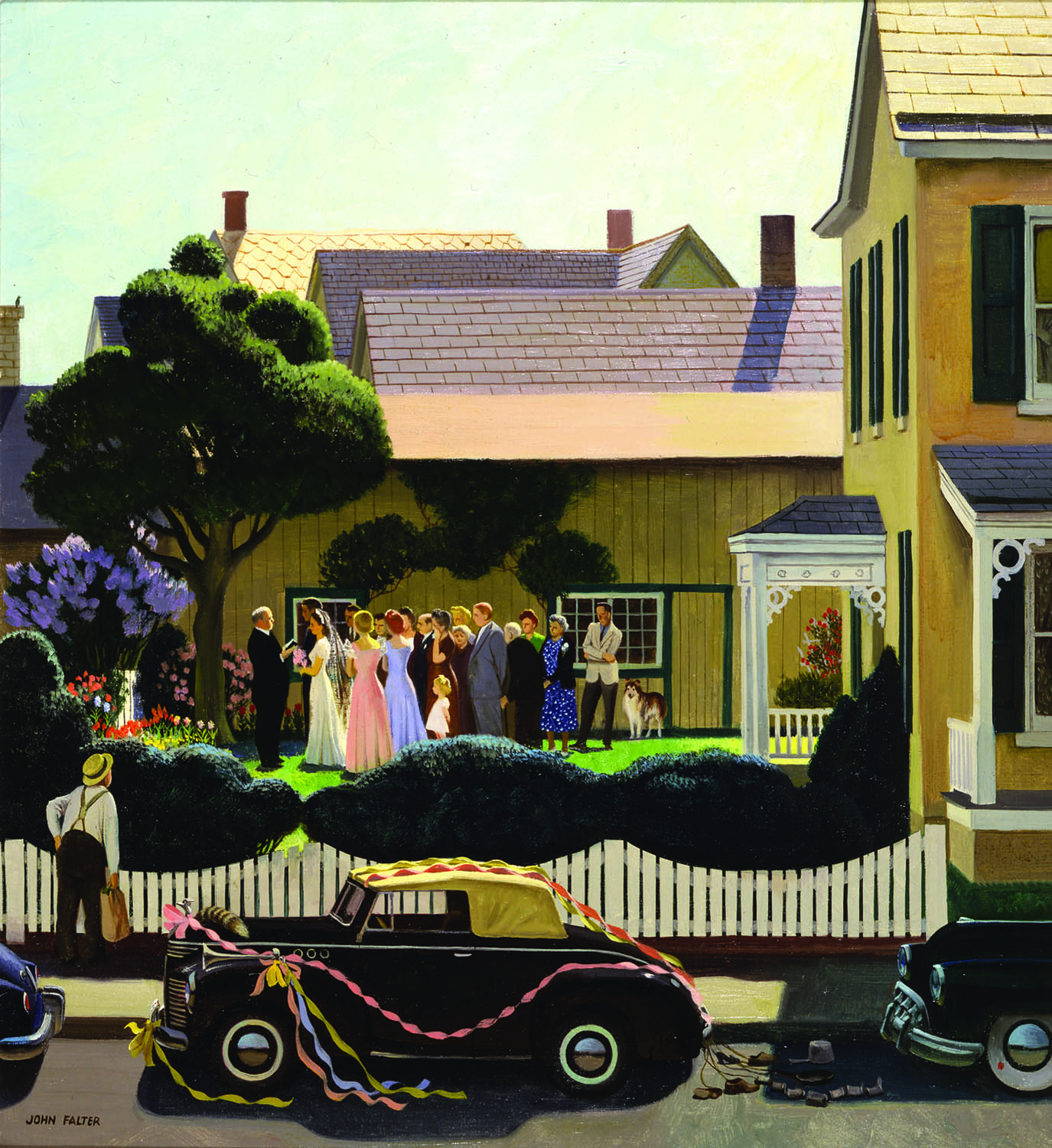
John Falter (1910-1982)
June Wedding
1950, oil on canvas
24" x 22", signed lower left
Saturday Evening Post, June 24, 1950 cover
John Falter’s June Wedding, created for the June 24, 1950 cover of The Saturday Evening Post, captures the excitement, humor, and emotion surrounding a classic American summer wedding. Set in a bustling suburban neighborhood beneath clear June skies, the illustration is filled with the lively activity and memorable personalities that accompany such an occasion. Proud family members look on with emotion and curious onlookers become part of the celebration, creating a scene that feels both deeply personal and universally familiar.
Falter was a master at transforming ordinary American moments into rich visual narratives, and June Wedding perfectly demonstrates his gift for storytelling. The accompanying text published in The Saturday Evening Post playfully expanded upon the scene, offering congratulations to the happy couple while humorously pointing out the colorful cast of wedding guests—from the tearful mother and the mischievous prankster plotting decorations for the honeymoon car, to the absentminded husband suddenly remembering his own anniversary. Together, the illustration and commentary celebrate the warmth, comedy, and shared traditions of postwar American family life, making June Wedding an enduring portrait of summertime celebration and community.
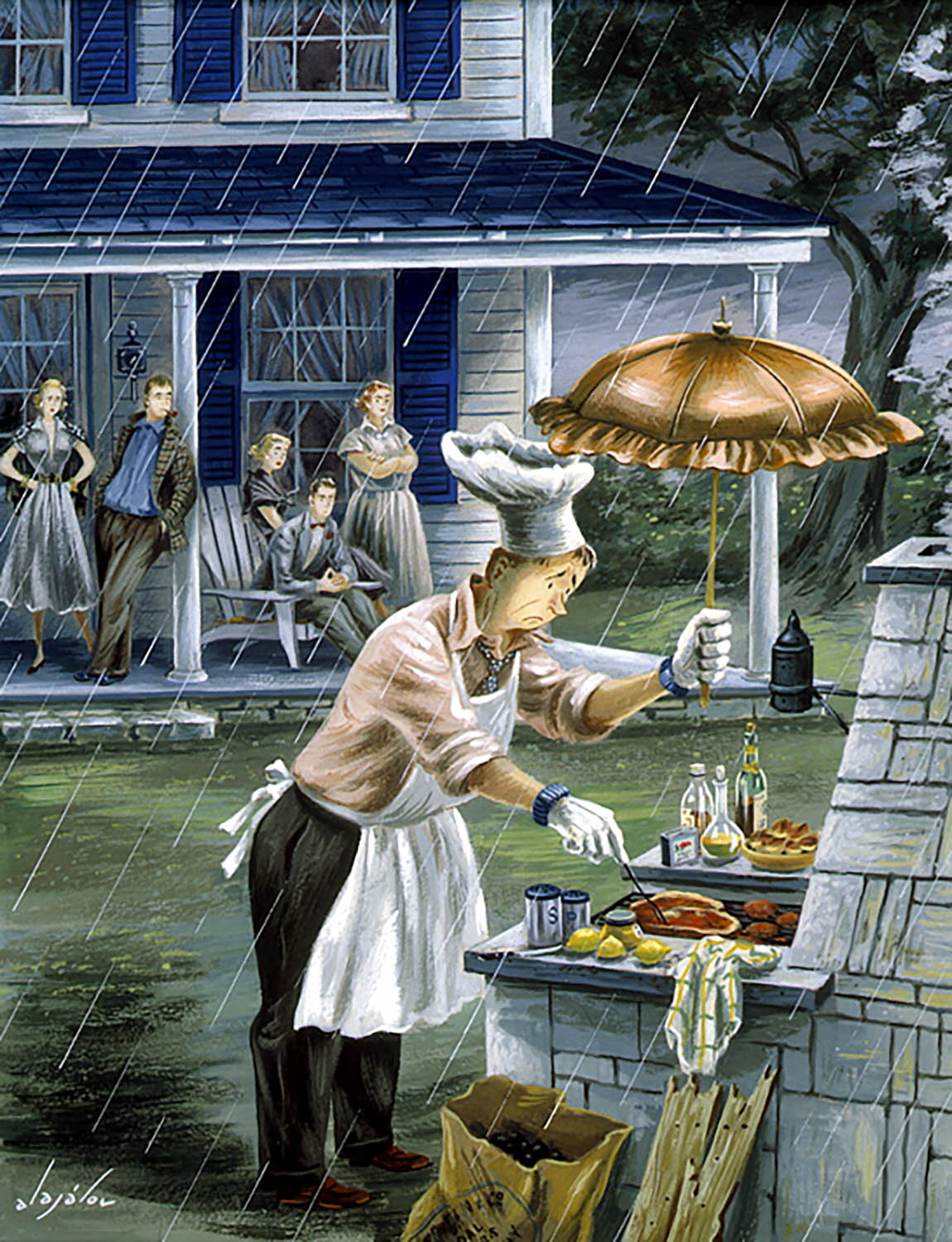
Constantin Alajalov (1900-1987)
Outdoor Barbeque in the Rain
1951, tempera on board
16" x 12 1/2", signed lower left
Saturday Evening Post, July 28, 1951 cover
Constantin Alajalov’s Outdoor Barbeque in the Rain, created for the July 28, 1951 cover of The Saturday Evening Post, humorously captures the unpredictability of summer entertaining. At the center of the scene stands the family "chef," stubbornly determined to continue cooking despite the pouring rain. Sheltered only by a frilly umbrella, he tends carefully to the grill with an impressive assortment of seasonings, sauces, and cooking tools spread around him, revealing both his culinary passion and his refusal to surrender the perfect barbeque to bad weather.
Meanwhile, his family and guests watch sympathetically from the safety of the porch, amused by the soggy spectacle unfolding before them. Alajalov’s gift for expressive characters and comedic storytelling transforms an everyday mishap into a wonderfully relatable summer scene. The cover celebrates not only outdoor cooking and family gatherings, but also the humor and resilience that often accompany summertime traditions when nature refuses to cooperate.
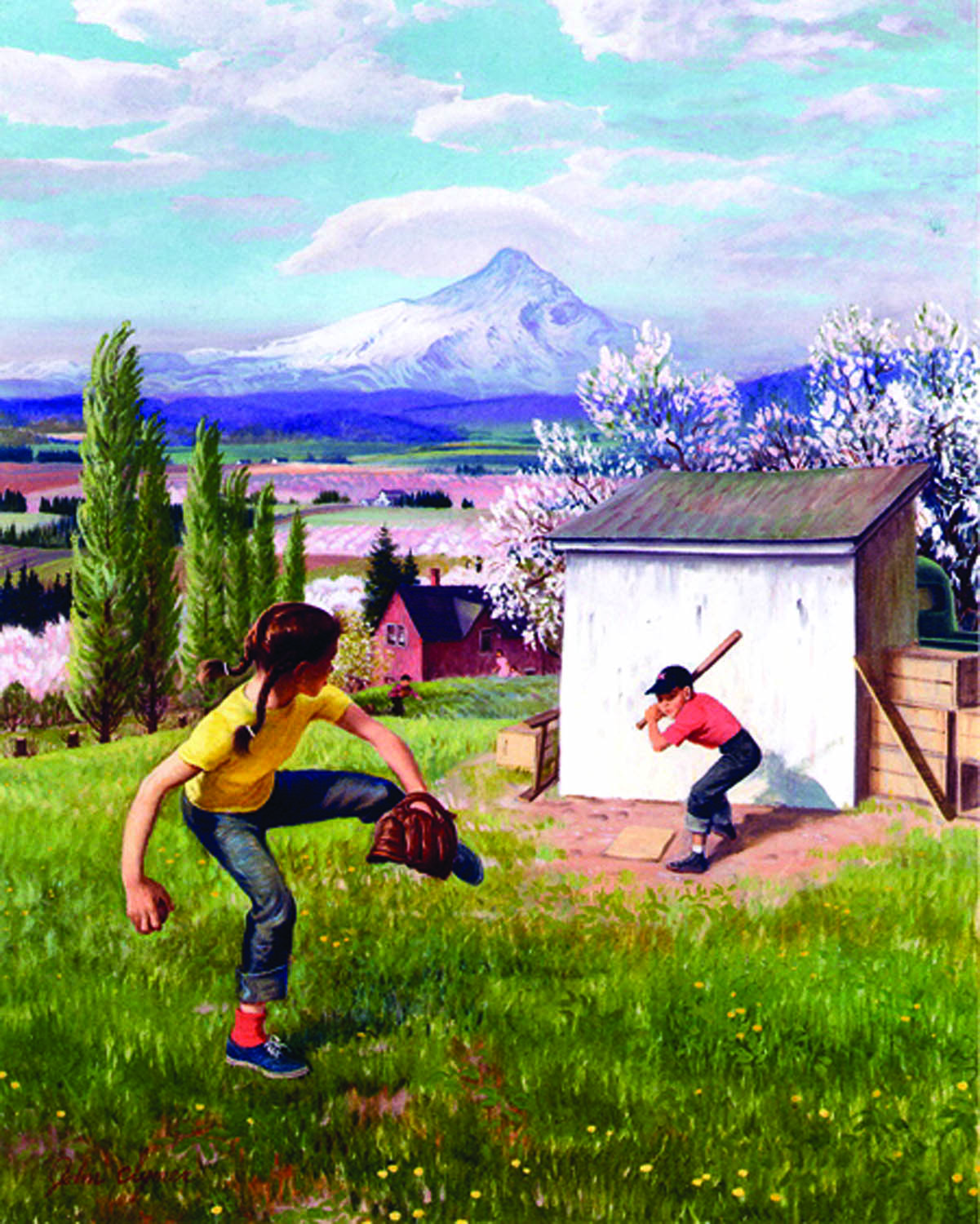
John Clymer (1907-1989)
Backyard Baseball
1951, oil on canvas
35" x 28 3/4", signed lower left
Saturday Evening Post, April 21, 1951 cover
John Clymer’s Backyard Baseball, created for the April 21, 1951 cover of The Saturday Evening Post, celebrates America’s enduring love of baseball and the carefree joys of childhood play. Set in an orchard in Oregon beneath the towering presence of Mount Hood, visible in the distance, the scene combines the grandeur of the American landscape with the simple excitement of a neighborhood ballgame.
The accompanying blurb in the magazine humorously remarked that the scenery was so beautiful that only baseball itself could possibly distract the children from admiring it. Clymer captures that sentiment perfectly, emphasizing the complete absorption and enthusiasm of the young players as they lose themselves in the game. The painting reflects the nostalgic ideal of postwar American childhood, where long summer afternoons, open fields, and pickup baseball games became treasured memories and enduring symbols of American life.
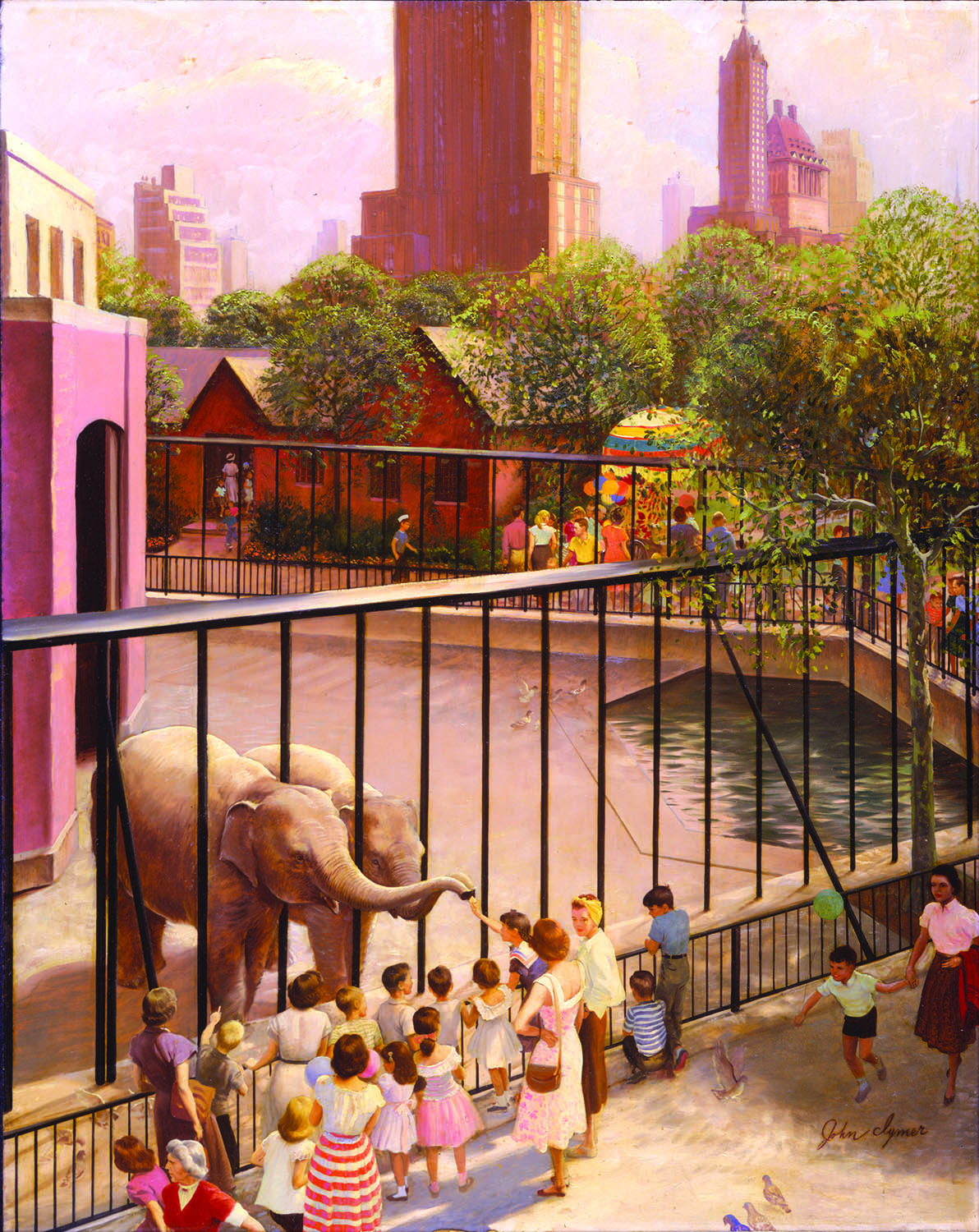
John Clymer (1907-1989)
Central Park Zoo
1953, oil on board
34" x 27", signed lower right
Saturday Evening Post, July 25, 1953 cover
John Clymer’s Central Park Zoo, created for the July 25, 1953 cover of The Saturday Evening Post, captures the excitement and wonder of a summer outing in New York City. The illustration shows mothers and children gathered at the zoo, enjoying a leisurely day among the animals and shaded walkways of Central Park. Clymer balances the charm of the park with subtle reminders of the surrounding metropolis, as the skyline of New York City rises above the treetops in the distance, grounding the idyllic scene firmly within the urban landscape.
The painting reflects the importance of Central Park as a place of recreation and escape for city families. Clymer’s warm storytelling and careful attention to everyday details transform an ordinary family excursion into a nostalgic portrait of summertime in New York, where nature, childhood curiosity, and city life comfortably coexist.
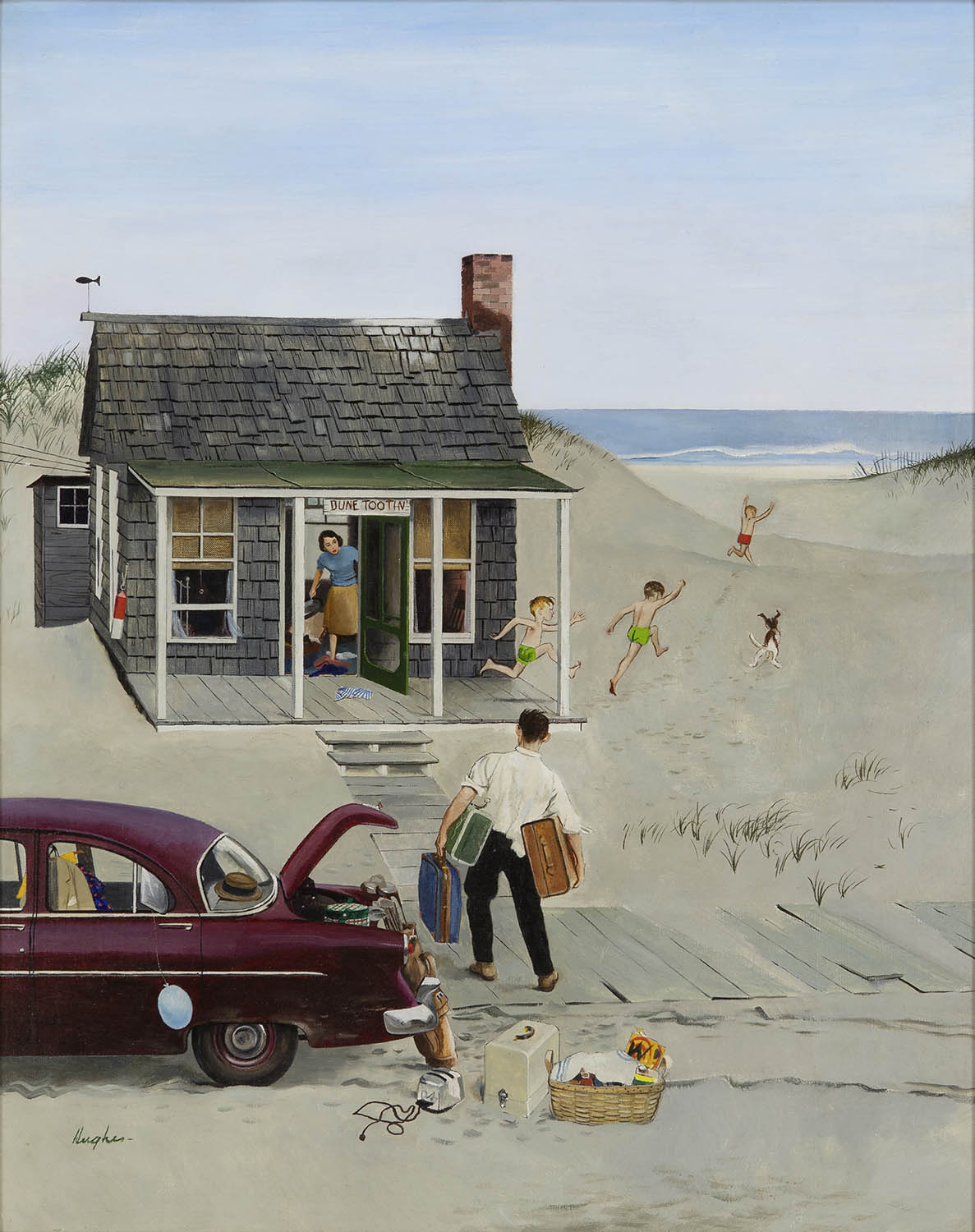
George Hughes (1907-1990)
First Day at the Beach
1956, oil on canvas
27 1/2" x 21 1/2", signed lower left
Saturday Evening Post, August 11, 1956 cover
George Hughes’ First Day at the Beach and No Chance to Be Alone, both created for The Saturday Evening Post, work together as a wonderfully humorous pair of summertime narratives. In First Day at the Beach (August 11, 1956), Hughes captures the excitement of a family finally arriving at their seaside vacation destination. Their car overflows with luggage, beach gear, and energetic children who can barely contain themselves as they race over the dunes for their first glimpse of the ocean. The scene perfectly conveys the anticipation and chaos of the classic American summer vacation.
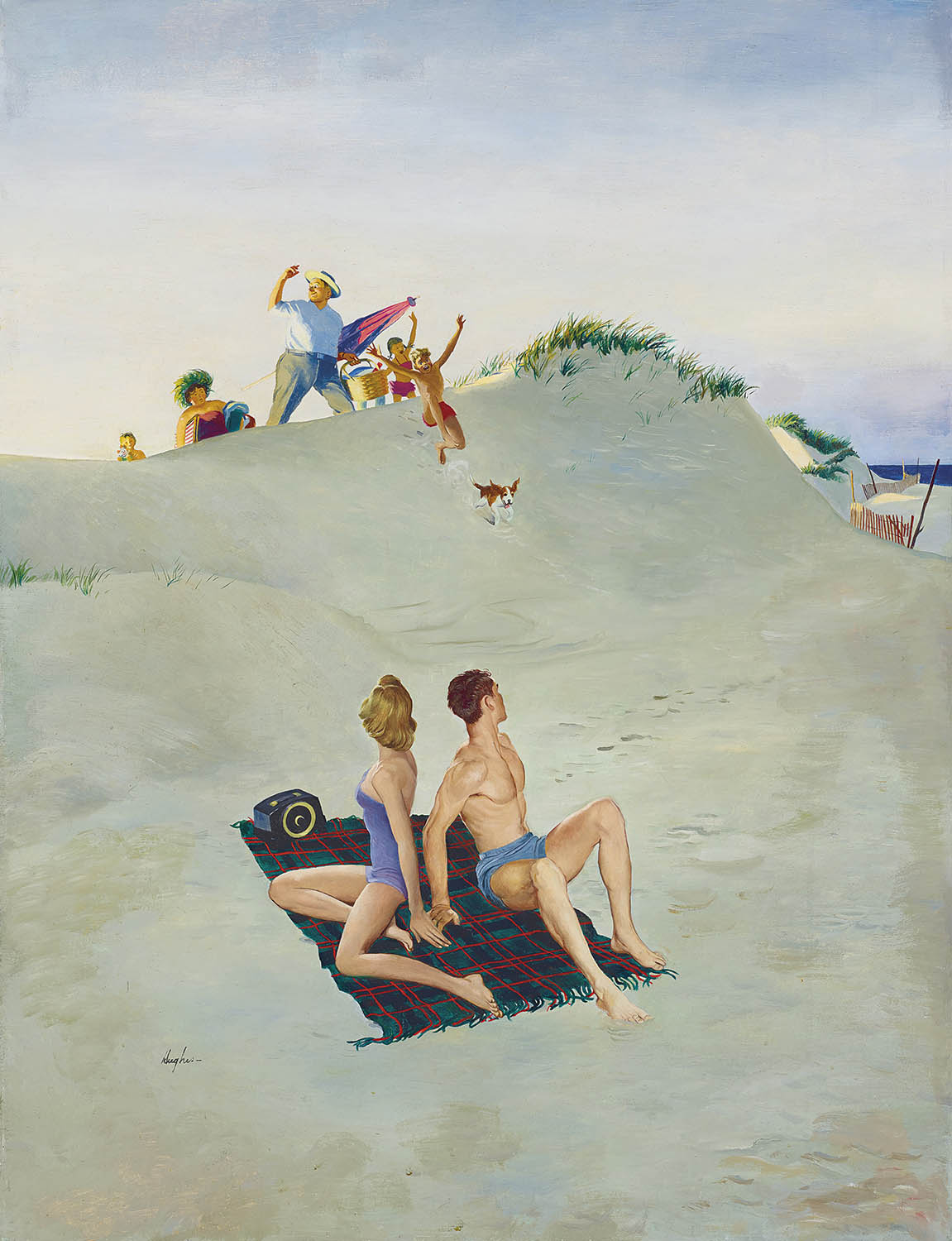
George Hughes (1907-1990)
No Chance to be Alone
1953, oil on masonite
30" x 22 3/4", signed lower left
Saturday Evening Post, August 8, 1953 cover
That same burst of youthful energy humorously continues in No Chance to Be Alone (August 8, 1953). Here, a young couple attempts to enjoy a quiet and romantic day at the beach, only to have their peaceful retreat interrupted as children suddenly come charging over the dunes and into the scene. Viewed together, the two covers create an amusing visual story of intersecting beachgoers and competing summertime experiences. Hughes’ talent for expressive characters and relatable situations transforms ordinary moments into charming observations of American leisure, family life, and the crowded realities of summer vacation destinations.
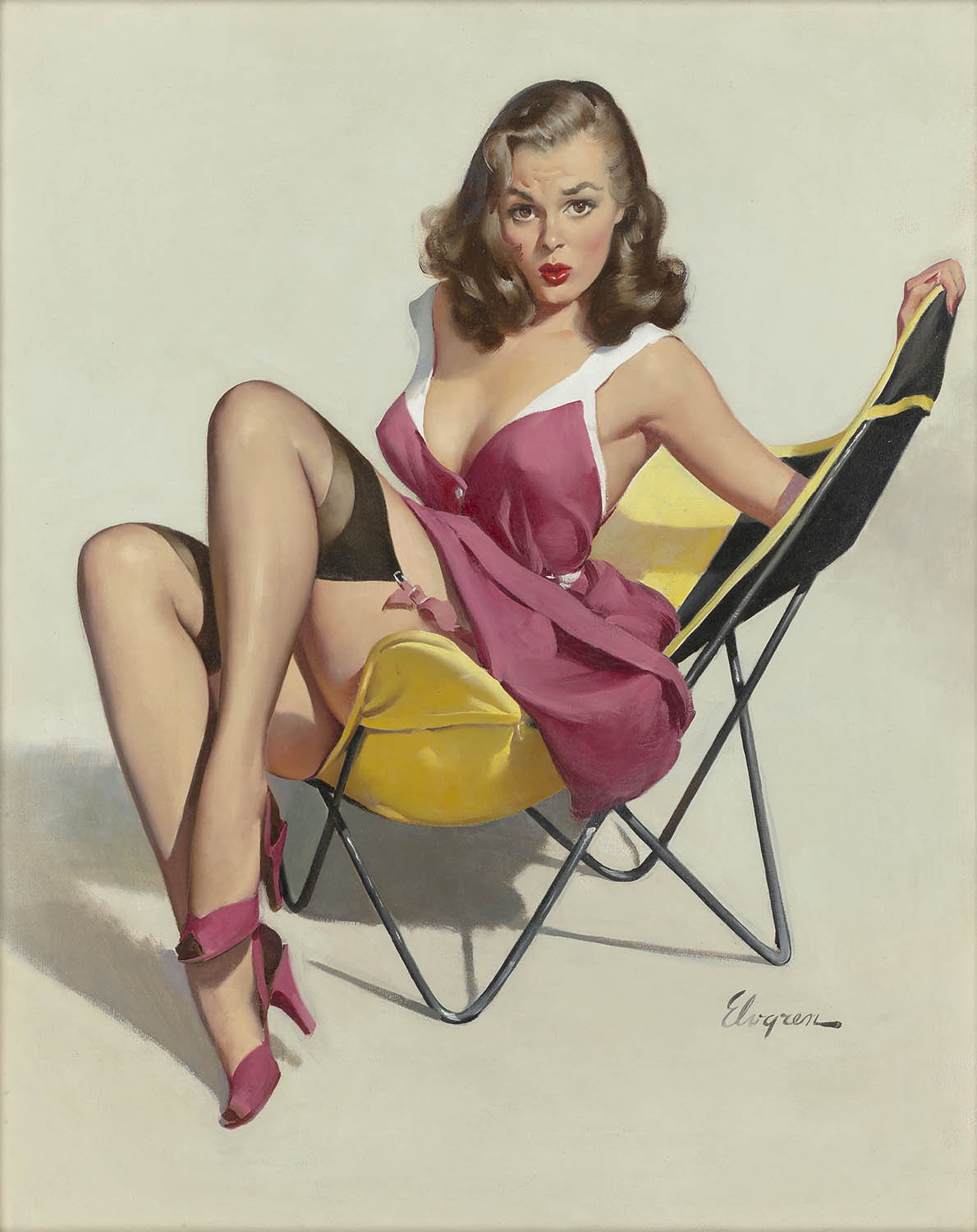
Gil Elvgren (1914-1980)
Low Down Feelings
1955, oil on canvas
30" x 24", signed lower right
Gil Elvgren’s Low Down Feeling is a classic example of the artist’s famous pin-up imagery, combining glamour, humor, and playful storytelling into a single unforgettable scene. Elvgren became one of America’s most celebrated pin-up artists through his depictions of beautiful young women caught in lighthearted and often embarrassing predicaments. In this illustration, the stylish young woman finds herself trapped in an awkward moment after sitting in an extremely low lawn chair, only to discover that her dress has become snagged.
Rather than focusing purely on glamour, Elvgren’s pin-ups succeeded because of their charm, wit, and relatability. The humor of the situation, paired with the model’s expressive reaction and elegant appearance, creates a scene that feels playful rather than provocative. Set against the backdrop of summer leisure and outdoor relaxation, Low Down Feeling reflects the carefree spirit and visual sophistication that made Elvgren’s illustrations enormously popular in mid-century American advertising and popular culture.
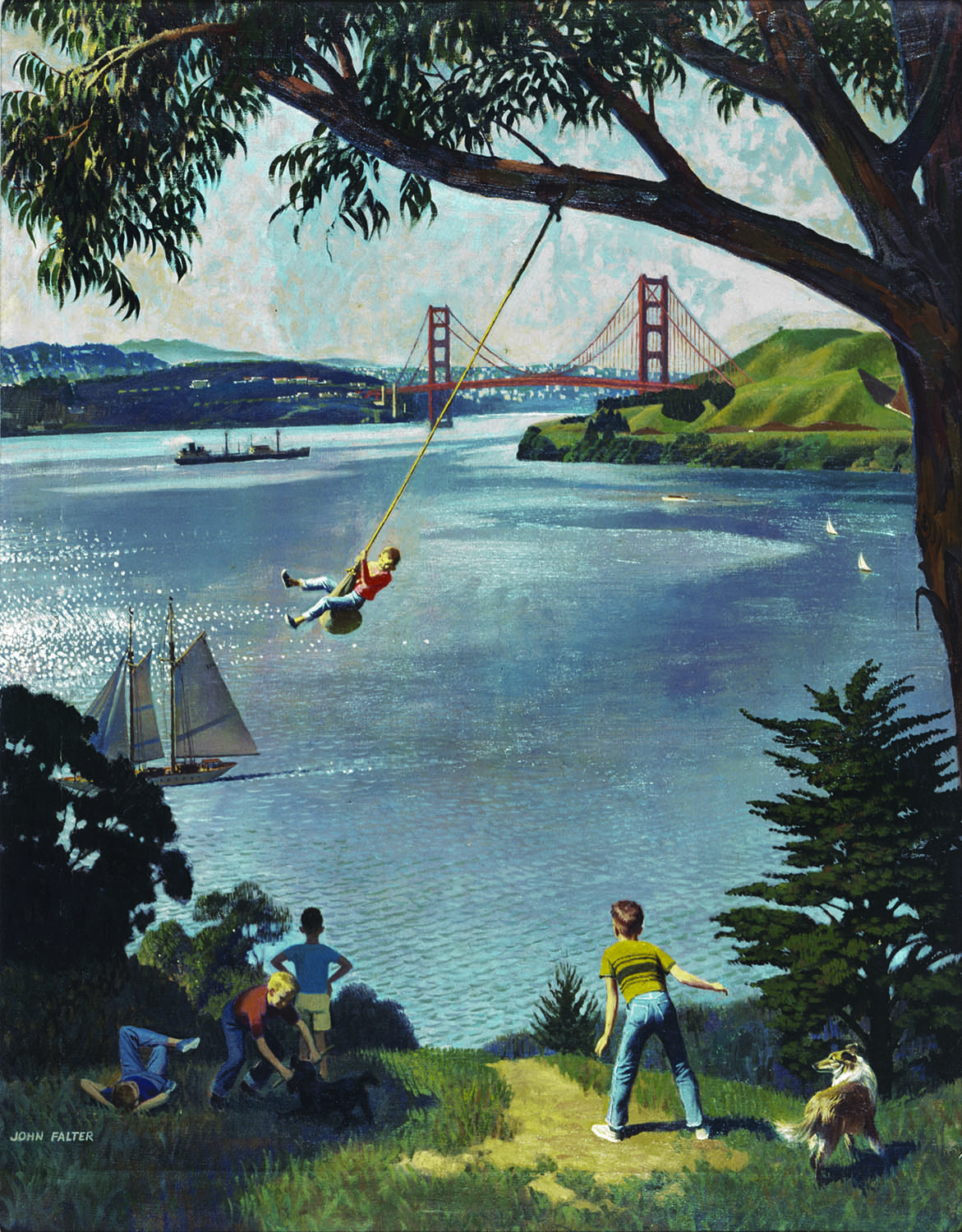
John Falter (1910-1982)
Golden Gate Bridge
1956, oil on canvas
28" x 24", signed lower left
Saturday Evening Post, May 26, 1956 cover
John Falter’s Golden Gate Bridge, created for the May 26, 1956 cover of The Saturday Evening Post, captures both the beauty of San Francisco Bay and the adventurous spirit of American childhood. Set against the sweeping backdrop of the Golden Gate Bridge stretching across the bright blue water, the illustration focuses on children fearlessly swinging from ropes along the cliffsides of Belvedere Island, turning the dramatic landscape into their personal playground. Falter contrasts the grandeur of one of America’s most iconic landmarks with the carefree daring of youth, creating a scene filled with movement, excitement, and nostalgia.
The accompanying anecdote published inside The Saturday Evening Post connected the scene to Falter’s own childhood memories. As a boy, Falter amused himself by swinging from a bag swing attached to a shed roof, testing whether he could avoid crashing into the building on the return swing. Years later, while admiring the Golden Gate Bridge from Belvedere Island near his own cliffside home, Falter was delighted to discover that children still entertained themselves in much the same thrilling way. The magazine jokingly noted that although Falter’s home appeared just blocks away from the scene, “he doesn’t bag-swing from it. The poor fellow must be getting old.” The humor and nostalgia of the story perfectly complement the cover’s celebration of youthful adventure and summertime freedom.
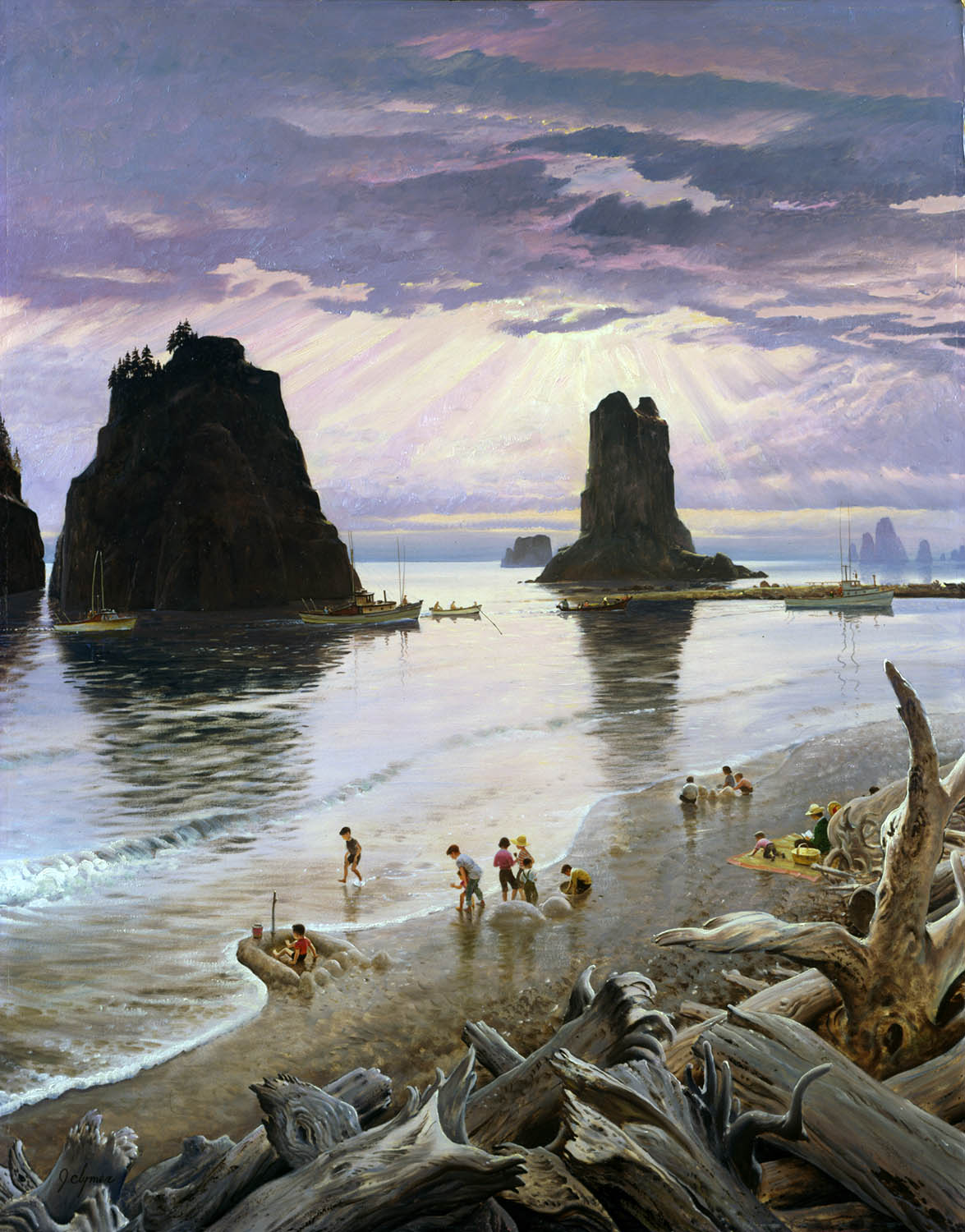
John Clymer (1907-1989)
Coast, La Push, Washington
1957, oil on board
34" x 27", signed lower left
Saturday Evening Post, July 27, 1957 cover
John Clymer’s Coast, La Push, Washington, created for the July 27, 1957 cover of The Saturday Evening Post, celebrates the rugged beauty and outdoor recreation of the Pacific Northwest during the summertime. Set along the dramatic coastline near La Push, Washington, the illustration shows families and vacationers gathering by the sea to fish, explore, and play among the towering sea stacks—described in the magazine as “rock cathedrals.” The unusual formations rise majestically from the water, giving the landscape both grandeur and mystery.
Clymer captures the excitement and freedom of a summer day spent outdoors, where nature itself becomes part of the adventure. The figures scattered along the shore emphasize the sense of discovery and recreation that drew visitors to the region, while the sweeping coastal scenery reflects the artist’s remarkable ability to portray the diverse American landscape. The cover transforms a specific location into a universal image of summertime exploration and family leisure.
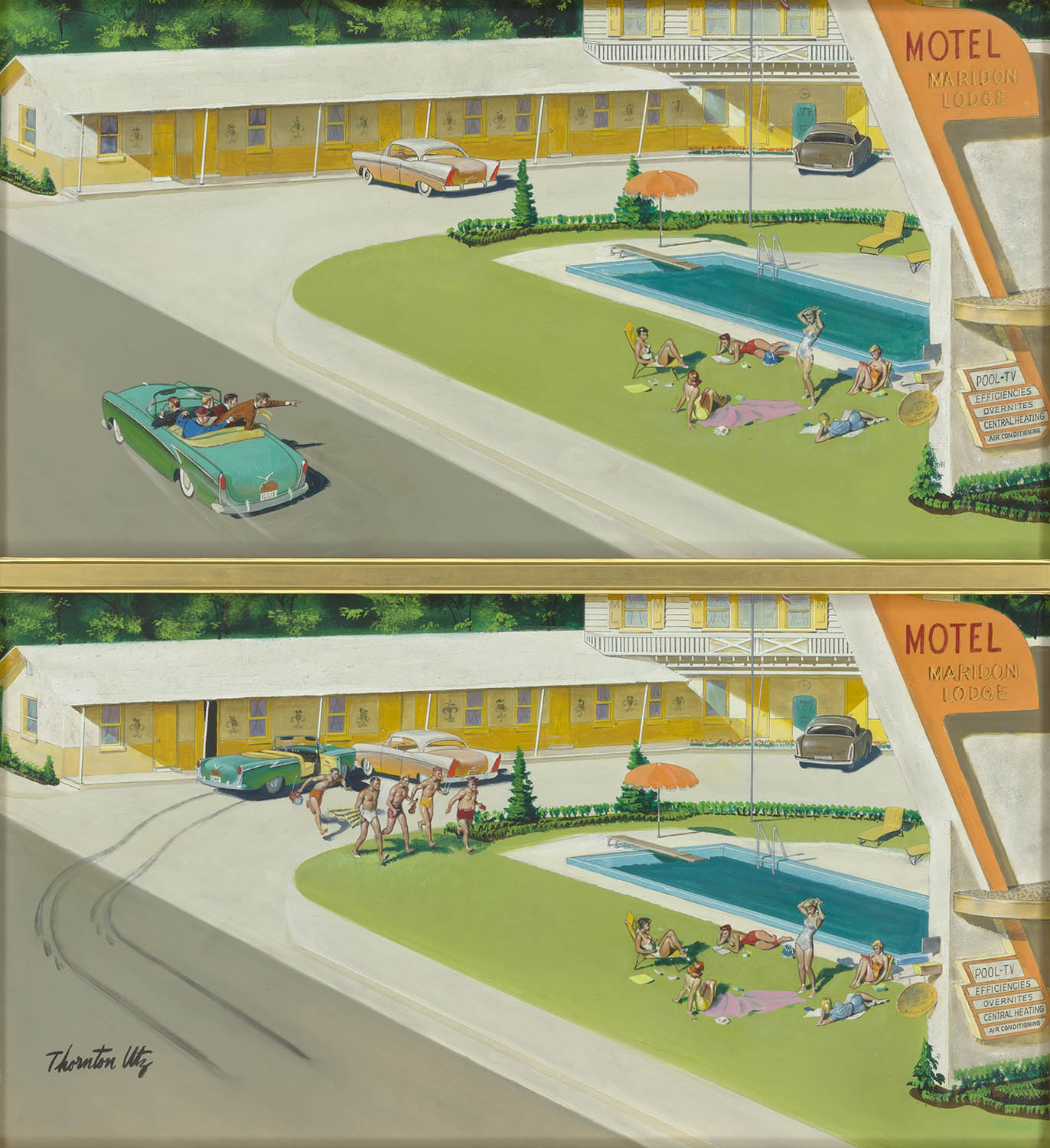
Thorton Utz (1914-1999)
Summer Madness
1957, oil and pencil on board
33 1/4" x 29 1/2", signed lower left
Saturday Evening Post, August 17, 1957 cover
Thornton Utz’s Summer Madness, created for the August 17, 1957 cover of The Saturday Evening Post, is a humorous and energetic portrayal of summertime road travel and youthful spontaneity. The scene, staged outside the Maridon Lodge in Sarasota, Florida, shows young women piled exuberantly onto and around an automobile, transforming an ordinary roadside moment into a lively spectacle of postwar American summer culture.
Utz went to remarkable lengths to ensure the realism and authenticity of the composition. As explained in The Saturday Evening Post, the girls in the painting were friends of Utz’s daughter, Wendy, while Mrs. Utz helped pose the models. Thornton Utz himself observed the scene from across the street atop a ladder as Sarasota police patiently directed bewildered motorists past the unusual tableau. Although inspired by Florida, Utz intentionally removed the palm trees and added a University of Connecticut car to make the setting feel universally American. The result is a playful celebration of the freedom, adventure, and occasional absurdity of the American summer road trip.
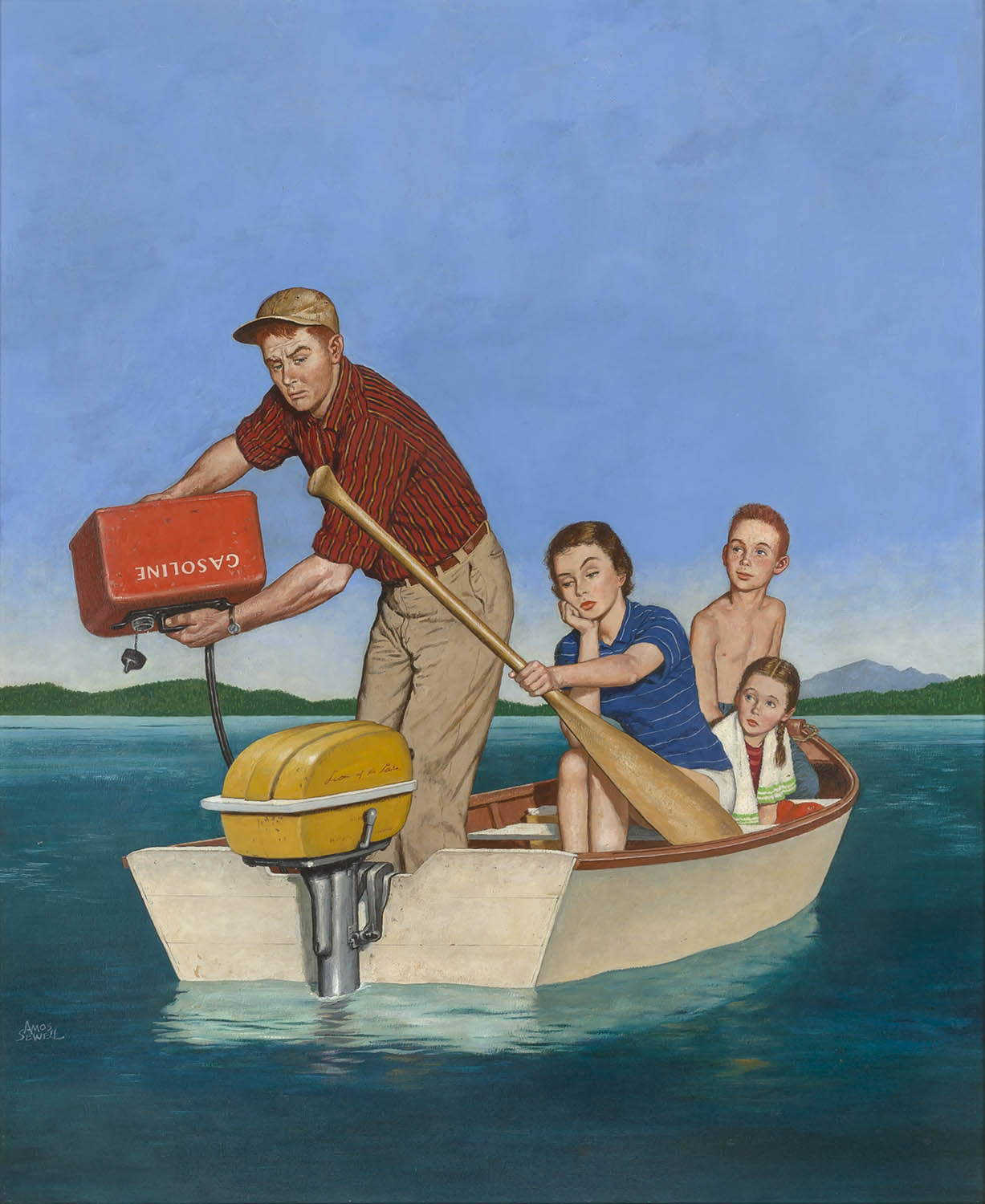
Amos Sewell (1901-1983)
Row, We're Out of Gas
1959, oil on board
30" x 24 1/2", signed lower left
Saturday Evening Post, June 27, 1959 cover
Amos Sewell’s Row, We’re Out of Gas, created for the June 27, 1959 cover of The Saturday Evening Post, is a masterful example of the artist’s ability to tell an entire story through expression and gesture alone. Stranded in a small boat after running out of fuel, the family faces a humorous summertime predicament familiar to anyone who has experienced vacation mishaps. The father desperately tilts the empty gas tank, hoping to coax out the final drops of gasoline, while the mother raises an eyebrow with a perfect expression of skepticism and disappointment as she hands him an oar. Nearby, the son and daughter watch anxiously, clearly eager to continue on to their anticipated destination.
Sewell’s brilliance lies in the subtle emotional interplay between the figures. Without dramatic action or dialogue, he captures frustration, embarrassment, impatience, and humor all at once. The illustration transforms an ordinary family inconvenience into a relatable and affectionate portrait of American summer travel, reminding viewers that the misadventures along the way often become the most memorable part of the vacation itself.
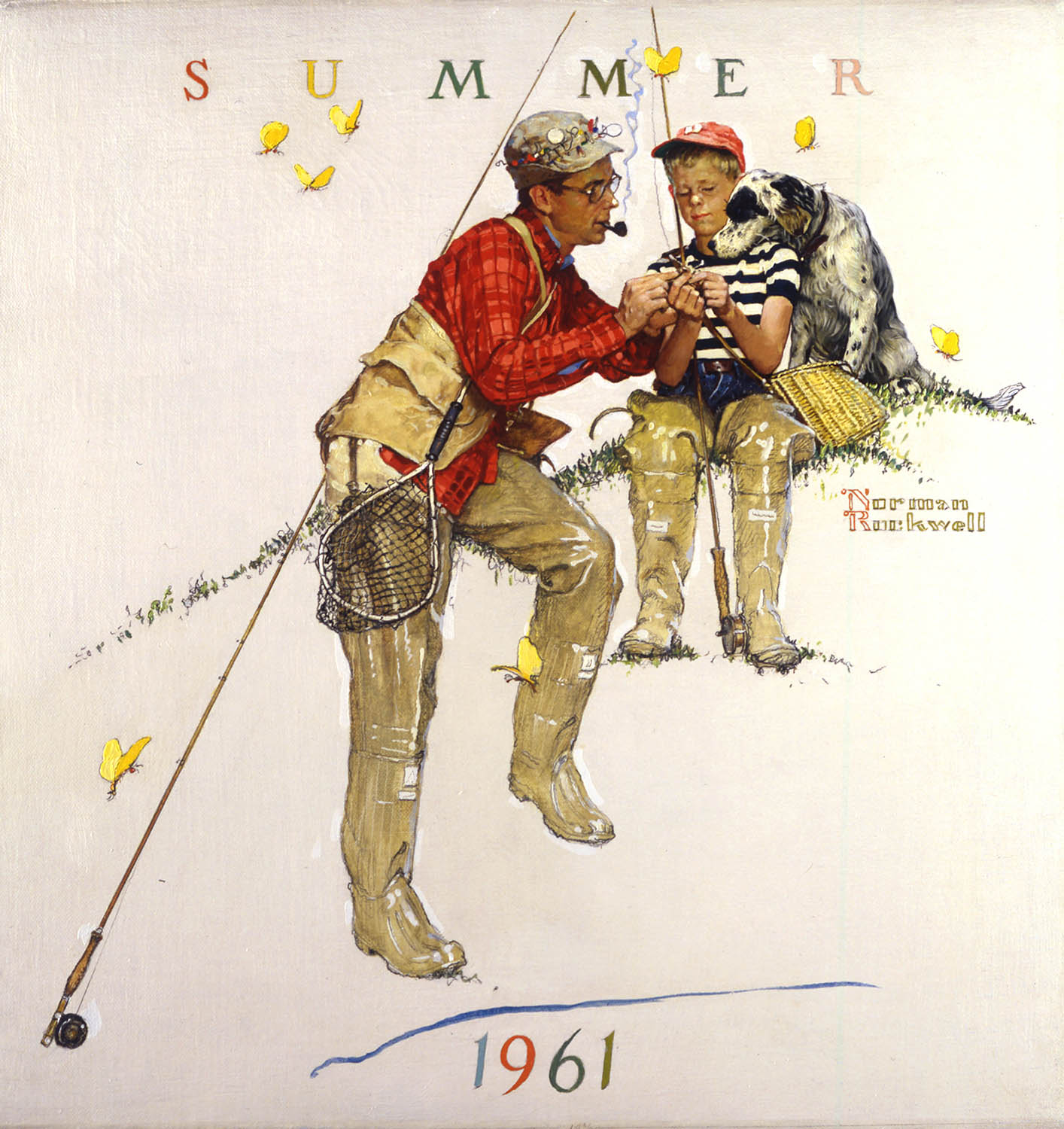
Norman Rockwell (1894-1978)
Summer: Father and Son Fishing
1961, oil on canvas
19 1/2" x 19 1/2", signed center left
Brown & Bigelow Four Seasons calendar, Summer, 1961
Norman Rockwell’s Summer: Father and Son Fishing, created for his 1961 Brown & Bigelow calendar series, is a touching portrayal of the quiet lessons and shared experiences that define family life. In the scene, a father teaches his young son how to bait a fishing hook while the family dog watches with eager curiosity. Rather than focusing on action or humor, Rockwell emphasizes tenderness, patience, and the bond between parent and child—qualities that made his calendar illustrations especially beloved by American audiences.
From 1948 through 1964, Rockwell created calendar illustrations for Brown & Bigelow, then the nation’s largest and most prolific calendar publisher. Reflecting on the difference between calendar art and magazine illustration, Rockwell explained that calendar images should be “quiet, pleasing—and enduring,” favoring emotional warmth and relatable subjects over dramatic humor or surprise. His paintings for Brown & Bigelow were designed to become familiar companions in homes and offices throughout the year.
Each calendar featured four seasonal images connected by a common theme or recurring characters. In the 1961 series, Rockwell explored meaningful moments between a father and son across the four seasons. Winter showed the father teaching his son to ski; Spring centered on a tender Easter scene of prayer; Summer focused on fishing and outdoor recreation; and Autumn concluded with the father teaching his son to shoot as leaves fell around them. Together, the series presents an idealized vision of American family life, where learning, tradition, and companionship unfold gently through the changing seasons.
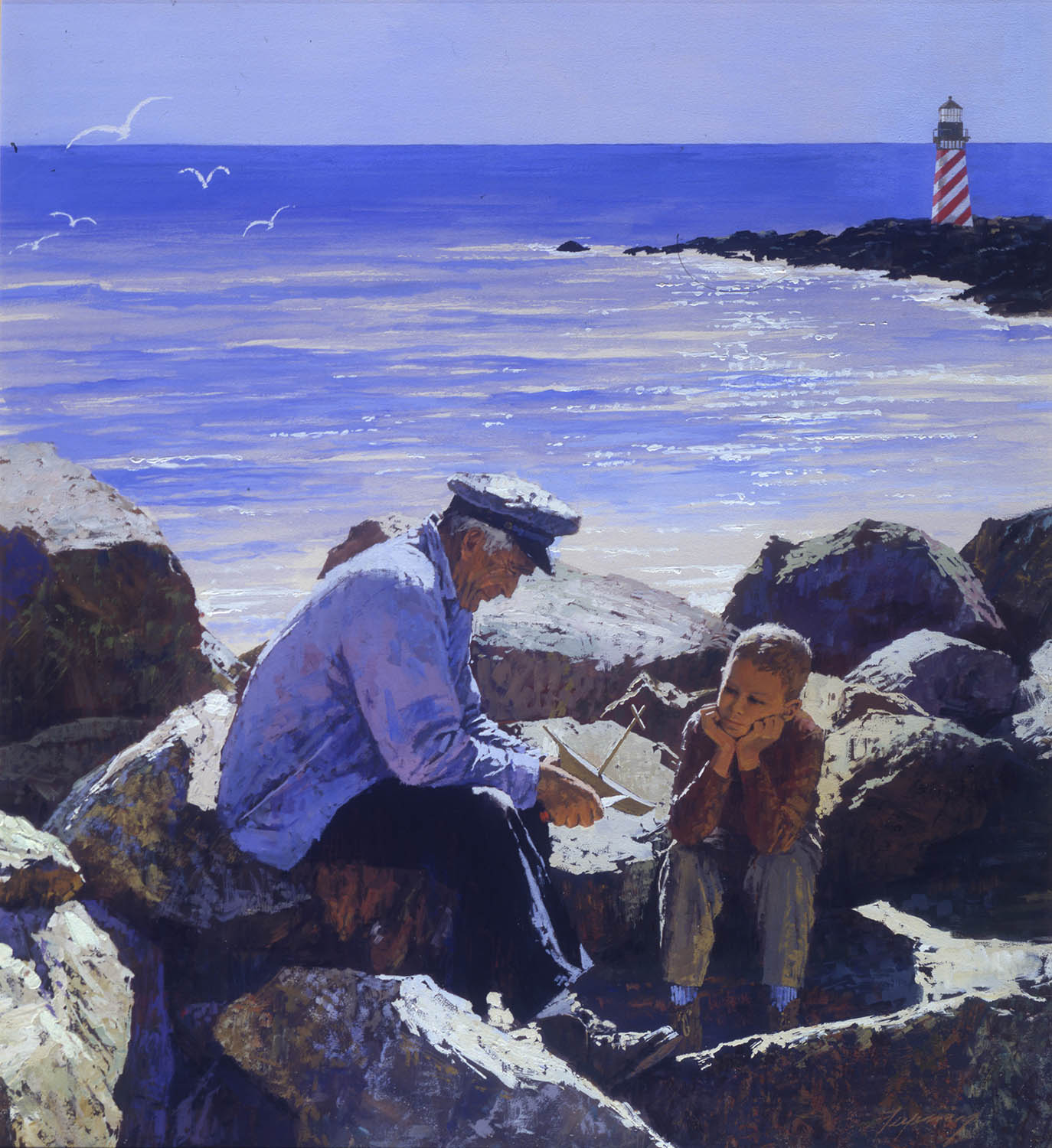
Howard Terpning (1927-?)
Captains' Conference
1965, tempera on board
22" x 20", signed lower right
Reader's Digest, June 1965 cover
Howard Terpning’s Captains’ Conference, created for the June 1965 cover of Reader’s Digest, is a tender and reflective portrayal of the bond between generations. Seated together on rocks beside the sea, a grandfather and grandson quietly work on a wooden sailboat, the older man carefully whittling and shaping the small vessel as the child watches with complete attention and admiration. The calm coastal setting and intimate interaction between the two figures create a scene filled with warmth, patience, and quiet affection.
Known for his extraordinary storytelling abilities, Terpning captures not simply an activity, but the passing of knowledge, tradition, and companionship from one generation to the next. The small handcrafted sailboat becomes a symbol of shared experience and childhood memory, while the peaceful seaside setting reinforces the contemplative and nostalgic tone of the image. As the final work in the exhibition, Captains’ Conference offers a fitting conclusion to Here Comes Summer, reminding viewers that some of the season’s most meaningful moments are the quiet ones spent together.