

As the United States marks the 250th anniversary of the signing of the Declaration of Independence, we celebrate not only the birth of a nation, but the generations of Americans who have preserved its story through art. From bustling Fourth of July parades and fireworks to commemorations of the nation's centennial anniversaries, American illustrators have captured the pride, optimism, and shared traditions that have defined Independence Day.
July's exhibition traces the many ways artists have interpreted our nation's founding. It begins with joyous celebrations of the Fourth of July, showcasing the community gatherings, patriotic pageantry, and family traditions that have long made the holiday a cornerstone of American life. It then looks back at the Centennial of 1876 and the Bicentennial of 1976, when illustrators were called upon to commemorate milestone anniversaries and reflect on the nation's continuing story. Finally, the exhibition returns to the Revolutionary War itself, portraying the courage, sacrifice, and determination of the men and women whose fight for independence made these celebrations possible.
American illustration has always done more than document history—it has shaped the way generations of Americans remember it. Through magazine covers, advertisements, books, posters, and paintings, these artists transformed historical events into enduring images that continue to inspire patriotism, gratitude, and a deeper appreciation for the ideals upon which the United States was founded.
The 4th of July
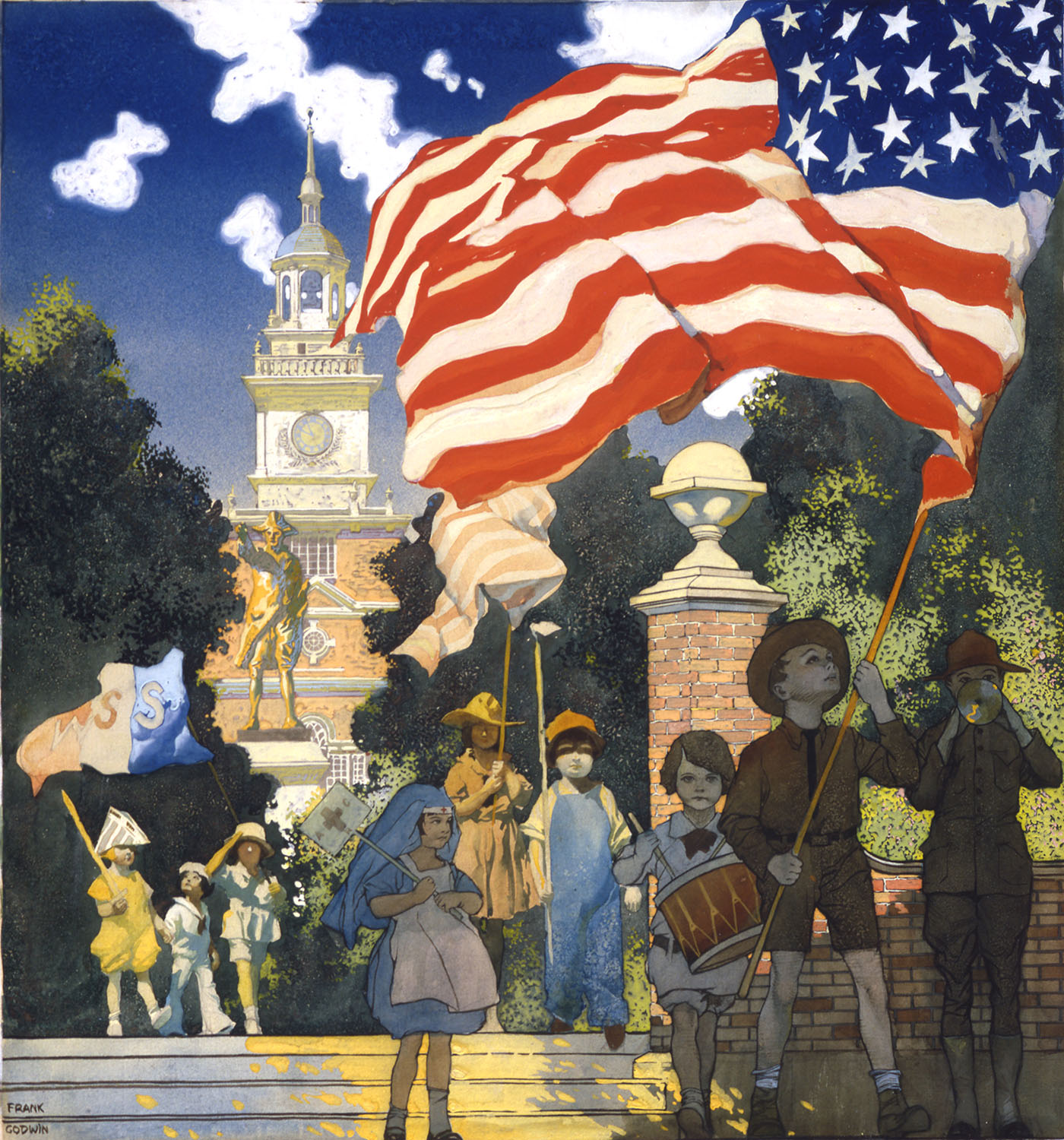
Frank Godwin (1889-1959)
Philadelphia Patriotic Scene
1917, gouache on board
18 1/2" x 17", signed lower left
World War I poster - War Savings Stamps Drive
Created during the First World War, Frank Godwin's Philadelphia Patriotic Scene was commissioned as a patriotic poster encouraging Americans to purchase War Savings Stamps in support of the war effort. Rather than depicting the battlefield, Godwin turned to one of the nation's most historic cities, filling the composition with recognizable Philadelphia landmarks and monuments that symbolize America's founding ideals.
At the heart of the scene, children dressed as soldiers, nurses, drummers, buglers, and other military personnel parade through the city in a spirited celebration of patriotism. Their youthful pageantry evokes both civic pride and optimism, reminding viewers that the nation's future rested with the next generation. By combining Revolutionary-era symbolism with the contemporary call to support the war effort, Godwin created an image that linked America's fight for independence with its ongoing defense of liberty.
Today, the illustration serves as both a vivid celebration of American heritage and a reminder of how artists have used patriotic imagery to unite the nation during moments of historic significance.
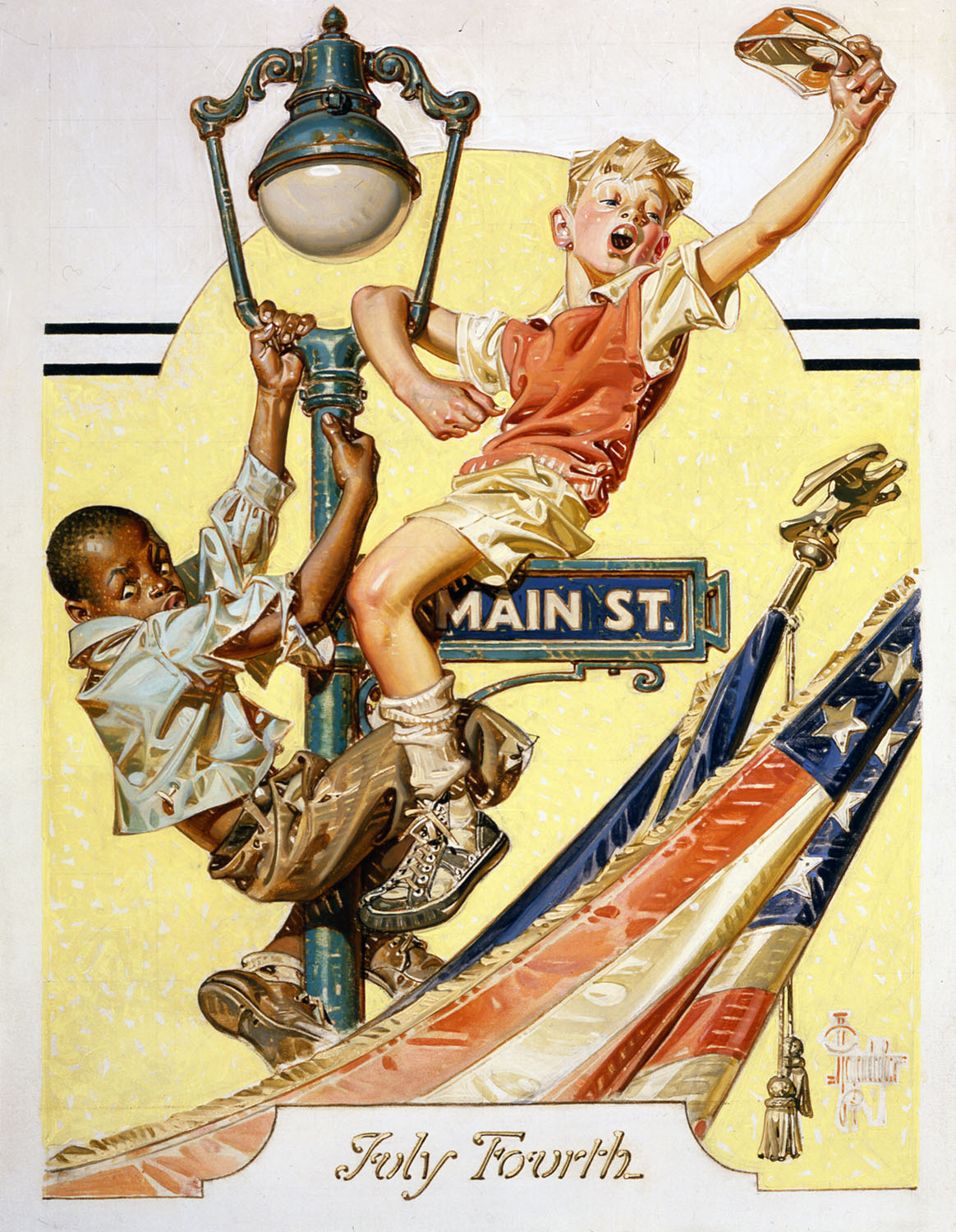
J.C. Leyendecker (1874-1951)
Fourth of July Parade View from Lamp Post
1937, oil on canvas
31 1/2" x 24 1/4", signed lower right
Saturday Evening Post, July 3, 1937 cover
J.C. Leyendecker's most beloved covers for The Saturday Evening Post often celebrated America's favorite holidays, including Christmas, Thanksgiving, Mother's Day, New Year's, and the Fourth of July. Painted for the magazine's July 3, 1937 cover, this illustration was inspired by a scene Leyendecker witnessed the previous year in his hometown of New Rochelle, New York.
Unable to see the local Independence Day parade from the crowded street, young Howard Davenport Jr. and his friend climbed a nearby lamp post for a better view. Leyendecker transformed this ordinary childhood moment into one of his most memorable holiday images. Perched confidently atop the street sign, Howard enthusiastically waves his hat as the parade passes below, while his friend clings to the pole beneath him, his anxious expression and precarious position adding both humor and dramatic tension to the composition.
The pairing of a White child and a Black child on the cover was also notable for its time. While reflecting the racial attitudes and visual conventions of the 1930s, the image nevertheless presents the boys sharing the excitement of Independence Day, united by their anticipation of the celebration unfolding before them. More than a festive holiday scene, the painting captures the timeless wonder of childhood and the shared traditions that have long brought Americans together on the Fourth of July.
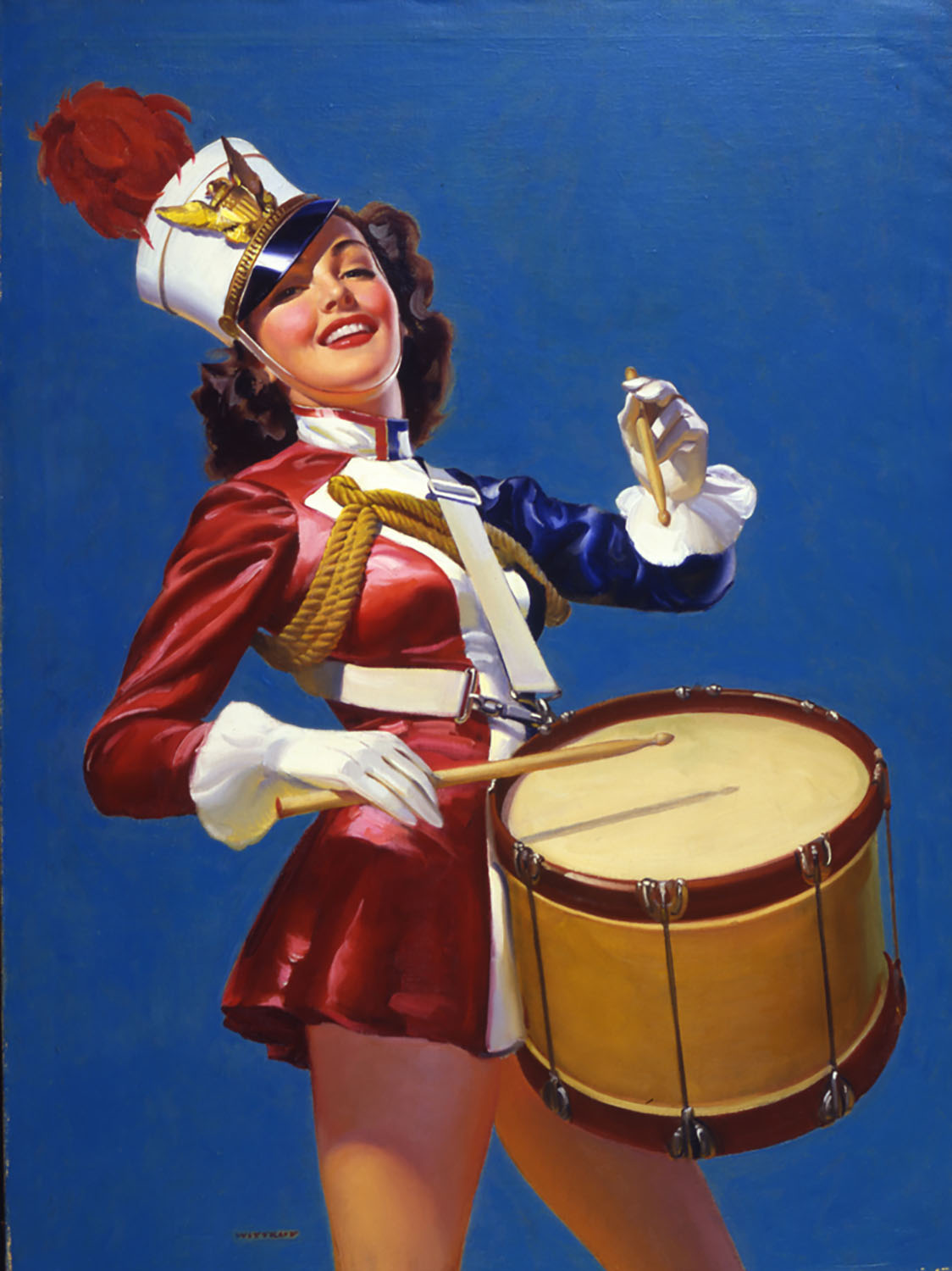
Jack Wittrup (1912-1987)
Leading the Parade
1945, oil on canvas
42" x 31", signed lower left
All-American Way calendar, 1945
Painted for the 1945 All-American Way calendar, Jack Wittrup's Leading the Parade captures the spirited optimism that defined America at the close of the Second World War. Featuring a young majorette leading a Fourth of July marching band, the illustration embodies the confidence, energy, and patriotic pride associated with postwar America.
Rendered in Wittrup's distinctive pin-up style, the composition is striking in its simplicity. Set against a bold, solid blue background, the drummer commands the viewer's attention as she marches confidently forward, meeting our gaze with a bright, engaging expression. The uncluttered design emphasizes her crisp uniform, vibrant colors, and dynamic pose, creating an image that is both celebratory and unmistakably American.
Like many commercial illustrations of the era, Leading the Parade reflects the idealized vision of small-town celebrations that became synonymous with Independence Day. Wittrup transforms a familiar holiday tradition into an iconic image of patriotism, reminding viewers that the Fourth of July is celebrated not only through history and remembrance, but through music, community, and joyful pageantry.
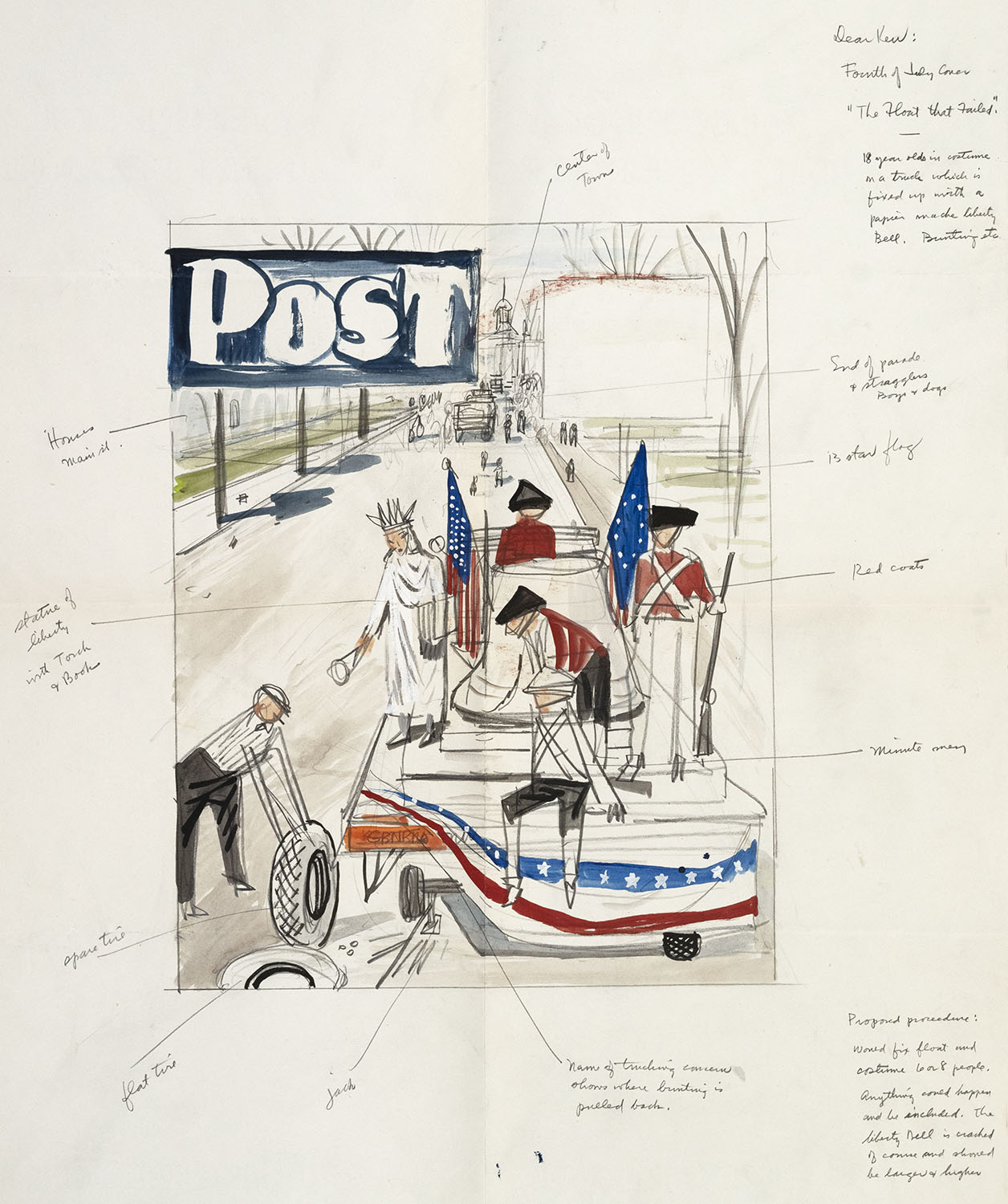
Stevan Dohanos (1907-1994)
The 4th of July Float That Failed
Gouache and pencil on paper
23" x 18"
Proposed cover for The Saturday Evening Post
Few artists captured the humor and charm of everyday American life as successfully as Stevan Dohanos. This unpublished sketch, created as a proposed cover for The Saturday Evening Post, imagines a delightfully human mishap during a Fourth of July parade.
The illustration centers on a patriotic float carrying a young woman dressed as the Statue of Liberty alongside participants dressed as Revolutionary War soldiers. Their grand entrance is abruptly halted by a flat tire, leaving the stranded riders looking on in disappointment as someone struggles to repair the wheel. Meanwhile, the rest of the parade continues down the street, disappearing into the distance and leaving the unlucky group behind.
Like many of Dohanos' best works, the humor lies not in slapstick exaggeration but in the relatable frustrations of everyday life. Even during one of the nation's most treasured celebrations, unexpected setbacks can become memorable moments. The sketch reminds us that the Fourth of July is not only about patriotic ceremony but also about the shared experiences, laughter, and imperfections that make community celebrations so enduringly American.
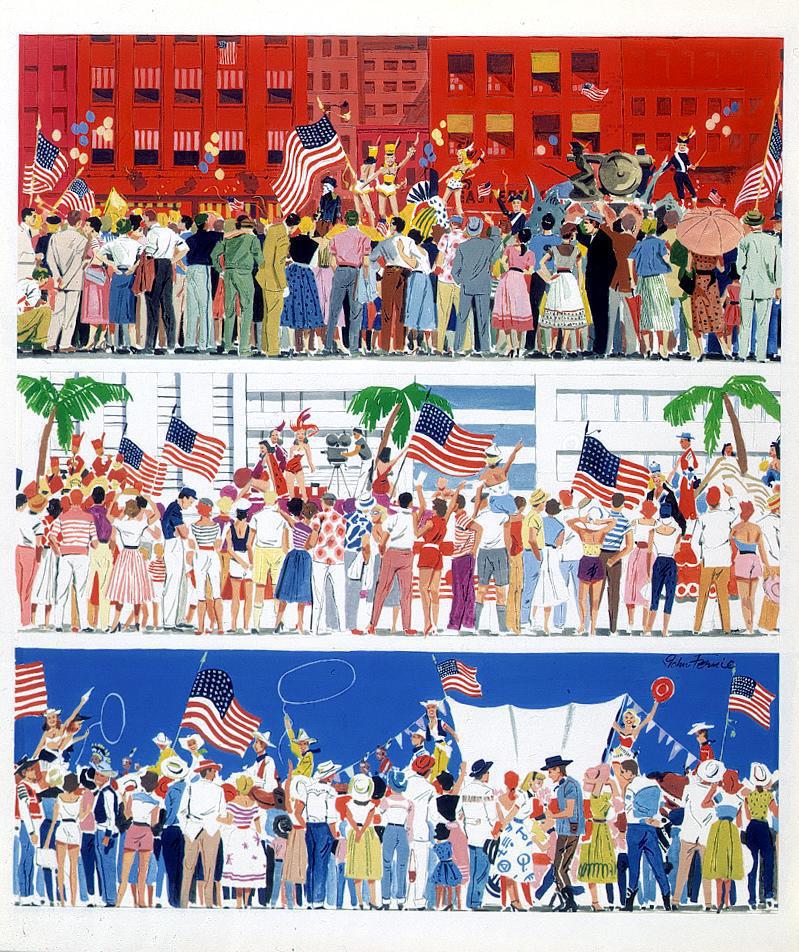
John Fernie
Fourth of July Parade
Gouache on board
26" x 20", signed lower right
The American Weekly, July 3, 1955 cover
Created for the July 3, 1955 cover of The American Weekly, John Fernie's Fourth of July celebrates the many ways Americans observe Independence Day across the country. Rather than depicting a single community, Fernie presents three distinct parades unfolding simultaneously—one in New York City, another in Hollywood, and a third in Texas.
Set against bold fields of red, white, and blue, each scene reflects the unique character of its region while emphasizing the traditions they share. New York's urban pageantry, Hollywood's touch of glamour, and Texas's Western flair each offer a different interpretation of the holiday, yet all are united by patriotic processions, waving flags, marching bands, and enthusiastic spectators.
Fernie's composition reminds viewers that although Independence Day is celebrated differently from one community to the next, it remains a shared national tradition. By juxtaposing these regional celebrations within a single image, he illustrates the diversity of the American experience while underscoring the common values of patriotism, community, and remembrance that have defined the Fourth of July for generations.
Centennial Celebrations
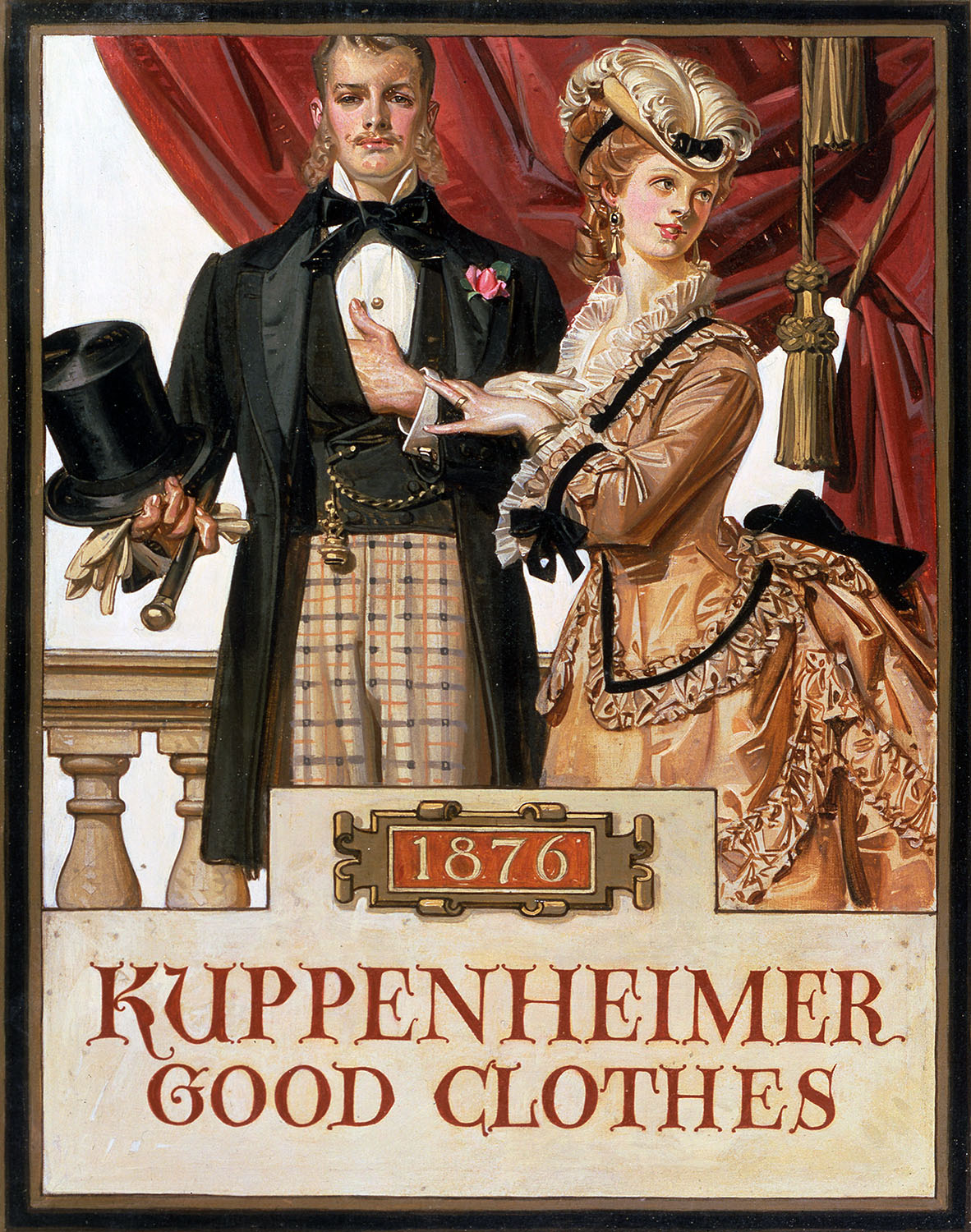
J.C. Leyendecker (1874-1951)
1876 - Kuppenheimer Good Clothes
1926, oil on canvas
26" x 20"
House of Kuppenheimer advertisement, printed in Saturday Evening Post, September 18, 1926
Painted in 1926 for House of Kuppenheimer's "Kuppenheimer Good Clothes" advertising campaign, 1876 was created to commemorate the sesquicentennial—the 150th anniversary of the founding of the United States. As Americans reflected on a century and a half of independence, many artists and advertisers looked to the nation's past for inspiration, celebrating both its history and its cultural evolution.
Leyendecker's illustration presents a fashionable couple dressed in the elegant attire of 1876, recreating the refined styles that would have been worn during the nation's Centennial celebration fifty years earlier. Rich in historical detail, the painting evokes an era of optimism and prosperity while showcasing the craftsmanship and sophistication that Kuppenheimer sought to associate with its clothing.
Like many commemorative works produced during the sesquicentennial year, 1876 demonstrates how American illustration could transform history into a powerful marketing tool. By inviting viewers to look back on the nation's first 150 years, Leyendecker linked patriotism, nostalgia, and fashion, reminding audiences that the American story is preserved not only in monuments and history books, but also through the images that have shaped each generation's memory of the past.
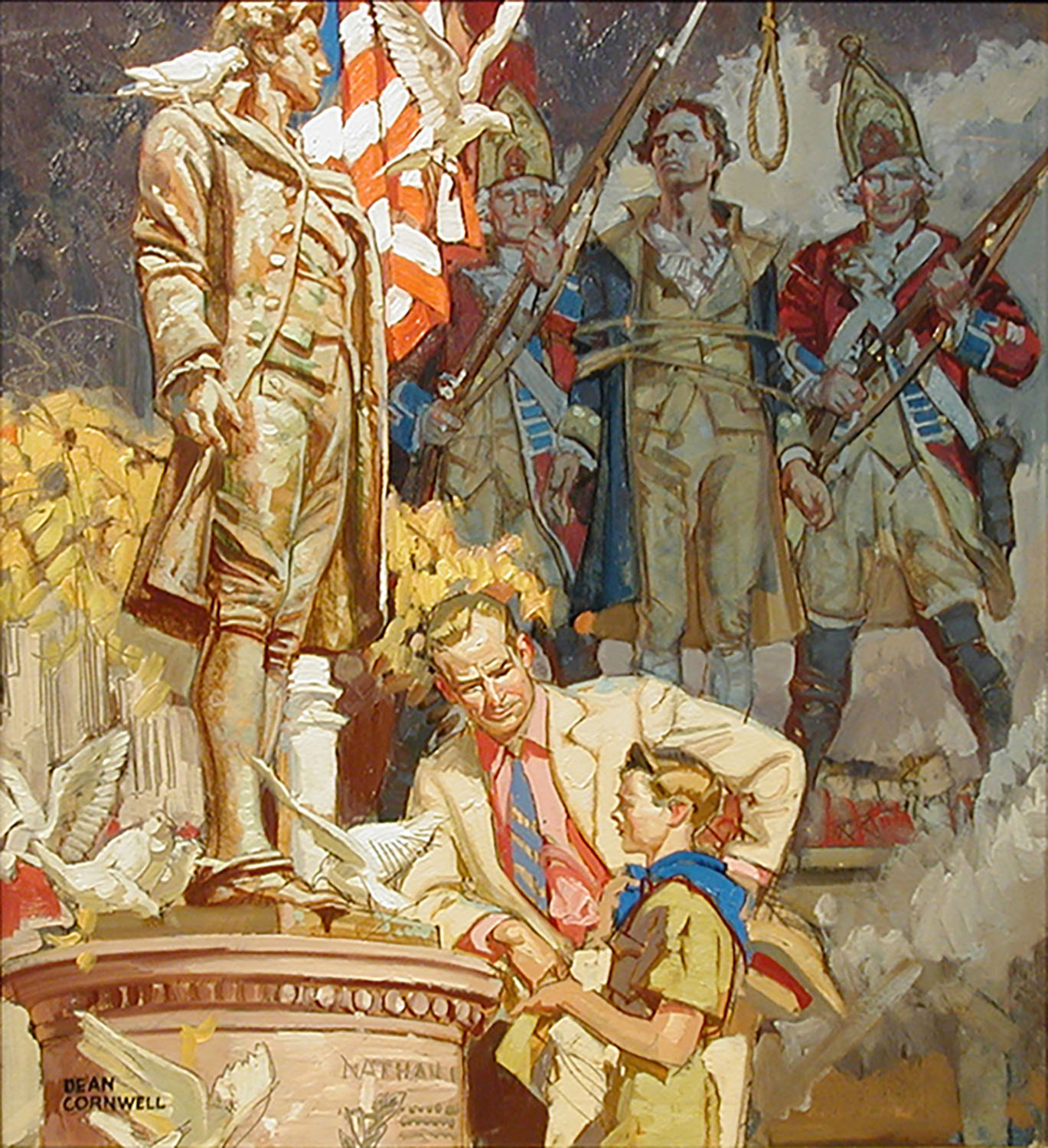
Dean Cornwell (1892-1960)
Nathan Hale and the Boy Scouts - Study
1952, oil on board
19 1/2" x 18 1/2", signed lower left
Boys' Life, July 1952 cover study
Known as the “Dean of Illustrators,” Dean Cornwell was celebrated for his powerful narrative compositions and his ability to bring history to life for popular audiences. In this study for the July 1952 cover of Boys' Life, Cornwell depicts a young Boy Scout standing in quiet admiration before a statue of Nathan Hale, the Revolutionary War hero remembered for his famous last words: “I only regret that I have but one life to lose for my country.”
The image captures a moment of reverence and historical reflection. Carefully arranged details enrich the story: Redcoat figures in the upper right allude to Hale’s capture and execution, doves surrounding the statue suggest peace, and the prominent American flag connects Hale’s sacrifice to the enduring ideals of the nation he served.
Created for young readers in the early years of the Cold War, the cover encouraged Boy Scouts to see Hale’s courage, honor, and devotion to country as values still relevant to their own lives. Through Cornwell’s dramatic yet thoughtful storytelling, the Revolutionary past becomes a source of inspiration for future generations.

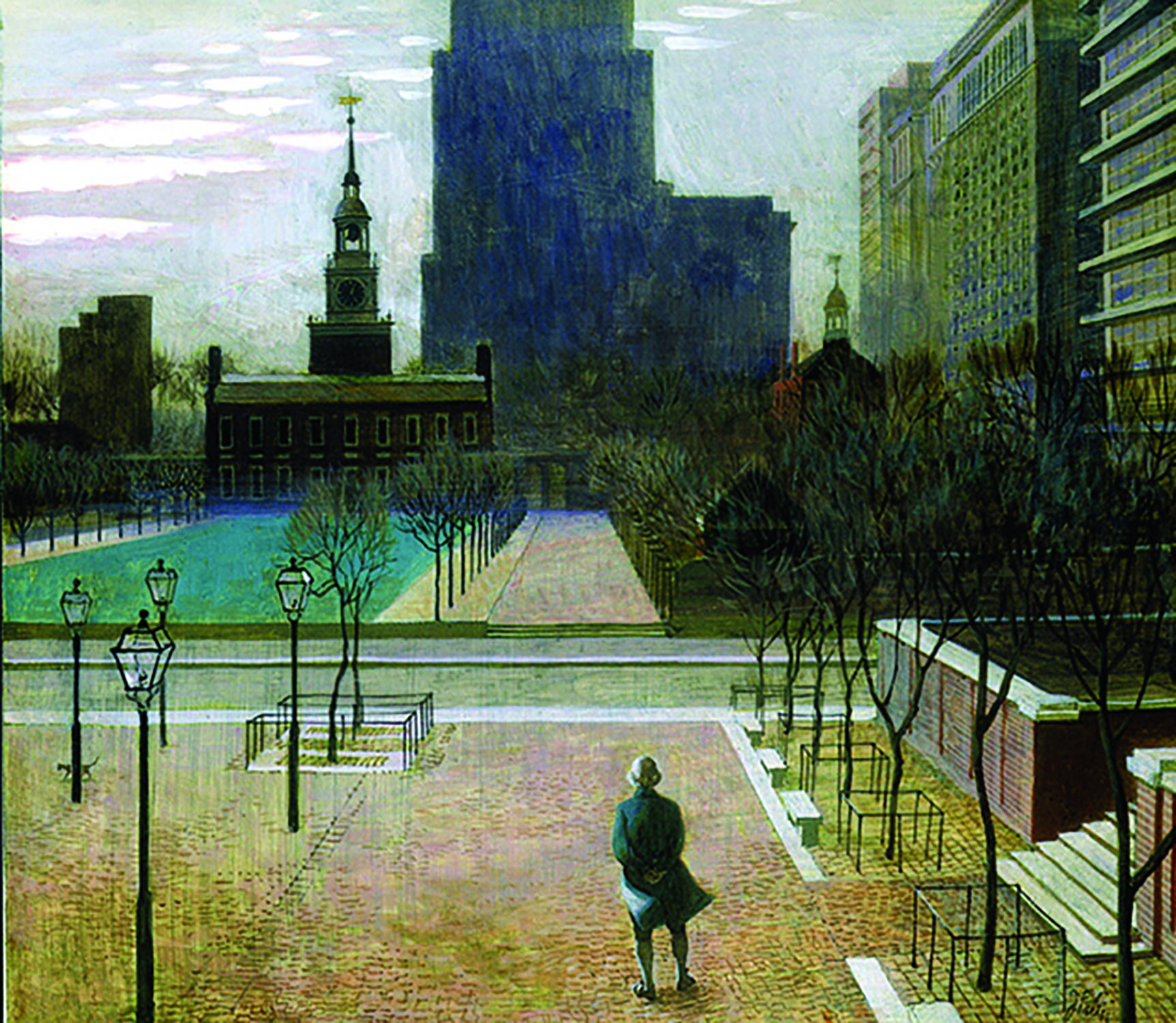
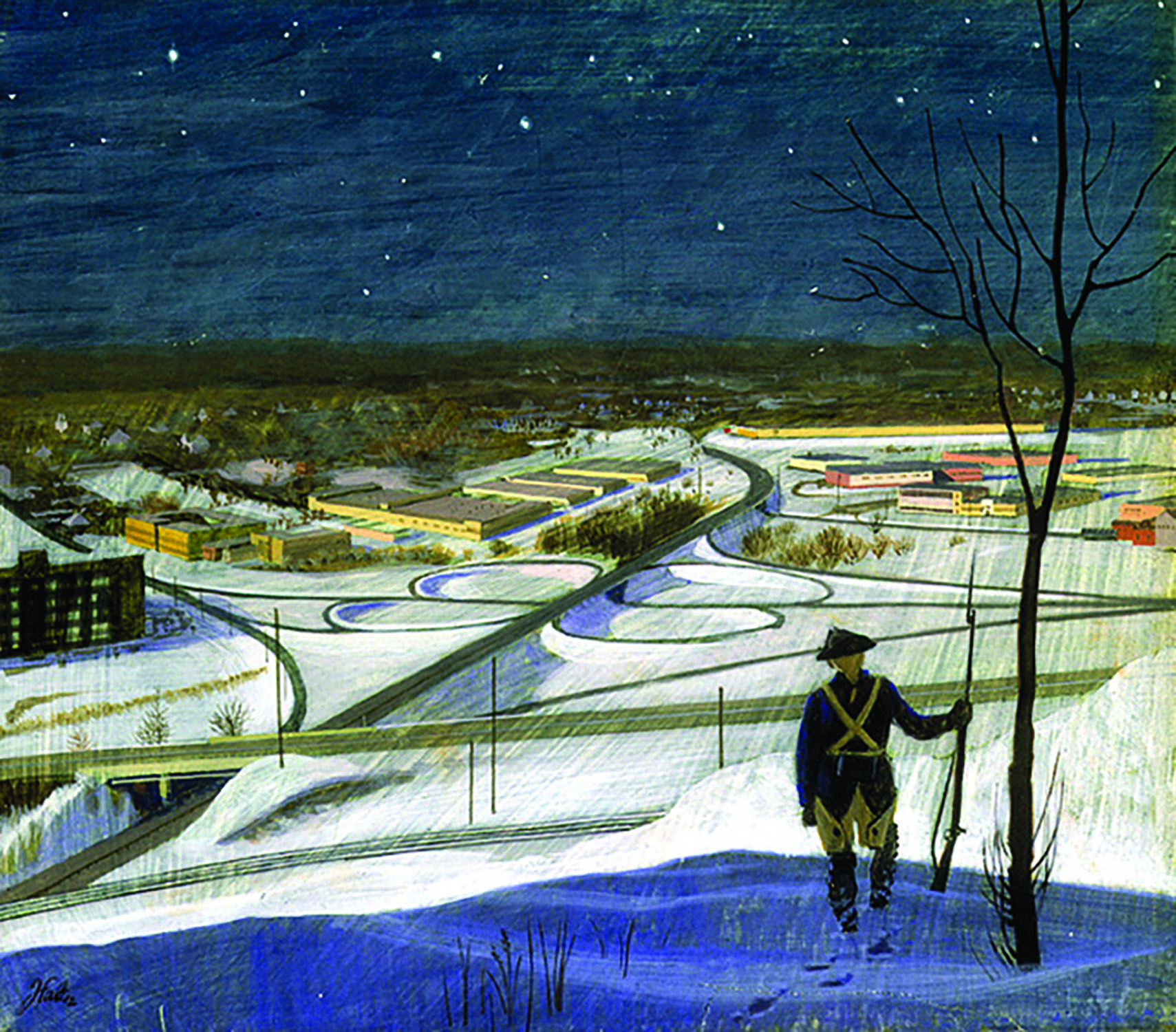
John Falter (1910-1982)
150th Anniversary Series: Center City, Philadelphia; Independence Hall; Valley Forge
1976, tempera on board
Center City, Philadelphia: 12" x 13 1/2", signed lower left
Independence Hall: 12" x 13 1/2", signed lower right
Valley Forge: 12" x 13 1/2", signed lower left
Created for the United States Bicentennial in 1976, this trio of illustrations by John Falter imaginatively bridges two centuries of American history by placing Benjamin Franklin and a Revolutionary War soldier into modern-day Philadelphia. Rather than recreating the past, Falter invites viewers to imagine how two iconic figures of the American Revolution might experience the nation they helped create 200 years later.
The first two paintings follow Franklin as he strolls through the streets of Center City and visits Independence Hall, the very place where he helped shape the nation's founding. Surrounded by modern skyscrapers, automobiles, and bustling crowds, Franklin becomes both a visitor and a witness to the remarkable transformation of the city he once called home. The third painting shifts to Valley Forge, where a Revolutionary War soldier stands amid the peaceful historic landscape, reflecting on the sacrifices made there during the nation's struggle for independence.
Commissioned during America's Bicentennial celebration, these works capture the spirit of 1976 by connecting the ideals of the Revolutionary generation with contemporary America. Falter's inventive juxtaposition of past and present reminds viewers that while the nation has changed dramatically over two centuries, the places where history was made continue to serve as enduring symbols of the American story.
The American Revolution
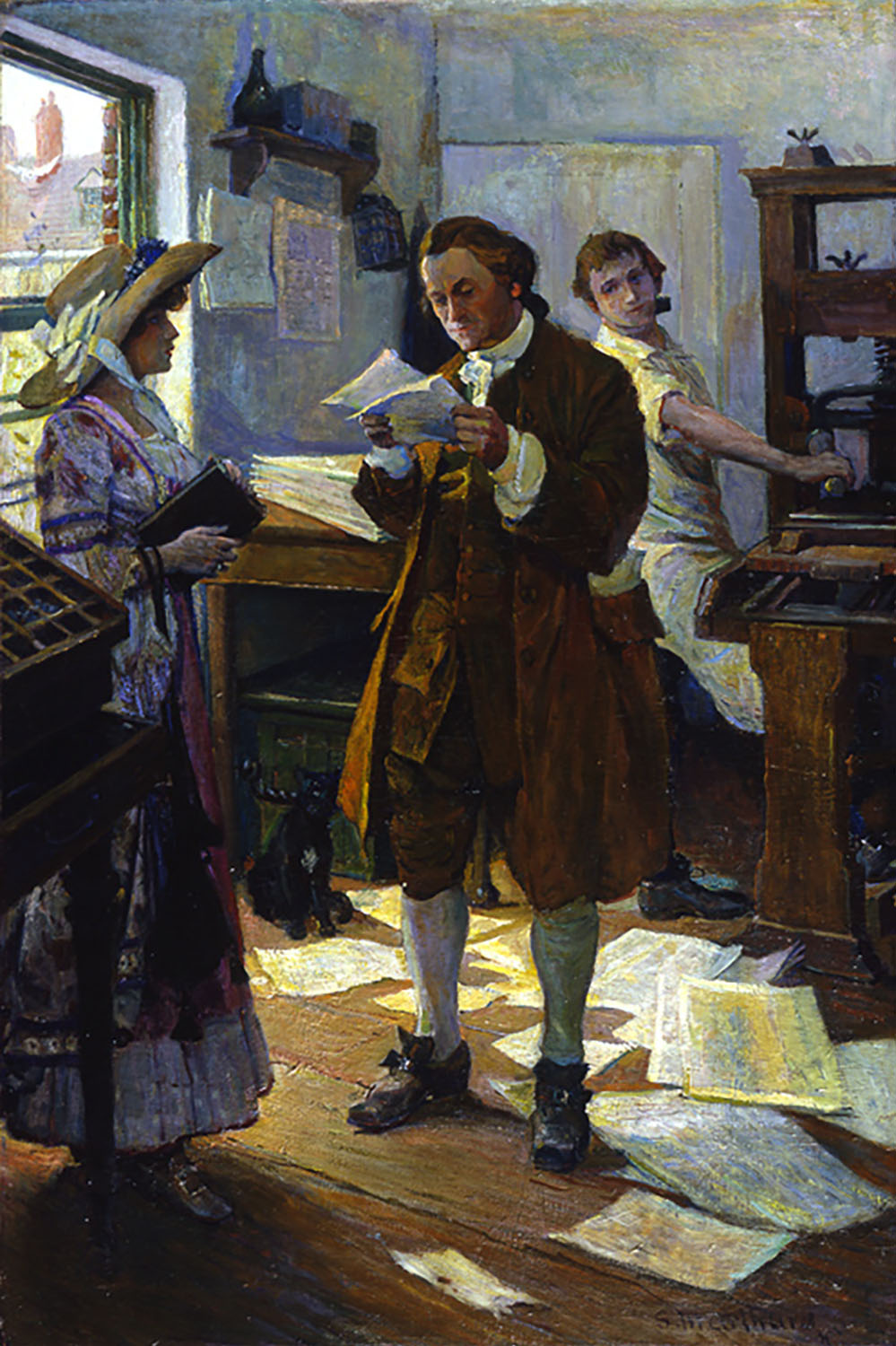
Stanley Arthurs (1877-1950)
Ben Franklin, Printer
1915, oil on canvas
36" x 24", signed lower right
"Ben Franklin, Printer," Ellis Paxon Oberholtzer, American Historical Scene, University of Pennsylvania Press, 1935, pg. 44
Before Benjamin Franklin became one of the most influential figures of the American Revolution, he first made his name as a printer, publisher, and man of ideas. In Ben Franklin, Printer, Stanley Arthurs depicts Franklin at work in his print shop, surrounded by the tools of the trade that helped launch his remarkable career.
The printing press was central to Franklin's life and to the spread of revolutionary thought in colonial America. Through newspapers, pamphlets, almanacs, and public notices, printers helped circulate the ideas that shaped political debate and encouraged a growing sense of American identity. Franklin's own success as a printer gave him the influence, independence, and intellectual reach that would later make him essential to the cause of independence.
Arthurs' image reminds viewers that the Revolution was fought not only on battlefields, but also through words, ideas, and communication. By portraying Franklin at the press, the illustration honors the power of the printed word in building a nation and celebrates one of America's founding figures at the beginning of his extraordinary public life.
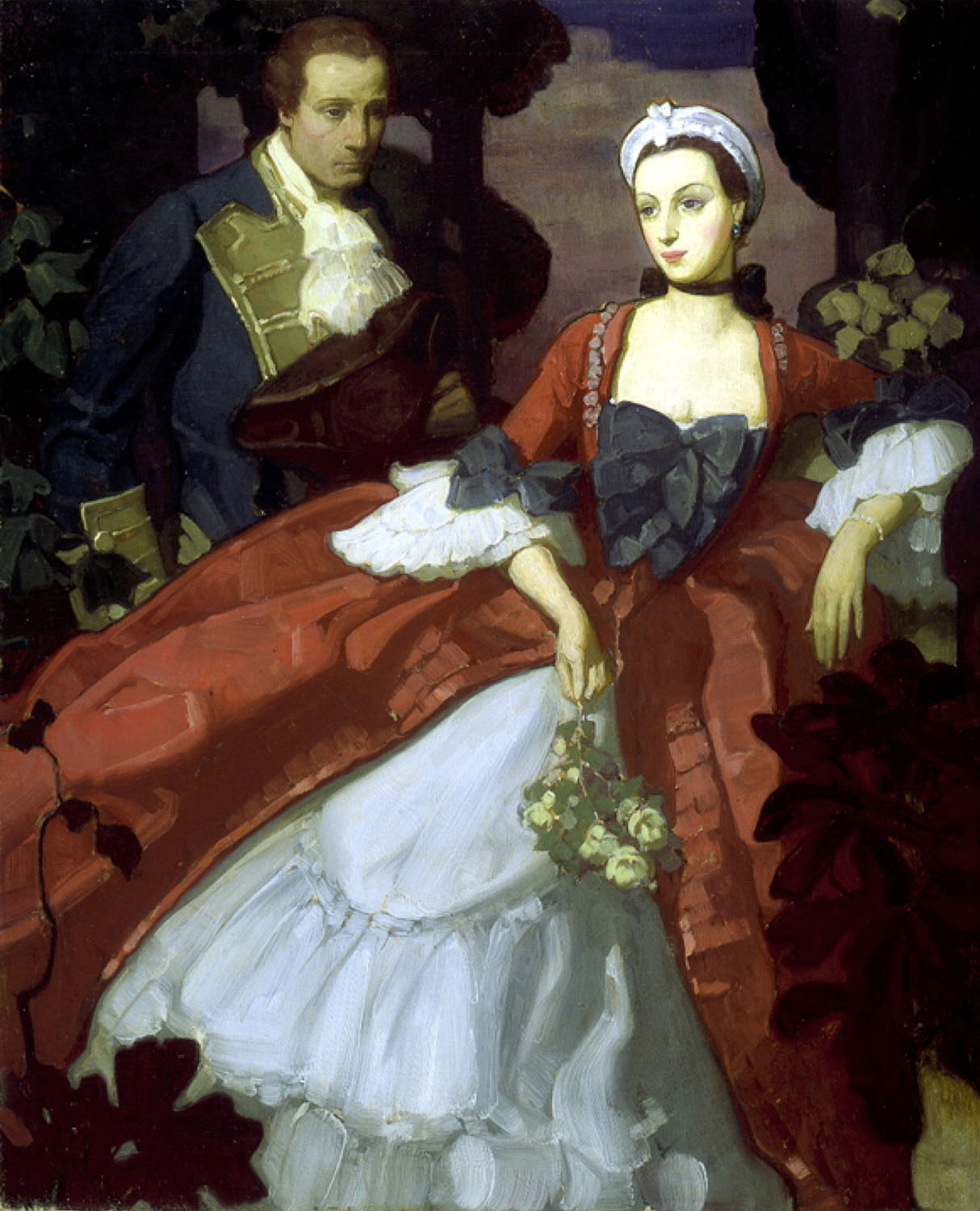
Mead Schaeffer (1898-1980)
George Washington with Sally Fairfax
1931, oil on canvas
32" x 26 1/2"
Everybody's Washington, by Alden Knipe, Dodd Mead & Company, 1931
"The Young Major visited Belvoir to see Sally Fairfax, whom he greatly admired."
Rather than portraying George Washington as the commanding general or revered first president, Mead Schaeffer offers a more intimate glimpse of the man before history transformed him into an American icon. Created to illustrate Alden Knipe's Everybody's Washington, the painting depicts the young Washington with Sally Fairfax, his close friend, confidante, and the woman widely believed to have been his first great love.
By focusing on this quiet, personal moment, Schaeffer reveals a thoughtful and emotionally complex Washington whose character was shaped not only by military triumphs and political leadership, but also by the relationships and experiences of his early life. The tenderness of the scene offers a striking contrast to the more familiar heroic portrayals of the nation's founding figures.
Painted during the twentieth century, when illustrators increasingly sought to make historical figures more relatable to modern audiences, George Washington and Sally Fairfax reminds viewers that even America's greatest leaders began as ordinary people. Schaeffer's interpretation suggests that the qualities of courage, wisdom, and leadership are forged through both public service and personal experience, enriching our understanding of the man who would become the first President of the United States.
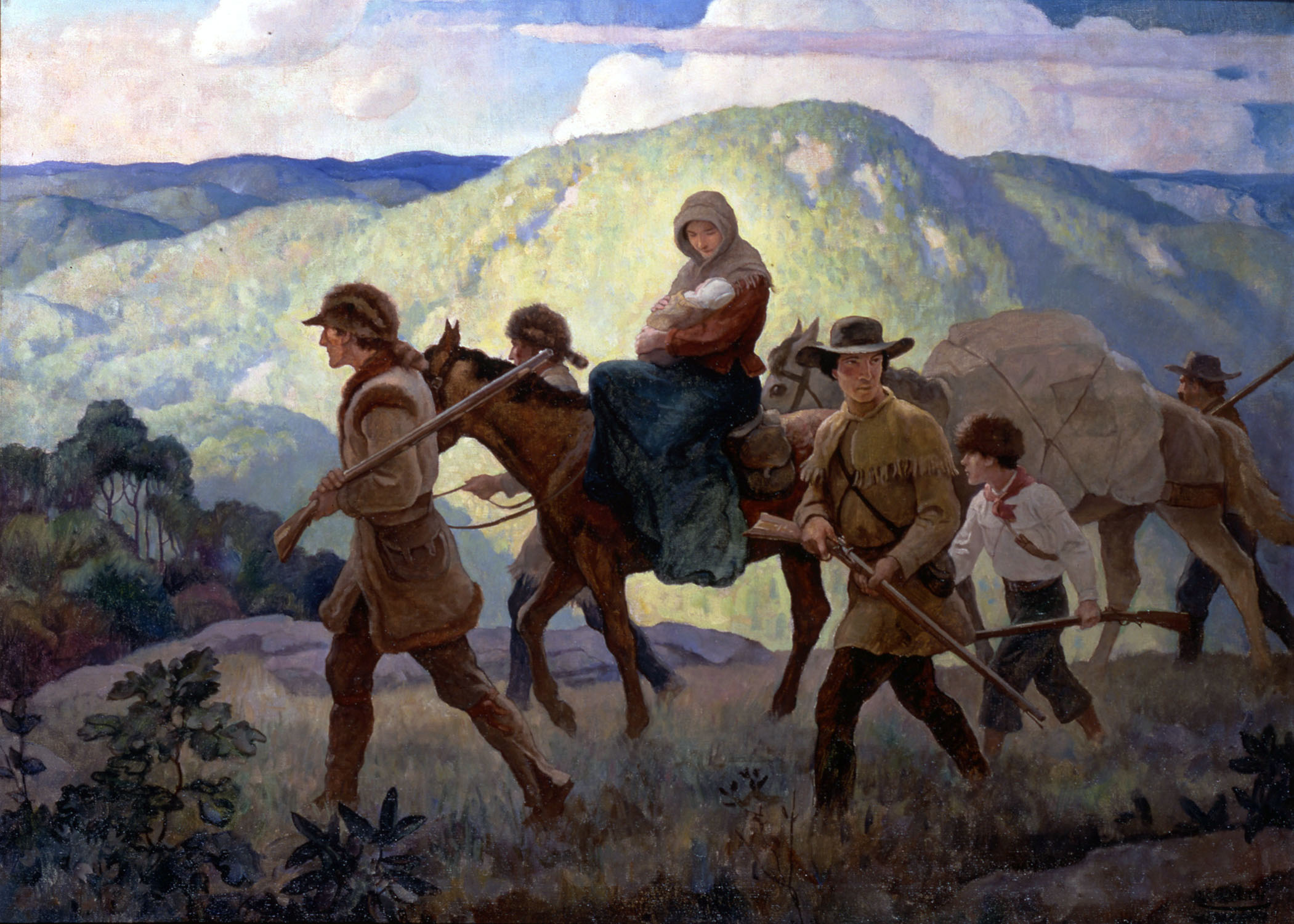
N.C. Wyeth (1882-1945)
Daniel Boone, The Home Seeker - Cumberland Valley
1936, oil on canvas
30" x 41", signed lower right
The Home Insurance Company calendar, 1938
In Daniel Boone, The Home Seeker – Cumberland Valley, N. C. Wyeth portrays the legendary frontiersman leading settlers through the Cumberland Valley in search of new opportunities on the American frontier. While Boone serves as the guide, Wyeth places a mother holding her infant at the emotional center of the composition, shifting the focus from exploration alone to the families who helped shape the young nation.
Her presence transforms the scene into a story of perseverance, hope, and the creation of home. The settlement of the American frontier was not accomplished by explorers alone; women and children carried with them the promise of stability, community, and future generations. By emphasizing this family's journey, Wyeth reminds viewers that the nation's expansion depended as much on ordinary families as it did on legendary pioneers.
Created during the twentieth century, the illustration reflects the enduring American fascination with the frontier and the ideals of courage, resilience, and opportunity associated with westward expansion. Through his masterful storytelling, Wyeth celebrates not only Daniel Boone's leadership but also the determination of the families who ventured into an uncertain future in pursuit of a better life.
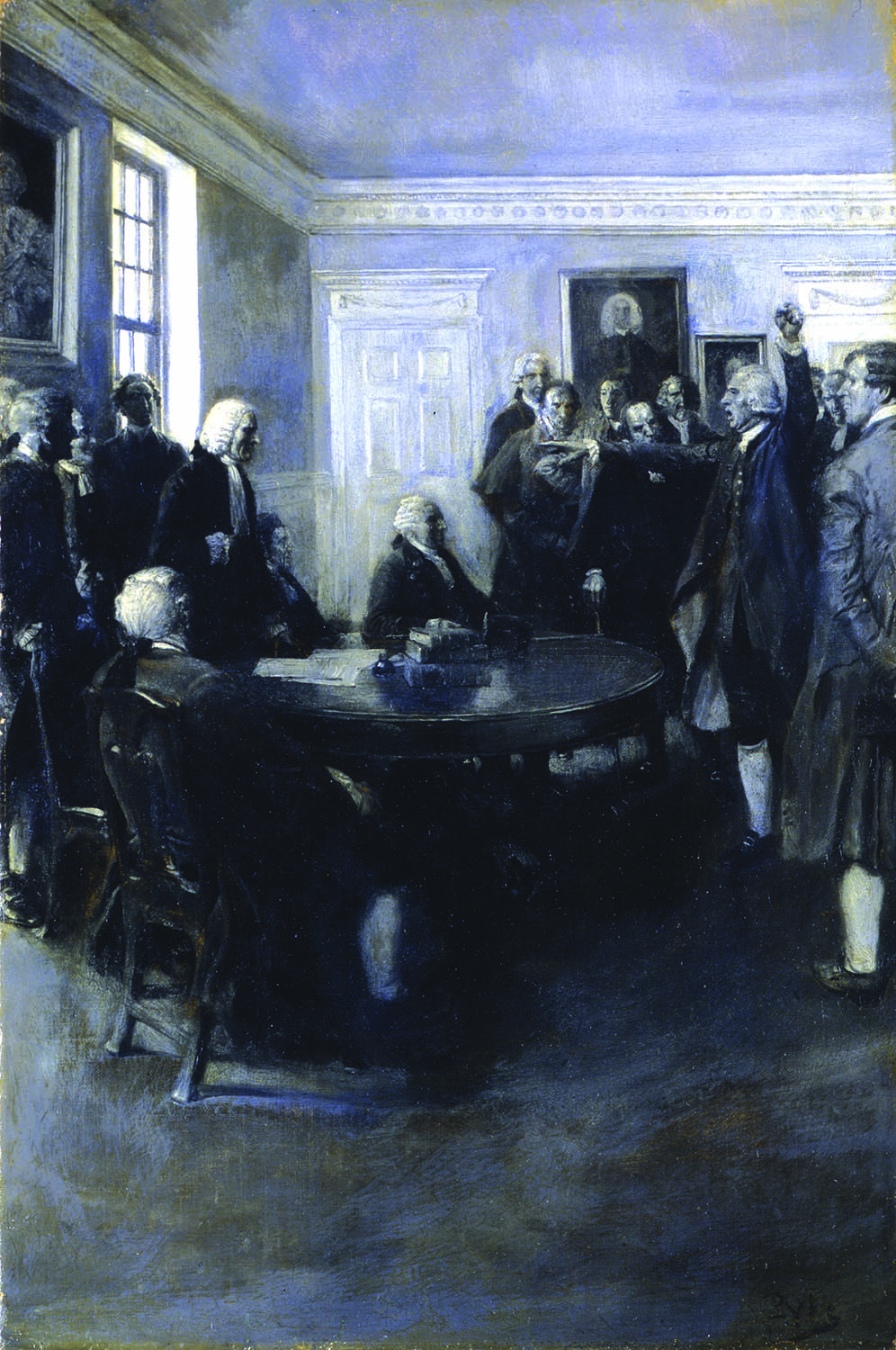
Howard Pyle (1853-1911)
After the Massacre - Samuel Adams Demanding of Governor Hutchinson the Instant Withdrawal of British Troops
1901, oil on canvas
24" x 16", signed lower right
Colonies and Nations Part 6, by Woodrow Wilson, Harper's Magazine, August 1901, pg. 195
Howard Pyle captures one of the defining moments leading to the American Revolution in this dramatic illustration of Samuel Adams confronting Massachusetts Governor Thomas Hutchinson in the aftermath of the Boston Massacre. Following the deadly clash between British soldiers and Boston civilians on March 5, 1770, Adams demanded the immediate removal of British troops from the city, recognizing that their continued presence threatened both public safety and colonial liberty.
Created to accompany Woodrow Wilson's historical series Colonies and Nation in the August 1901 issue of Harper's Magazine, the illustration reflects Pyle's extraordinary ability to combine historical scholarship with compelling visual storytelling. Rather than depicting the violence of the massacre itself, Pyle focuses on the tense political confrontation that followed, emphasizing the resolve and moral courage of the colonial leaders who challenged British authority.
Often regarded as the father of modern American illustration, Pyle believed historical paintings should immerse viewers in the drama and humanity of the past. Through expressive figures, carefully researched costumes, and a powerful sense of atmosphere, he transforms a pivotal political meeting into a defining moment on the road to American independence.
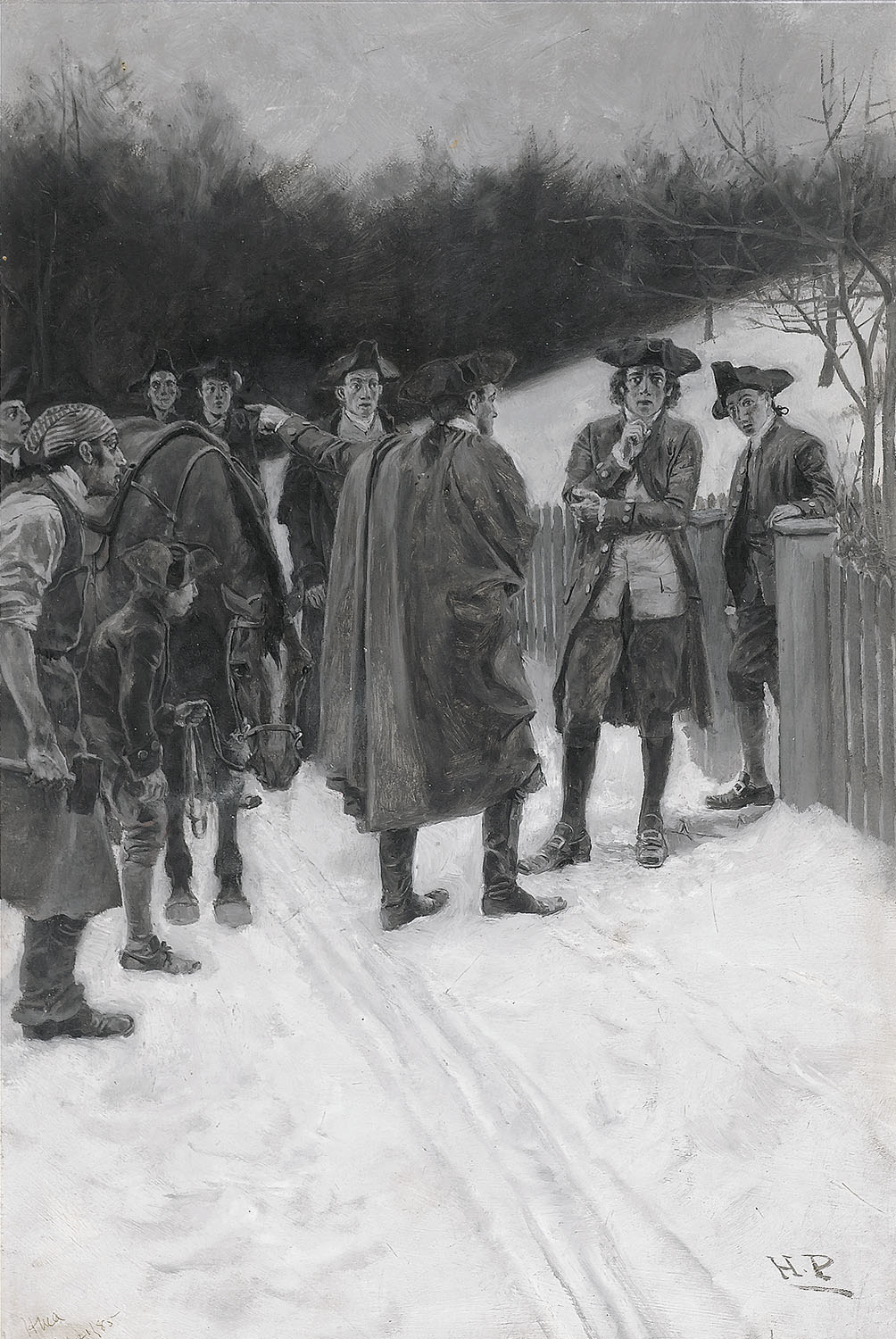
Howard Pyle (1853-1911)
Paul Revere Bringing News to Sullivan
1886, oil on board
17 1/2" x 11 1/2", initialed lower right
"The Gunpowder for Bunker Hill," by Ballard Smith, Harper's Monthly Magazine, July 1886
Howard Pyle's Paul Revere Bringing News to Sullivan illustrates a dramatic episode from the opening months of the American Revolution. Created for Ballard Smith's historical article The Gunpowder for Bunker Hill, published in the July 1886 issue of Harper's Monthly Magazine, the image depicts Paul Revere delivering urgent intelligence to General John Sullivan during the race to secure desperately needed gunpowder for the colonial forces.
While Revere is best remembered for his midnight ride warning that the British were advancing on Lexington and Concord, he also served as an important courier throughout the Revolution, carrying vital messages that helped coordinate the Patriot cause. Pyle captures the urgency of that role, emphasizing the speed, determination, and sense of purpose that made communication as critical to victory as military action itself.
One of America's greatest historical illustrators, Pyle possessed an unmatched ability to transform documentary history into compelling visual drama. His carefully researched costumes, expressive figures, and cinematic compositions helped generations of readers experience the Revolutionary War as a living story, making history immediate, accessible, and deeply human.
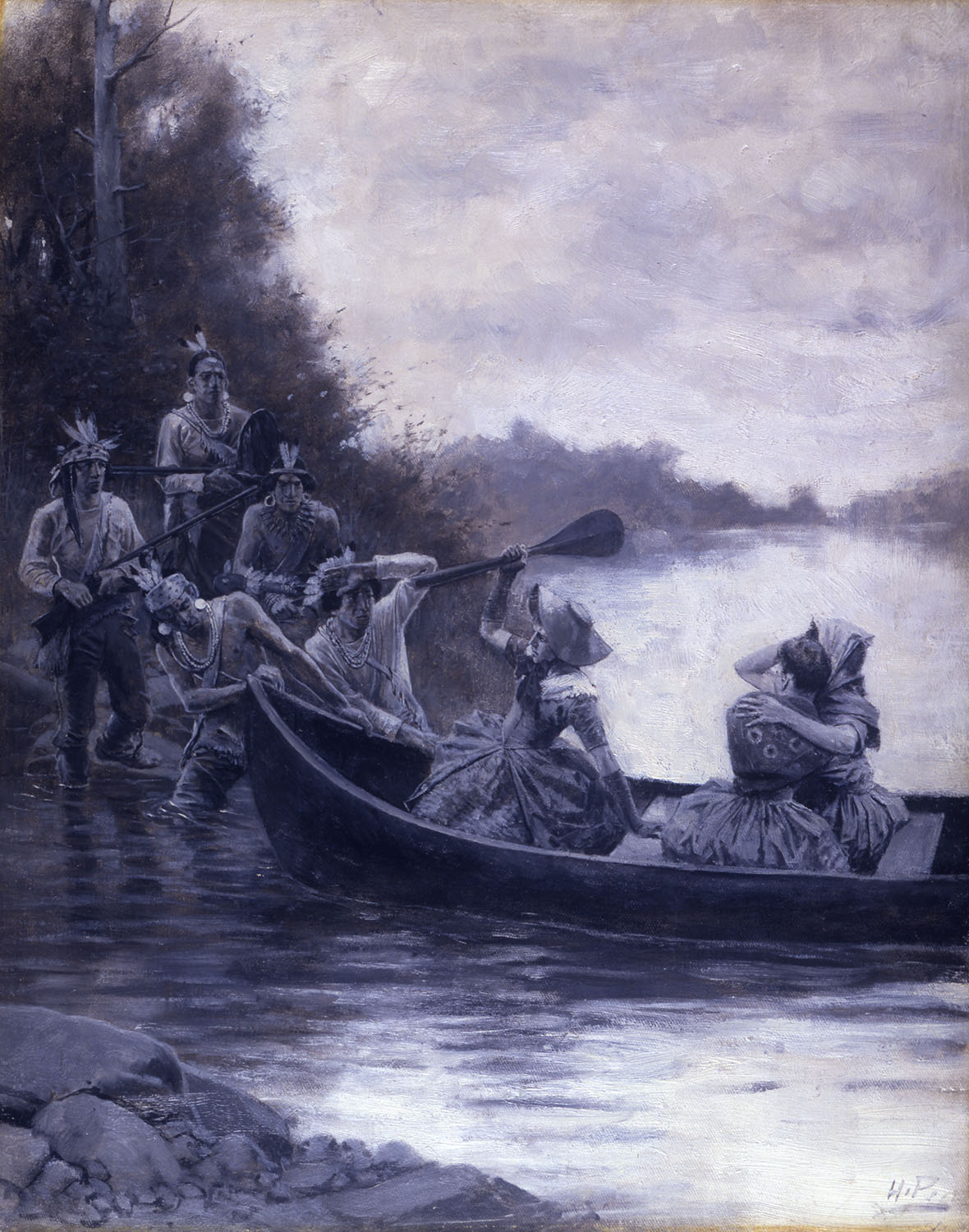
Howard Pyle (1853-1911)
The Capture of Elizabeth, Frances Callaway and Jemima Boone
1884, oil en grisaille on board
20" x 16", signed lower right
"The Kentucky Pioneers," by John Mason Brown, Harper's Monthly, June 1887
Howard Pyle vividly recreates one of the best-known episodes of America's early frontier history in The Capture of Elizabeth, Frances Callaway and Jemima Boone. The illustration accompanied John Mason Brown's article The Kentucky Pioneers, published in the June 1887 issue of Harper's Monthly Magazine, and depicts the dramatic capture of the daughters of Daniel Boone and Colonel Richard Callaway while they were canoeing on the Kentucky River during the summer of 1776.
Following the abduction, Boone and Callaway quickly assembled a rescue party, successfully tracking and freeing the young women after several days. The daring rescue became one of the most celebrated stories of the early American frontier, symbolizing both the dangers faced by settlers and the resilience required to build new communities in the wilderness.
Pyle masterfully heightens the drama through expressive gestures and a dynamic composition. Elizabeth Boone emerges as the central figure, courageously raising an oar in an attempt to strike her captor, while Frances Callaway and Jemima Boone huddle together at the rear of the canoe, their fear contrasting with Elizabeth's determination. Rather than depicting passive victims, Pyle presents the young women as active participants in the unfolding drama, creating a powerful narrative of courage, survival, and the hardships that accompanied America's westward expansion.
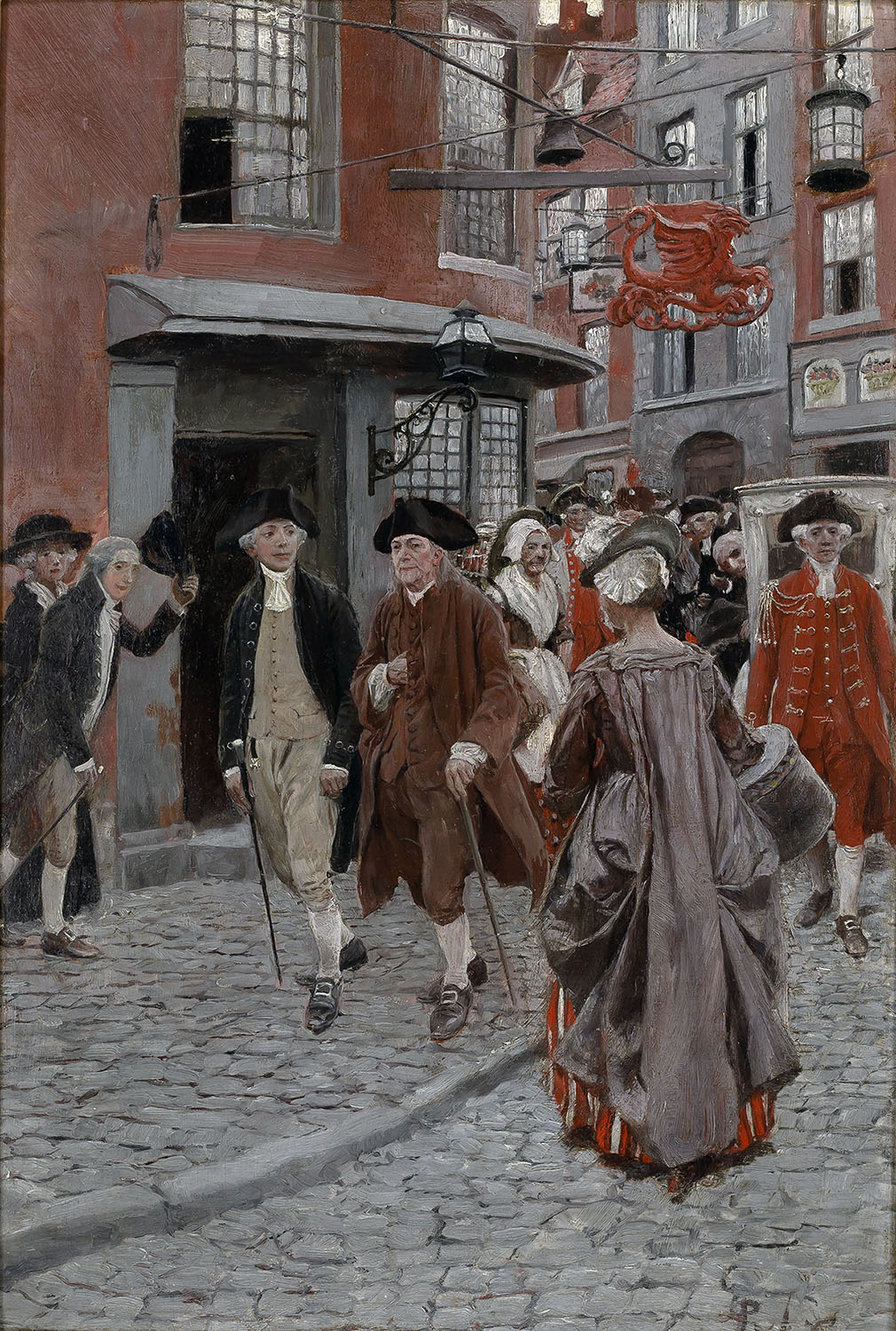
Howard Pyle (1853-1911)
The Good, Aged Doctor
1899, oil on board
19 1/2" x 14", signed lower right
The Man for the Hour, by James Barnes, McClure's Magazine, December 1899
In The Good Aged Doctor, Howard Pyle portrays Benjamin Franklin during his years as America's ambassador to France, where his diplomacy proved as essential to the success of the American Revolution as any victory on the battlefield. The title refers to Franklin himself, whose wisdom, humility, and international reputation helped secure the French alliance that ultimately made American independence possible.
Created for James Barnes's historical story The Man for the Hour, published in the December 1899 issue of McClure's Magazine, the illustration depicts Franklin walking through the streets of Paris, where he became one of the most admired and recognizable figures in Europe. Pyle emphasizes Franklin's quiet dignity rather than dramatic action, presenting him as a respected statesman whose greatest achievements came through intellect, persuasion, and diplomacy.
Although the original magazine reproduction appeared in black and white, Pyle's original oil painting reveals a remarkably sophisticated palette dominated by blacks, whites, and rich reds, demonstrating his mastery of color and atmosphere. Like many of his historical illustrations, The Good Aged Doctor combines careful research with compelling storytelling, reminding viewers that the American Revolution was won not only by soldiers and generals, but also by diplomats whose efforts secured the international support necessary for the nation's birth.
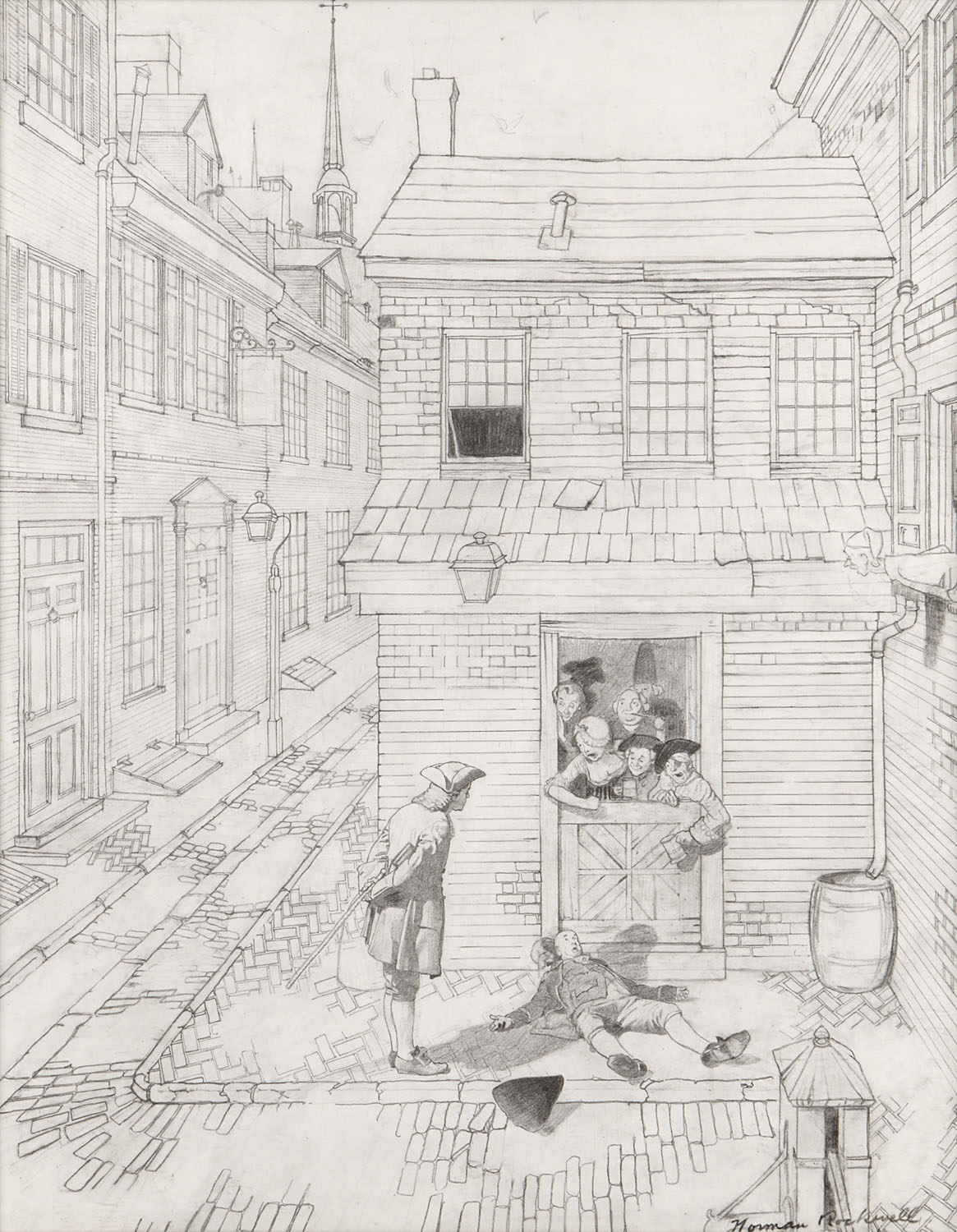
Norman Rockwell (1894-1978)
The Tavern - Study
1963, pencil on paper
26 1/2" x 21 1/2", signed lower right
Study for Poor Richard's Almanacks, by Benjamin Franklin, reprinted by The Heritage Press, 1964
"Personally, I love this part of picture making because it seems to me the very essence of story telling. When your charcoal drawing is finished, it should express clearly and interestingly what you want to tell. Later the color and final painting will enhance it, but the real foundation of the picture is right here." — Norman Rockwell
This expressive charcoal study reveals Norman Rockwell's storytelling process at its most fundamental. Created for The Tavern, one of the illustrations commissioned for the 1964 edition of Poor Richard's Almanacks, the drawing demonstrates Rockwell's belief that a successful illustration begins with a compelling narrative long before paint is applied.
Originally published annually from 1732 to 1758, Benjamin Franklin's Poor Richard's Almanack, written under the pseudonym Richard Saunders, became one of the most popular publications in colonial America. Filled with calendars, weather forecasts, practical advice, humor, proverbs, recipes, and anecdotes, the almanacs entertained and informed readers throughout the colonies. For the 1964 edition, Rockwell created a series of imaginative scenes inspired by colonial life and Franklin's world.
In The Tavern, Rockwell presents a humorous fictional episode in which an exceedingly intoxicated Benjamin Franklin lies sprawled across a cobblestone street outside a tavern as amused patrons cheer from the doorway and a bewildered passerby looks on. While entirely fanciful, the illustration reflects Franklin's wit and the playful spirit associated with Poor Richard's Almanack. As with many of Rockwell's greatest works, the humor is grounded in expressive characters, carefully observed gestures, and a timeless understanding of human nature.
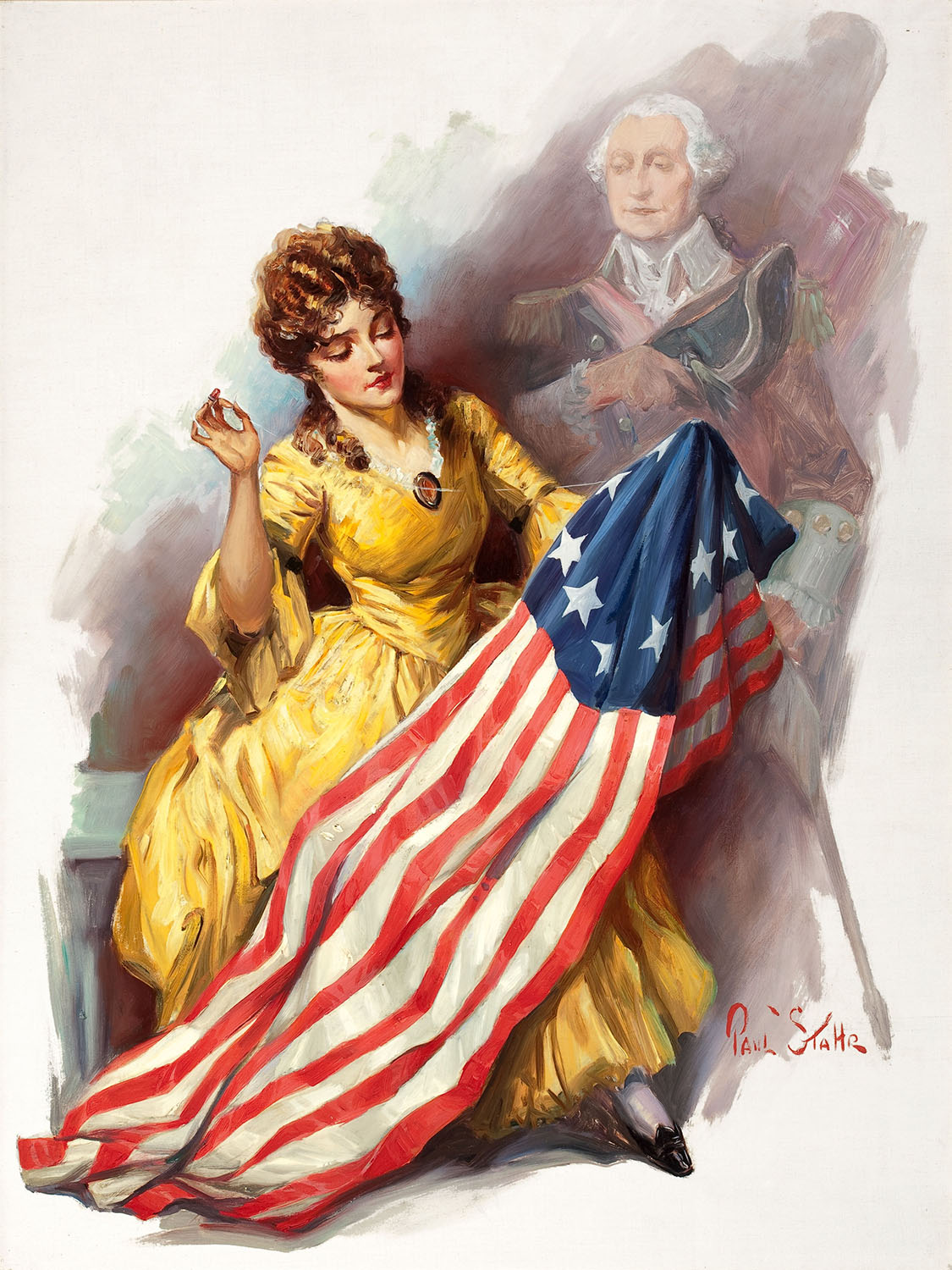
Paul Stahr (1883-1953)
Young Betsy Ross
1927, oil on canvas
36" x 27 1/2", signed lower right
The Elks magazine, June 1927 cover
Created for the July 1927 cover of The Elks Magazine, Paul Stahr's Young Betsy Ross celebrates one of the most enduring legends of the American Revolution. The beautifully rendered portrait depicts the young seamstress carefully sewing what tradition holds to be the first American flag, capturing a quiet moment of craftsmanship that has become deeply woven into the nation's historical memory.
Stahr enriches the composition by including a vision of George Washington over Betsy Ross's shoulder, respectfully saluting her work. Whether interpreted as a symbolic tribute or an imagined historical moment, Washington's presence underscores the significance of the flag as a unifying emblem of the new nation and honors the role Ross has long occupied in America's founding story.
Painted during the patriotic revival of the 1920s, Young Betsy Ross reflects the era's fascination with the heroes and legends of the Revolutionary period. Through Stahr's graceful composition and luminous color, the image celebrates not only the creation of the Stars and Stripes but also the ideals of unity, perseverance, and national identity that the American flag has represented for generations.
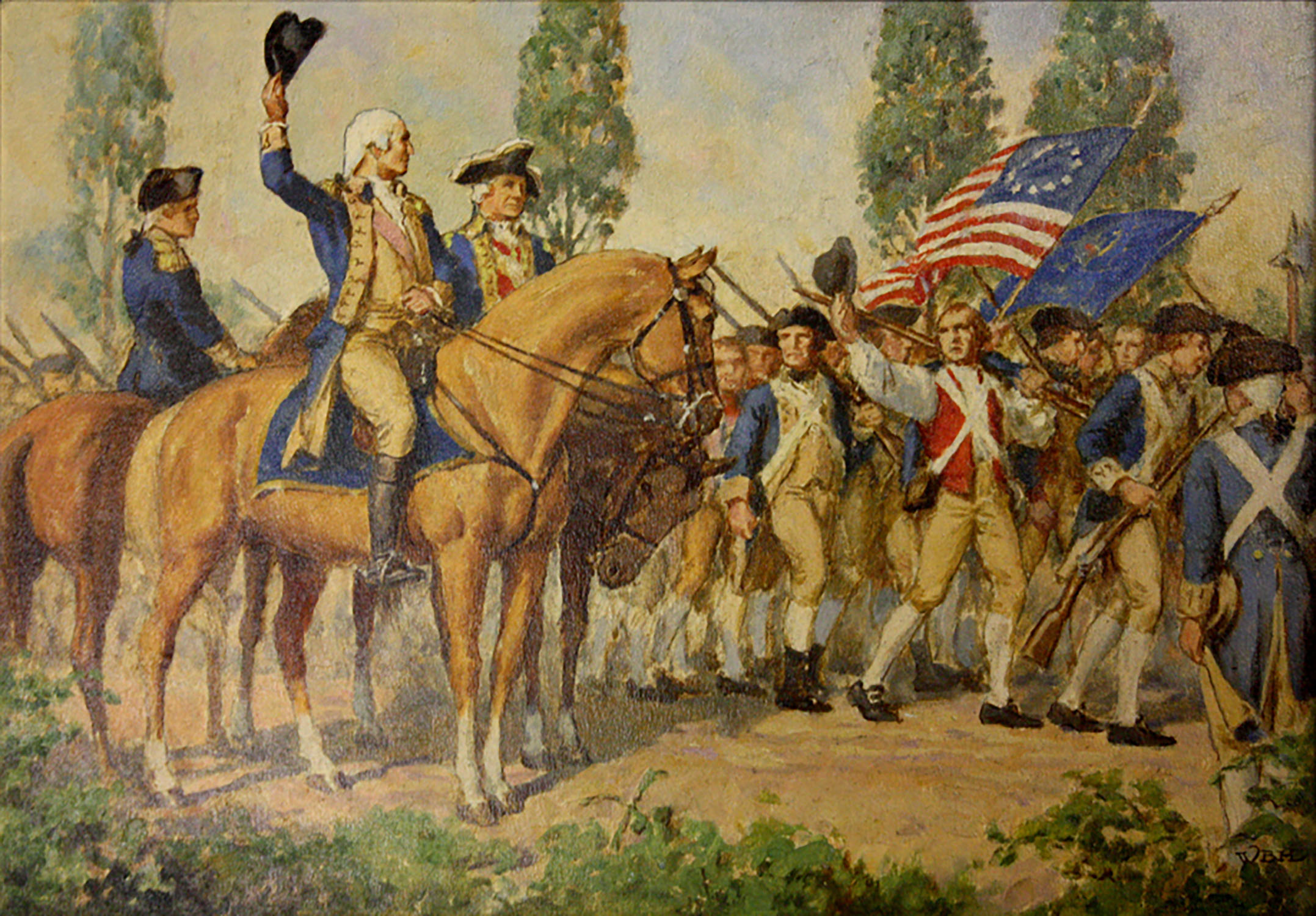
Walter Beach Humphrey (1892-1966)
A New Spring
Oil on paper
8 3/4" x 11 1/2", initialed lower left
In A New Spring, Walter Beach Humphrey presents George Washington at a defining moment of triumph and national renewal. Mounted on horseback and raising his hat in salute, Washington acknowledges his troops as they march proudly beneath an early American flag bearing its circle of thirteen stars—a powerful emblem of unity among the newly independent states.
Humphrey's title suggests more than the arrival of a new season; it symbolizes the birth of a nation and the promise of a democratic future. Washington's gesture is one of gratitude and mutual respect, recognizing the sacrifices of the Continental Army whose perseverance secured American independence. Rather than portraying a distant military hero, Humphrey emphasizes the bond between commander and citizen-soldier.
Painted during the twentieth century, when artists frequently looked to the Revolutionary generation for inspiration, A New Spring reflects the enduring admiration Americans have held for their first president. Together with Washington and His Troops, the painting celebrates Washington as both the victorious general who secured independence and the principled statesman who would guide the young republic into its first hopeful chapter.
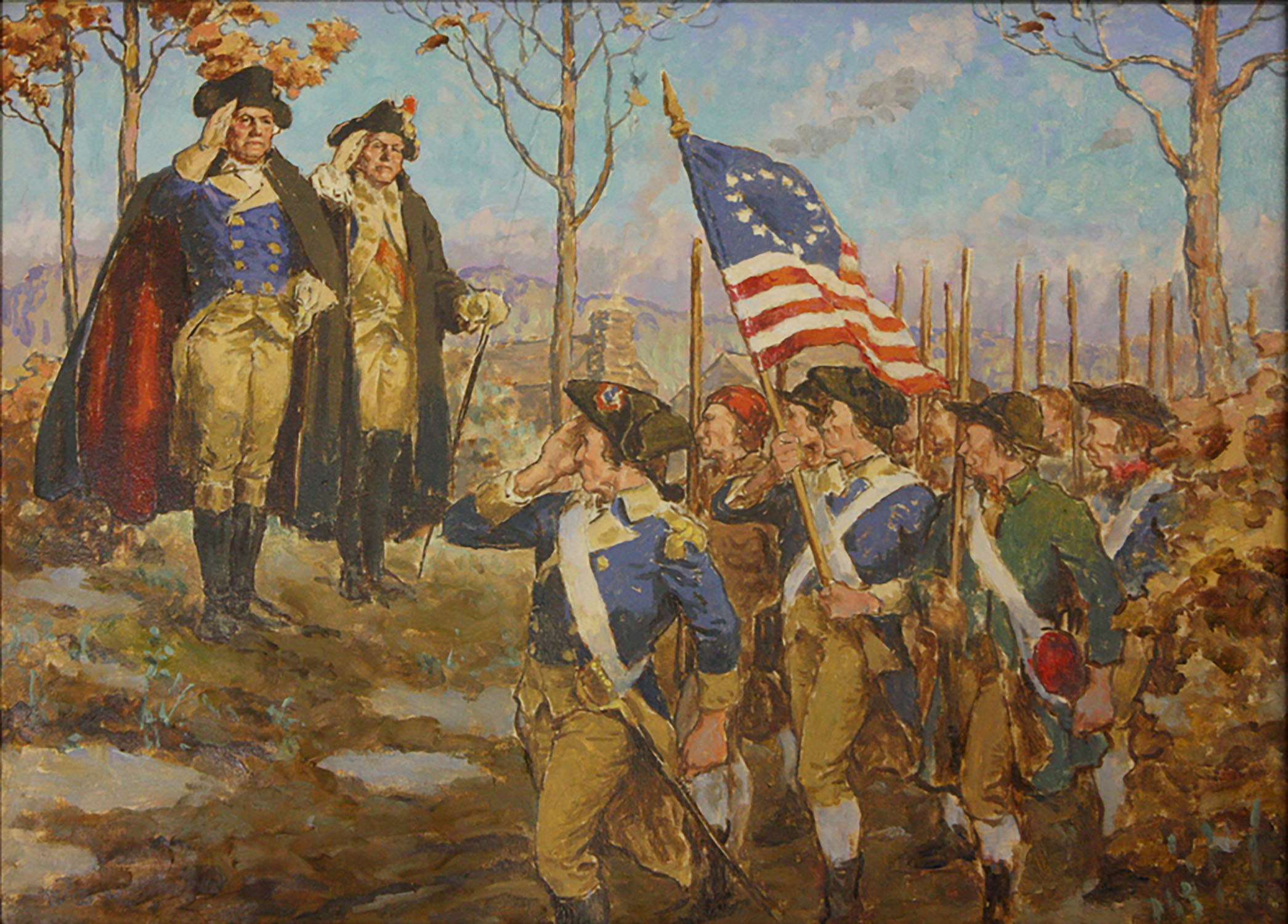
Walter Beach Humphrey (1892-1966)
Washington and His Troops
Oil on board
9" x 12", initialed lower left
In Washington and His Troops, Walter Beach Humphrey presents George Washington not as a commanding general on horseback, but as a dignified leader standing in solemn salute as his soldiers march past beneath the early American flag with its circle of thirteen stars. The restrained composition emphasizes Washington's humility and sense of duty, qualities that became as central to his legacy as his military achievements.
The image evokes the dawn of a new nation emerging from the hardships of the Revolutionary War. As the Continental soldiers pass in orderly formation, the painting celebrates not only their victory but also the ideals of unity, sacrifice, and perseverance that carried the colonies through the struggle for independence.
Together with A New Spring, this work offers a complementary vision of the nation's first leader—one defined not only by battlefield success but also by honor, restraint, and service to the republic. Humphrey presents Washington as a commander whose greatest strength lay in his character, reinforcing the enduring values upon which the United States was founded.
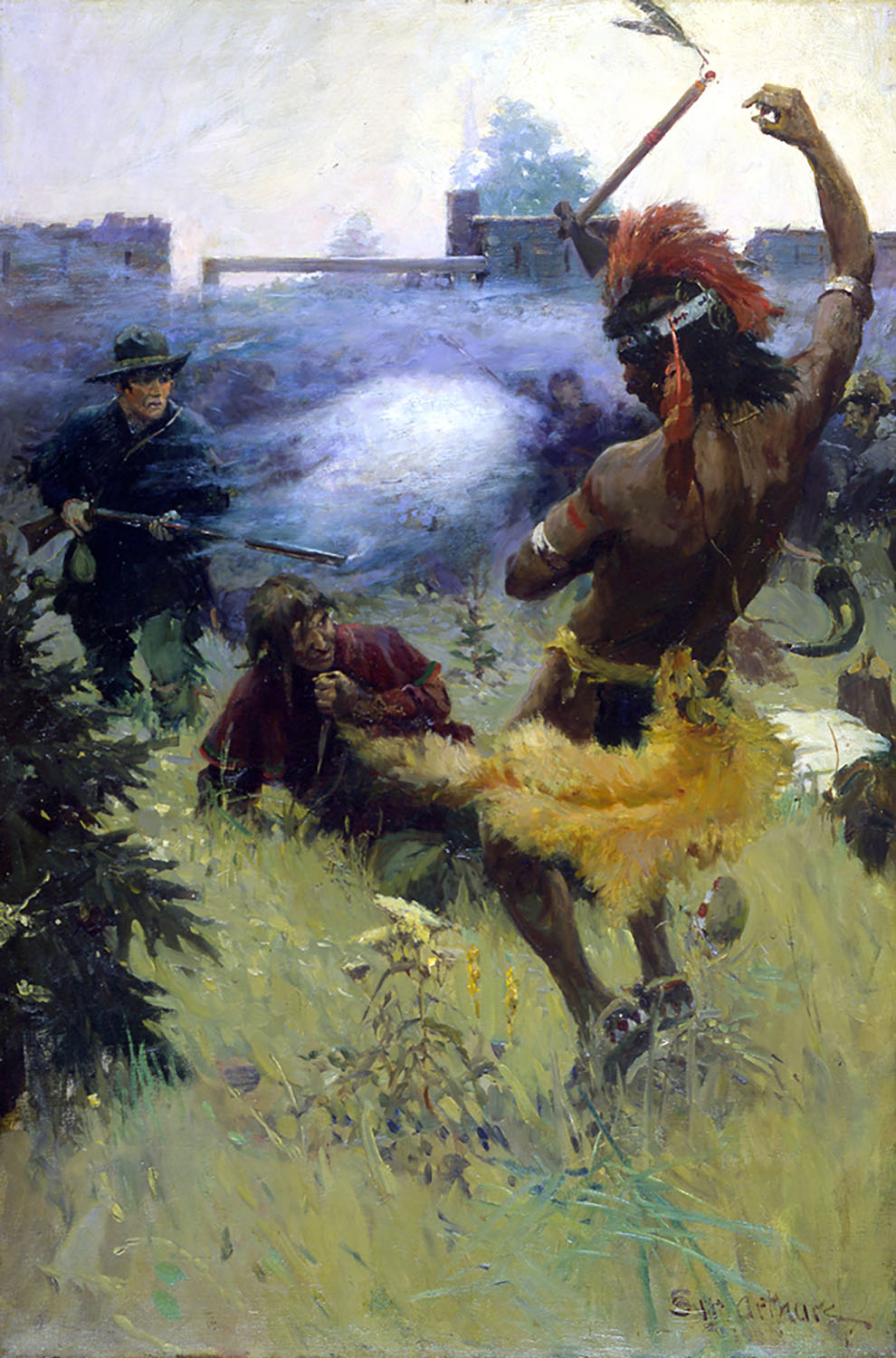
Stanley Arthurs (1877-1950)
Siege of Fort Boonesboro
1907, oil on canvas
36" x 24", signed lower right
Outing Magazine, June 1907
The American Historical Scene, University of Pennsylvania Press, 1935
Stanley Arthurs depicts one of the most dramatic episodes of America's early frontier in Siege of Fort Boonesboro. The painting illustrates the 1778 siege of Fort Boonesborough in Kentucky, when Daniel Boone and a small band of settlers successfully defended the isolated outpost against a much larger force. The confrontation became one of the defining stories of the westward movement that followed the American Revolution.
Originally created for the June 1907 issue of Outing Magazine and later reproduced in The American Historical Scene (1935), the illustration captures the tension and determination of the fort's defenders. Arthurs emphasizes the rugged resilience of the pioneers, portraying the settlement not simply as a military stronghold but as a symbol of perseverance on the expanding American frontier.
Like many historical illustrators of the early twentieth century, Arthurs sought to bring pivotal moments of the nation's past vividly to life. His dramatic composition reminds viewers that the story of American independence did not end with the Revolutionary War. As the new republic grew westward, settlers continued to face immense challenges, and their courage and endurance became an integral part of the nation's unfolding history.
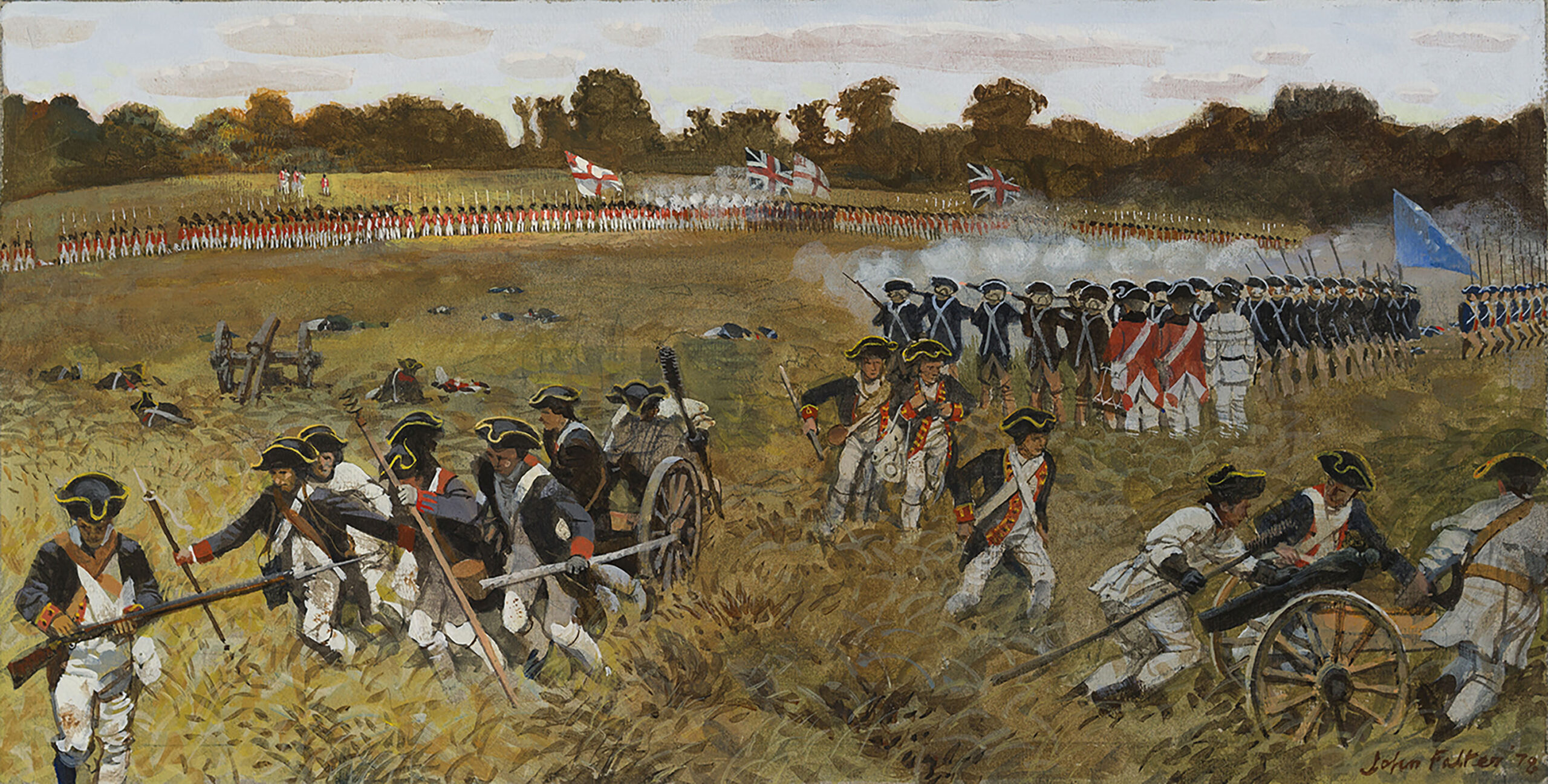
John Falter (1910-1982)
Revolutionary War Battle Scene
1978, watercolor on paper
9 1/2" x 18 3/4", signed and dated lower right
John Falter brings the intensity and confusion of the Revolutionary War to life in this dramatic battle scene, immersing viewers in the smoke, movement, and chaos of eighteenth-century combat. Known for his ability to tell compelling stories through richly detailed compositions, Falter captures not only the action of the battlefield but also the human experience of those who fought to secure American independence.
A memorable recollection from the artist's daughter offers a glimpse into Falter's painstaking creative process. She recalled entering his studio while he was working on the painting, only to be cautioned, "Don't walk—I'm painting inches of British soldiers." The remark reflects the extraordinary attention to detail that characterized Falter's work, as he carefully built the composition one tiny figure at a time.
Whether viewed from a distance or examined up close, the painting reveals the artist's remarkable ability to balance sweeping historical drama with meticulous craftsmanship. It stands as a tribute to the courage of those who fought in the Revolution and to the illustrators who have kept their stories alive through art for generations.
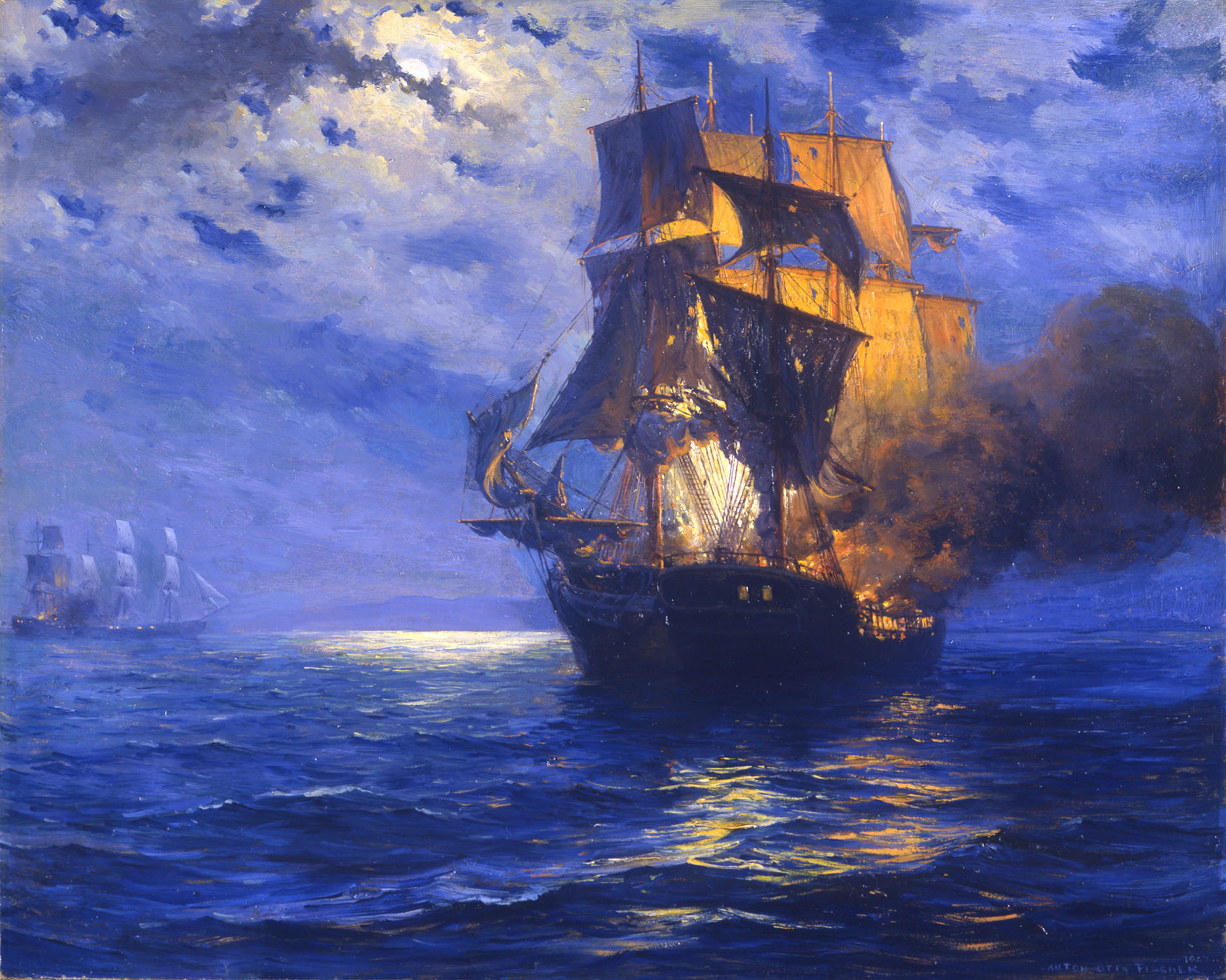
Anton Otto Fischer (1882-1962)
Battle Between Bonhomme Richard and the Serapis, September 23, 1779
1927, oil on canvas
24" x 30", signed lower right
Anton Otto Fischer captures one of the most celebrated naval engagements of the American Revolution: the battle between the American warship Bonhomme Richard, commanded by John Paul Jones, and the British frigate Serapis on September 23, 1779. Fought off the coast of England, the brutal encounter became legendary after Jones reportedly answered a British demand for surrender with the immortal words, "I have not yet begun to fight."
A master of maritime painting, Fischer was renowned for his ability to portray the drama and power of the sea. Here, he conveys the chaos of close-quarters naval combat through towering ships, billowing smoke, crashing waves, and the flashes of cannon fire that illuminate the darkness. The tightly locked vessels emphasize the desperate nature of the battle, in which victory depended as much on determination as on firepower.
Jones's eventual capture of Serapis became a defining victory for the fledgling American Navy, demonstrating that the young nation's forces could defeat the world's greatest naval power. Fischer's painting commemorates not only a pivotal moment in Revolutionary history but also the courage, perseverance, and indomitable spirit that became hallmarks of the American fight for independence.
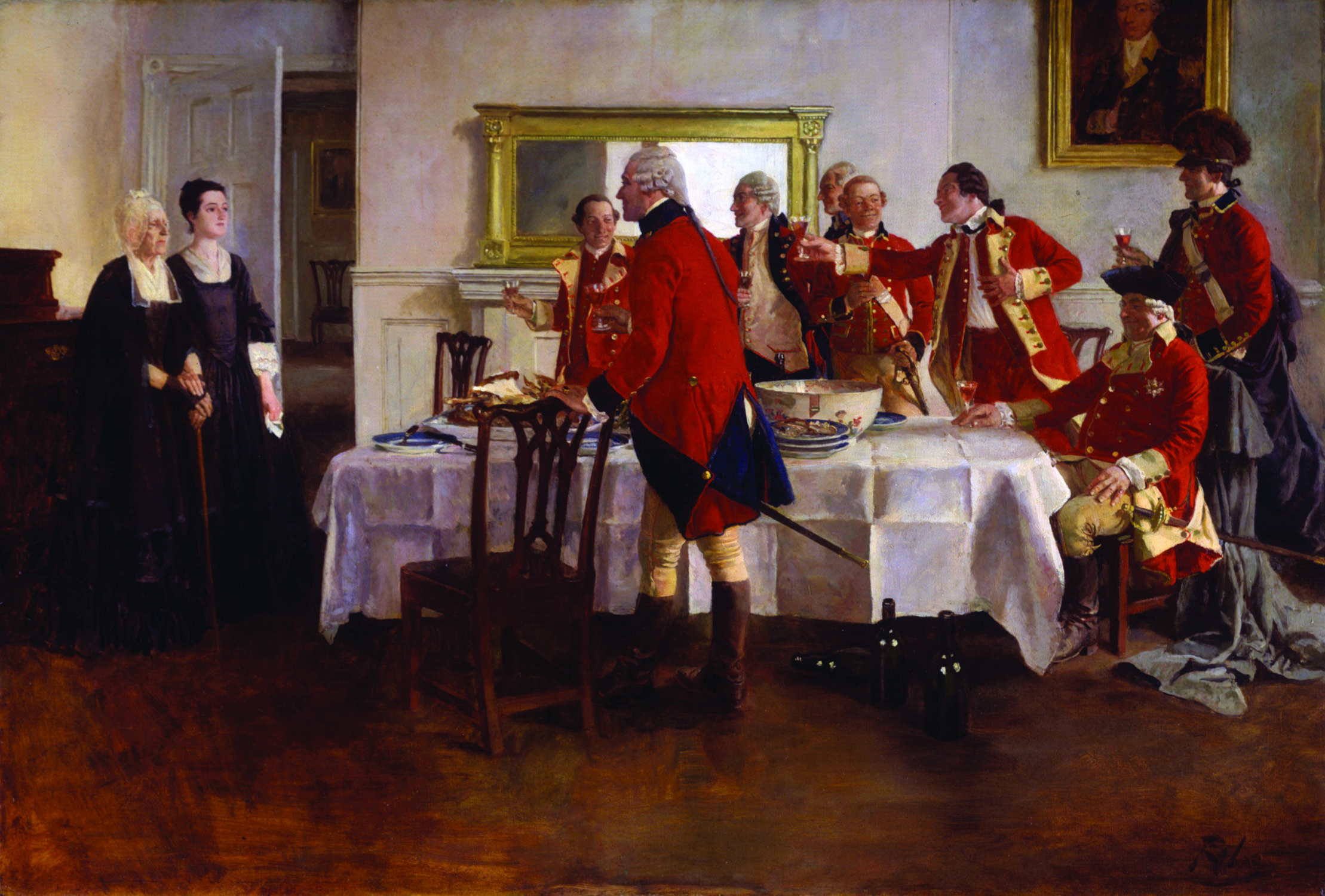
Howard Pyle (1853-1911)
An Unwelcome Toast
1895, oil on canvas
24 1/2" x 36 1/4", signed lower right
Harper's Weekly, December 14, 1895, double page spread
In An Unwelcome Toast, Howard Pyle shifts the focus of the Revolutionary War away from the battlefield and into the American home. Created for the December 14, 1895 issue of Harper's Weekly, the illustration depicts British soldiers occupying a colonial household while the men of the family are away fighting for independence.
The soldiers raise their glasses in a toast to the women of the house, thanking them for their "hospitality"—a bitter irony, as the family's welcome has been compelled by military occupation rather than freely given. Pyle masterfully captures the emotional tension of the moment through the women's restrained expressions and dignified composure, contrasting their quiet endurance with the soldiers' casual confidence.
Rather than celebrating military heroics, Pyle reminds viewers that the Revolutionary War was experienced not only by soldiers but also by the civilians whose homes, livelihoods, and daily lives were profoundly affected by the conflict. The painting is a poignant reflection on the sacrifices borne by ordinary Americans and the resilience of families who endured the hardships of war while holding fast to the hope of independence.
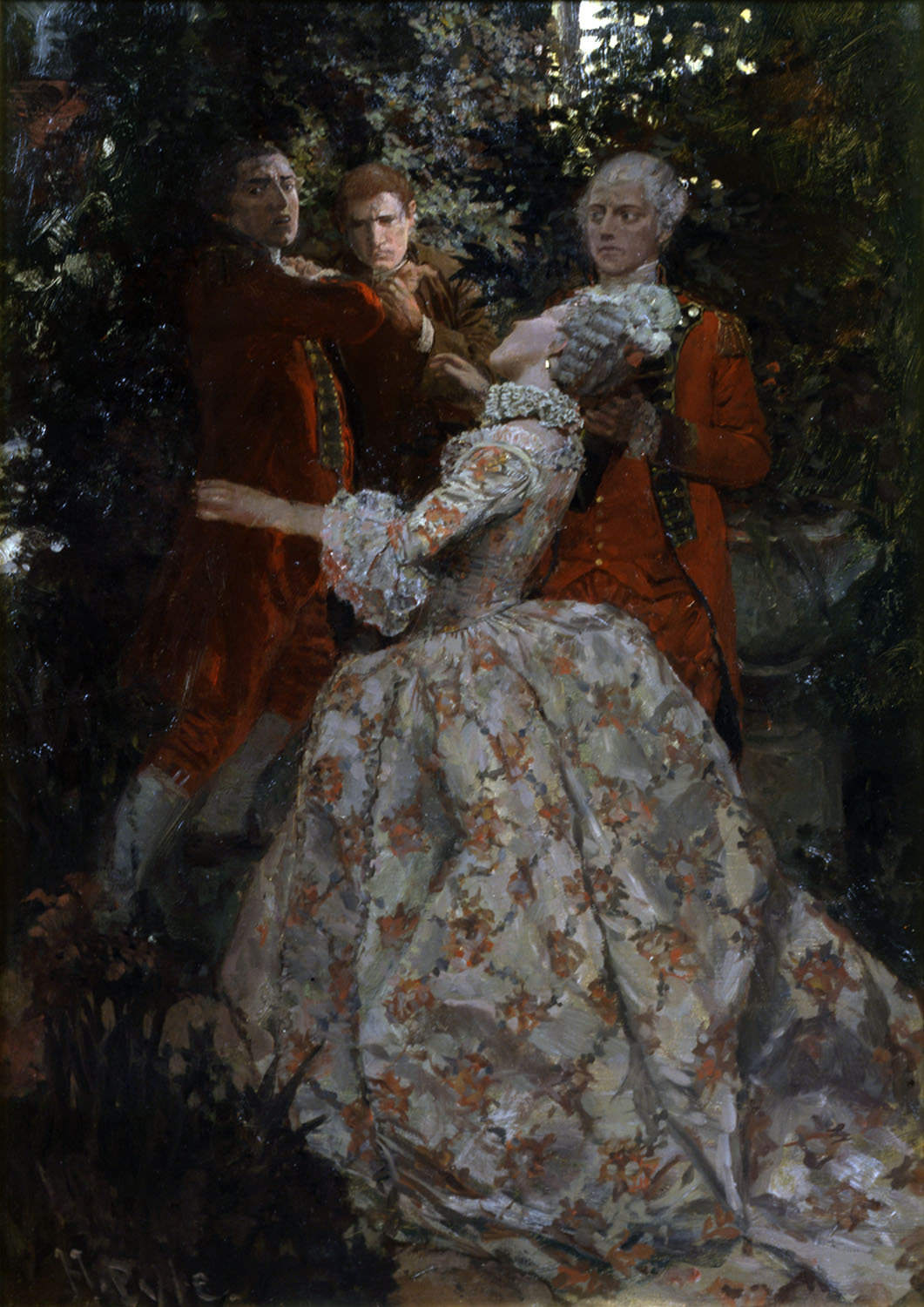
Howard Pyle (1893-1951)
Here, Andre! A Spy!
1897, oil on board
25 3/4" x 18 1/2", signed lower left
"Hugh Wynne, Free Quaker," by S. Weir Mitchell, June 1897
Howard Pyle captures the dramatic climax of one of the Revolutionary War's most famous espionage stories in "Here, André! A Spy!". Created to illustrate S. Weir Mitchell's historical novel Hugh Wynne, Free Quaker, the painting depicts the arrest of British Major John André, whose capture in 1780 exposed Benedict Arnold's infamous plot to surrender the American fortifications at West Point to the British.
Pyle freezes the decisive moment as André is confronted and denounced as a spy. The tense composition, expressive gestures, and carefully orchestrated staging heighten the suspense, emphasizing the split-second realization that the secret mission has failed. The scene marks a pivotal turning point in the Revolution, as André's capture ultimately led to Arnold's treason being uncovered and helped preserve one of the Continental Army's most important strategic positions.
Few artists brought Revolutionary history to life with greater drama than Howard Pyle. Combining meticulous historical research with masterful storytelling, he transformed this episode of espionage and betrayal into a compelling human drama, reminding viewers that the fight for American independence was won not only through battlefield victories but also through vigilance, courage, and loyalty to the Patriot cause.
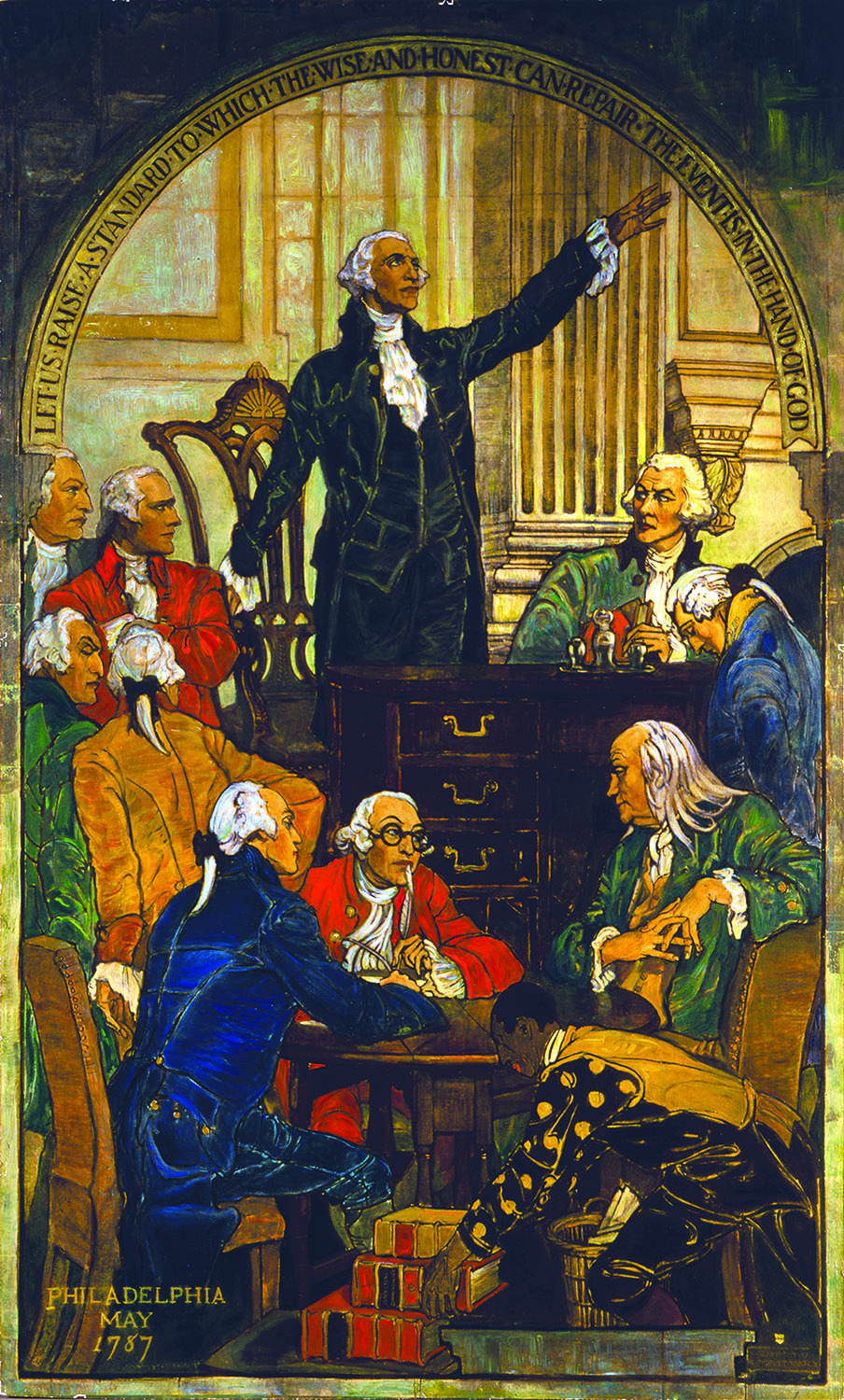
Violet Oakley (1874-1960)
"The Creation and Preservation of the Union" - George Washington at the Constitutional Convention
1911, oil on printed base
39 3/4" x 24"
Working study for the murals at the State Capitol Building, Harrisburg, Pennsylvania, 1911
This study by Violet Oakley depicts George Washington presiding over the Constitutional Convention of 1787, one of the most consequential gatherings in American history. Following the hard-won victory of the Revolutionary War, delegates from the thirteen states assembled in Philadelphia to draft a new framework of government, establishing the Constitution that continues to guide the United States today.
Created as a preparatory study for Oakley's monumental mural cycle The Creation and Preservation of the Union in the Pennsylvania State Capitol, the painting reflects her belief that history painting could both educate and inspire. Washington occupies the central role, symbolizing the steady leadership and unity that were essential to transforming a loose confederation of states into a lasting republic.
One of America's foremost muralists, Violet Oakley devoted much of her career to illustrating the ideals of democracy, justice, and civic responsibility. Her murals for the Pennsylvania State Capitol remain among the greatest public art commissions in American history. This study demonstrates her careful planning and thoughtful composition while celebrating a defining moment in the creation of the United States and the enduring principles upon which the nation was founded.
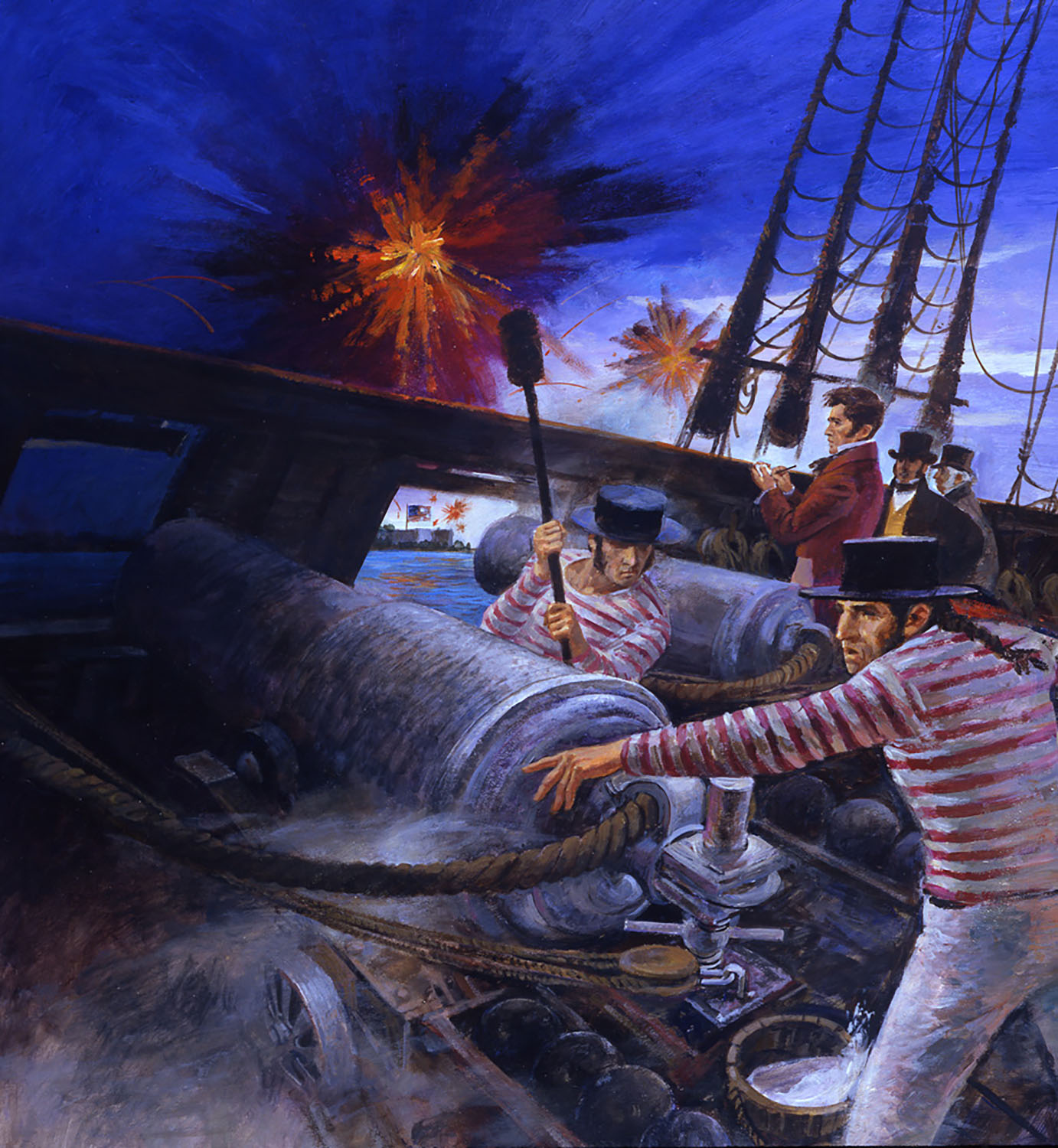
Ben F. Stahl (1910-1987)
The Star-Spangled Banner
Oil on paper board
30" x 27 3/4"
Ben Stahl concludes this exhibition with a stirring tribute to one of America's most enduring patriotic symbols. The Star-Spangled Banner presents a richly layered narrative of the events that inspired Francis Scott Key to write the poem that would later become the national anthem of the United States.
Stahl masterfully combines two moments into a single composition. In the foreground, the fierce bombardment of Fort McHenry unfolds amid smoke, fire, and the chaos of battle during the War of 1812. In the background, Francis Scott Key watches the conflict, pen in hand, composing the verses inspired by the sight of the American flag still flying after the night-long attack. By weaving together the battle and its artistic legacy, Stahl demonstrates how moments of conflict can give rise to symbols that endure for generations.
As the final work in Celebrating Independence: 250 Years of the American Story, the painting serves as a fitting conclusion to the exhibition. It reminds us that the story of American independence did not end with the Revolution, but continued to evolve through later generations who preserved and celebrated the nation's founding ideals. Like the illustrators featured throughout this exhibition, Francis Scott Key transformed history into a lasting work of art, ensuring that the spirit of American perseverance would continue to inspire future generations through both image and song.