

From the earliest days of the Republic, sports have reflected the values, aspirations, and spirit of the American people. Whether played on neighborhood sandlots, country clubs, winding rivers, racetracks, or packed stadiums, athletic pursuits have long been woven into the fabric of American life. Illustrators captured these moments not simply as competitions, but as celebrations of determination, camaraderie, recreation, and the joy of being outdoors.
This month's exhibition explores how America's greatest illustrators chronicled the nation's favorite pastimes. From the timeless traditions of baseball, fishing, football, golf, swimming, and tennis, these artworks reveal how sport became a shared language that united communities across generations and regions. Whether depicting the drama of competition or the quiet satisfaction of a day on the water, each illustration tells a story about the people who played, watched, and cherished these activities.
As part of the National Museum of American Illustration's yearlong virtual exhibition series celebrating America's 250th anniversary, Sports in America continues our exploration of the experiences that have shaped the nation's identity. These images remind us that the story of America is told not only through its historic events and leaders, but also through the everyday moments of competition, recreation, and shared tradition that continue to define the American experience.
Baseball
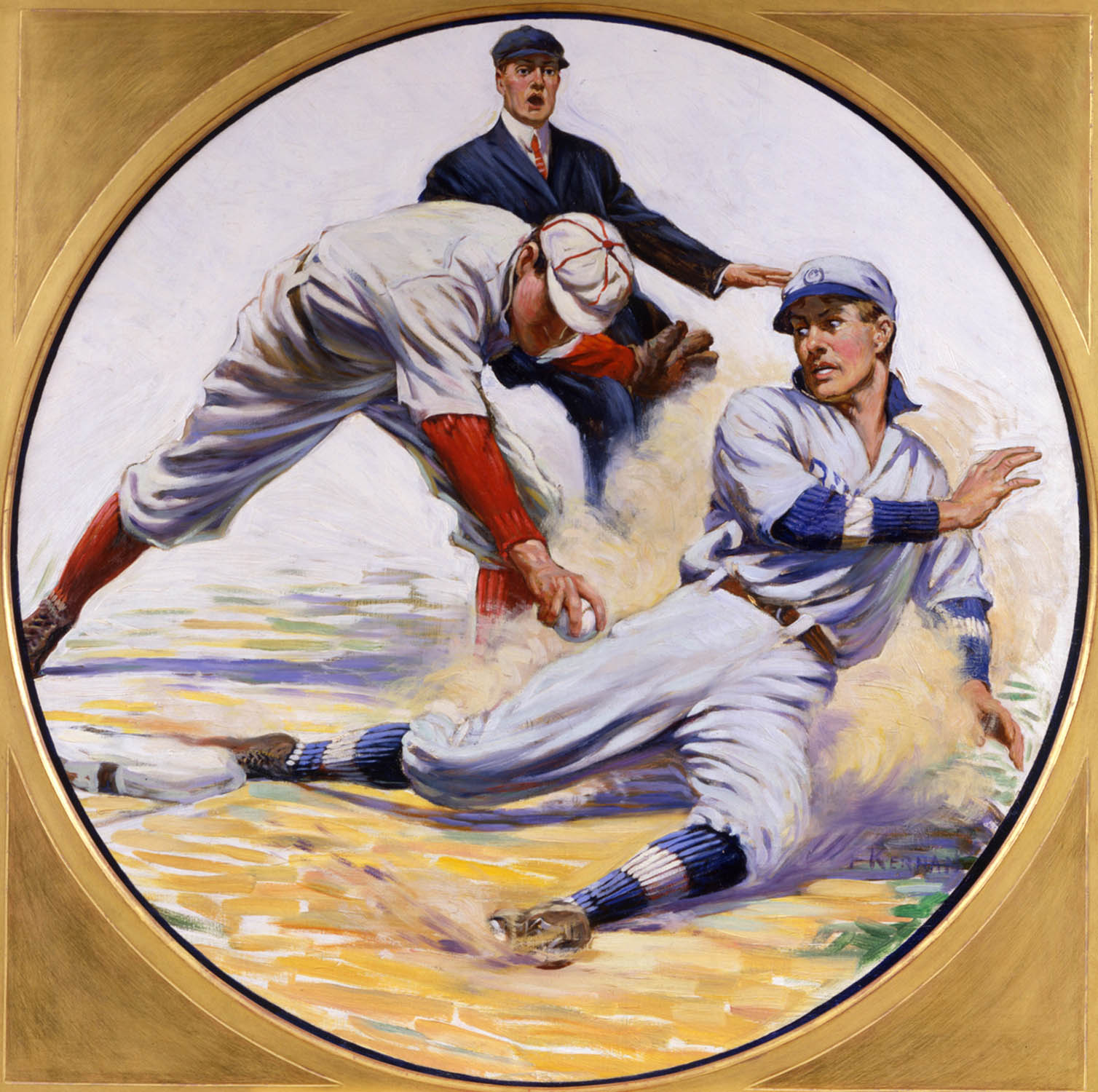
J.F. Kernan (1878-1958)
Safe at Home
1913, oil on canvas
25 1/2" round, signed lower right
Sunday Magazine, April 13, 1913 cover
As America's national pastime captured the country's imagination in the early twentieth century, illustrators brought the excitement of the ballpark to readers across the nation. J.F. Kernan's Safe at Home freezes one of baseball's most dramatic moments—a runner sliding across home plate as the catcher reaches for the ball—capturing the energy and suspense that have long defined the game.
Published as the cover of Sunday Magazine on April 13, 1913, the illustration appeared in newspapers across the United States. Kernan drew upon his own experience as a professional baseball player, a career he pursued to finance his artistic ambitions, giving his sporting scenes an authenticity that helped make him one of America's finest illustrators of outdoor life.
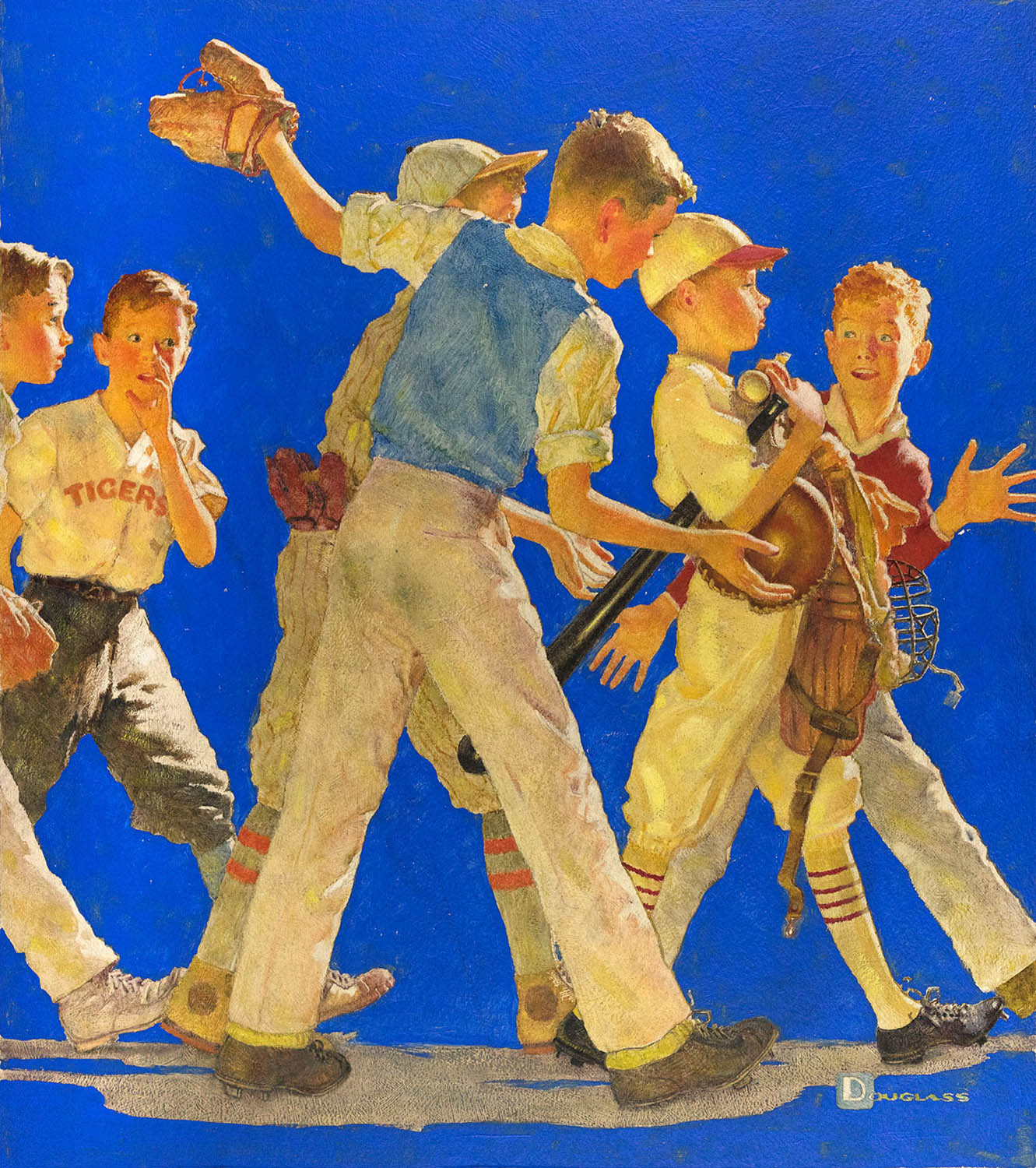
Douglass Crockwell (1904-1968)
Baseball Players
1936, oil on board
28" x 21", signed lower right
Proposed cover for The Saturday Evening Post, c. 1936
Douglass Crockwell captures a moment before the action as a group of baseball players gathers on the field, conveying the camaraderie and anticipation that are as much a part of the game as the competition itself. Rather than focusing on a dramatic play, Crockwell celebrates the character and spirit of America's pastime through expressive figures and natural, everyday interaction.
Created around 1936 as a proposed cover for The Saturday Evening Post, the painting was ultimately never published. Even so, it exemplifies the Post's tradition of portraying relatable scenes of American life, offering a glimpse into the editorial vision behind one of the nation's most influential illustrated magazines.
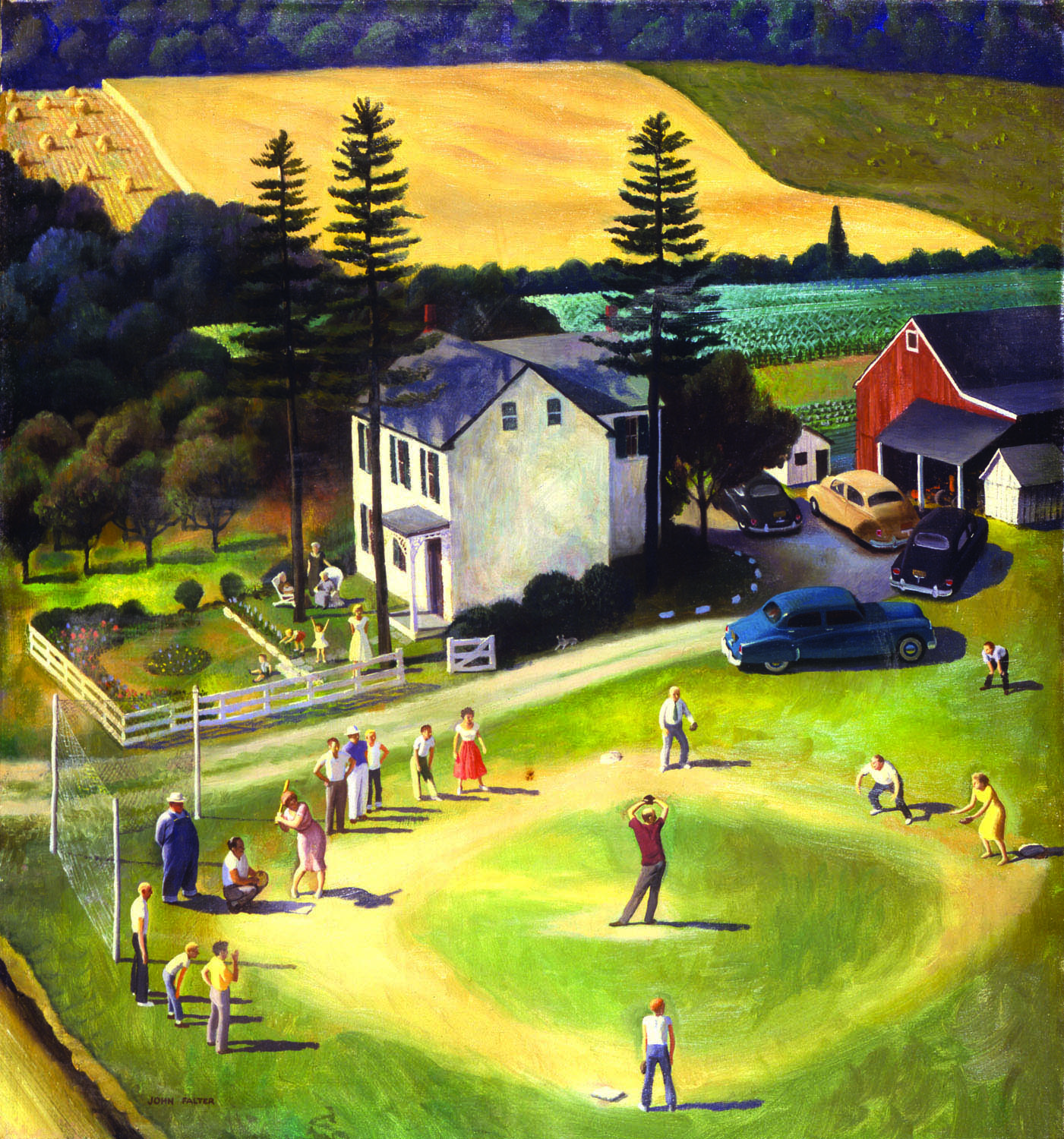
John Falter (1910-1982)
Family Baseball (The Family Picnic)
1950, oil on canvas
26 1/8" x 24 1/8", signed lower left
Saturday Evening Post, September 2, 1950 cover
John Falter's Family Baseball perfectly captures the warmth, humor, and togetherness that made him one of America's most beloved illustrators. Rather than depicting a professional game, Falter celebrates baseball as a family tradition, showing how the sport brought generations together in backyards, parks, and neighborhood fields across the country.
Published as the September 2, 1950 cover of The Saturday Evening Post, the painting exemplifies Falter's work at the height of his popularity. His ability to transform ordinary moments into enduring images of American life made him one of the Post's defining artists and helped shape the nation's nostalgic vision of the postwar era.
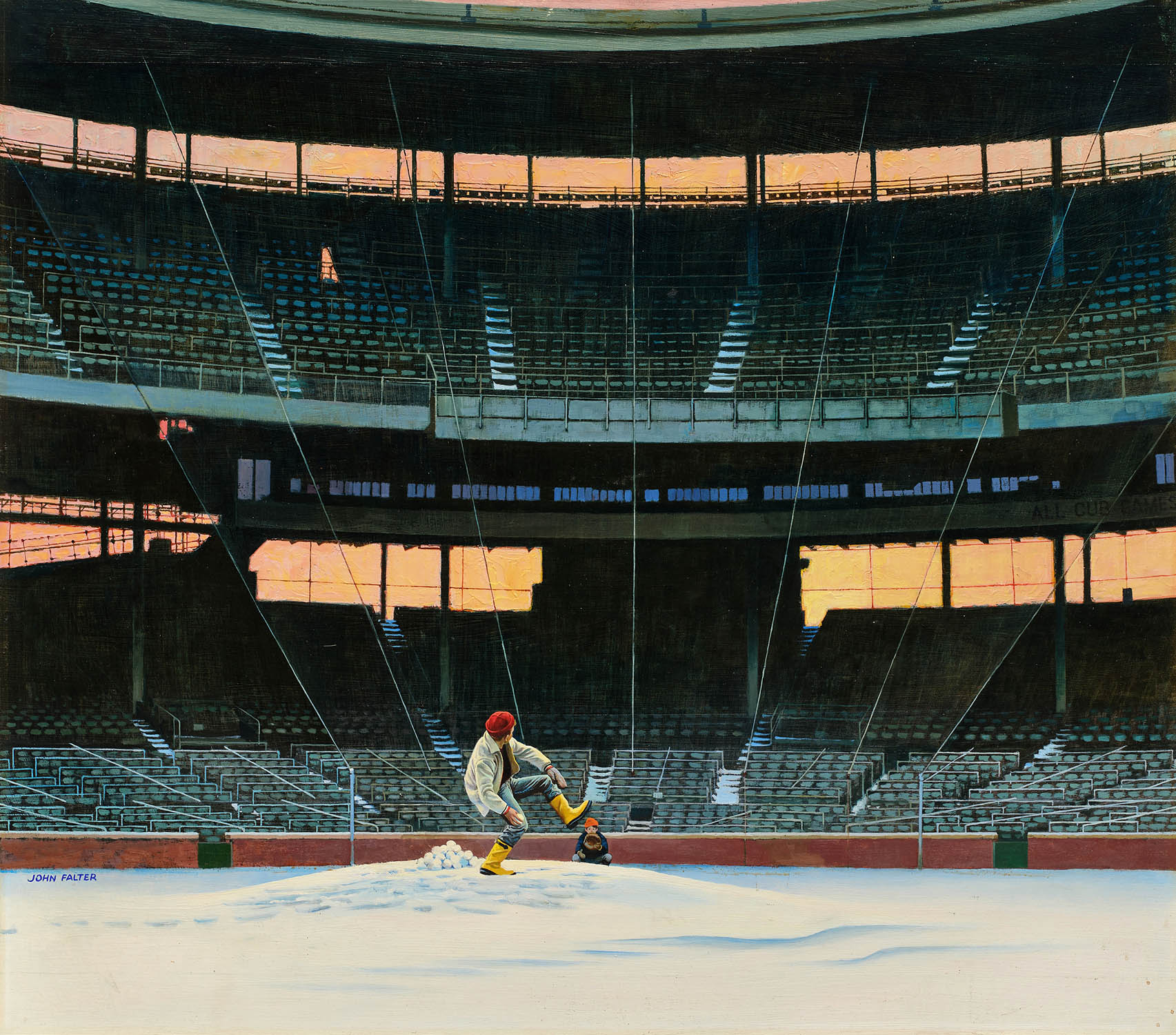
John Falter (1910-1982)
Boy Throwing Snowballs in Stadium (Wrigley Field)
c. 1950, oil on masonite
24 3/8" x 27 5/8", signed lower left
Few baseball dreams are more universal than stepping onto the field of a major league ballpark. In Boy Throwing Snowballs in Stadium, John Falter transforms that childhood fantasy into reality, depicting two boys using snowballs to play an imaginary game from the pitcher's mound at Chicago's iconic Wrigley Field. The empty stadium becomes their playground, where imagination matters more than the score.
Like many of Falter's finest works, the painting celebrates the wonder of everyday American life through the eyes of children. It reminds us that baseball's magic extends far beyond professional competition, inspiring generations of young fans who dreamed of one day taking the field themselves.
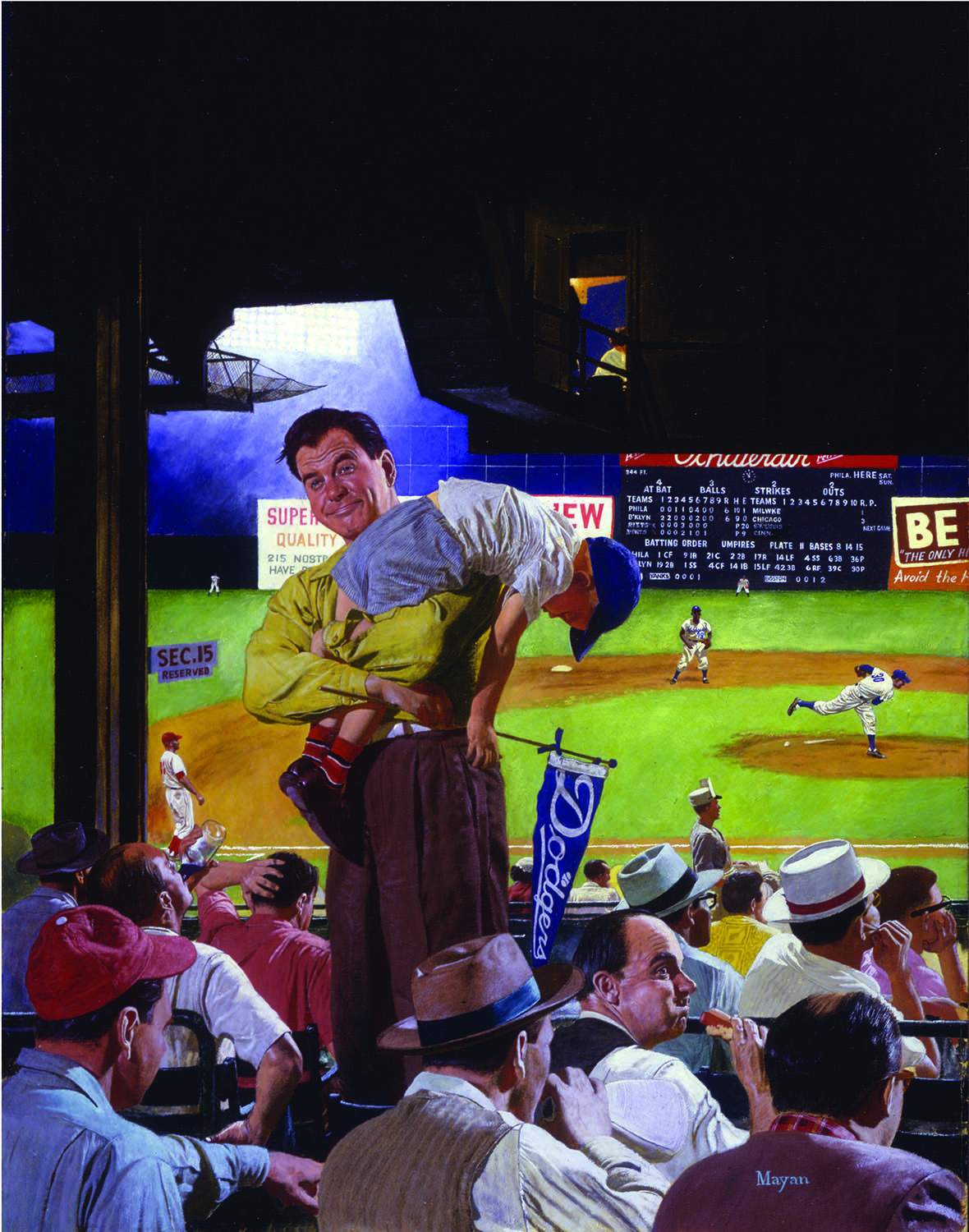
Earl Mayan (1916-2009)
Dad Carrying Sleeping Son from Ballgame - Phillies vs. Dodgers Game
1955, oil on board
27 1/2" x 21 1/4", signed lower right
Saturday Evening Post, April 23, 1955 cover
Earl Mayan's delightful Saturday Evening Post cover captures a tender moment familiar to generations of baseball fans. As a Philadelphia Phillies and Brooklyn Dodgers game heads into the top of the ninth inning tied, a devoted father carries his exhausted son home, sacrificing the thrilling finish while the boy sleeps peacefully after an unforgettable day at the ballpark.
One of ten covers Mayan created for The Saturday Evening Post, the painting showcases his gift for lively composition and storytelling through countless small details. More than a scene about baseball, it is a celebration of family, tradition, and the lasting memories created by America's national pastime.
Fishing
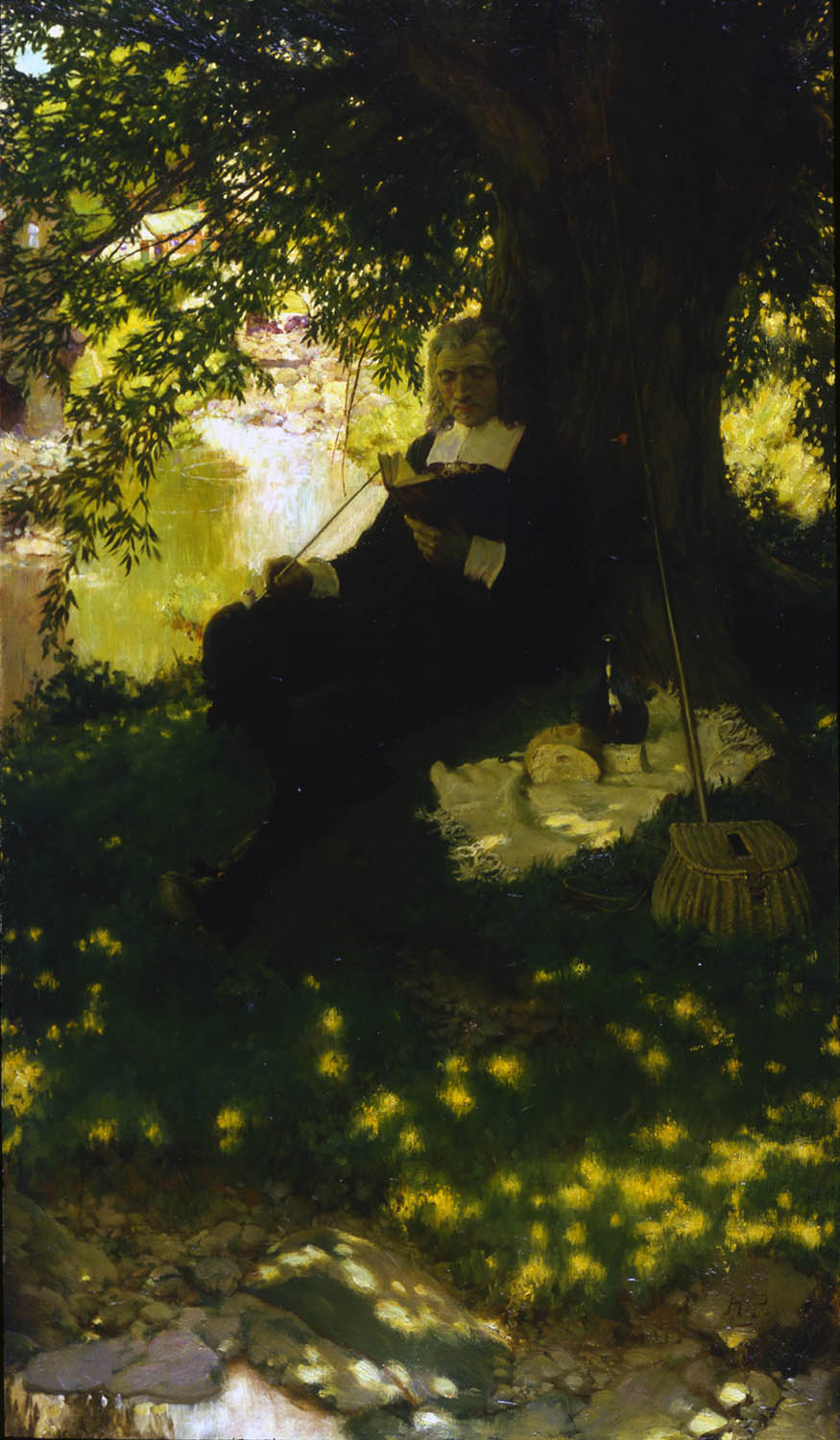
Howard Pyle (1853-1911)
Isaac Walton, The Father of Angling
1903, oil on canvas
35" x 20", initialed lower right
The Bibliomania, by Thomas Frognall Dibdin, Bibliophile Society, 1903
Howard Pyle pays tribute to Isaac Walton, the seventeenth-century English author of The Compleat Angler, one of the most influential books ever written on the art and philosophy of fishing. More than a practical guide, Walton's work celebrated angling as a peaceful pursuit that fostered patience, reflection, and a deep appreciation for the natural world.
Painted for the 1903 edition of The Bibliomania, Pyle's illustration reflects the reverence Walton inspired among generations of sportsmen and artists alike. By honoring the man long regarded as the "Father of Angling," Pyle reminds us that fishing has always been about more than the catch—it is an enduring tradition of quiet enjoyment, contemplation, and connection with nature.
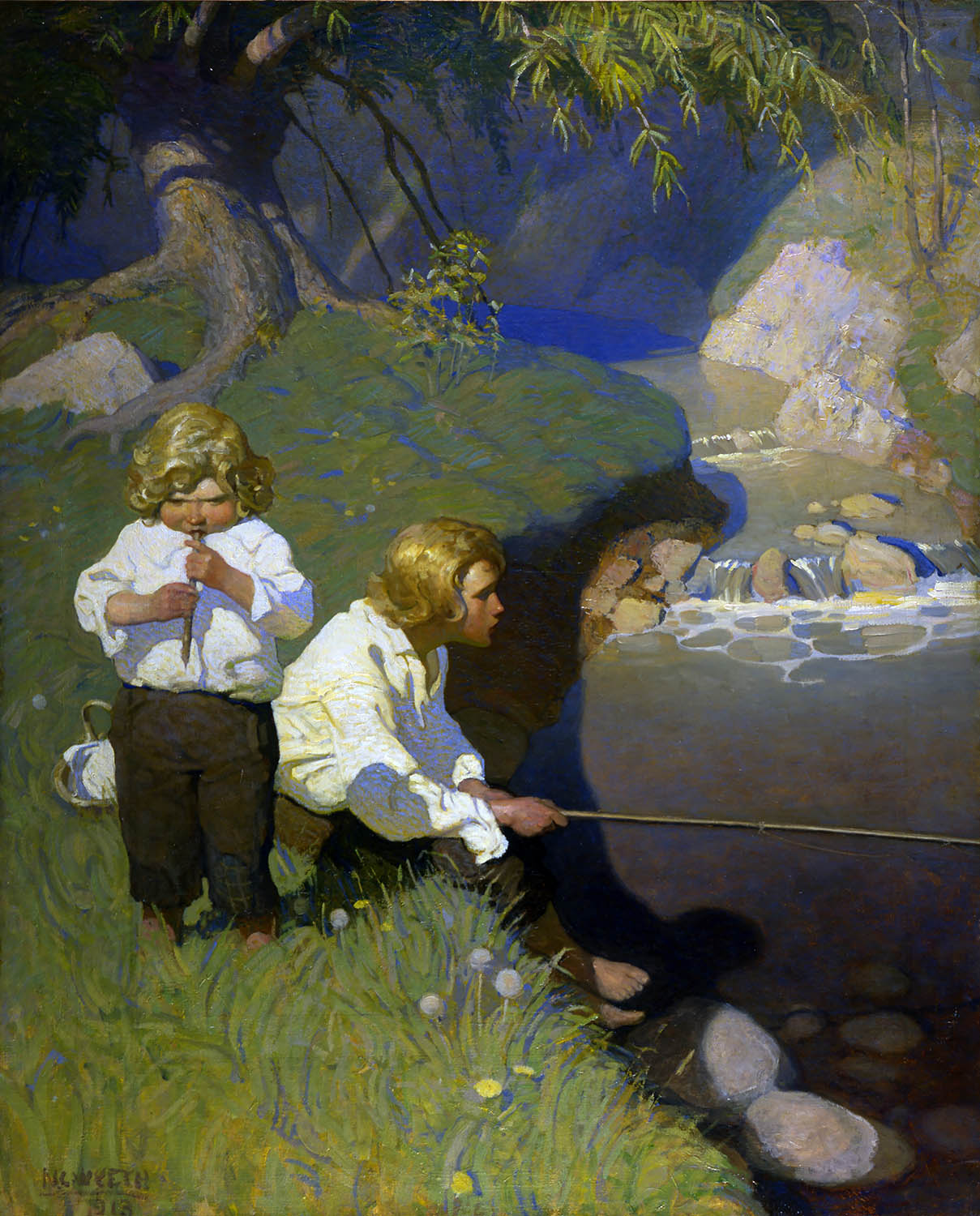
N.C. Wyeth (1882-1945)
He Never Caught a Thing and Ruined Jon's Reputation as a Fisherman (Along the Brandywine)
1913, oil on canvas
47" x 28", signed and dated lower left
War, or What Happens When One Loves One's Enemy, by John Luther Long, 1913, frontispiece
N.C. Wyeth transforms a lighthearted fishing tale into a celebration of childhood and the outdoors. Set along Pennsylvania's Brandywine Creek, the scene was inspired by the landscape surrounding Wyeth's home in Chadds Ford and even featured his own children as models. Following the teachings of his mentor, Howard Pyle, Wyeth drew inspiration from the people and places he knew best.
Painted with loose, impressionistic brushwork and the freshness of an outdoor sketch, the illustration reflects Wyeth's admiration for European Impressionism while remaining distinctly American in spirit. More than a fishing scene, it captures the simple pleasures of time spent in nature, where the experience often matters far more than the catch.
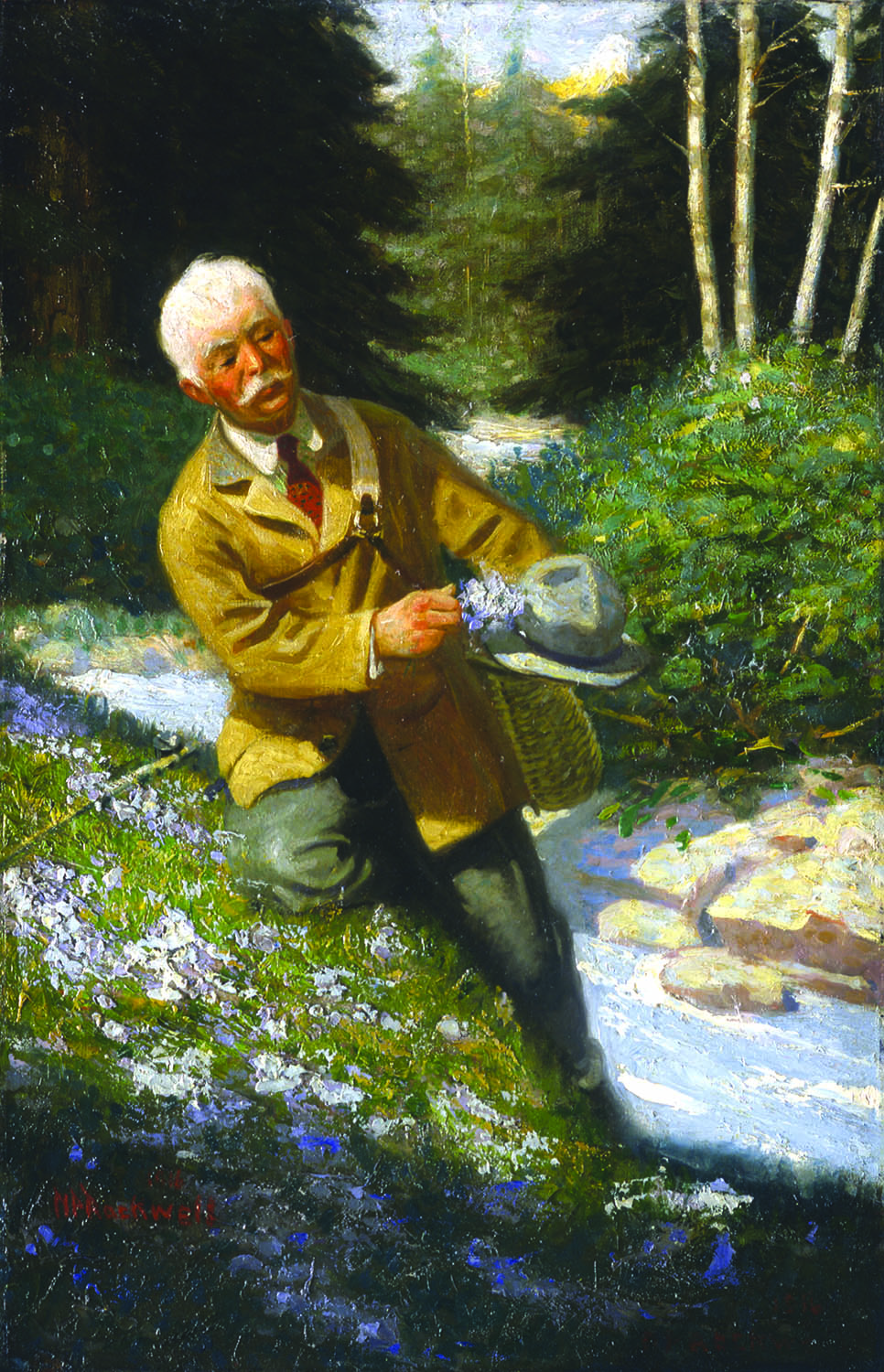
Norman Rockwell (1894-1978)
The Fisherman
1916, oil on canvas
24" x 16", signed lower left
Recreation magazine, May 1916 cover
Painted when Norman Rockwell was just twenty-two years old, The Fisherman is one of only three covers he created for Recreation magazine, a publication devoted to outdoor life and sporting pursuits. The painting reflects Rockwell's early fascination with fishing as both a pastime and a symbol of America's love of the outdoors.
This early work reveals an artist still developing his distinctive style. Signed with his middle initial "P" for Percevel—a name he abandoned the following year—the painting displays the painterly influence of Howard Pyle, whose dramatic compositions and rich brushwork helped shape the young Rockwell before he developed the storytelling approach that would make him America's most celebrated illustrator.
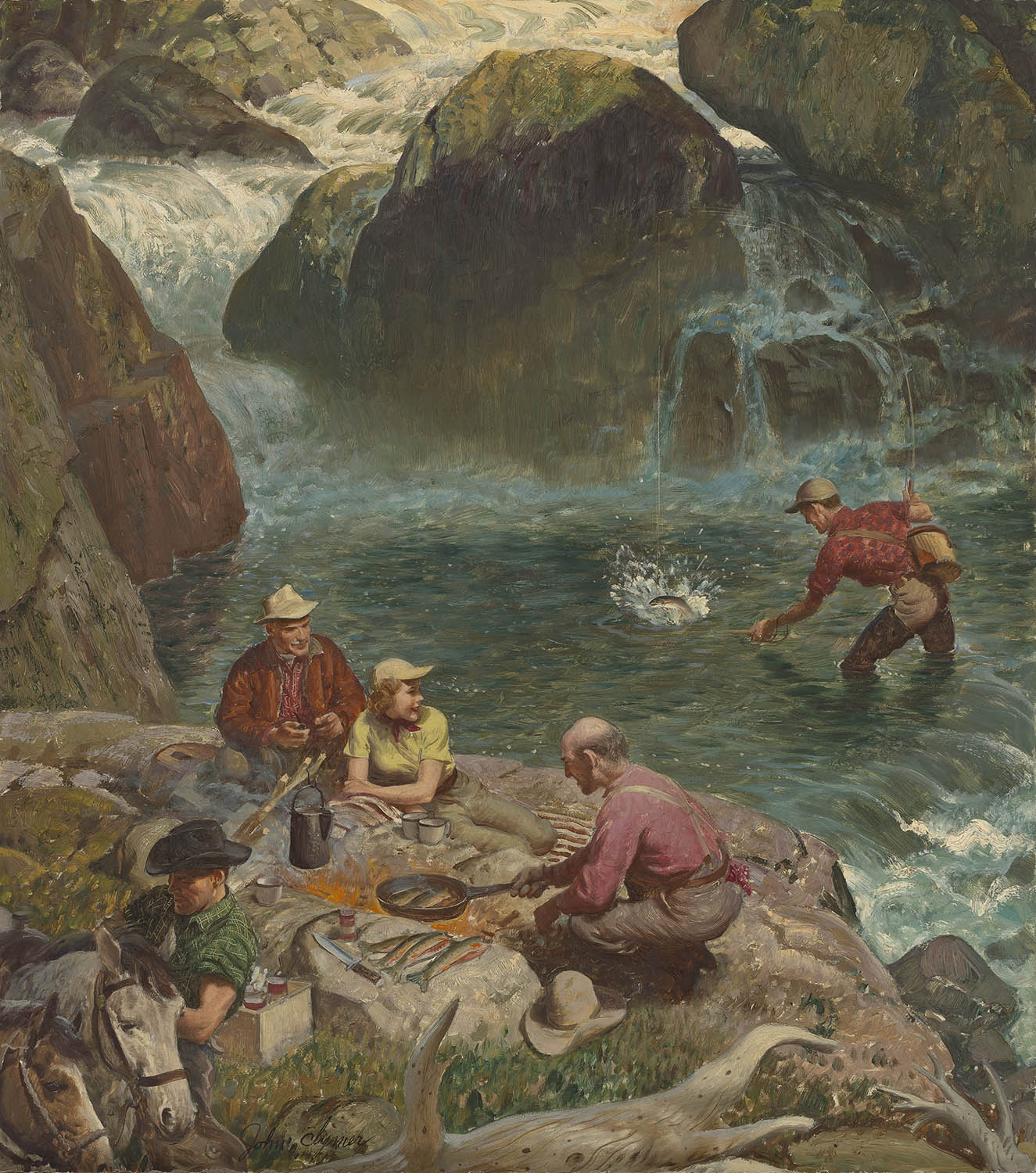
John Clymer (1907-1989)
Trout Fishing with Guides
1950, oil on masonite
26" x 23", signed lower left
John Clymer was renowned for his ability to portray the American outdoors with remarkable authenticity, drawing upon his own lifelong love of hunting, fishing, and the wilderness. In Trout Fishing with Guides, he captures the quiet concentration and companionship that define a successful day on the river, emphasizing the experience as much as the pursuit itself.
Known for his meticulous research and naturalistic style, Clymer brought an extraordinary sense of realism to every scene he painted. This work celebrates the enduring traditions of fly fishing, where patience, skill, and an appreciation for nature come together in one of America's most cherished sporting pastimes.
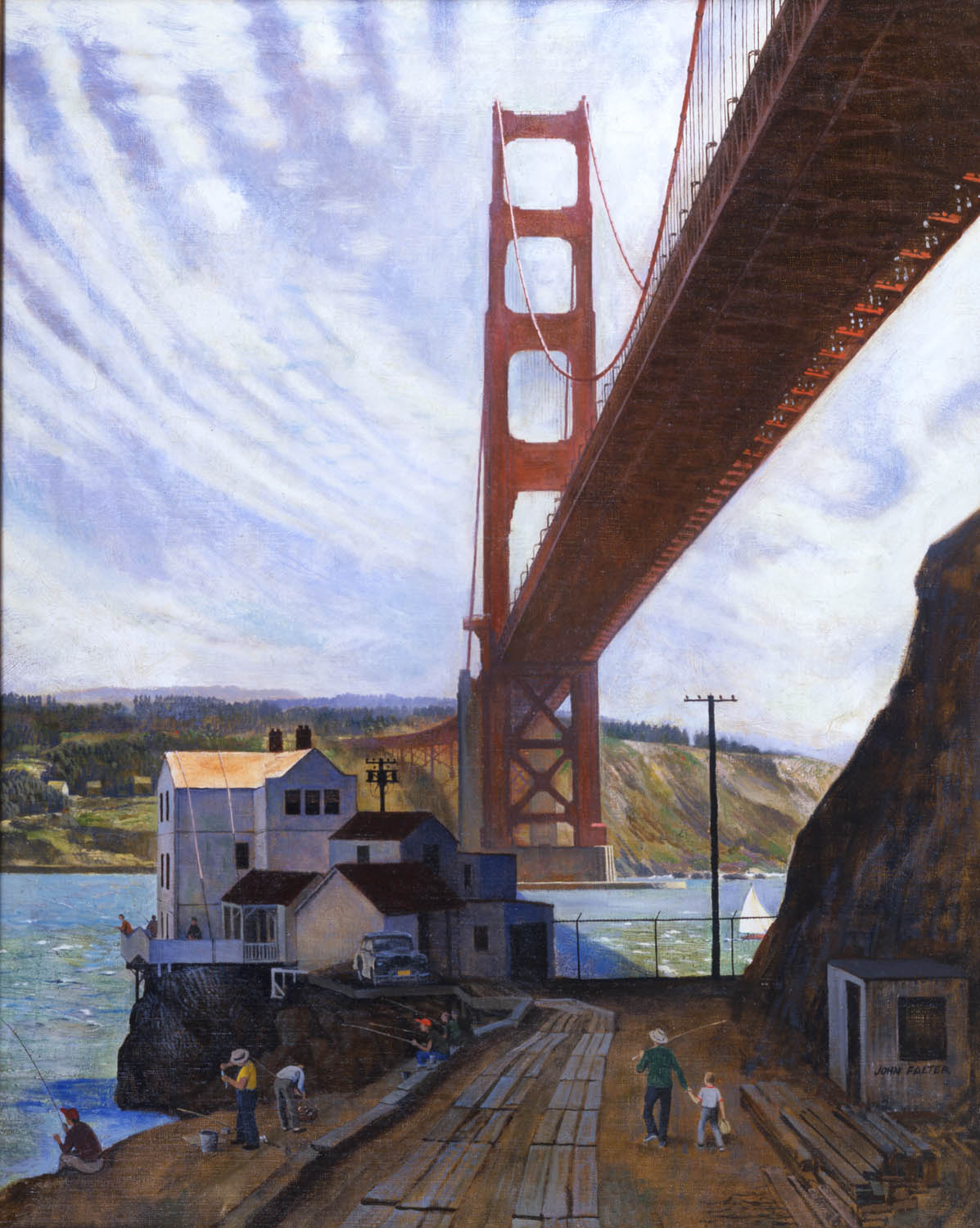
John Falter (1910-1982)
Fishing Under the Golden Gate Bridge
1957, oil on canvas
27 1/4" x 21 1/2", signed lower right
Saturday Evening Post, November 16, 1957 cover
With the Golden Gate Bridge rising majestically in the background, John Falter turns his attention to a quieter story unfolding on the pier—a father and son setting out together for a day of fishing. Their walk toward the water captures the anticipation of a shared adventure, reminding us that some of life's most meaningful moments are found in simple traditions passed from one generation to the next.
Published as the November 16, 1957 cover of The Saturday Evening Post, the painting exemplifies Falter's gift for finding warmth and humanity in everyday American life. Here, fishing becomes more than a sport; it is an opportunity for family, conversation, and memories that last long after the lines have been reeled in.
Football
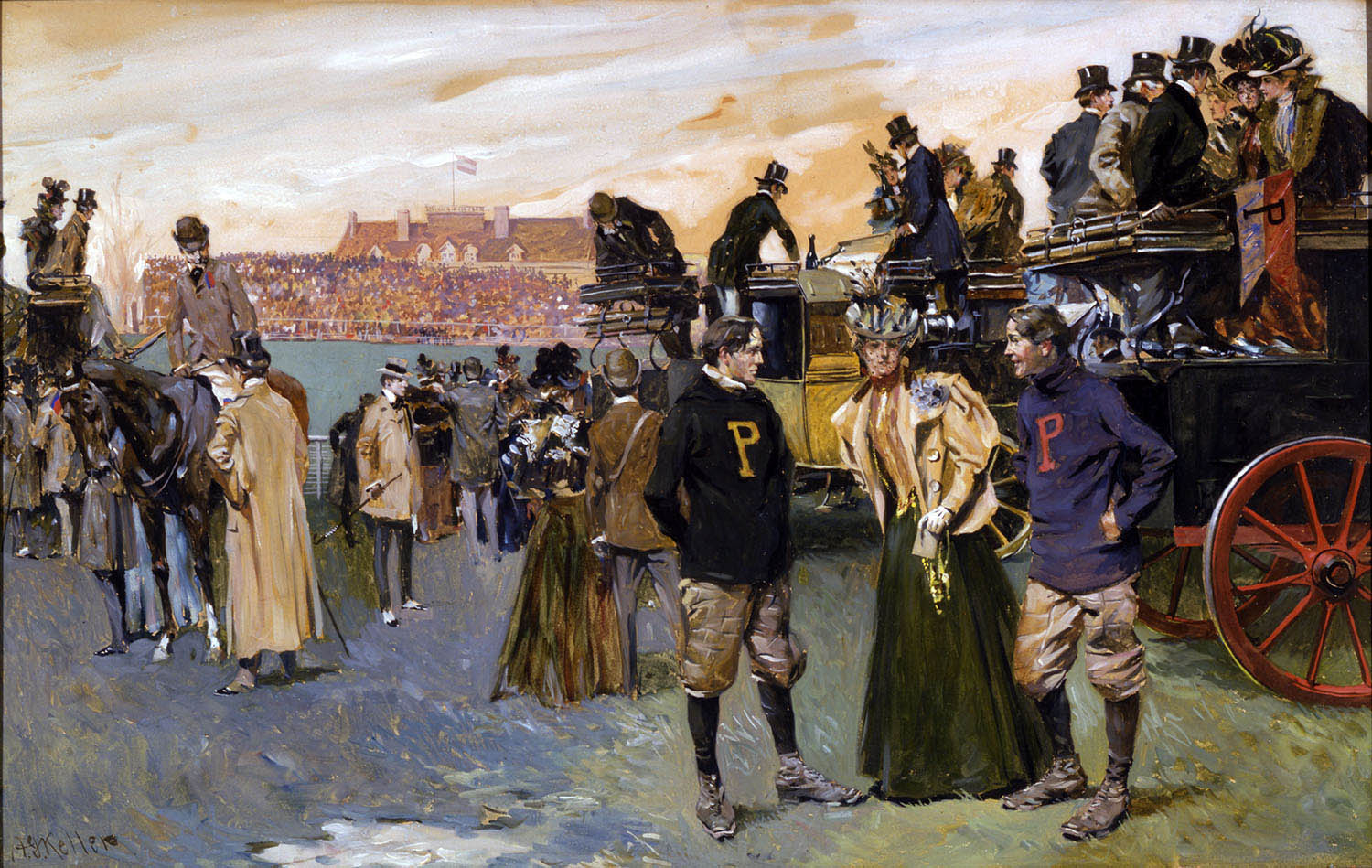
Arthur I. Keller (1866-1924)
Penn and Princeton Meet at a Football Game
1905, gouache on board
17" x 27", signed lower left
Truth Magazine illustration
As organized sports grew in popularity during the late nineteenth century, attending athletic contests became an important social event as well as a competitive spectacle. Arthur I. Keller captures the excitement surrounding a football game between the University of Pennsylvania and Princeton, where crowds gathered not only to watch the action on the field but also to participate in the shared experience of the day. Lining the sidelines are horse-drawn carriages, offering a fascinating glimpse into one of America's earliest forms of "tailgating."
Created during football's formative years, the illustration documents a time when the sport was rapidly becoming a defining feature of American college life. Keller's lively scene reminds us that from the very beginning, football has been as much about community and tradition as it has been about the game itself.
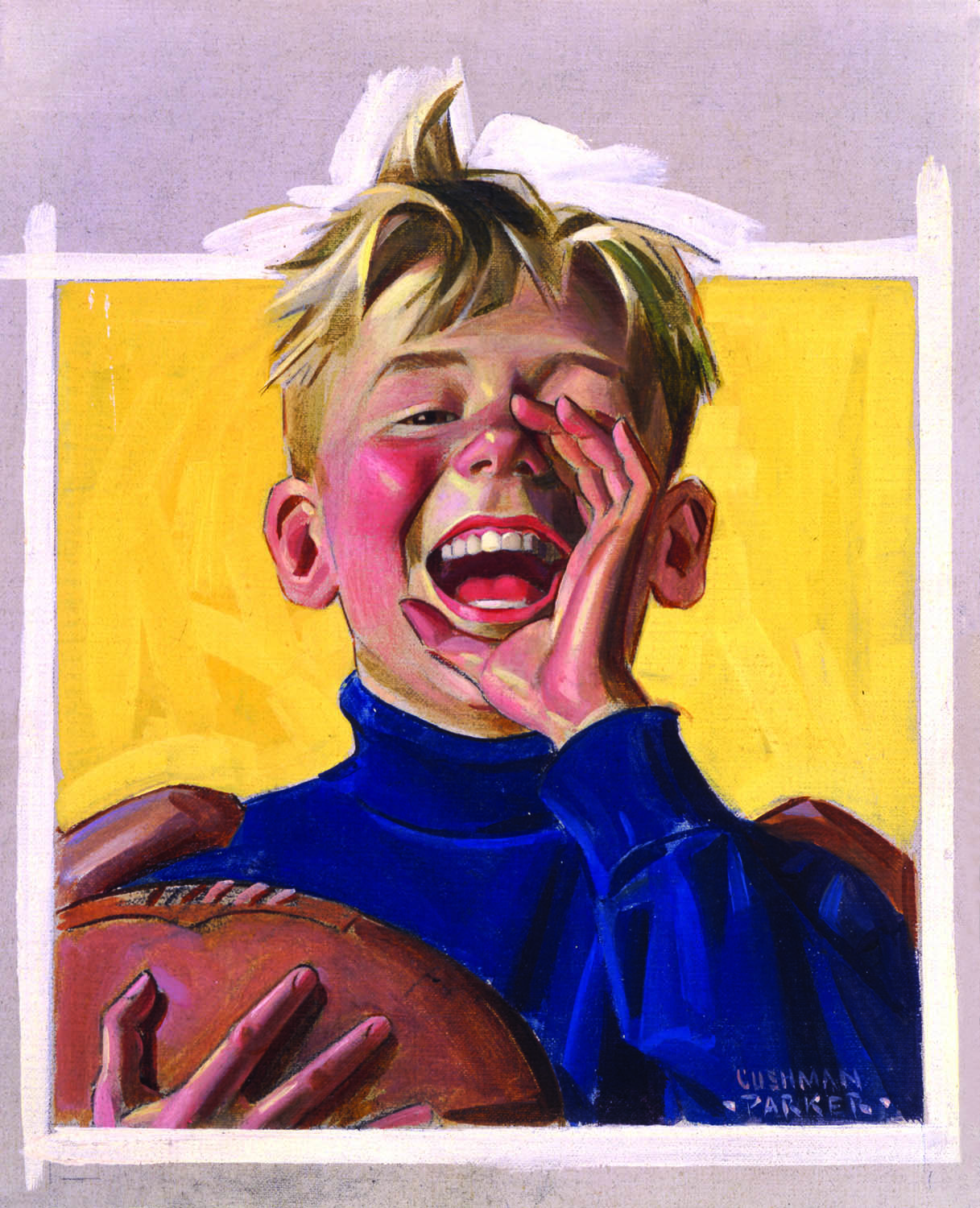
Cushman Parker (1881-1940)
Football Player
1910, oil on canvas
13 3/4" x 13", signed lower right
Beech Nut advertisement
Cushman Parker was celebrated for his charming illustrations of children, and this young football player became part of Beech-Nut's beloved advertising campaign. Clutching the ball with determined confidence while yelling to a fellow teammate, the child embodies the playfulness that made Parker's work so appealing to American audiences.
Created during the Golden Age of illustrated advertising, the painting demonstrates how sports had become woven into everyday American life, even for the youngest generations. Rather than emphasizing competition, Parker celebrates childhood aspirations and the joy of play, reminding viewers that the love of football often begins long before anyone steps onto a real playing field.
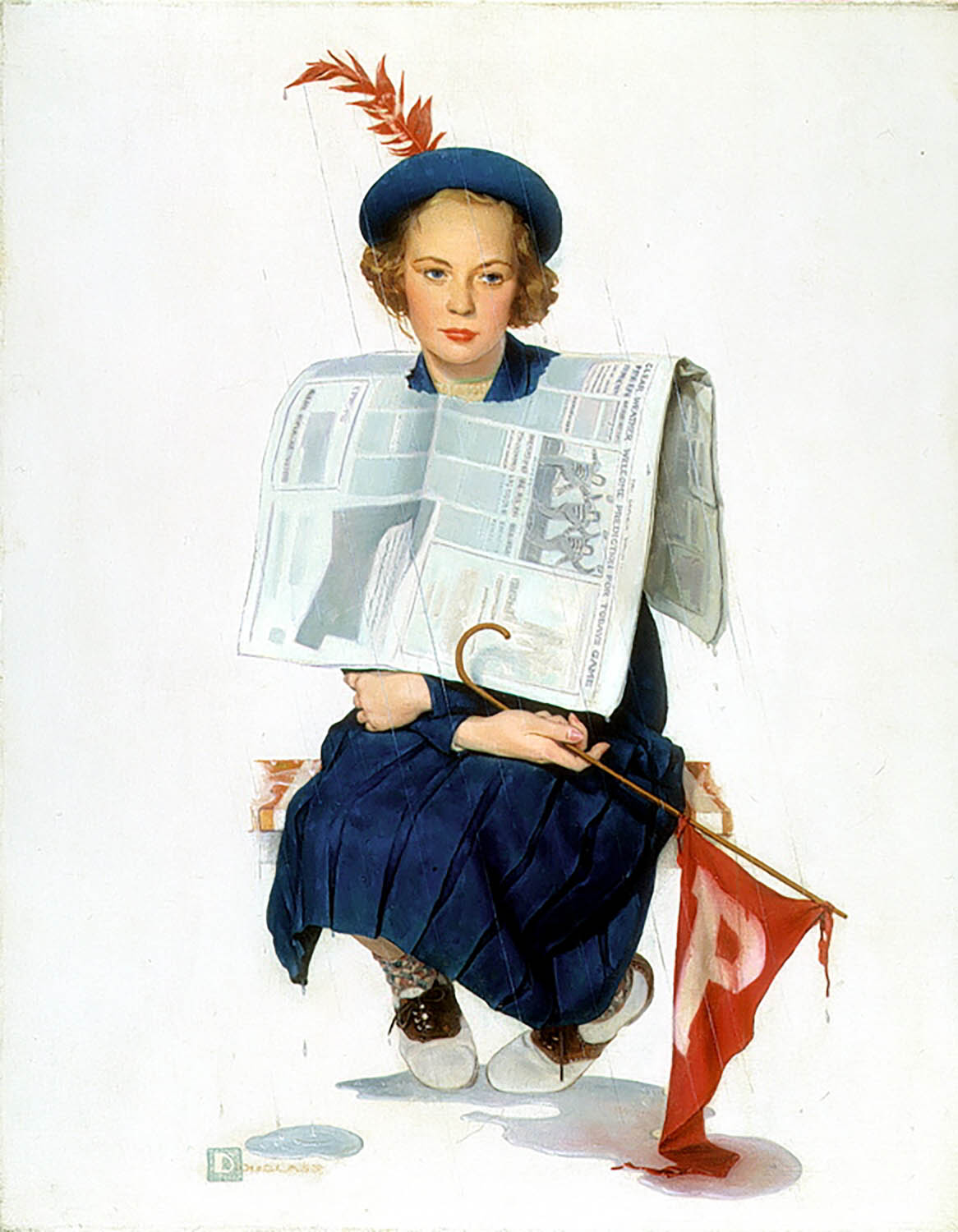
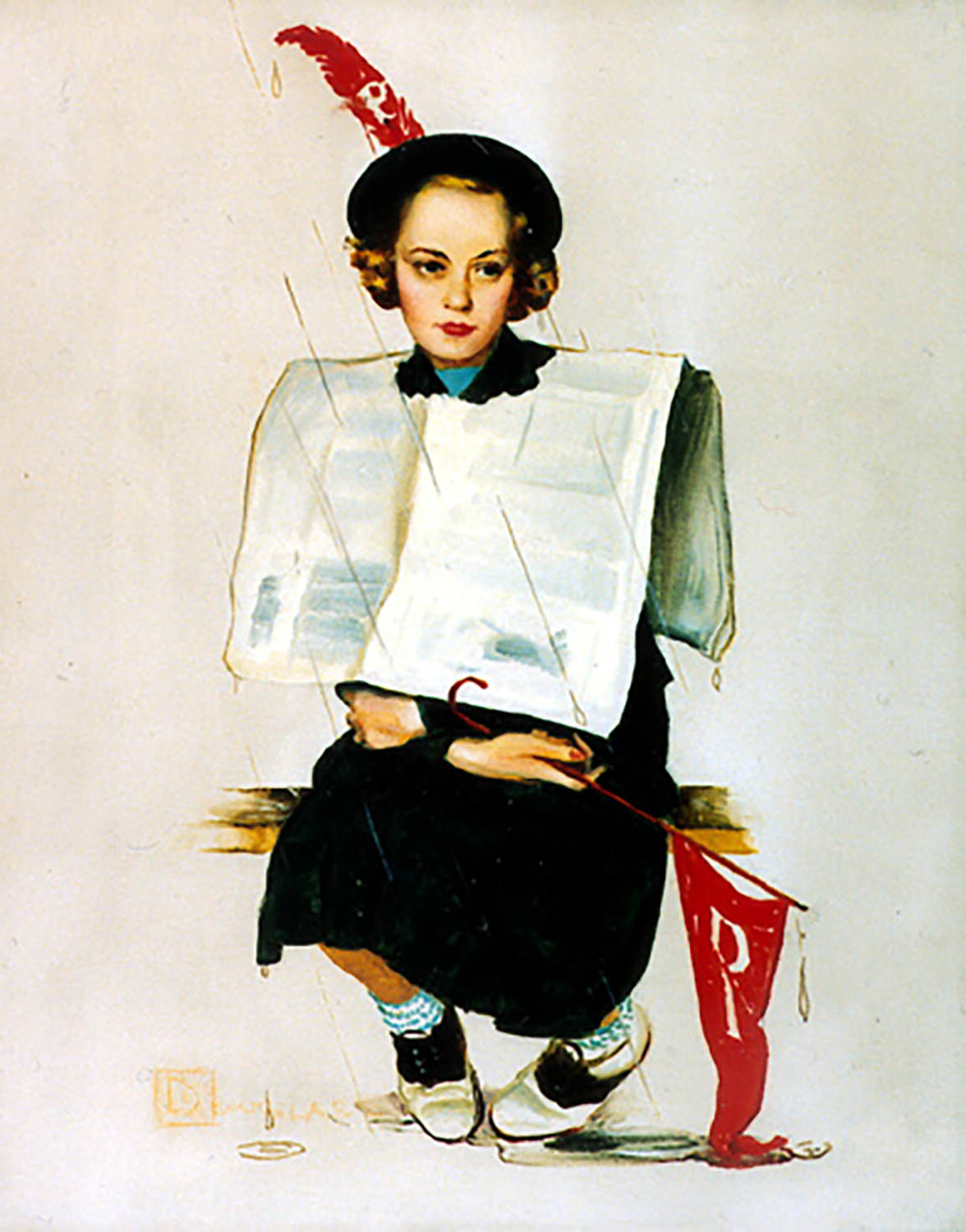
Douglass Crockwell (1904-1968)
Clear Weather Prediction - Final Painting and Study
1938, oil on canvas
Final: 30" x 24", signed lower right
Study: 13 1/2" x 11", signed lower left
Saturday Evening Post, November 5, 1938 cover
Douglass Crockwell tells an entire story through a single disappointed football fan. Trusting the newspaper's prediction of clear weather, she has arrived at the game only to find herself caught in a downpour. Shielding herself with the very newspaper that led her astray, she sits dejectedly in the rain as her Princeton "P" pennant droops into the mud—a humorous reminder that even the best-laid plans can be washed away.
Painted for the November 5, 1938 cover of The Saturday Evening Post, the illustration exemplifies Crockwell's remarkable gift for visual storytelling. With just one figure and a handful of carefully chosen details, he creates a complete narrative that is instantly relatable, capturing both the unpredictability of autumn football and the enduring devotion of America's fans.
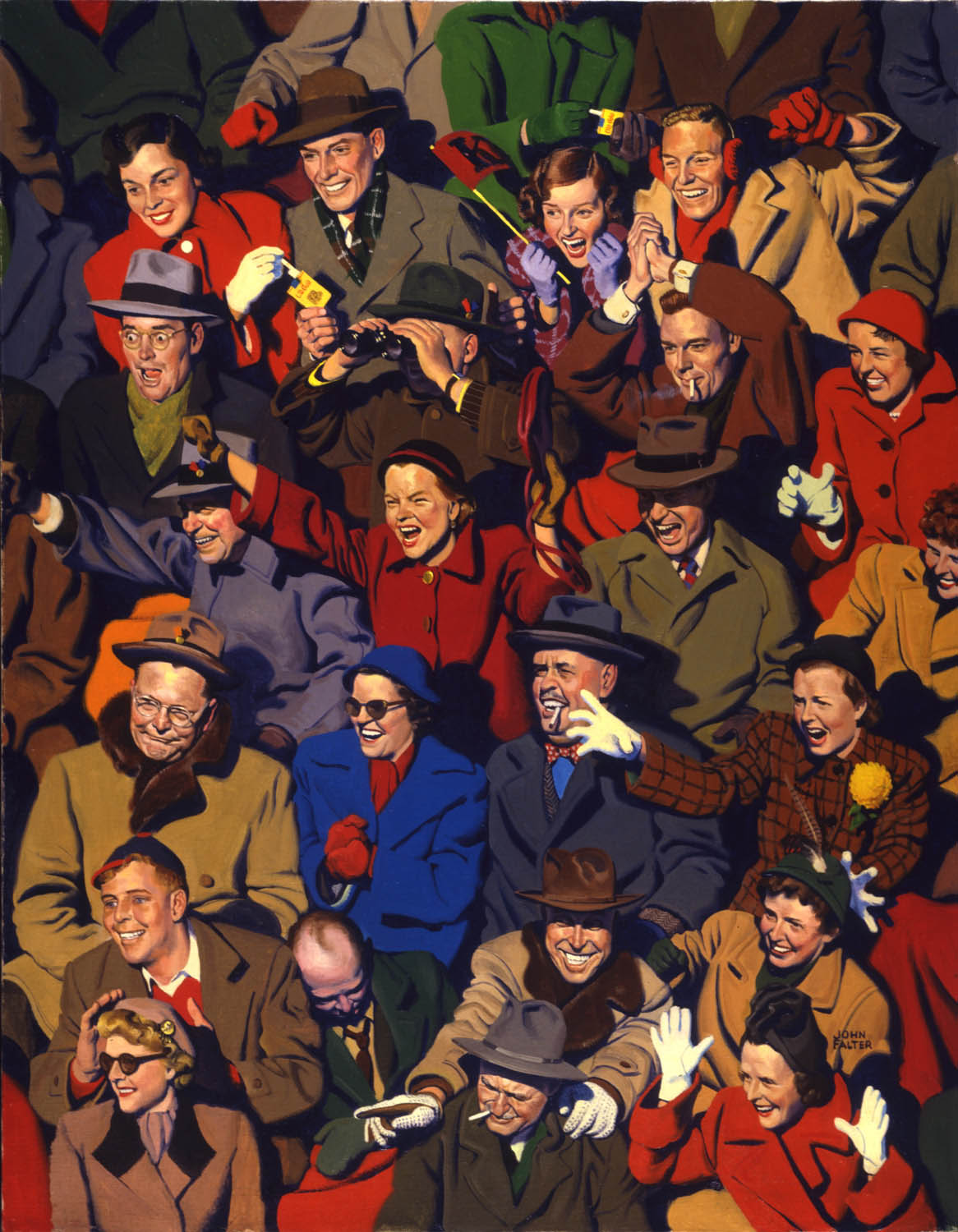
John Falter (1910-1982)
In The Stands (Old Gold Advertisement)
1950, oil on canvas
19 1/8" x 16", signed lower right
Old Gold advertisement, c. 1950s
John Falter captures the exhilaration of a packed football stadium at the very moment the home crowd erupts in celebration. The grandstand becomes the true subject of the painting, with jubilant fans leaping to their feet in a wave of excitement that conveys the energy and spectacle of America's favorite autumn pastime.
Only upon closer inspection does the painting reveal its commercial purpose. Scattered throughout the cheering crowd are subtle depictions of Old Gold cigarettes in the hands and mouths of spectators, seamlessly woven into the scene rather than dominating it. This understated approach exemplifies the Golden Age of illustrated advertising, when artists like Falter created memorable narratives first and product promotion second, allowing the advertisement to feel like a genuine slice of American life.
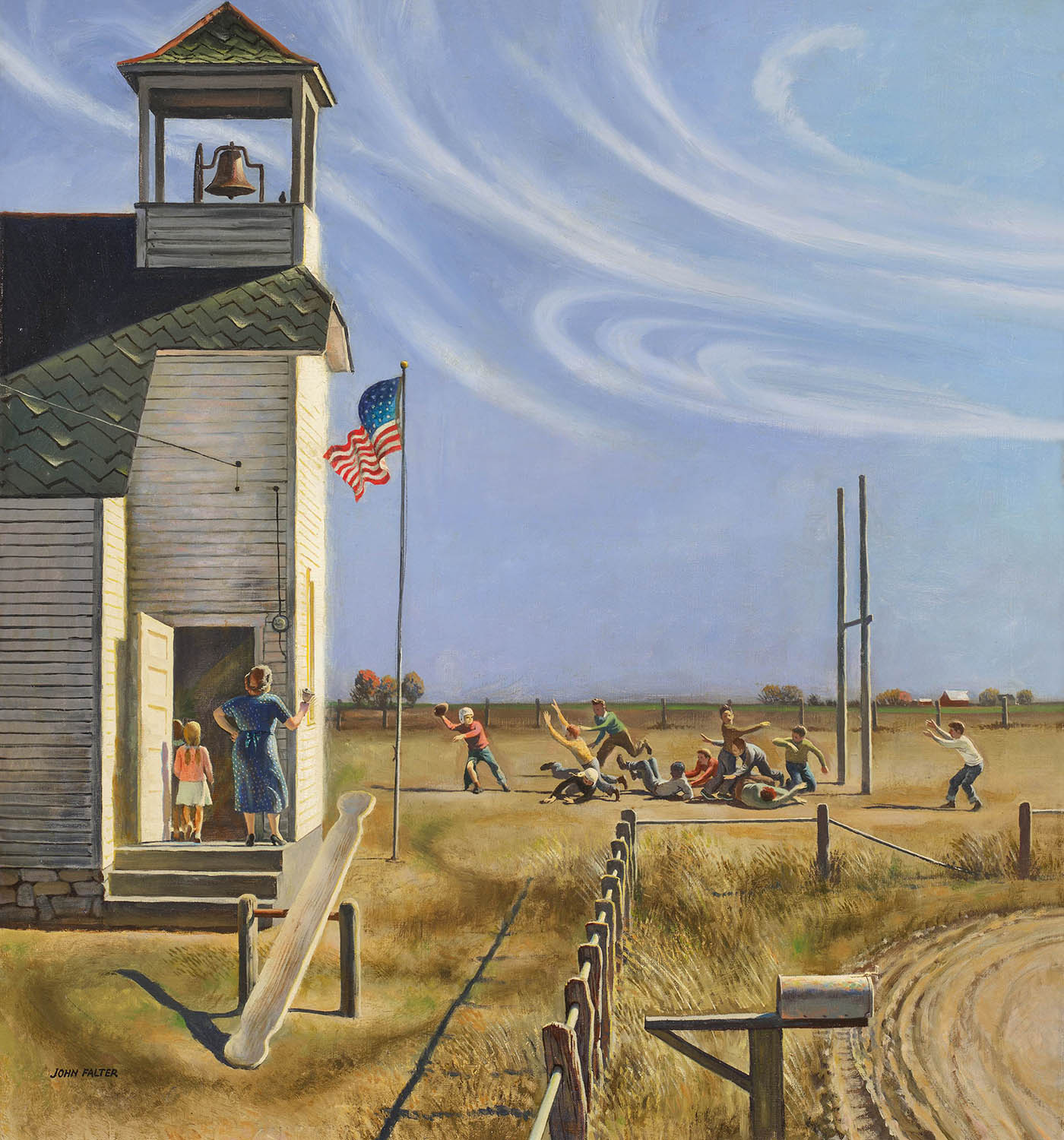
John Falter (1910-1982)
End of Recess
1953, oil on canvas
28" x 25 3/4", signed lower left
Saturday Evening Post, October 17, 1953 cover
John Falter perfectly captures the universal childhood dilemma of not wanting recess to end. A group of boys is immersed in an impromptu football game outside their Midwestern schoolhouse as the quarterback cocks his arm to throw what could be the game-winning touchdown pass. In the end zone, the intended receiver eagerly calls for the ball, while their teacher stands impatiently with one hand on her hip and the school bell in the other, signaling that class must resume.
Published as the October 17, 1953 cover of The Saturday Evening Post, the painting exemplifies Falter's mastery of visual storytelling. By freezing the action at its most suspenseful moment, he leaves viewers wondering whether the pass will ever be thrown, celebrating the irresistible pull of childhood play and football's place in the everyday lives of American children.
Golf
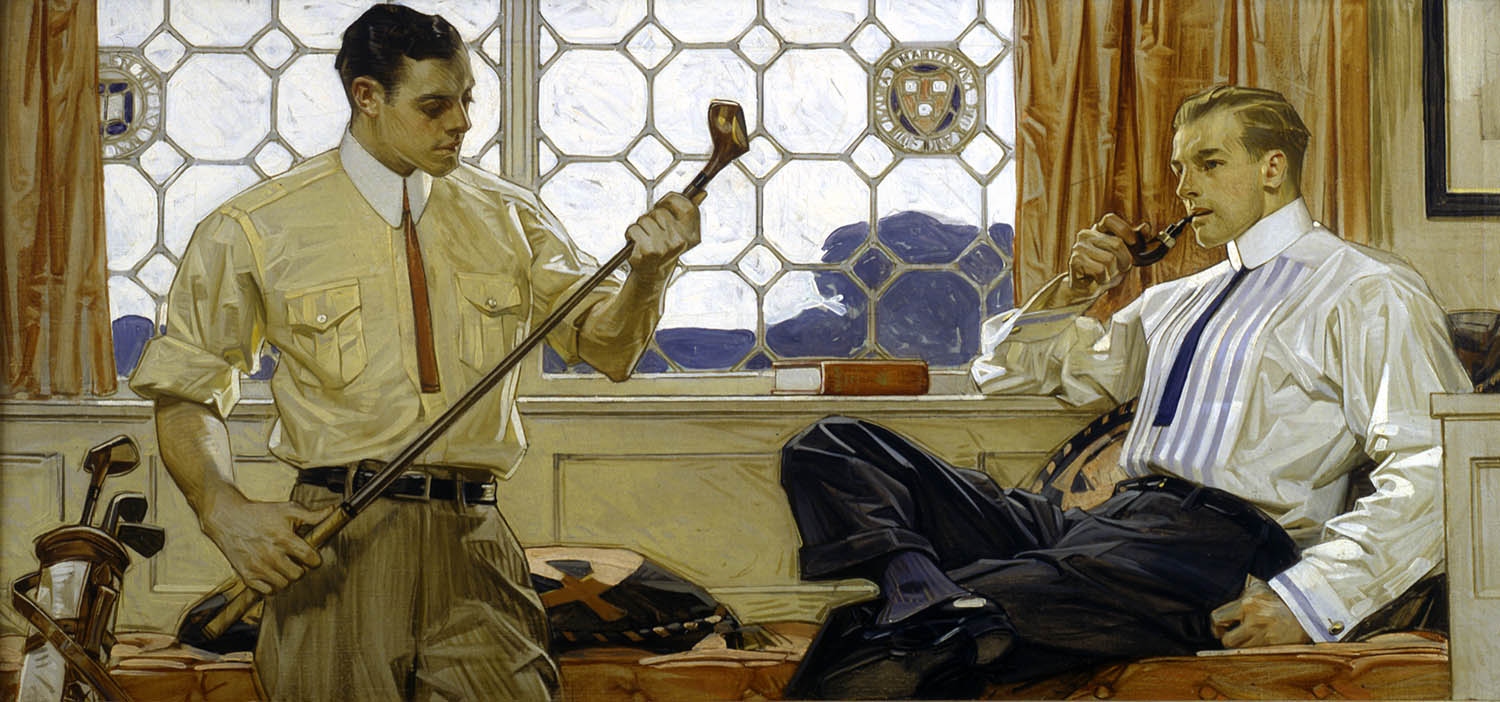
J.C. Leyendecker (1874-1951)
Men with Golf Clubs - Arrow Collar Advertisement
1909, oil on canvas
20 1/2" x 42 1/2"
Arrow Collar advertisement, printed in Collier's, April 3, 1909
Two impeccably dressed golfers pause with clubs in hand, presenting an image of confidence, leisure, and modern sophistication. Rather than focusing on the mechanics of the game, J.C. Leyendecker uses golf to suggest refinement and social standing. The sport becomes part of a carefully constructed lifestyle in which athleticism, fashion, and personal success are closely intertwined.
Leyendecker was among the most influential fashion illustrators of the early twentieth century, helping to define the polished ideal of the American man through his celebrated advertisements for Arrow Collars. He frequently placed his models in sporting settings, using golf, rowing, football, and other pursuits to associate Arrow clothing with strength, vitality, and good taste. His elegant figures and commanding compositions did more than sell shirts and collars—they helped shape American ideas of masculine style for a generation.
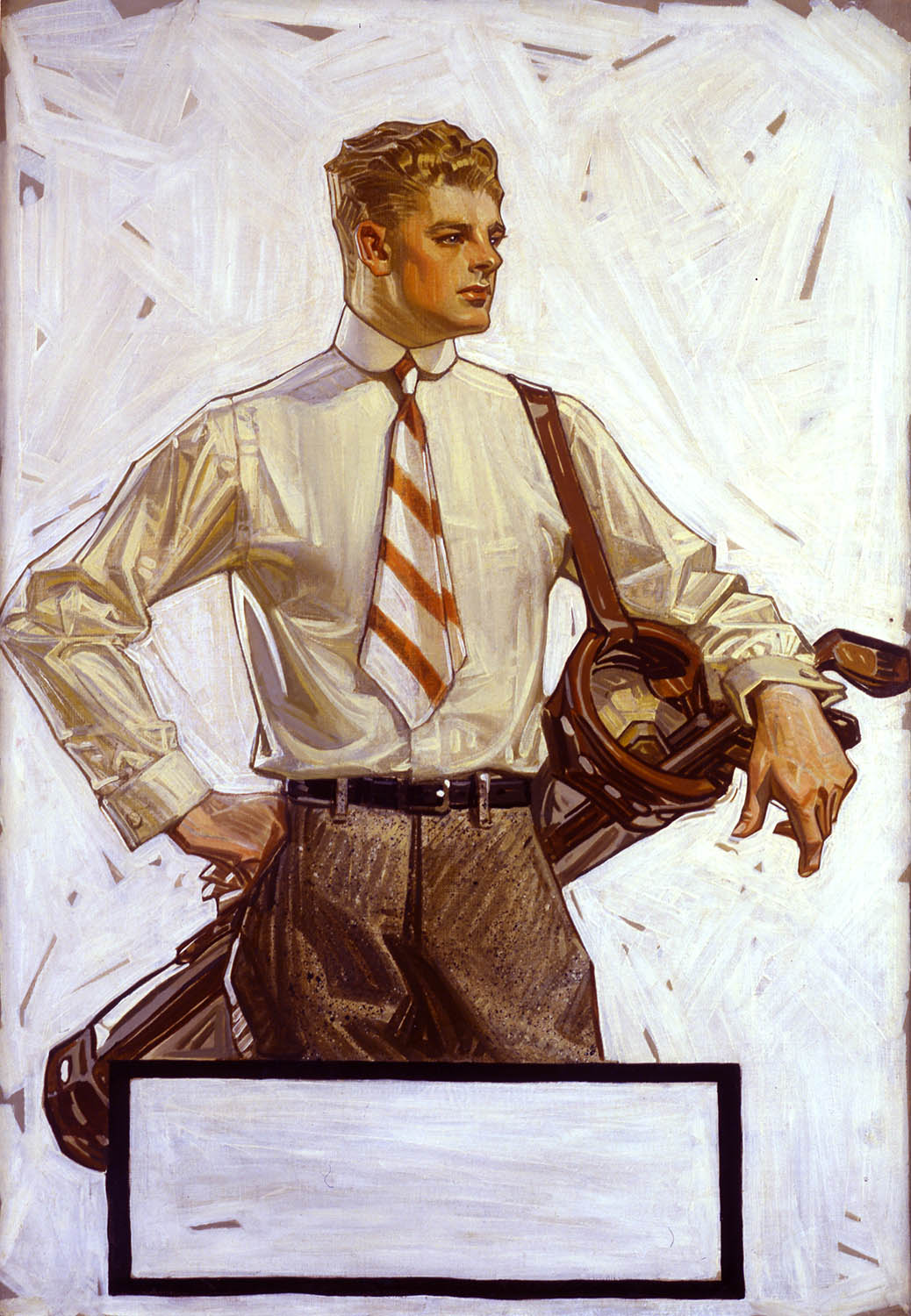
J.C. Leyendecker (1894-1978)
Golf - Arrow Collar Advertisement
1913, oil on canvas
29" x 20 1/2"
Arrow Collar advertisement, printed in Cosmopolitan Magazine, July 1913
A stylish golfer pauses after his swing, embodying the confidence, elegance, and effortless sophistication that became synonymous with J.C. Leyendecker's work. The artist was less interested in the action of the game than in the image it projected. Golf, still emerging as a fashionable pastime in the United States, provided the perfect setting to associate the Arrow brand with leisure, success, and impeccable taste.
By 1913, Leyendecker had become one of America's most celebrated commercial artists. His covers for The Saturday Evening Post and his long-running campaigns for Arrow Collars helped transform advertising into an art form, influencing fashion, illustration, and graphic design for decades. His idealized "Arrow Collar Man" became one of the first national advertising icons, admired for his athletic build, refined appearance, and quiet confidence. Whether depicting golfers, football players, rowers, or tennis enthusiasts, Leyendecker consistently used sport to communicate the modern American ideal—one in which athleticism, style, and aspiration were inseparable.
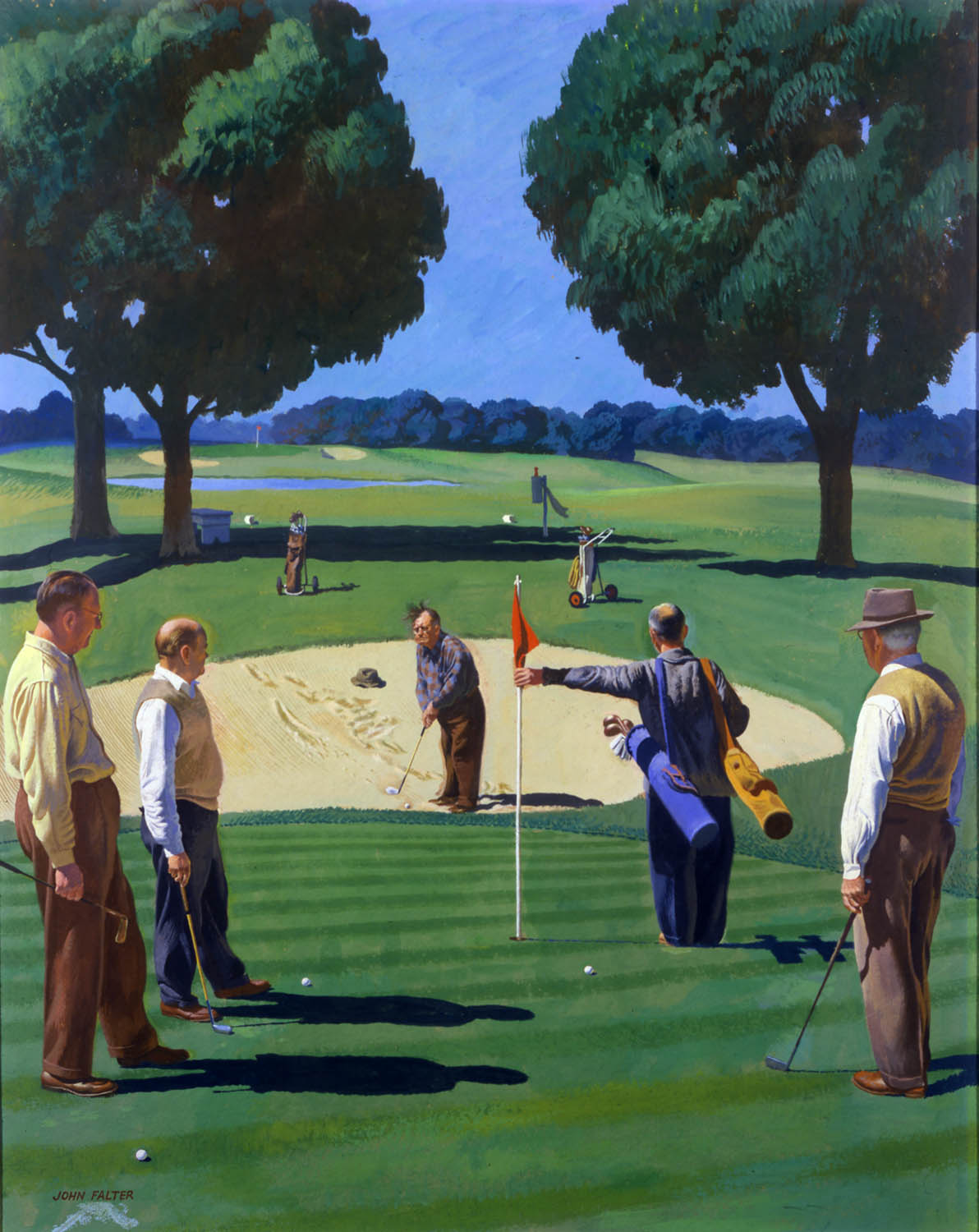
John Falter (1910-1982)
Sand Trap
1948, gouache on board
24" x 18", signed lower left
Saturday Evening Post, July 3, 1948 cover
With his trademark humor, John Falter captures one of golf's most familiar frustrations: escaping a stubborn sand trap. A weary golfer, his clothes rumpled from repeated attempts, prepares yet another swing while his companions look on with a mixture of patience and sympathy. The numerous divots scattered throughout the bunker reveal that this is far from his first effort, turning an ordinary golfing mishap into a scene of gentle comedy that any golfer can appreciate.
Painted for the July 3, 1948 cover of The Saturday Evening Post, the illustration demonstrates Falter's remarkable ability to tell an entire story in a single image. In an accompanying feature, the Post revealed that the golfers had been modeled on a course near Phoenix, Arizona, but Falter added leafy Eastern trees to create a more familiar setting for readers. The editors jokingly observed that the result was "a Western course with Eastern trees, and it's a wonder anybody can win there." Like many of Falter's most beloved covers, Sand Trap transforms an everyday moment into a timeless celebration of the joys—and occasional exasperations—of American recreation.
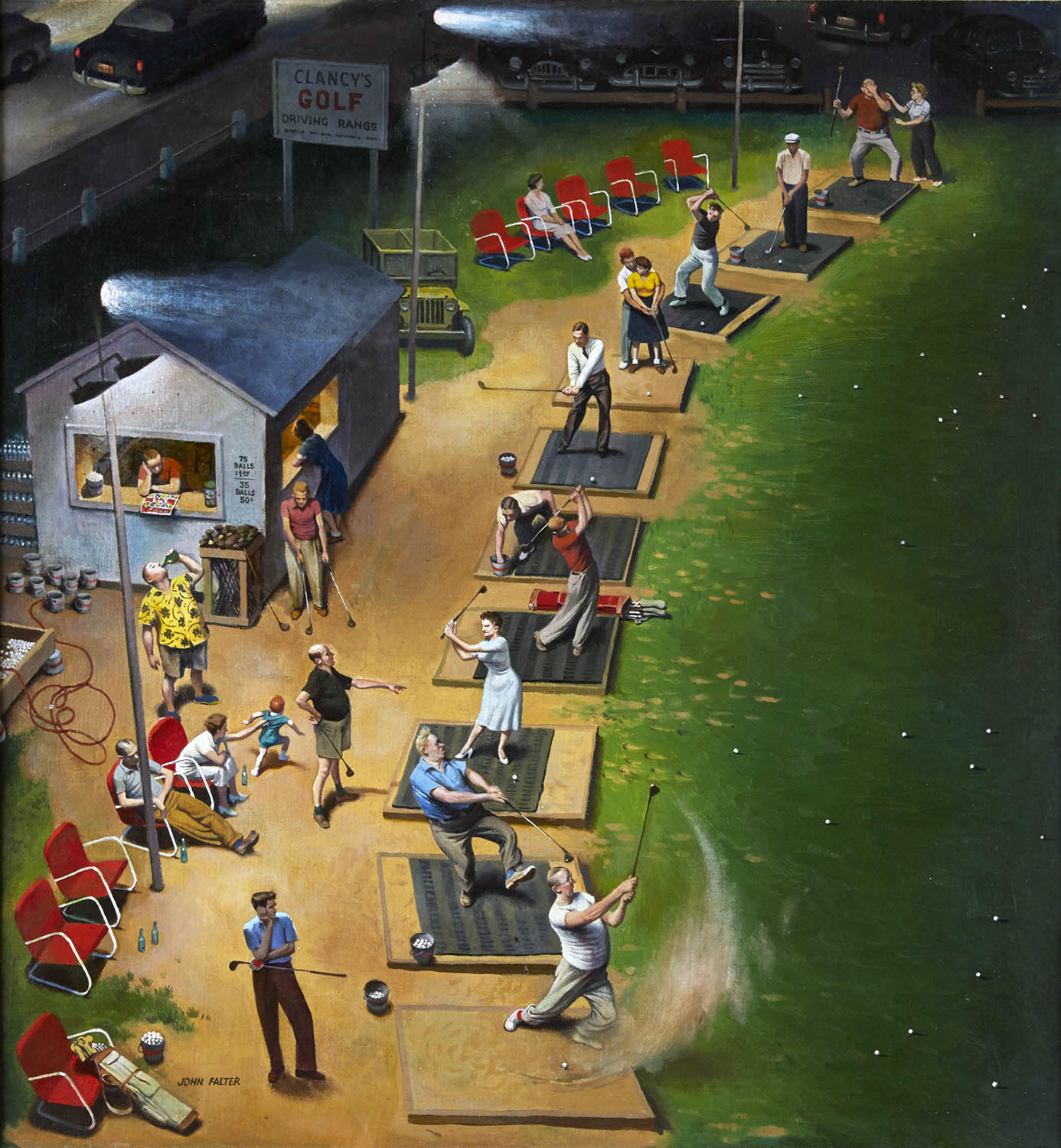
John Falter (1910-1982)
Golf Driving Range
1952, oil on canvas
26" x 24", signed lower left
Saturday Evening Post, July 26, 1952 cover
John Falter transforms an ordinary driving range into a lively study of the triumphs and frustrations that make golf so endlessly captivating. Rather than focusing on a single golfer, he fills the composition with dozens of players, each demonstrating a different swing, stance, or reaction. From wild over-swings and awkward follow-throughs to confident poses that fail to produce results, the painting is both a humorous catalog of golfing mishaps and an affectionate tribute to the perseverance of amateur players.
In the Saturday Evening Post, Falter explained that the idea grew from his own love-hate relationship with golf. After playing on rustic Nebraska courses as a boy, he abandoned the game for years before becoming, in his own words, "a golf nut" in 1948. The scene was modeled on a driving range along Rockville Pike in Bethesda, Maryland, where Falter deliberately painted nearly every poor swing he had experienced himself. He joked that arthritis prevented him from discovering even more, concluding with characteristic wit, "It's a grand old game, and I have a low handicap on the tube." The cover exemplifies Falter's gift for finding humor in everyday American life, inviting viewers to recognize a bit of themselves in every golfer on the range.
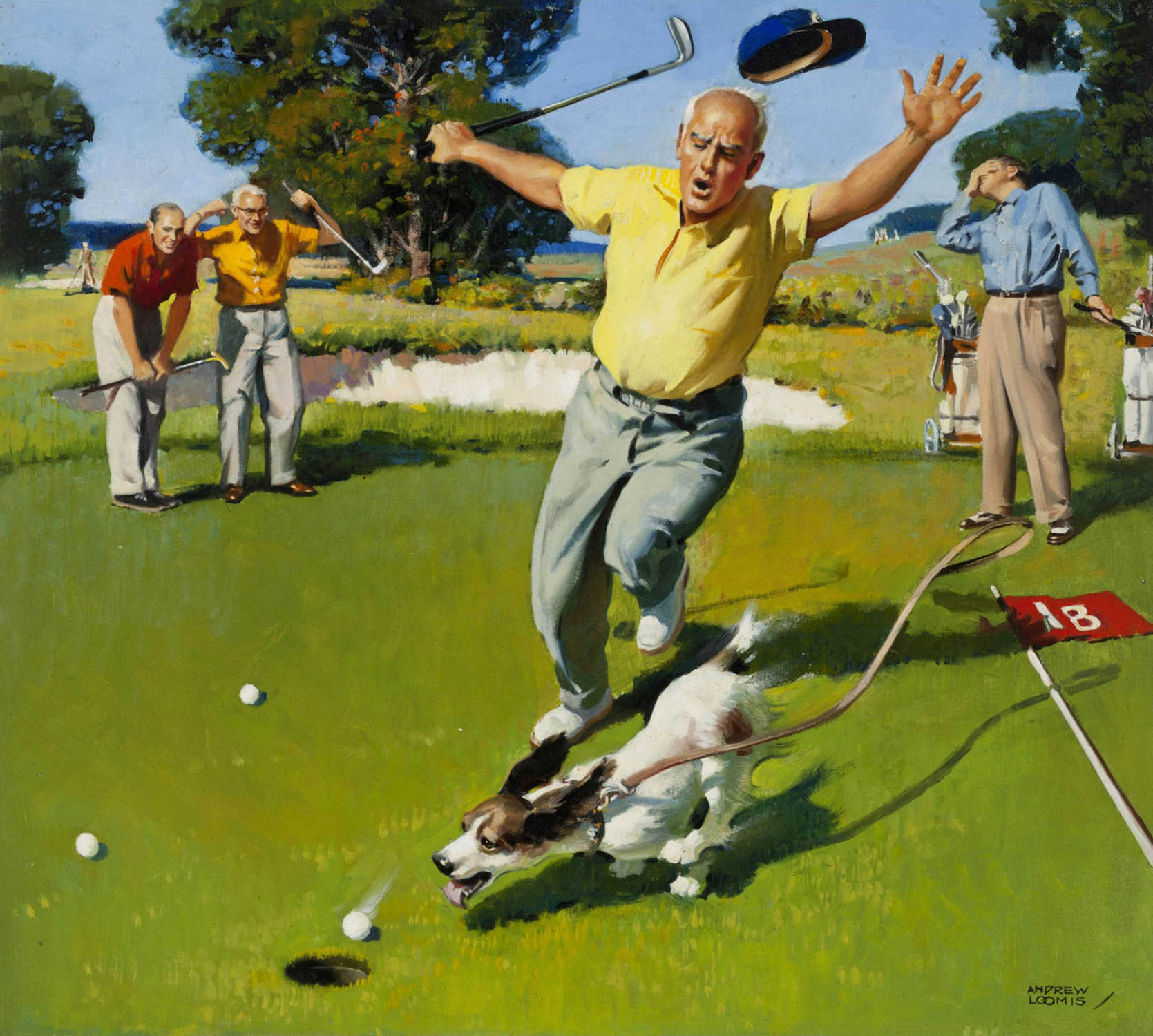
Andrew Loomis (1892-1959)
Dog Chasing Golf Ball
1957, oil on canvas board
19" x 21", signed lower right
American Weekly, July 21, 1957 cover
Andrew Loomis brings a delightful sense of humor to the game of golf by depicting one of its most unpredictable hazards—a playful dog with no intention of letting the golfers finish their round in peace. As the determined canine races after the freshly struck ball, the golfers can only watch in disbelief, their carefully planned shot suddenly at the mercy of an enthusiastic four-legged retriever. The scene captures the good-natured frustrations that every golfer inevitably encounters on the course.
Published as the July 21, 1957 cover of The American Weekly, the illustration demonstrates Loomis's exceptional ability to blend elegant figure painting with engaging visual storytelling. Best known today for his influential instructional books on drawing and illustration, Loomis was also one of America's finest commercial artists. Like many magazine illustrators of the era, he found inspiration not in championship victories but in the humorous, relatable moments that made sports such a cherished part of everyday American life.
Swimming
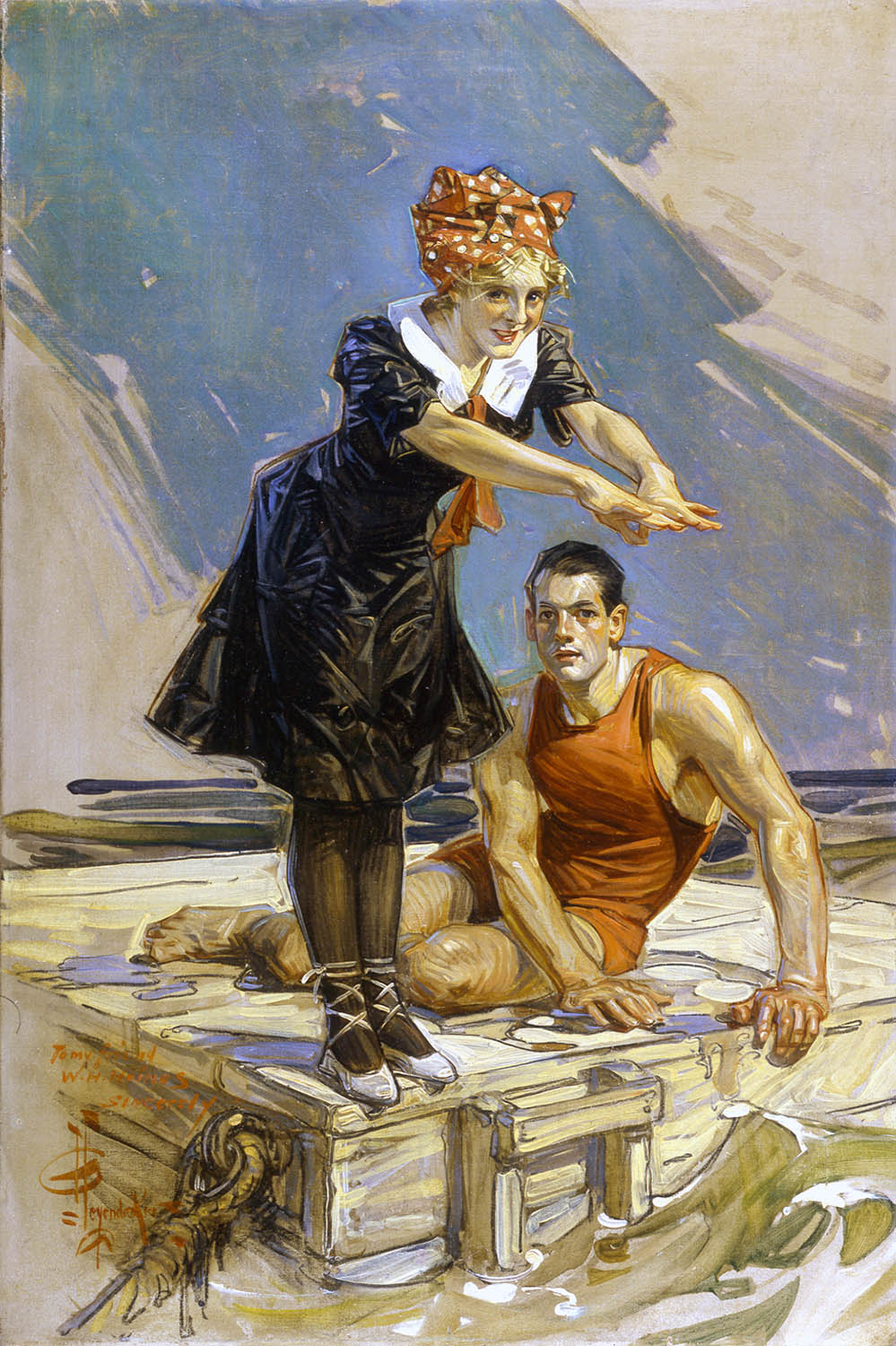
J.C. Leyendecker (1874-1951)
Couple on Raft
1909, oil on canvas
30" x 20", signed lower left
Popular Magazine, August 1909 cover
A young couple relaxes together on a raft, enjoying the carefree pleasures of a summer day on the water. Rather than emphasizing movement or action, J.C. Leyendecker creates a scene of effortless elegance, using swimming and recreation as an expression of the healthy, modern lifestyle that became a hallmark of early twentieth-century America.
Painted for the 1909 cover of Popular Magazine, this work exemplifies the distinctive style that established Leyendecker as one of America's foremost illustrators. Working exclusively from live models, he developed a specially formulated oil paint that dried quickly, allowing him to execute broad, confident brushstrokes with remarkable speed and precision. His paintings were never overworked; instead, he relied on impeccable draftsmanship and carefully placed passages of color, inviting viewers to complete forms through suggestion as much as description. This balance of bold technique and refined design produced the fresh, vibrant "Leyendecker Look" that influenced generations of illustrators and helped define the golden age of American illustration.
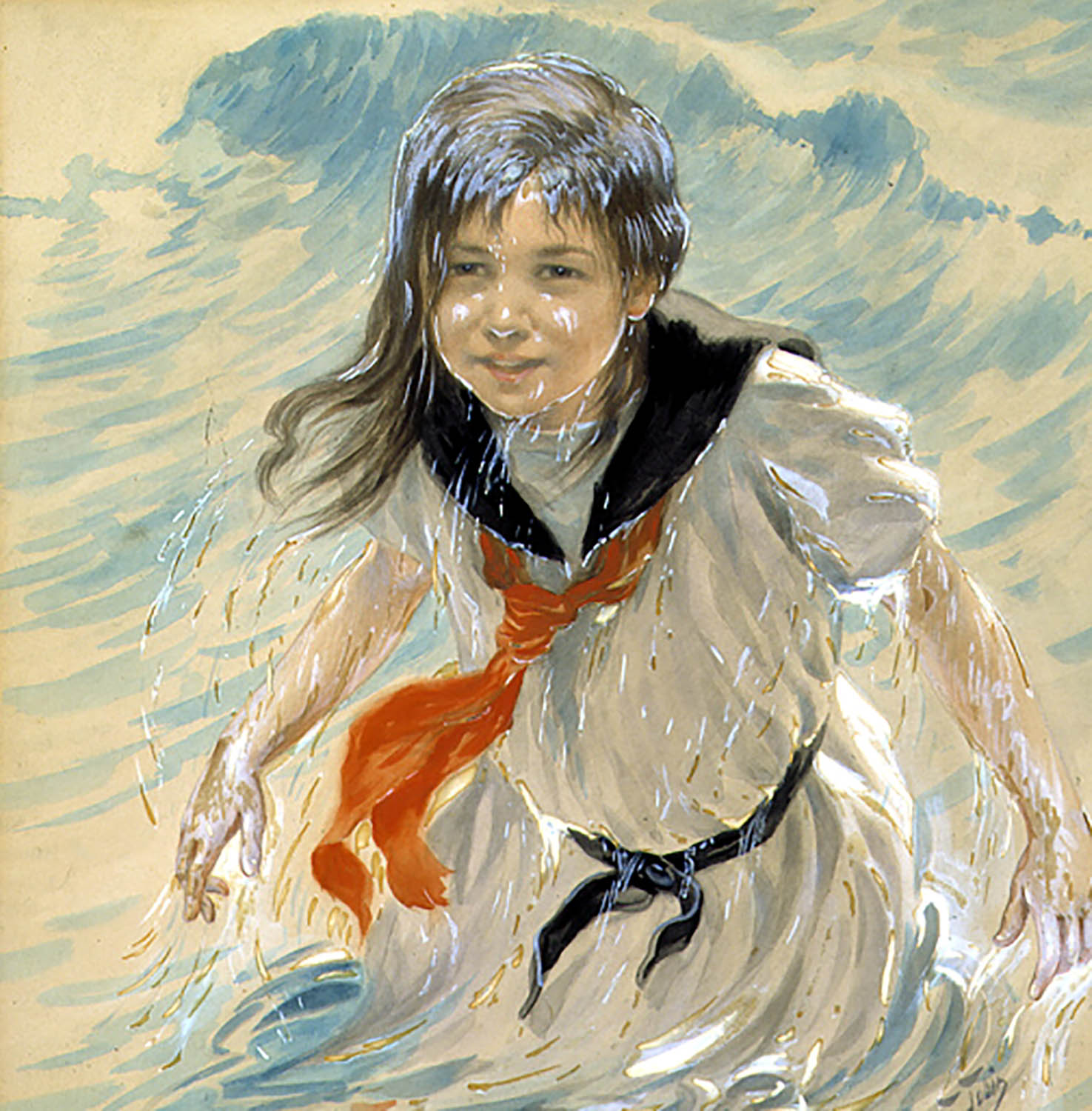
George T. Tobin (1864-1956)
Girl Swimming
1913, watercolor on board
14 1/2" x 14 1/2"
St. Nicholas, September 1913 cover
Fresh from the ocean, a young swimmer emerges from the water with droplets cascading from her hair, arms, and bathing costume. George T. Tobin masterfully captures the shimmering effect of water through delicate highlights that seem to glisten across the figure, creating a remarkable sense of movement and freshness. Her modest one-piece swimming costume reflects the fashions of the early twentieth century, when recreational swimming was becoming an increasingly popular pastime for American families.
Created for the September 1913 cover of St. Nicholas, one of America's most beloved children's magazines, the illustration celebrates the simple joys of a day at the beach. Tobin's refined draftsmanship and sensitivity to light elevate an everyday moment into an image of timeless summer nostalgia. As swimming grew in popularity during the early 1900s, illustrations like this helped portray the activity as both wholesome recreation and an essential part of the American childhood experience.
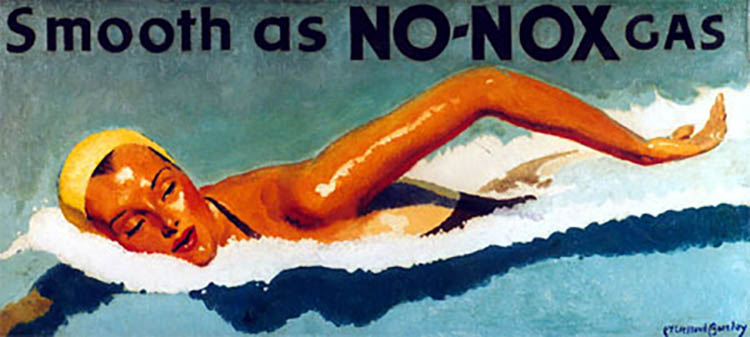
McClelland Barclay (1891-1943)
Young Woman Swimming
1930, oil on canvas
22" x 38 1/2", signed lower right
Advertisement for NO-NOX GAS
A glamorous young woman glides effortlessly through the water, embodying the confidence, vitality, and sophistication that defined American advertising during the 1930s. McClelland Barclay was renowned for his ability to blend athleticism with elegance, creating idealized figures that celebrated the modern American lifestyle. Here, swimming becomes more than a sport—it symbolizes health, leisure, and the freedom of summer recreation, reflecting the nation's growing fascination with outdoor living and vacation culture during the interwar years.
Created as part of Gulf Oil's celebrated "No-Nox Gas" advertising campaign, the painting was likely designed for a large roadside billboard, its unusually wide horizontal format allowing the image to command attention from passing motorists. Barclay's polished realism and dynamic compositions transformed commercial advertising into fine art, while linking Gulf's gasoline with scenes of swimming, tennis, and other summertime pursuits. By connecting the automobile to recreation, mobility, and youthful optimism, the campaign promoted not only a product but the promise of the American dream—a life defined by freedom, adventure, and the open road.
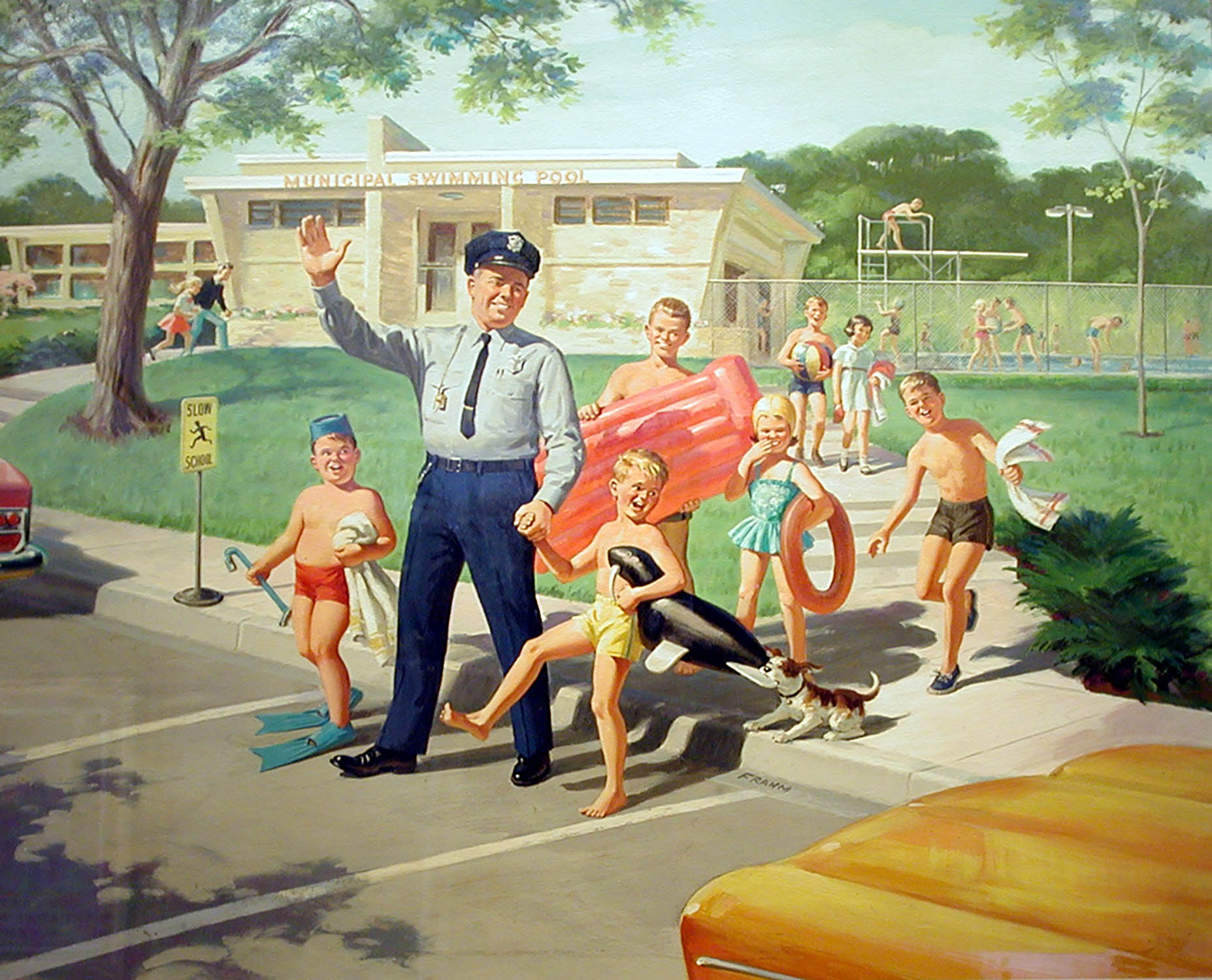
Art Frahm (1907-1981)
Safety Cop with Swimmers
1955, oil on board
25 1/2" x 31", signed lower right
A cheerful crossing guard halts traffic as a line of children, wrapped in towels and carrying their swimming gear, safely crosses the street after a day at the pool. Art Frahm captures the excitement that follows an afternoon of summer recreation, while also highlighting the everyday routines and community traditions that surrounded childhood in mid-century America. The children's animated expressions and relaxed postures convey the carefree spirit of summer vacation.
Known for his warm, accessible depictions of American family life, Frahm specialized in scenes that transformed ordinary moments into memorable visual stories. In Safety Cop with Swimmers, swimming serves not as a competitive sport but as a cherished community activity, reflecting the rapid growth of public pools and organized recreation programs during the twentieth century. The painting celebrates both the simple pleasures of childhood and the sense of safety, neighborliness, and civic responsibility that defined many American neighborhoods in the postwar era.
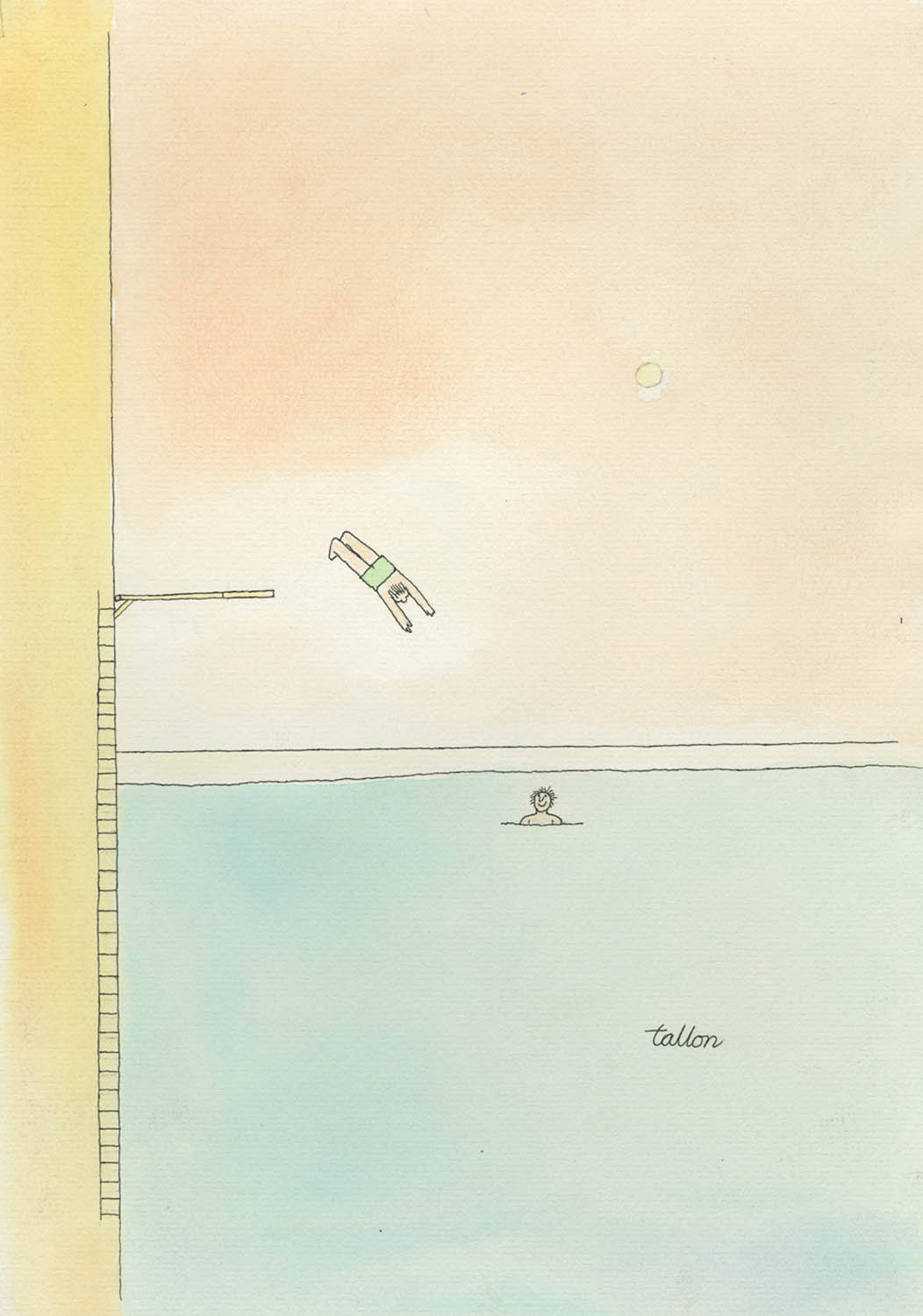
Robert Tallon
Swimming Pool
1981, watercolor on paper
15 3/4" x 11 1/2", signed lower right
The New Yorker, July 20, 1981 cover
At first glance, Robert Tallon's Swimming Pool appears to be a carefree summer scene, with two friends enjoying a playful moment in the water. Beneath its lighthearted surface, however, lies a deeply personal memory. Tallon based the illustration on a childhood experience in which he was unexpectedly pushed from an eighteen-foot diving board despite his intense fear of water. Recalling the terrifying plunge, he later joked that he sank "like a seventy-five-pound sack of horrified loose potatoes," only to resurface—shaken, coughing, and grateful simply to be alive.
Created for the July 20, 1981 cover of The New Yorker, the illustration reflects Tallon's remarkable ability to transform personal experiences into images of warmth, humor, and optimism. Throughout a career spanning more than five decades, Tallon earned international acclaim as an illustrator, author, and fine artist, creating award-winning children's books, magazine covers, and paintings celebrated for their wit and humanity. Like much of his work, Swimming Pool reminds viewers that even life's most frightening moments can, with time and perspective, become joyful stories worth sharing.
Tennis
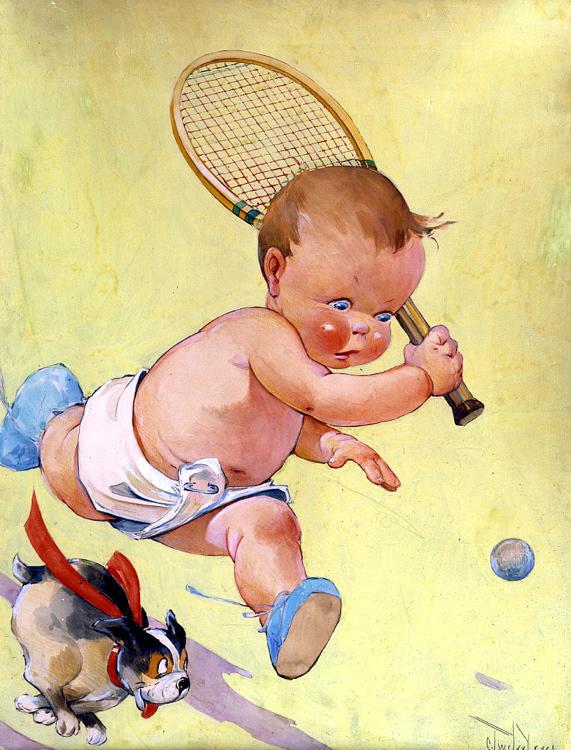
Charles Twelvetrees (1872-1948)
May: Tennis
1915, watercolor on paper
20 5/8" x 15 1/2", signed lower left
Calendar illustration
A rosy-cheeked child enthusiastically grips an oversized tennis racket, capturing the innocence, imagination, and playful charm that made Charles Twelvetrees one of America's most beloved illustrators. Rather than depicting serious athletic competition, Twelvetrees presents tennis through the eyes of childhood, transforming the sport into a joyful expression of springtime energy and youthful optimism. His signature cherubic figures, with their round faces and endearing expressions, became instantly recognizable to generations of Americans.
This illustration was created for the month of May in a calendar series that celebrated the changing seasons through the activities of childhood. Each month featured one of Twelvetrees' quintessential cherubic children participating in a pastime associated with that time of year, making tennis the perfect symbol of the return of warm weather and outdoor recreation. Best known for his immensely popular postcards, calendars, and illustrations, Twelvetrees built a career celebrating the everyday adventures of children. His heartwarming images offered an idealized vision of American childhood that remained enormously popular throughout the first half of the twentieth century.
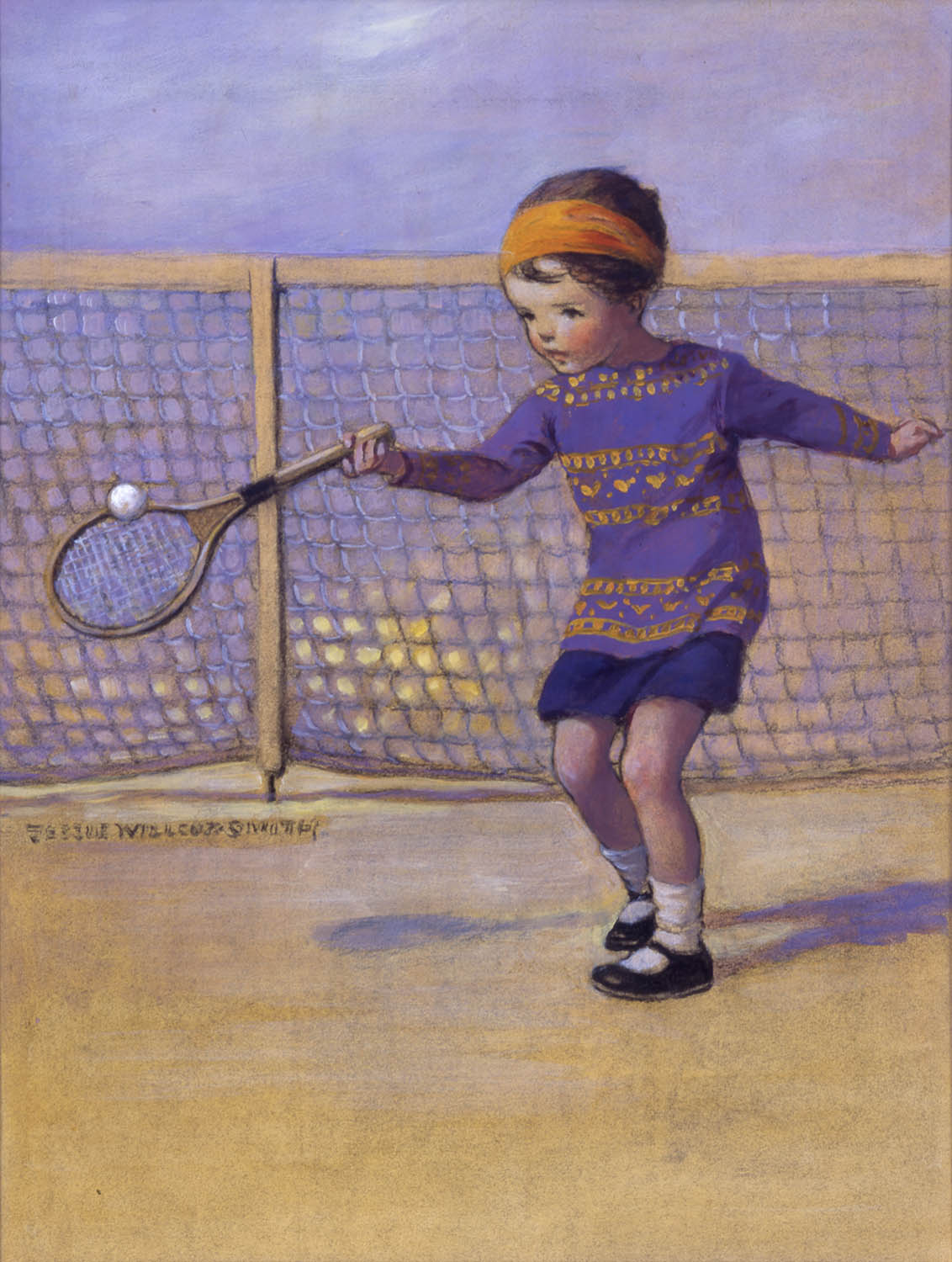
Jessie Willcox Smith (1863-1935)
Young Tennis Player
1929, oil, charcoal and mixed media on board
22" x 16 1/4", signed center left
Good Housekeeping, September 1929 cover
A young girl stands confidently with tennis racket in hand, dressed in the crisp white attire that defined the sport during the early twentieth century. Created for the September 1929 cover of Good Housekeeping, Jessie Willcox Smith's Young Tennis Player beautifully captures the innocence, charm, and quiet confidence that made her one of America's most beloved illustrators. More than a portrait of a child at play, the painting reflects the growing popularity of organized sports and outdoor recreation for young Americans, presenting tennis as both healthy exercise and an opportunity to build character.
From 1918 through 1932, Smith created the covers of Good Housekeeping, producing some of the most recognizable images in American publishing. Reaching millions of households each month, her illustrations helped define an idealized vision of childhood rooted in warmth, imagination, and emotional sincerity. Young Tennis Player exemplifies Smith's extraordinary ability to elevate an everyday moment into something timeless, celebrating not only the joys of childhood but also the values of optimism, health, and wholesome recreation that shaped American family life.
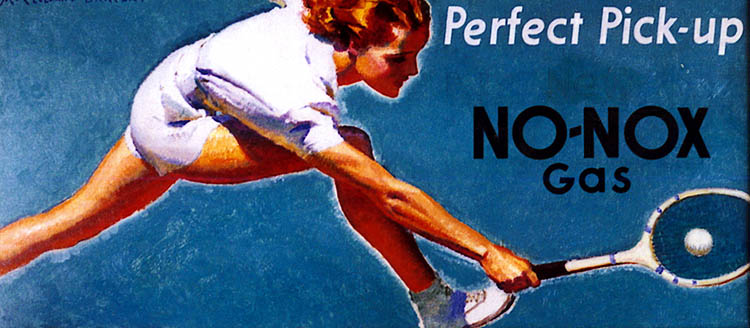
McClelland Barclay (1891-1943)
Young Woman Playing Tennis
1930, oil on canvas
20" x 30", signed upper left
Advertisement for NO-NOX GAS
A stylish young woman prepares to return a tennis shot with effortless poise, embodying the athleticism, elegance, and confidence that became hallmarks of McClelland Barclay's commercial art. Like its companion painting, Young Woman Swimming, this image celebrates the modern American woman—active, fashionable, and embracing the growing culture of leisure that flourished during the 1930s. Barclay's polished realism transforms a simple sporting moment into an idealized vision of health, sophistication, and summertime recreation.
Created as part of Gulf Oil's celebrated "No-Nox Gas" advertising campaign, the painting was likely intended for large-format billboard display, its expansive horizontal composition designed to capture the attention of passing motorists. Barclay elevated commercial advertising through dramatic compositions and refined draftsmanship, associating Gulf's gasoline with an aspirational lifestyle built around travel, recreation, and personal freedom. Together with its companion swimming scene, the painting reflects how tennis had become a symbol of modern living—where the automobile made country clubs, public courts, and summer vacations more accessible, and the open road promised adventure, relaxation, and the pursuit of the American dream.
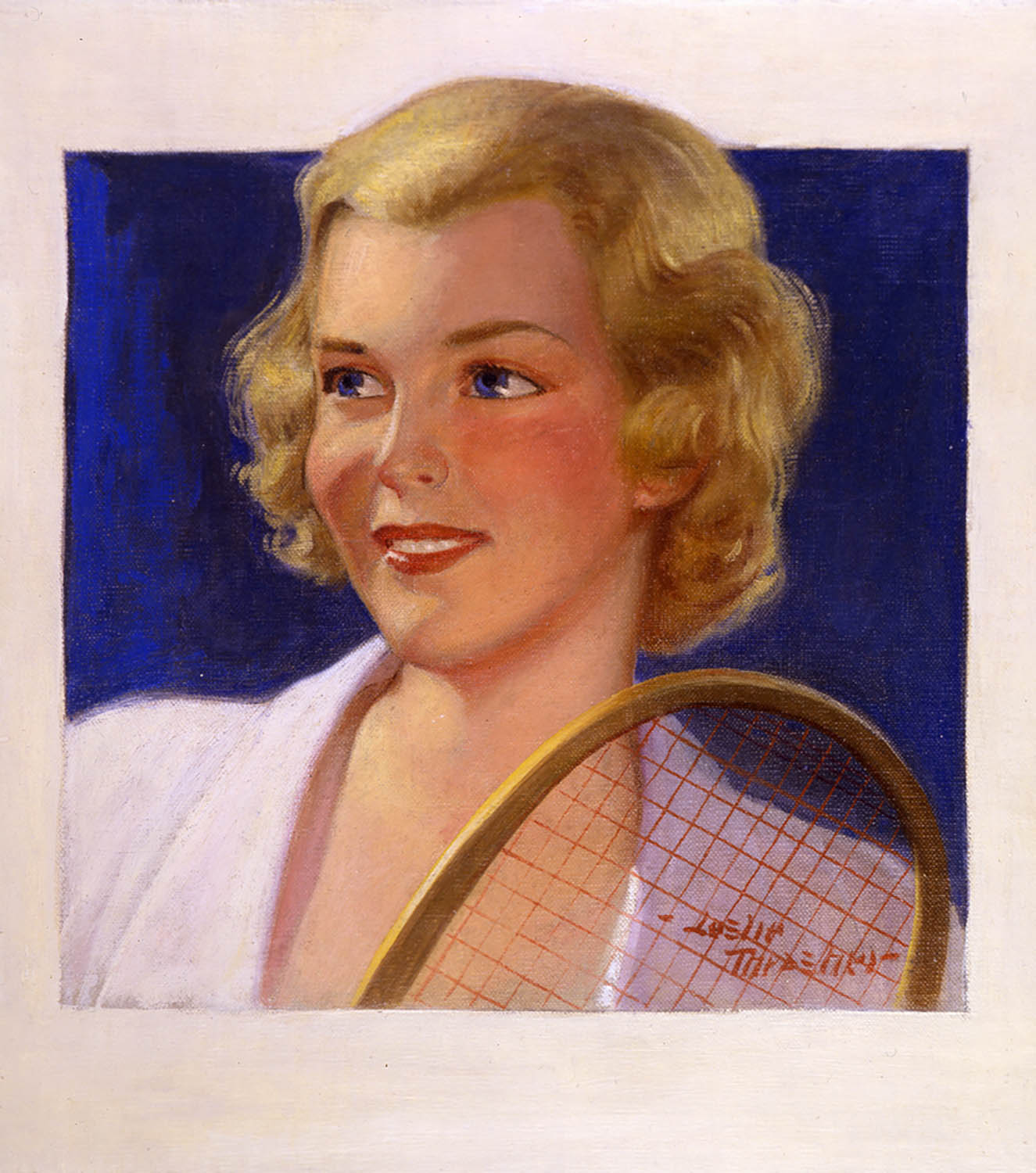
Leslie Thrasher (1889-1936)
Blonde with Tennis Racket
1932, oil on canvas
16 3/8" x 15", signed lower right
Liberty Magazine, June 25, 1932 cover
A smiling young woman pauses with tennis racket in hand, embodying the vitality, confidence, and effortless glamour that became synonymous with American leisure during the 1930s. Leslie Thrasher captures more than an athlete preparing for a match—he presents an ideal of modern American womanhood, where fashion, recreation, and optimism were inseparable. Set against the bright spirit of summer, the image reflects tennis's growing popularity as both a competitive sport and a fashionable social pastime enjoyed by Americans of all ages.
Created for the June 25, 1932 cover of Liberty magazine, the illustration demonstrates Thrasher's remarkable ability to create inviting, character-driven images that resonated with millions of readers each week. One of the nation's most prolific magazine illustrators, Thrasher produced hundreds of covers that celebrated everyday American life with warmth and humor. His optimistic vision offered welcome encouragement during the hardships of the Great Depression, reminding readers that simple pleasures—an afternoon on the tennis court, a sunny summer day, or time spent outdoors—remained enduring sources of happiness and hope.
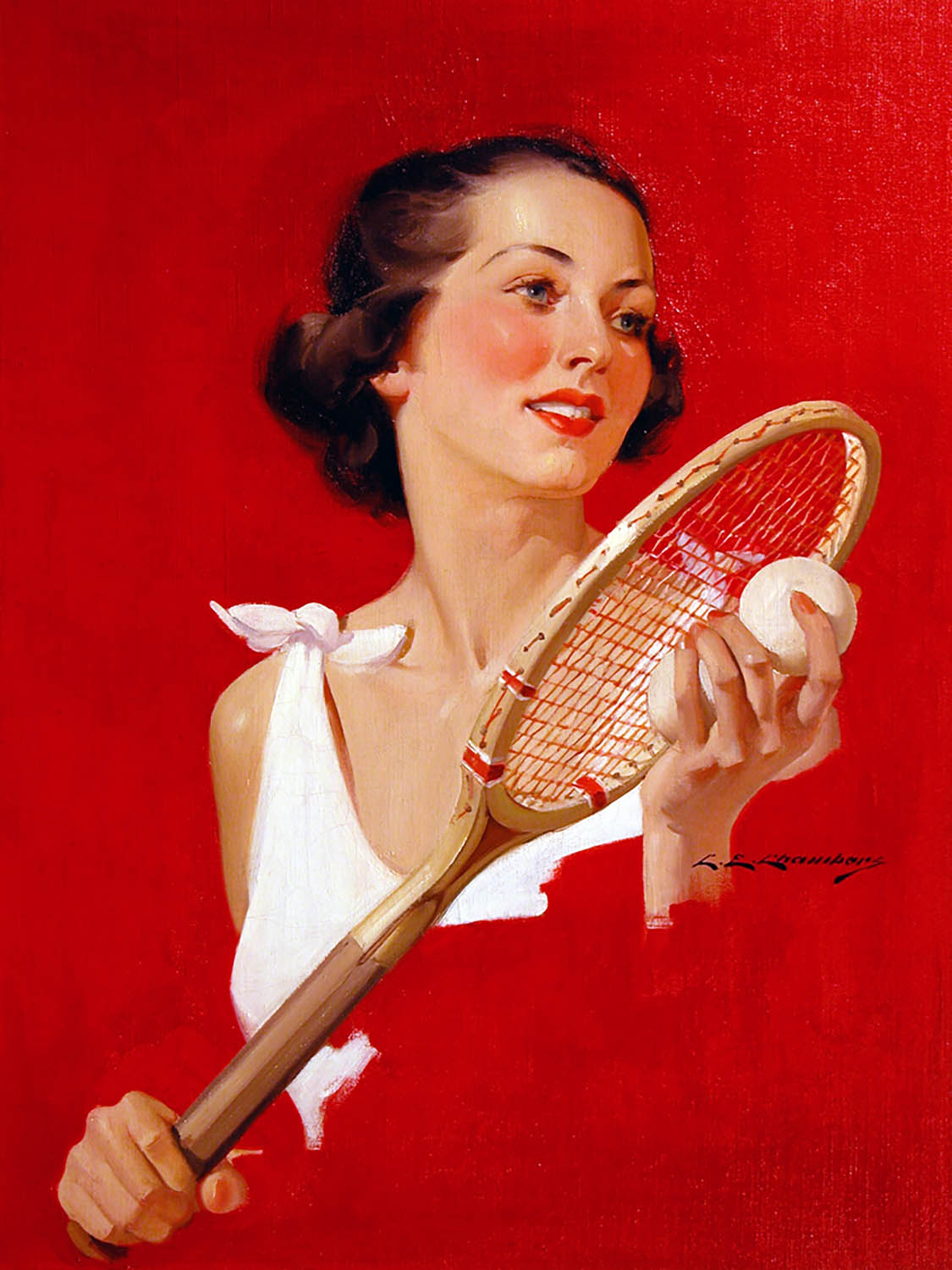
Charles Edward Chambers (1892-1942)
Portrait of a Tennis Player
1936, oil on canvas
25 3/4" x 19 3/4", signed lower right
Redbook, 1936 cover
A poised young tennis player gazes confidently toward the viewer, racket in hand, embodying the grace, athleticism, and refined elegance that made tennis one of America's most fashionable sports during the 1930s. Rather than depicting the excitement of competition, Charles Edward Chambers focuses on the individual, creating a portrait that celebrates both the physical discipline and quiet confidence associated with the game. The crisp white attire and polished presentation reflect an era when tennis represented not only recreation but also sophistication, health, and modern living.
Created for the cover of Redbook magazine in 1936, the illustration demonstrates Chambers' extraordinary talent for portraiture and his ability to capture both likeness and personality. One of America's foremost illustrators, Chambers was renowned for his refined depictions of prominent figures and elegant women, bringing a painterly realism to magazines, advertisements, and books throughout the first half of the twentieth century. In Portrait of a Tennis Player, his sophisticated style elevates a sporting subject into a timeless portrait, perfectly concluding this celebration of tennis as both an athletic pursuit and an enduring symbol of the American summer.