

American Storytelling
September marks a return to school, and to the teachers, books, stories, and ideas that shape how we understand the world. It is therefore a fitting month to consider the legacy of Howard Pyle, one of the most influential teachers in the history of American illustration.
Howard Pyle did more than teach artists how to illustrate stories. He transformed the way pictures could make readers feel. As an artist, author and pioneering teacher, Pyle encouraged his students to imagine themselves within a story - to experience its danger, emotion and atmosphere before putting brush to canvas. He emphasized dramatic composition, expressive gesture and the selection of the “supreme moment”: the instant that reveals what has just happened while leaving the outcome tantalizingly unresolved.
His students carried these principles into books, magazines, advertisements, murals and public commissions, shaping how millions of Americans envisioned history, adventure, heroism, romance, childhood and the natural world. Several became influential teachers themselves, extending Pyle’s ideas far beyond the artists who studied with him directly.
Bringing together works by Pyle, his students and later inheritors of the Brandywine tradition, The Pyle Effect traces the spread of a revolutionary idea: a successful illustration does not merely describe a story.
It draws us inside it.
The Source:
Howard Pyle's Visual Language
Howard Pyle believed an illustration should communicate more than the visible facts of a scene. It should convey atmosphere, emotion and the unseen forces propelling the story forward. The works in this section reveal the range of his visual language: historical violence, intimate exchange, and dreamlike romance. Despite their differences, each composition places the viewer inside the narrative. Pyle does not simply show us what happened. He makes us wonder what preceded the scene, what the characters are feeling and what will happen next.
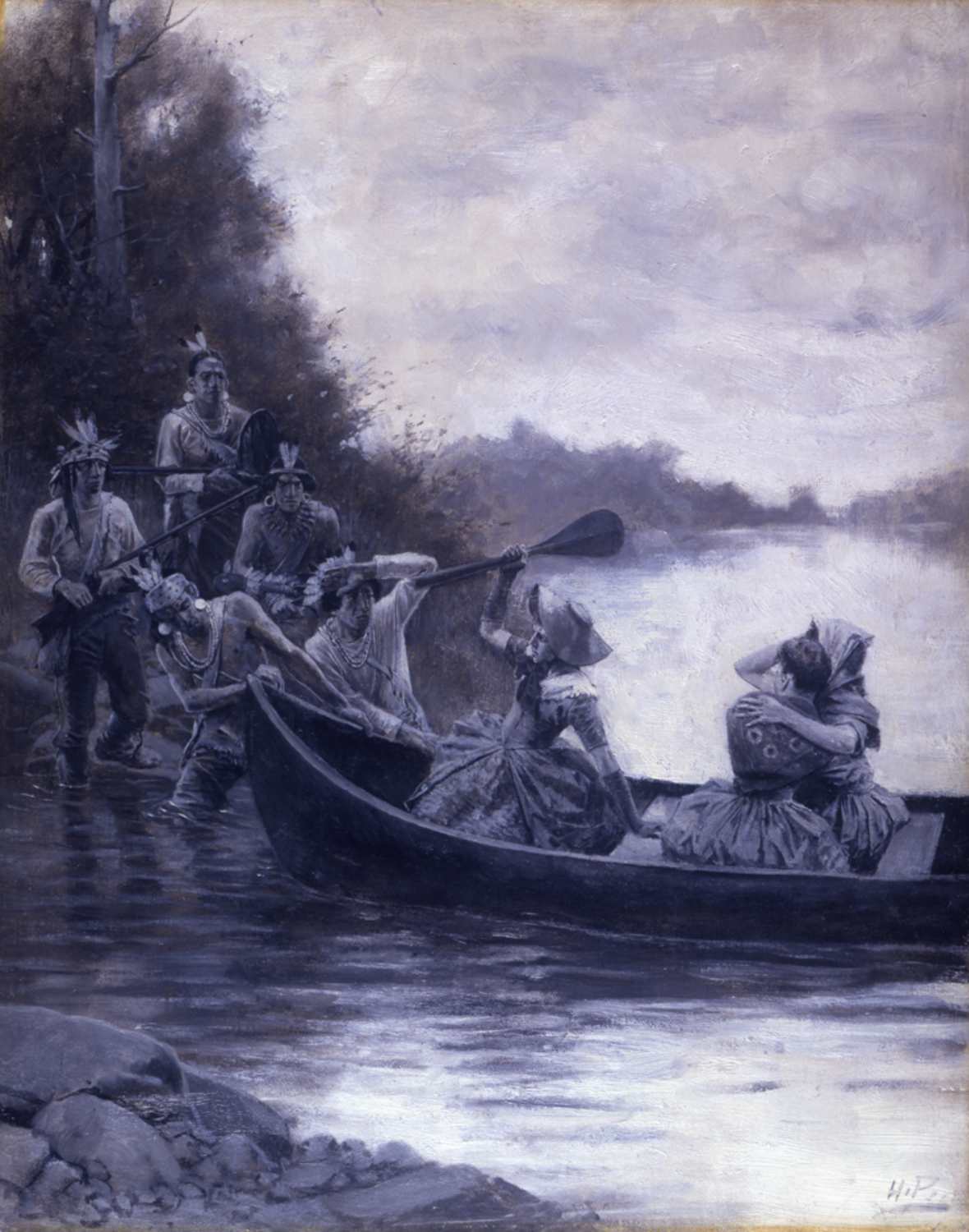
Howard Pyle (1853-1911)
The Capture of Elizabeth, Frances Callaway and Jemima Boone
1884, oil on board
20" x 16", signed lower right
"The Kentucky Pioneers," by John Mason Brown, Harper's Monthly, June 1887
Pyle uses the landscape to heighten the drama. The figures appear small within an expansive and uncertain wilderness, suggesting both the difficulty of pursuit and the captives’ vulnerability. He selected a moment of transition rather than resolution. The abduction is underway, but its outcome remains unknown, asking the viewer to enter the narrative and imagine what will happen next.
Three days after their abduction, the girls were rescued by a pursuing party led by Jemima’s father, Daniel Boone. The girls had helped their rescuers follow them by leaving subtle signs along their route. By withholding that outcome, Pyle preserves the uncertainty experienced at this moment and transforms a familiar frontier story into immediate suspense.
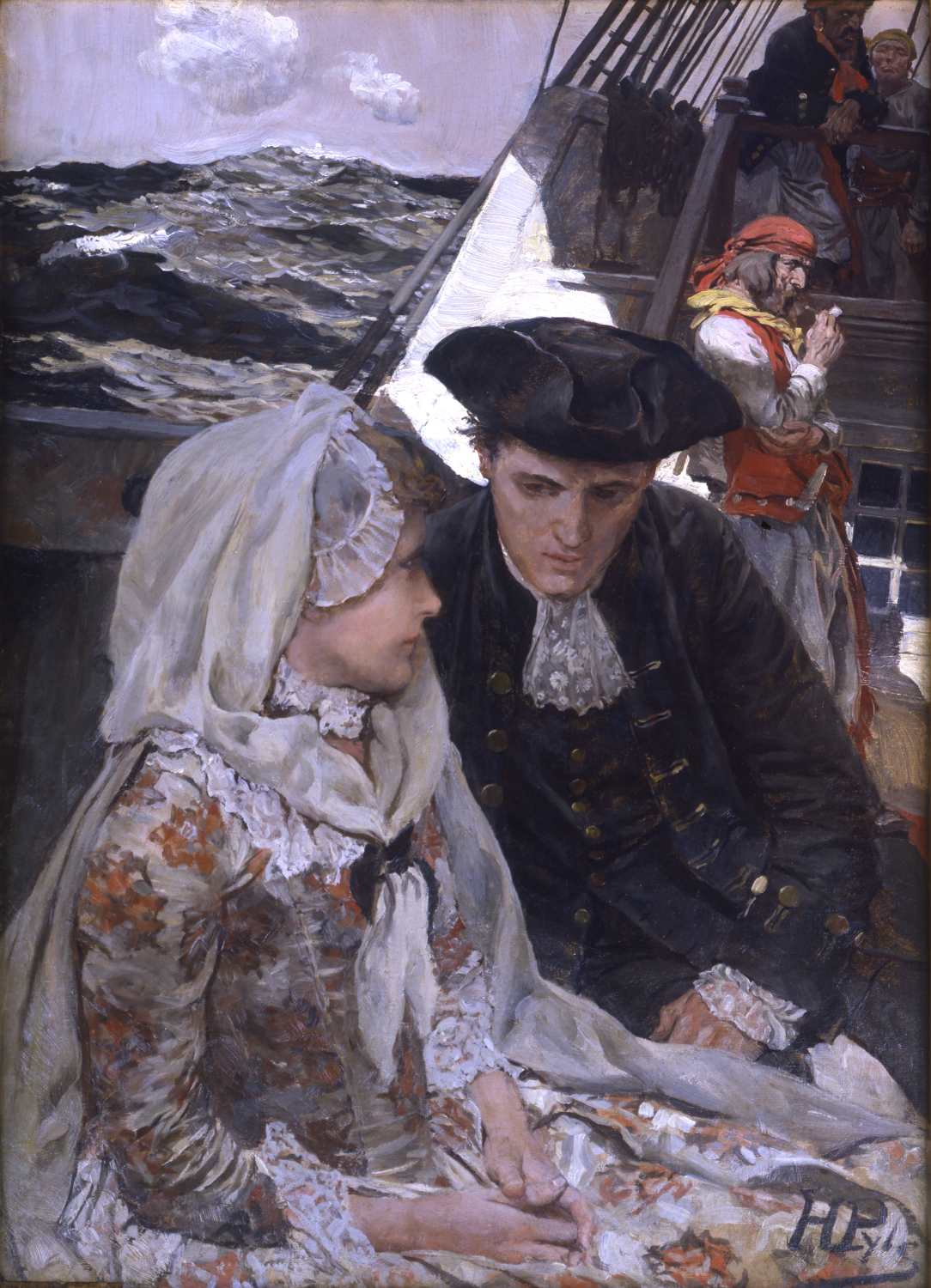
Howard Pyle (1853-1911)
Comforting Words
1908, oil on canvas
25" x 18", signed lower right
"The Ghost of Captain Brand," by Howard Pyle, Harper's Weekly, December 19, 1986
Tales of Pirates and Buccaneers, by Howard Pyle, 1908
By bringing two figures close to the foreground while the brigantine’s crew remains visible behind them, Pyle transforms a quiet conversation into an emotionally charged encounter. The figures’ proximity, posture and exchanged gaze communicate more than the story’s words alone. This is the “supreme moment” expressed through restraint: nothing visibly dramatic occurs, yet the emotional meaning of the scene seems poised to change.
Will they be separated, remain captives, or escape together? In Pyle’s story, the voyage brings them to Staten Island, where they agree to marry and return safely to New York. By illustrating this moment of uncertainty, Pyle invites viewers to imagine several possible endings and become participants in the story.
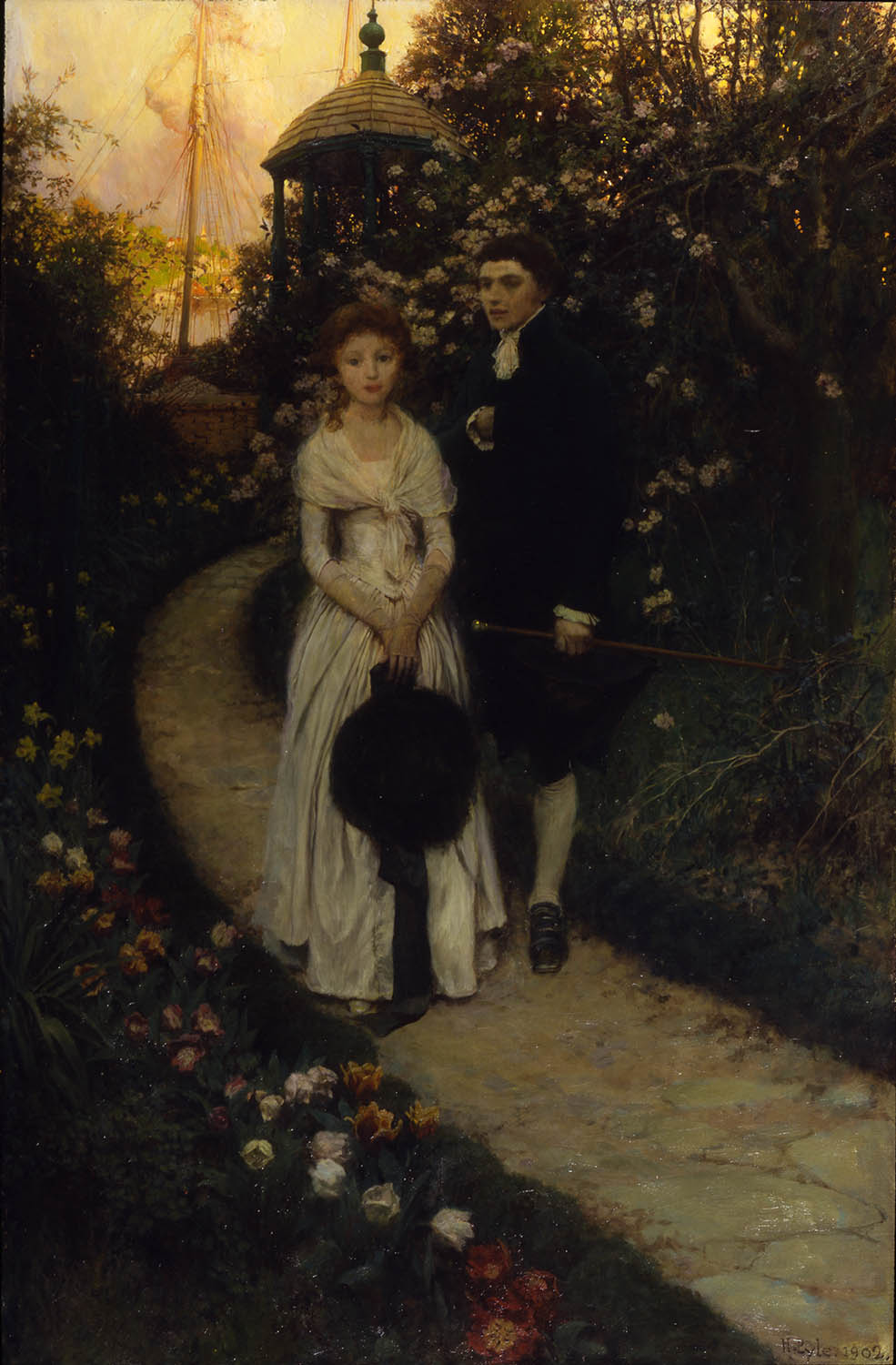
Howard Pyle (1853-1911)
The Garden of Youth
1902, oil on canvas
39 1/2" x 25 1/4", signed and dated lower right
In this dreamlike scene, Pyle moves beyond literal description to create an atmosphere of romance, memory and mystery. The darkened garden and illuminated figures suggest a world removed from ordinary time. Pyle taught that an artist must first feel the spirit of a story. Here, setting, light and color communicate that spirit before the viewer knows anything about the figures.
The Supreme Moment:
Entering the Story
Pyle urged his students to select what became known as the “supreme moment” - not necessarily the climax of a story, but the instant of greatest emotional and narrative possibility. A figure waits. A prisoner faces an uncertain fate. A child discovers a spider. A stranger suddenly appears. By withholding the resolution, these artists make viewers active participants. We instinctively imagine the moments before and after the one depicted, completing the story in our own minds.
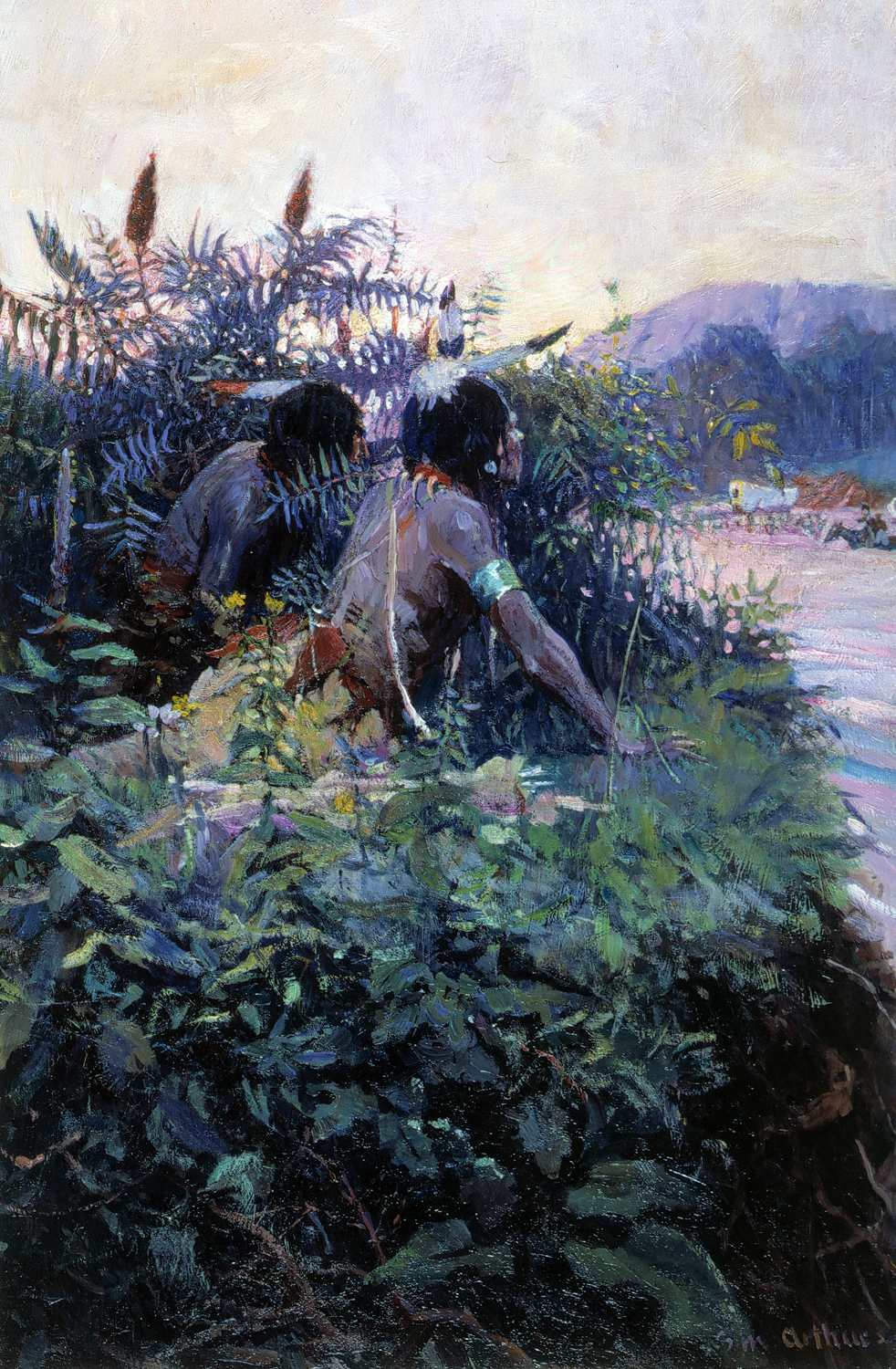
Stanley Arthurs (1877-1950)
Waiting at the Ford
1915, oil on canvas
36" x 24", signed lower right
Arthurs specialized in American historical subjects, but his paintings are rarely static reconstructions. Here, the title itself creates anticipation: someone is waiting, and the reason remains unresolved. Like Pyle, Arthurs uses landscape, distance and restrained action to create suspense. The scene appears calm, yet its stillness suggests an encounter may be imminent.
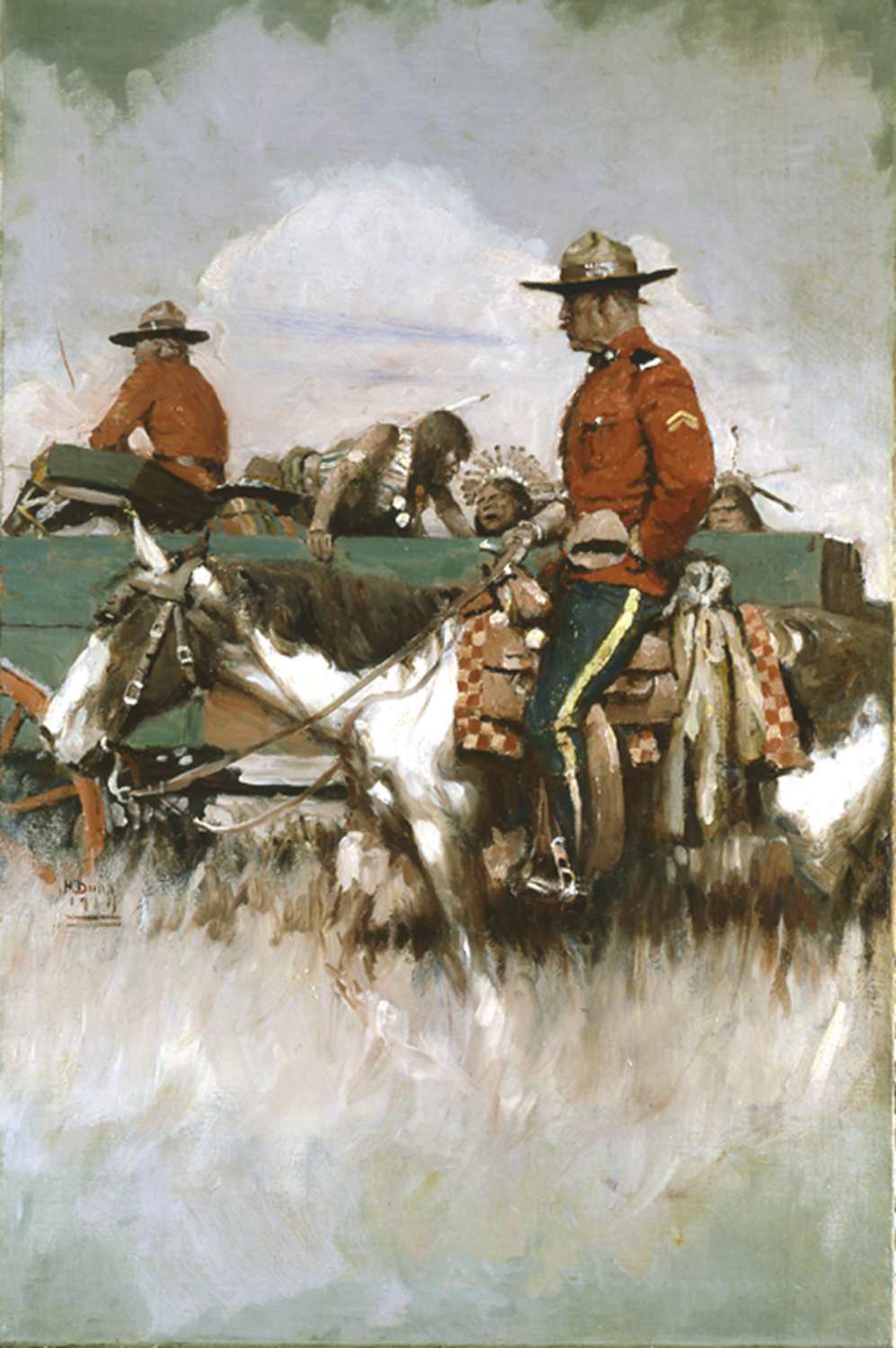
Harvey Dunn (1884-1952)
The Prisoners
1914, oil on canvas
35 1/2" x 23 1/4", signed and dated center left
Elgin Watch advertisement, 1914
Dunn creates an image whose psychological weight extends far beyond its commercial purpose. The riders’ poses, the rugged setting and the uncertain status of the prisoners suggest a much larger story. He gives viewers enough information to feel the tension while withholding the event’s final meaning.
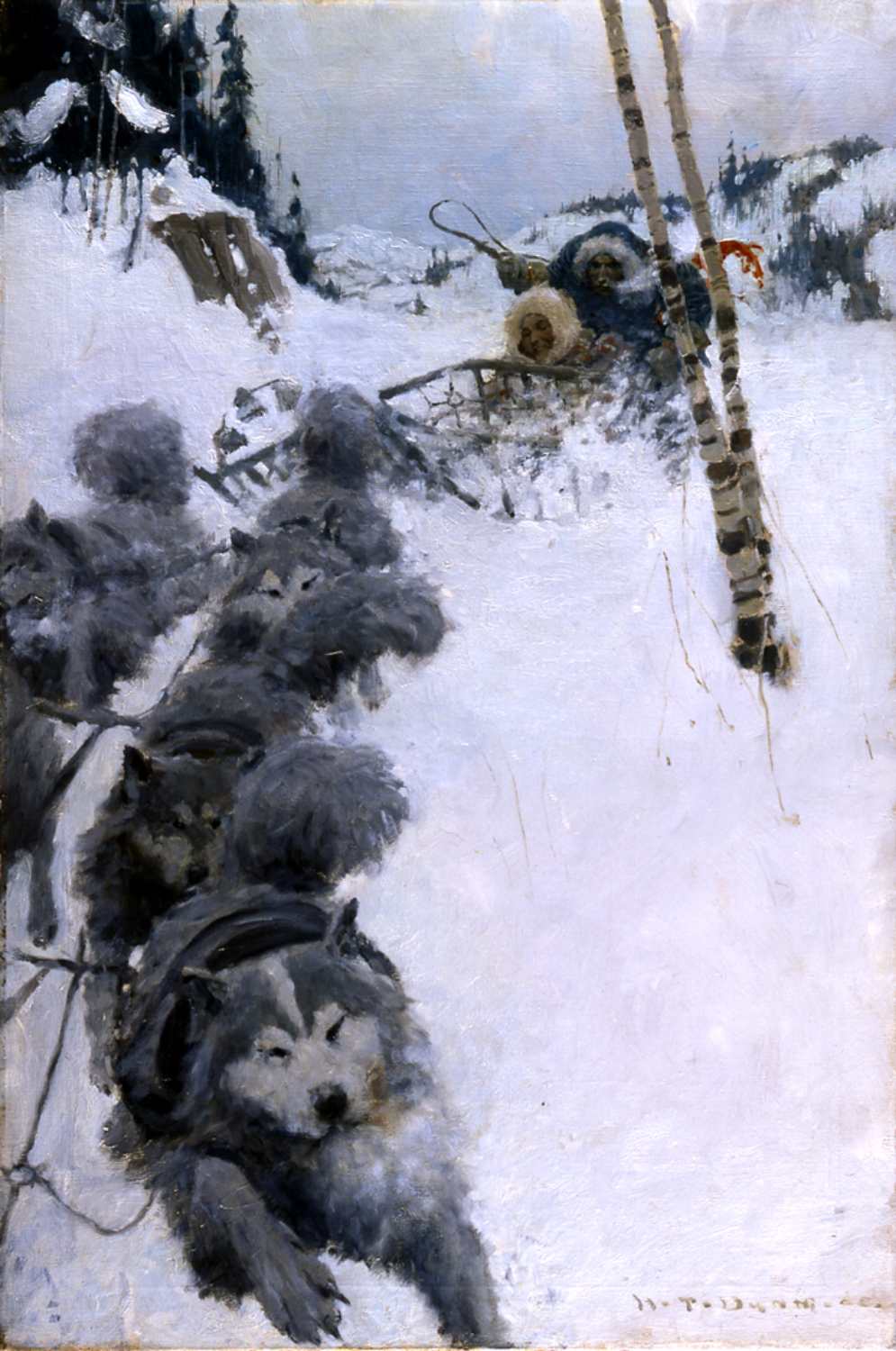
Harvey Dunn (1884-1952)
They Went Off At a Mad Run, Swooping Down the Steep Bank
1909, oil on canvas
36" x 24", signed and dated lower right
The Silver Horde, by Rex Beach, Harper and Brothers, 1909
Dunn thrusts viewers into the speed and danger of a dogsled descent. The steep diagonal, compressed space and blurred winter atmosphere make the composition feel unstable, as though the scene might rush beyond the canvas. Pyle taught his students to create movement through composition rather than merely depict moving figures.
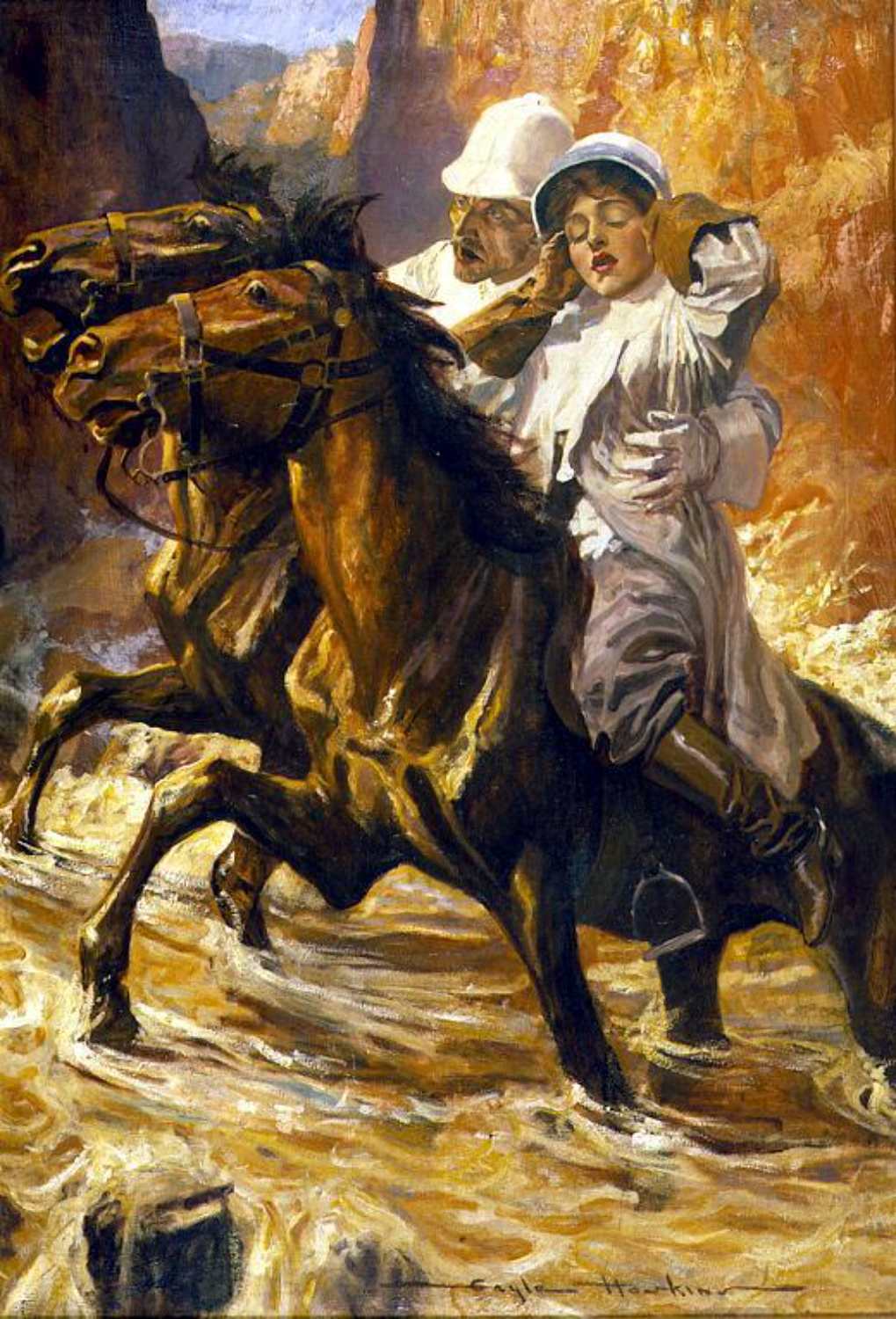
Gayle Porter Hoskins (1887-1962)
The Water Swirled About Her, She Closed Her Eyes
1913, oil on canvas
39" x 28 1/2", signed lower right
Hoskins freezes the narrative at an instant of physical danger and emotional surrender. The swirling water, urgent movement and closed eyes communicate the character’s experience before the viewer knows the full story. We do not merely witness the danger; we are asked to feel it.
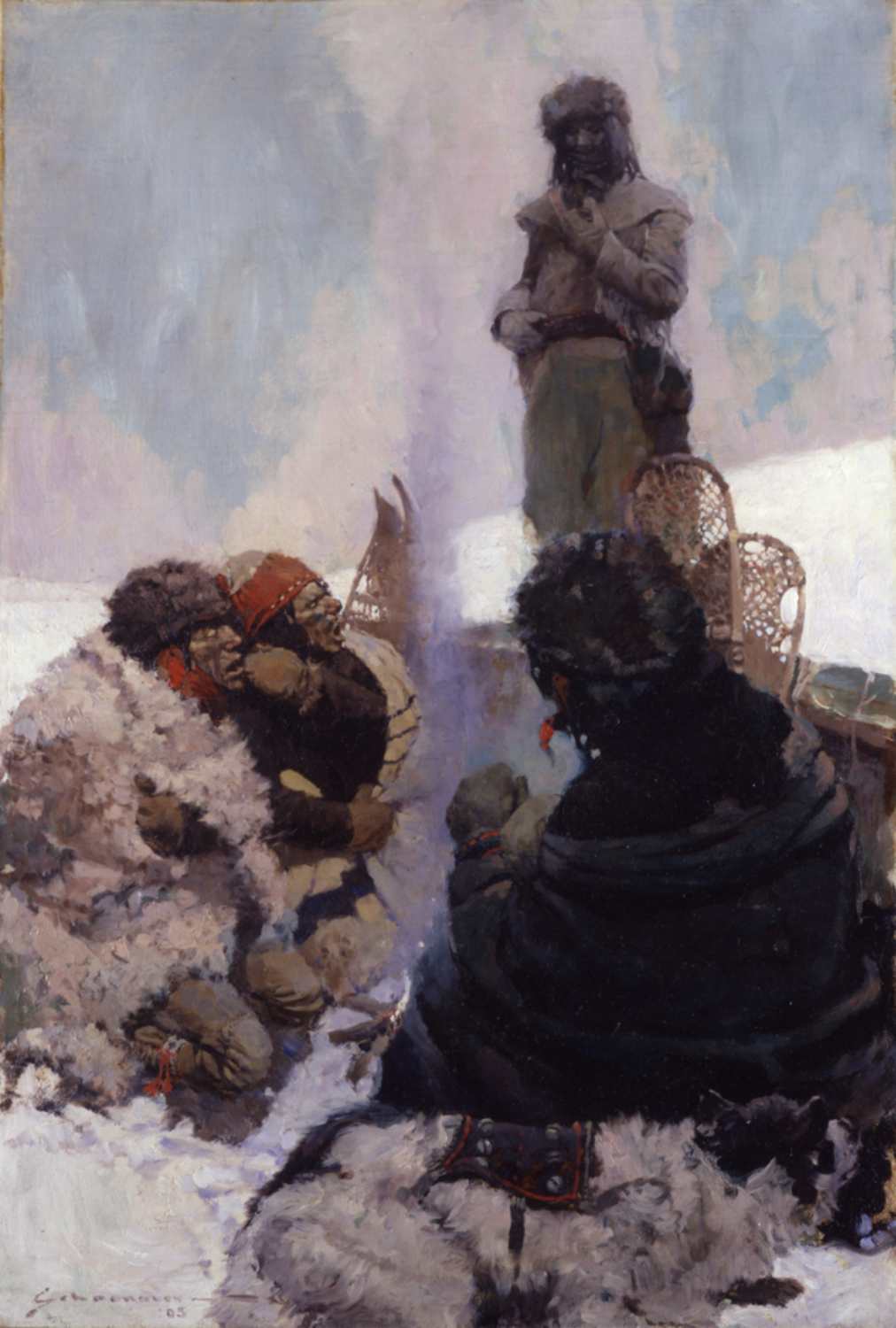
Frank E. Schoonover (1877-1972)
Only Jules Verbeaux
1905, oil on board
28 1/2" x 19", signed lower left
Story of the Far Northwest, by Laurence Mott, The Century Magazine, August 1905, pg. 590
Three exhausted trappers huddle beside their sledges after becoming lost in a snowstorm. Their food is gone, their dogs are collapsing, and a tall, muffled stranger appears almost without warning, transforming the scene into a moment of suspense. Is he an enemy, an apparition, or a rescuer? He is Jules Verbaux, a hunted trapper who gives the men food and guides them to safety. Schoonover selects the moment before his identity and intentions are known, drawing viewers further into the story.
Frank E. Schoonover (1877-1972)
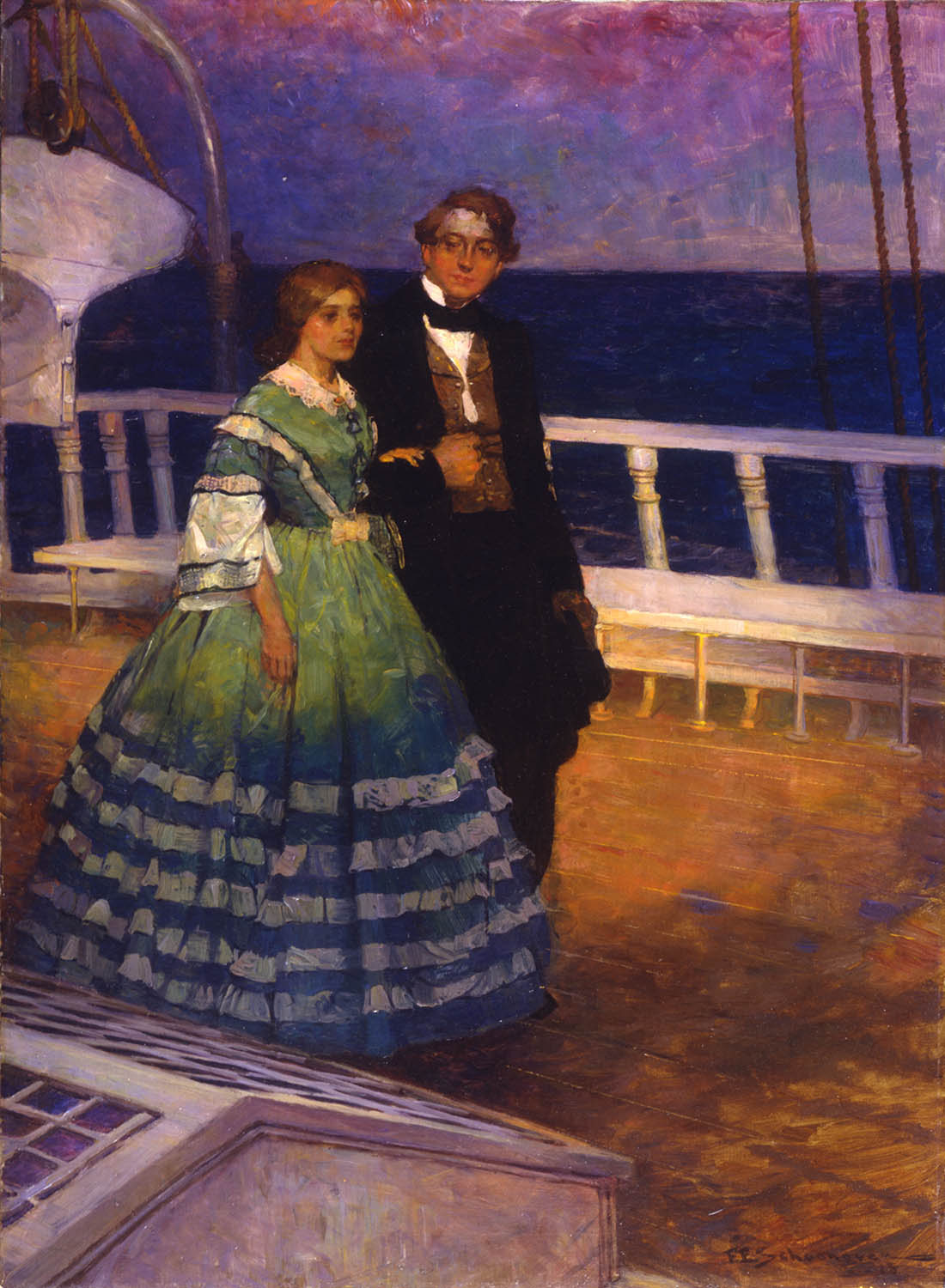
I Heard Him Call Her "Anne"
1913, oil on canvas
34" x 24", signed lower right
"The Little Wet Foot," by William Gilmore Beymer, Harper's Magazine, May 1913
Schoonover depicts a couple walking together on the deck of a ship, their closeness suggesting a private conversation. The darkened sea and quietness of the scene create an atmosphere of uncertainty, leaving their identities, relationship and destination unresolved. By selecting this quiet moment rather than a dramatic event, Schoonover invites the viewer to imagine what has brought them together and what might happen next.
In the story, this is the moment when the woman’s identity as Anne is revealed—a quiet discovery that becomes increasingly significant as her role in the unfolding danger comes to light.
Jessie Willcox Smith (1863-1935)
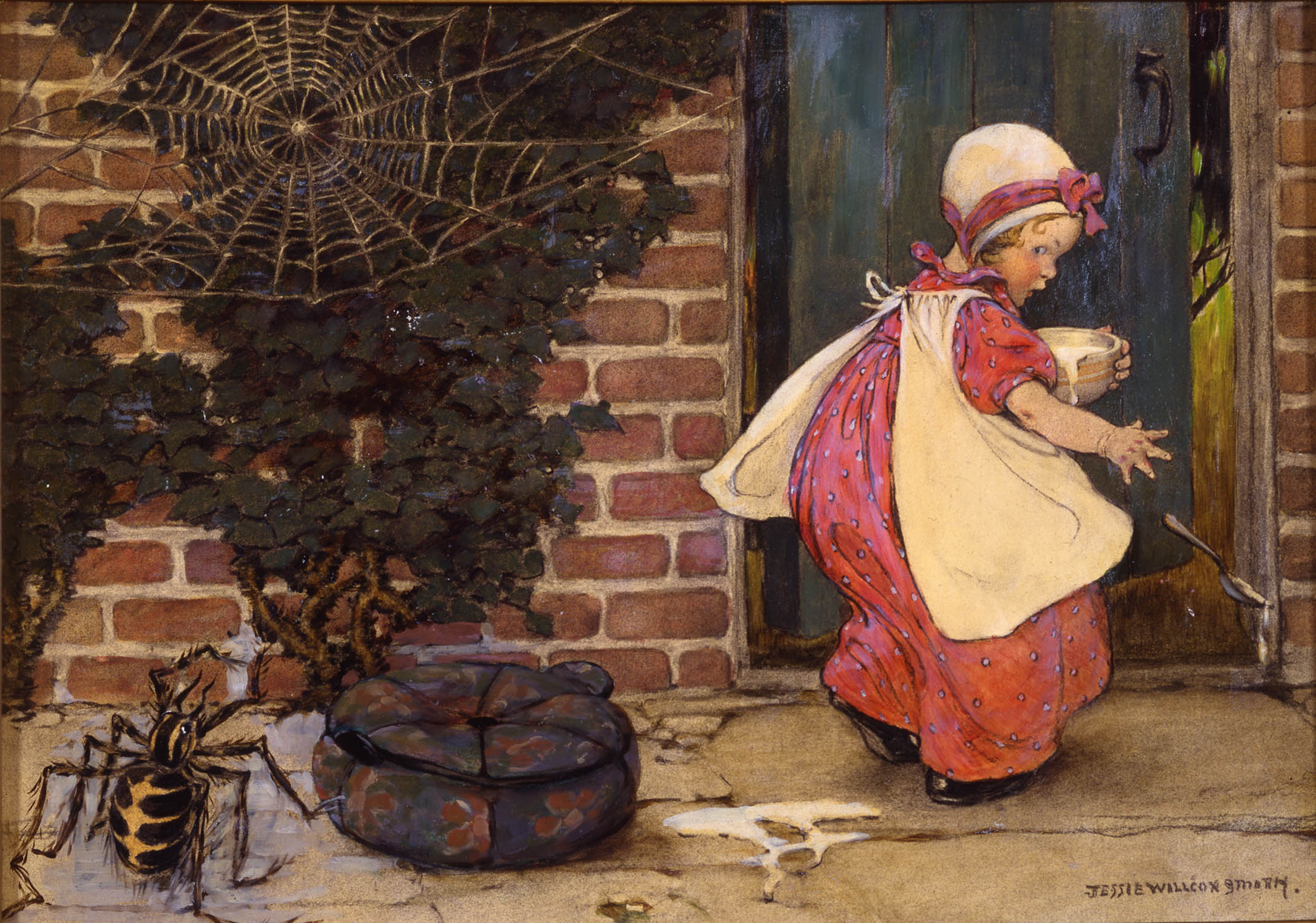
Little Miss Muffet
1912, oil on board
18" x 25 1/2", signed lower right
Good Housekeeping, January 1913
Smith selects the precise instant when the familiar nursery rhyme changes from peaceful routine to alarm. Miss Muffet turns toward the spider while her interrupted meal and startled posture complete the story. Pyle’s “supreme moment” did not require battle or heroic adventure; Smith found suspense, humor and psychological truth within childhood.
Jessie Willcox Smith (1863-1935)
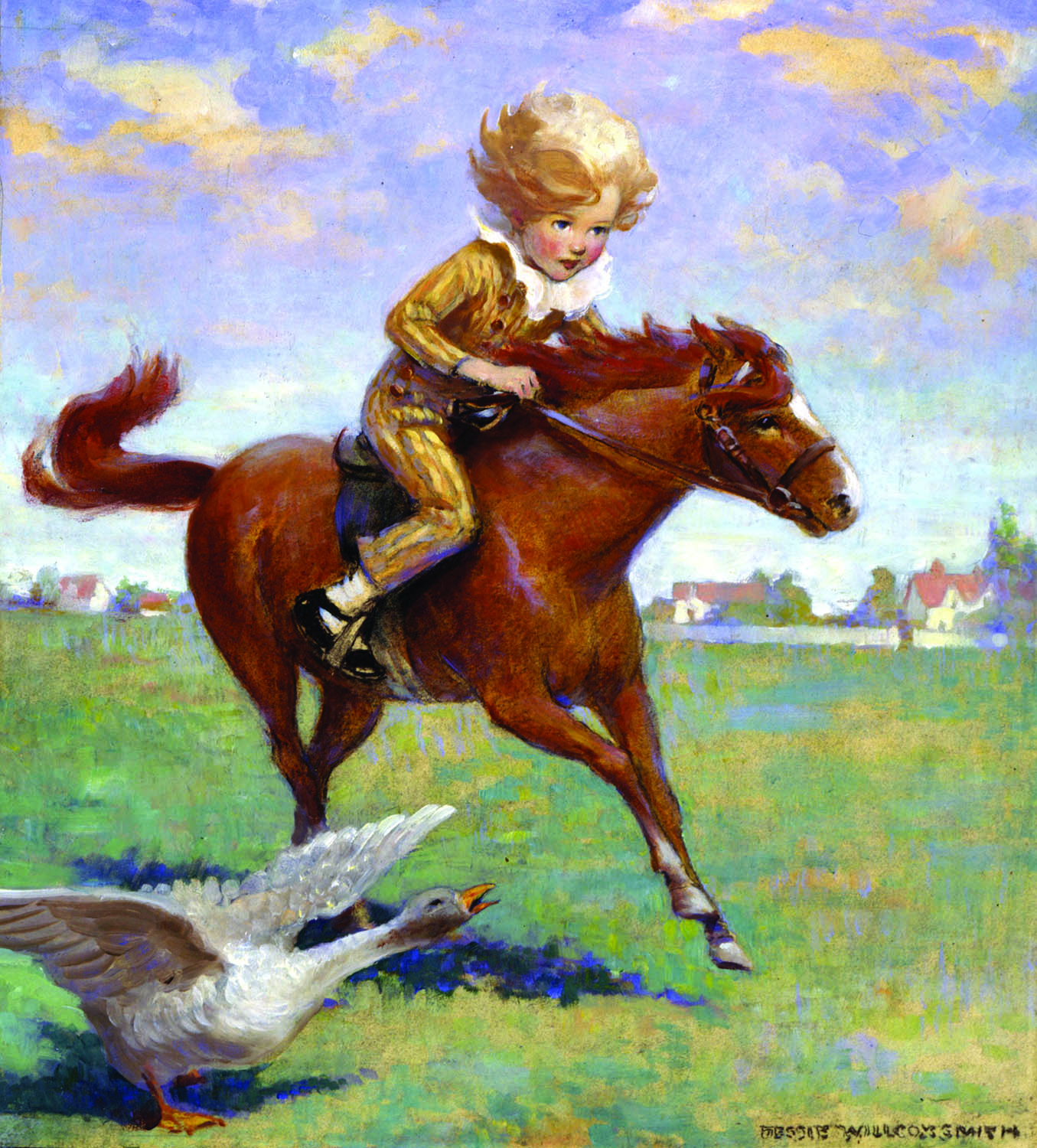
Jackanapes
1923, mixed media on board
18" x 16", signed lower right
Good Housekeeping, June 1923 cover
Jessie Willcox Smith creates an exciting scene of action and drama for this June 1923 Good Housekeeping cover. The young rider charges forward on his horse as a startled goose spreads its wings and prepares to take flight. The horse's extended stride with its mane and tail streaming behind combined with the boy's windswept hair create a powerful sense of speed and exhilaration. Smith is remembered for her tender images of children, but this work reveals her equal command of action.
Norman Price (1877-1951)
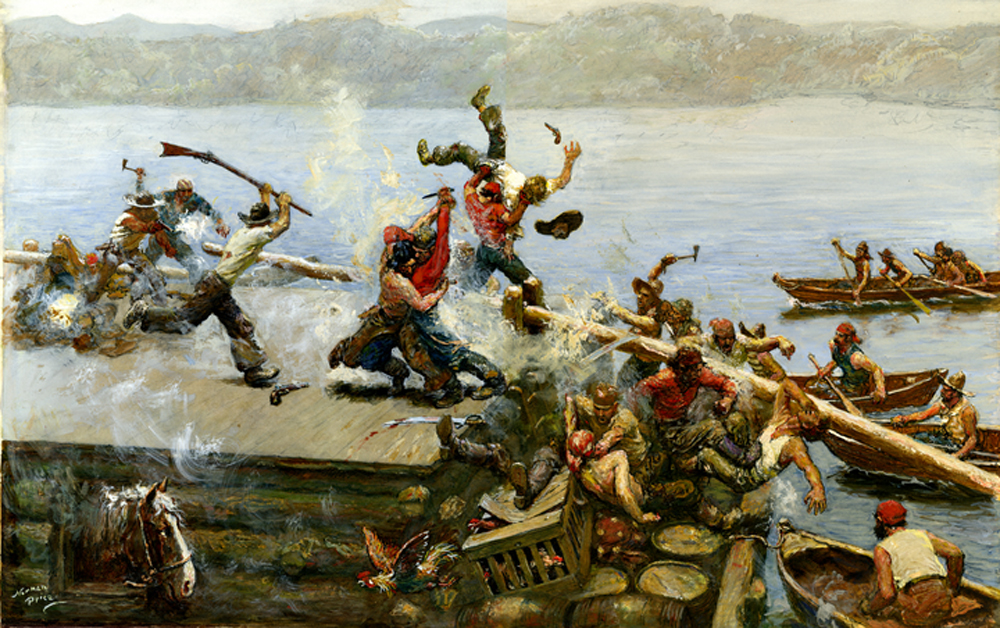
Fighting on the Docks
Pen and ink, watercolor and gouache on board
19 3/8" x 27 1/2", signed lower left
Price fills the composition with opposing gestures, weapons and diagonals, yet the action remains legible. Every figure contributes to the scene’s momentum. The viewer is positioned close to the struggle, eliminating the safety of distance.
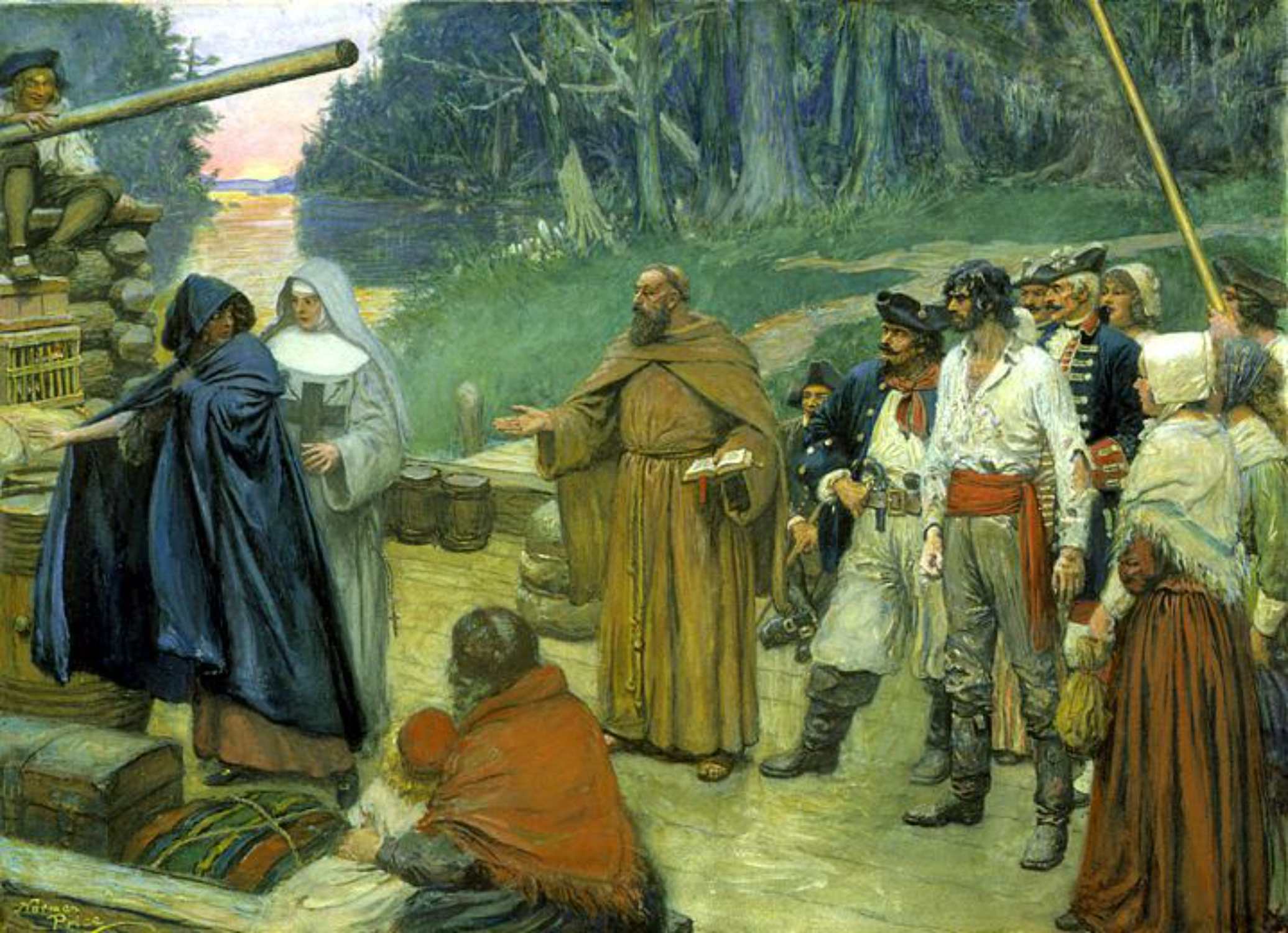
Norman Price (1877-1951)
The Reluctant Bride
Gouache on board
14 1/2" x 20", signed lower left
The bride’s hesitation gives this ceremonial scene its narrative tension. Expressions, gestures and the arrangement of surrounding figures invite viewers to interpret their relationships. Rather than illustrate a wedding as a completed event, Price chooses the moment when its outcome still appears uncertain.
Live the Story:
Experience, Adventure and Authenticity
Pyle’s most memorable advice was that artists must “live” their pictures. Accurate costumes and settings mattered, but research alone could not create a convincing illustration. Artists had to understand a scene physically and emotionally before they could make it believable to others. His students traveled, studied history, observed workers and landscapes, and drew upon firsthand experience. Observation becomes experience - and experience becomes story.
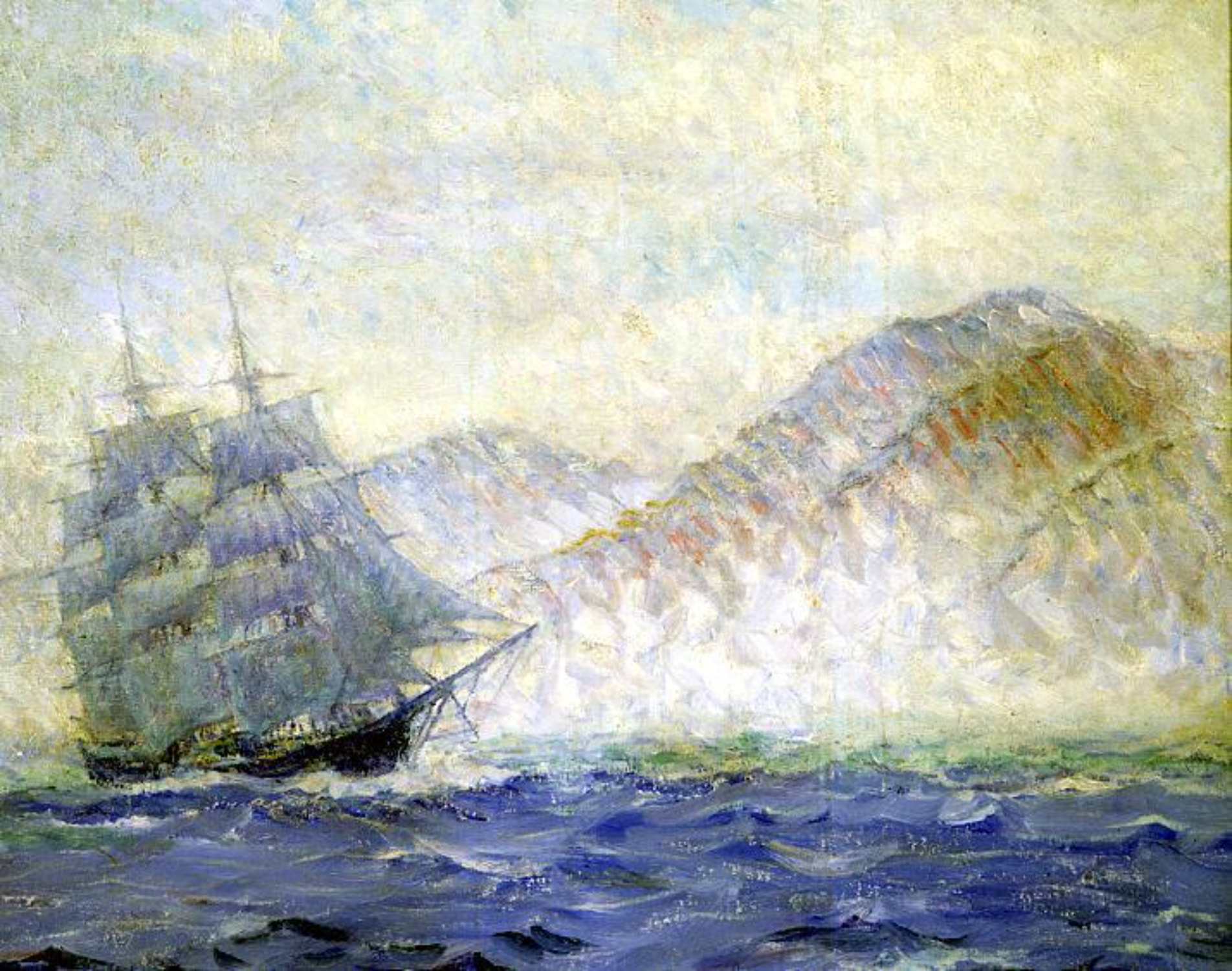
Clifford Ashley (1881-1947)
Through the Straights
1916, oil on canvas
30 1/4" x 36", signed lower right
The Yankee Whaler, by Clifford W. Ashley, 1926
Ashley’s firsthand knowledge of ships and sailors gave his maritime paintings unusual authority. The vessel appears subject to the immense forces of wind, water and weather rather than simply placed upon a picturesque sea. Technical observation establishes credibility, while the precarious passage transforms maritime experience into drama.
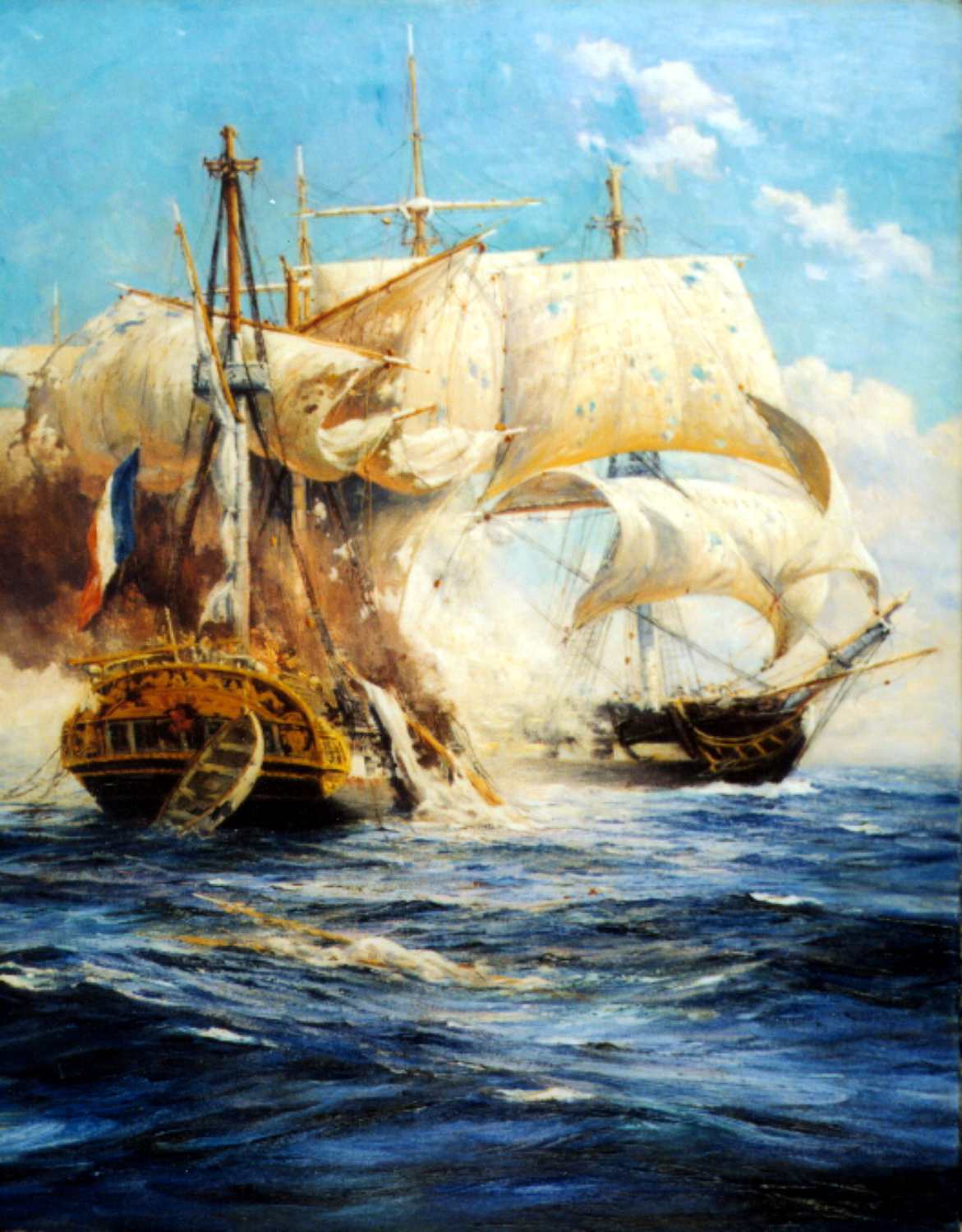
Anton Otto Fischer (1882-1962)
Action Between the Constellation and L'Insurgente, February 9, 1799
1940, oil on canvas
32" x 26", signed and dated lower right
Fischer’s years at sea gave him an intimate understanding of ships, weather and changing light. Rather than treating the vessel as an isolated object, he presents it as part of a larger maritime environment. Nautical knowledge makes the scene convincing; atmosphere makes it memorable.
Here, Fischer captures the height of the action between the American ship, The Constellation, and the French ship, L'Insurgente, on February 9, 1799 as part of the unofficial "Quasi-War."
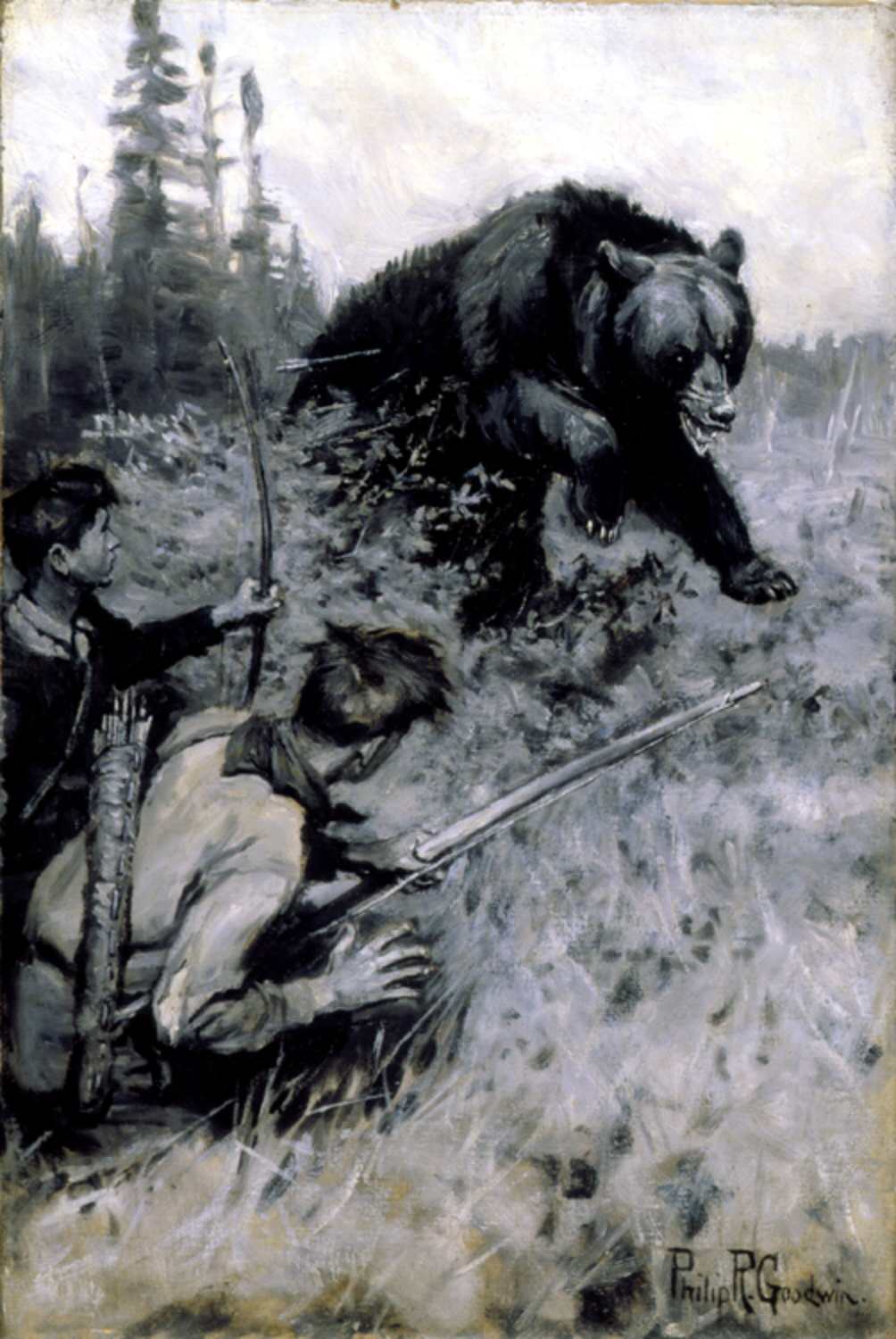
Philip R. Goodwin (1881-1935)
The Huge Beast Passed Within What Seemed to be Less Than a Yard
1916, oil on canvas
21" x 14 1/8", signed lower right
Adventures in Beaver Stream Camp: Lost in the Northern Wilds, by Captain A. Radclyffe Dugmore, Doubleday, Page & Co., 1918, pg. 222
Goodwin places the viewer perilously close to the encounter. The animal’s scale, compressed distance and obscured wilderness turn observation into suspense. Instead of showing an attack or escape, he selects the psychologically charged instant when danger passes almost within reach.
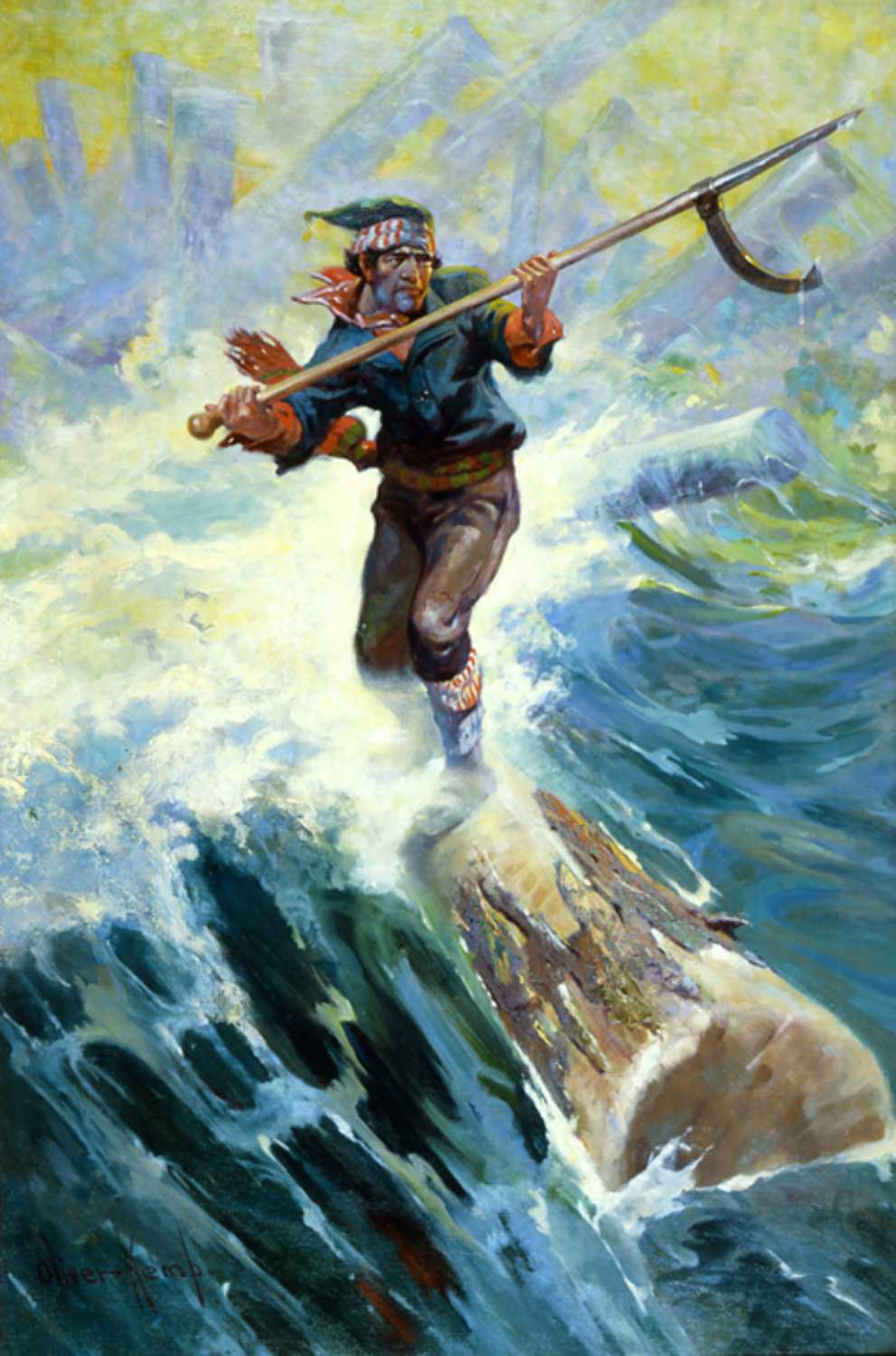
Oliver Kemp (1887-1934)
Breaking the Jam
1930, oil on canvas
53" x 35", signed lower left
Breaking the Jam, Braun Lumber Co. promotional booklet, 1930, cover
Kemp presents labor as a confrontation between human courage and the immense force of nature. The worker’s precarious position amid rushing water and timber creates physical tension. Strong diagonals propel the eye through the composition, while scale turns a commercial assignment into a heroic narrative.
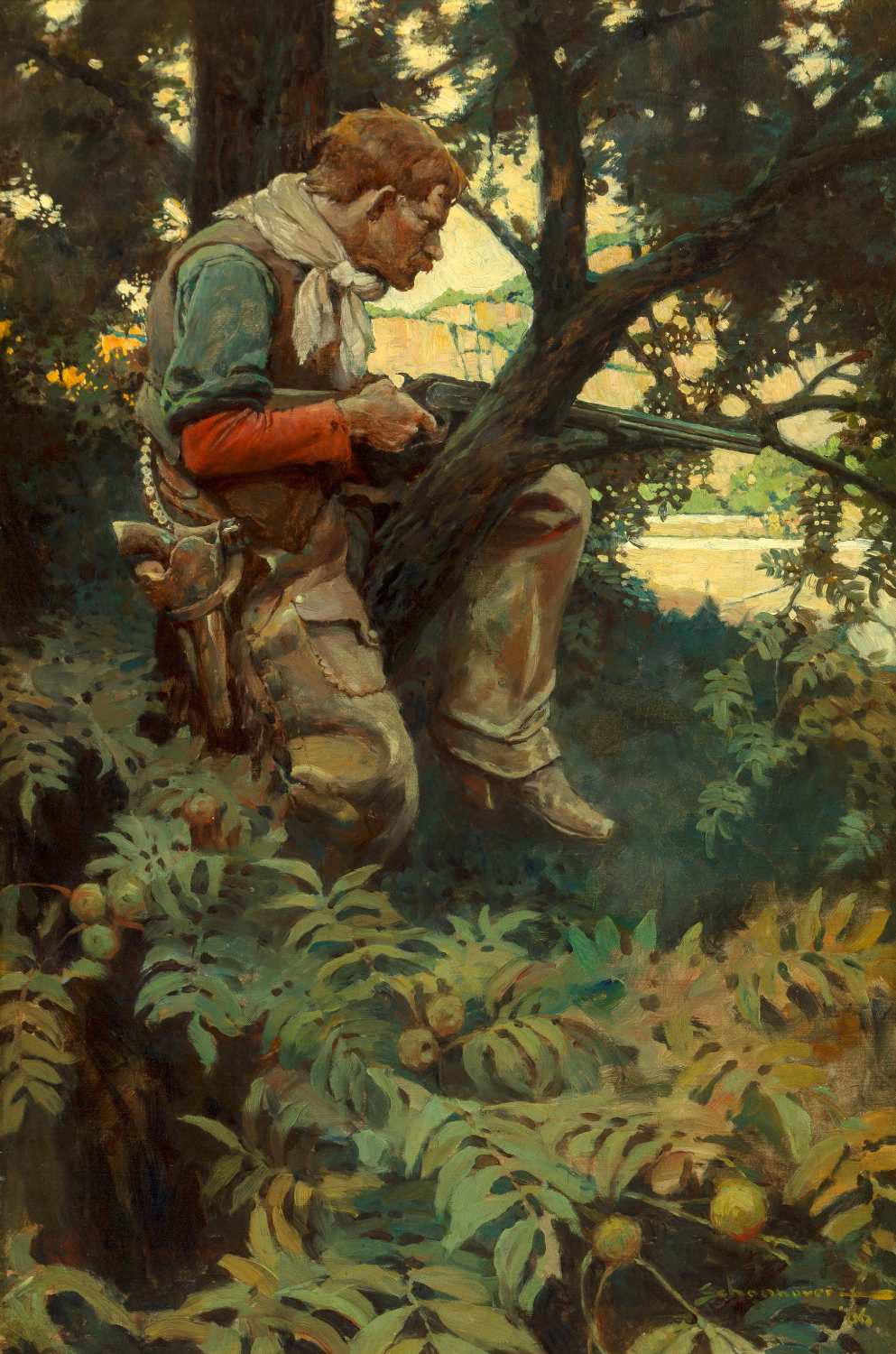
Frank E. Schoonover (1877-1972)
He Swung His Rifle Out Over a Forked Limb and Let It Settle in the Crotch
1907, oil on canvas
36" x 24", signed and dated lower right
"Bar-20 Range Yards, Part VIII - Roping a Rustler," by C.E. Mulford, The Outing Magazine, May 1907, pg. 175
Schoonover organizes the figure, tree and rifle into a tightly integrated pattern of diagonals. The action is clear, but its purpose and outcome remain unresolved. Every pose and object contributes to the story while preserving suspense.
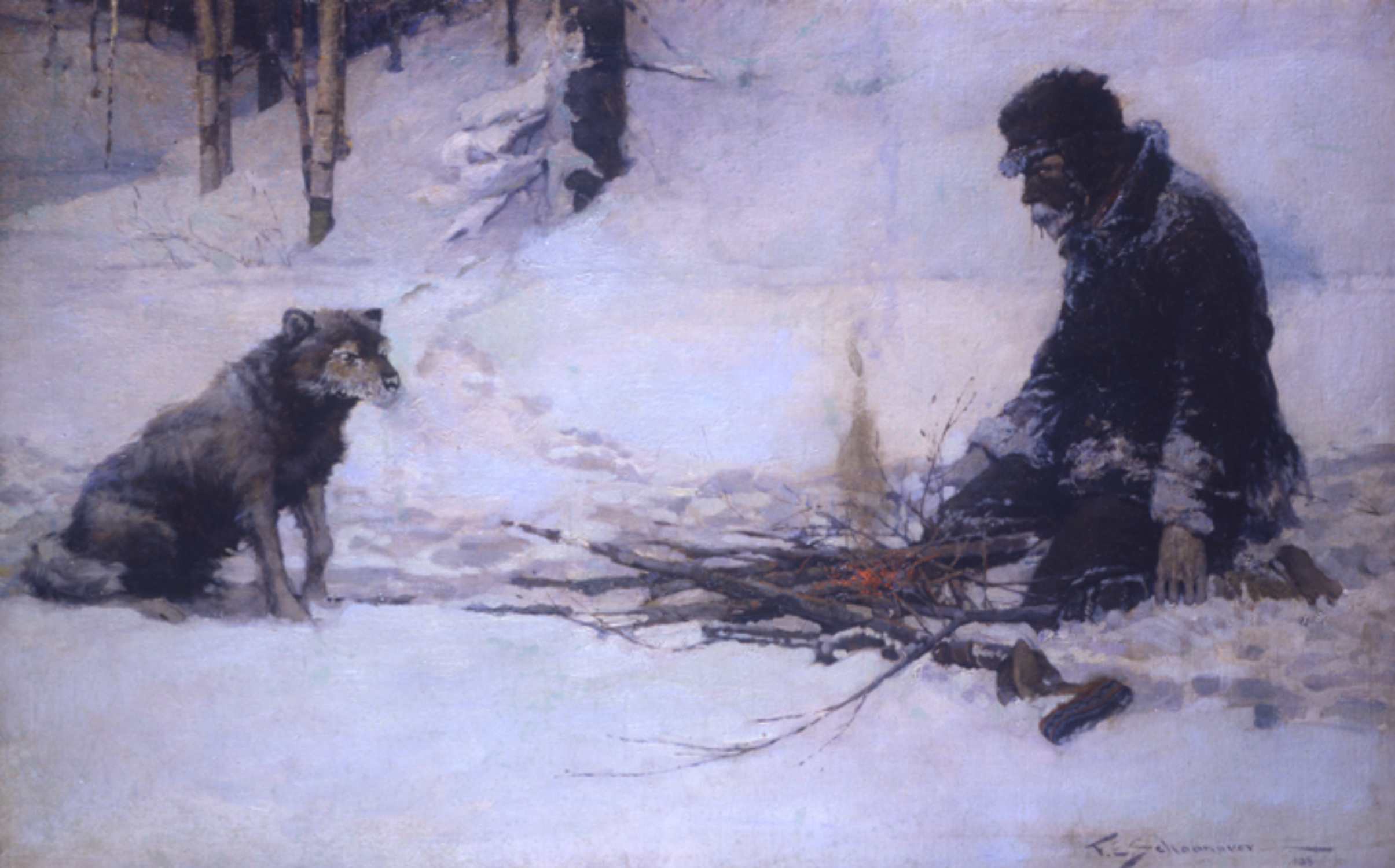
Frank E. Schoonover (1877-1972)
To Build a Fire
1908, oil on canvas
23" x 37", signed and dated bottom right
"To Build a Fire," by Jack London, Century Illustrated Monthly, August 1908, pg. 530
1908 | Oil on canvas | Century Illustrated Monthly, story by Jack London
Jack London’s story turns the Yukon cold into an implacable antagonist. Schoonover captures the moment when the man looks toward the dog, binding them together while emphasizing their difference: the man relies upon reason, while the animal possesses instinctive knowledge of the cold.
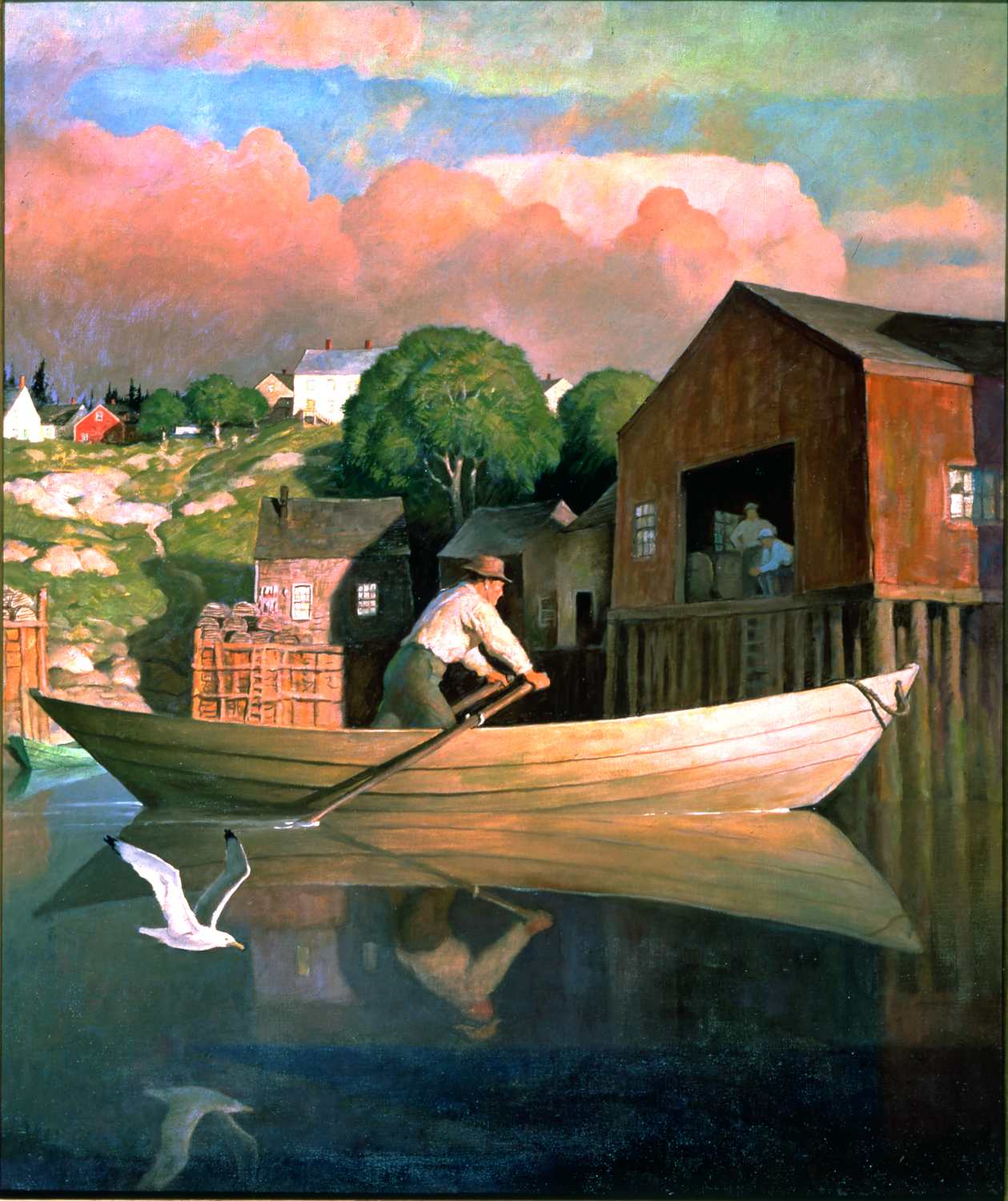
N.C. Wyeth (1882-1945)
The Doryman
1933, oil on canvas
42" x 35", signed lower right
Trending Into Maine, by Kenneth Roberts, Little Brown and Company, 1938, dust jacket and fp. 348
Wyeth absorbed Pyle’s teachings deeply, yet developed a visual language entirely his own. The massive figure, simplified forms and Maine setting elevate a working fisherman into an enduring symbol of strength and place. The painting is both specific and monumental.
Imagining America:
History, Labor and National Identity
Illustrators did not merely record history. They helped create the images through which Americans came to understand it. Pyle and the artists influenced by him transformed distant events, civic ideals, technological change and everyday labor into immediate human experiences. Reproduced in books, magazines, advertisements, posters and calendars, these images helped establish a shared visual memory of America - part historical record, part interpretation and part national mythology.
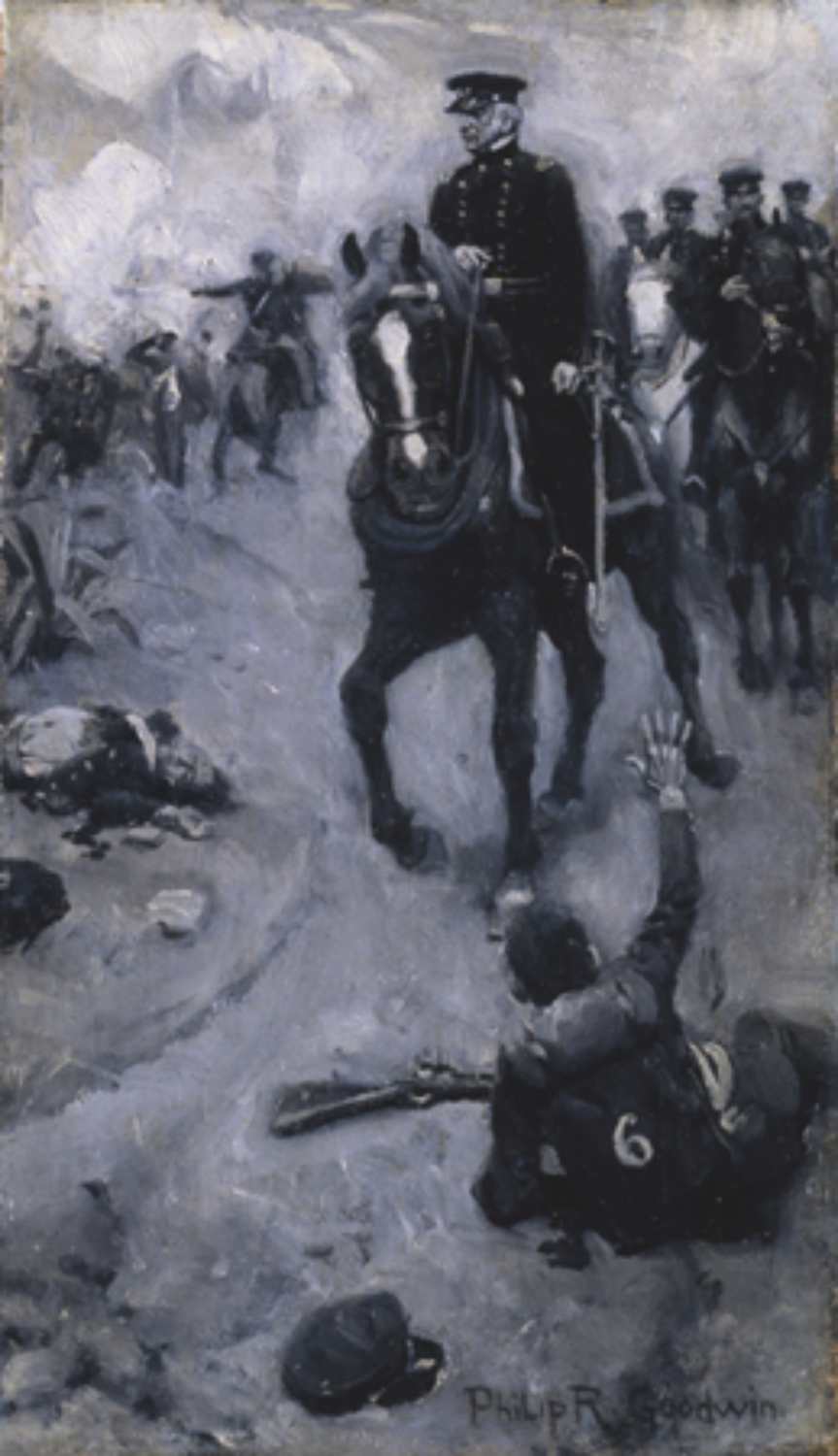
Philip R. Goodwin (1881-1935)
General Taylor at the Battle of Buena Vista (Mexican War)
1901, oil on canvas
14 1/8" x 8 1/8", signed lower right
Success Magazine, 1901
Created near the beginning of Goodwin’s career, this illustration transforms a military episode into a concentrated image of command and urgency. The limited palette reflects reproduction requirements, yet overlapping figures, diagonals and contrasts of light and dark create movement and drama.
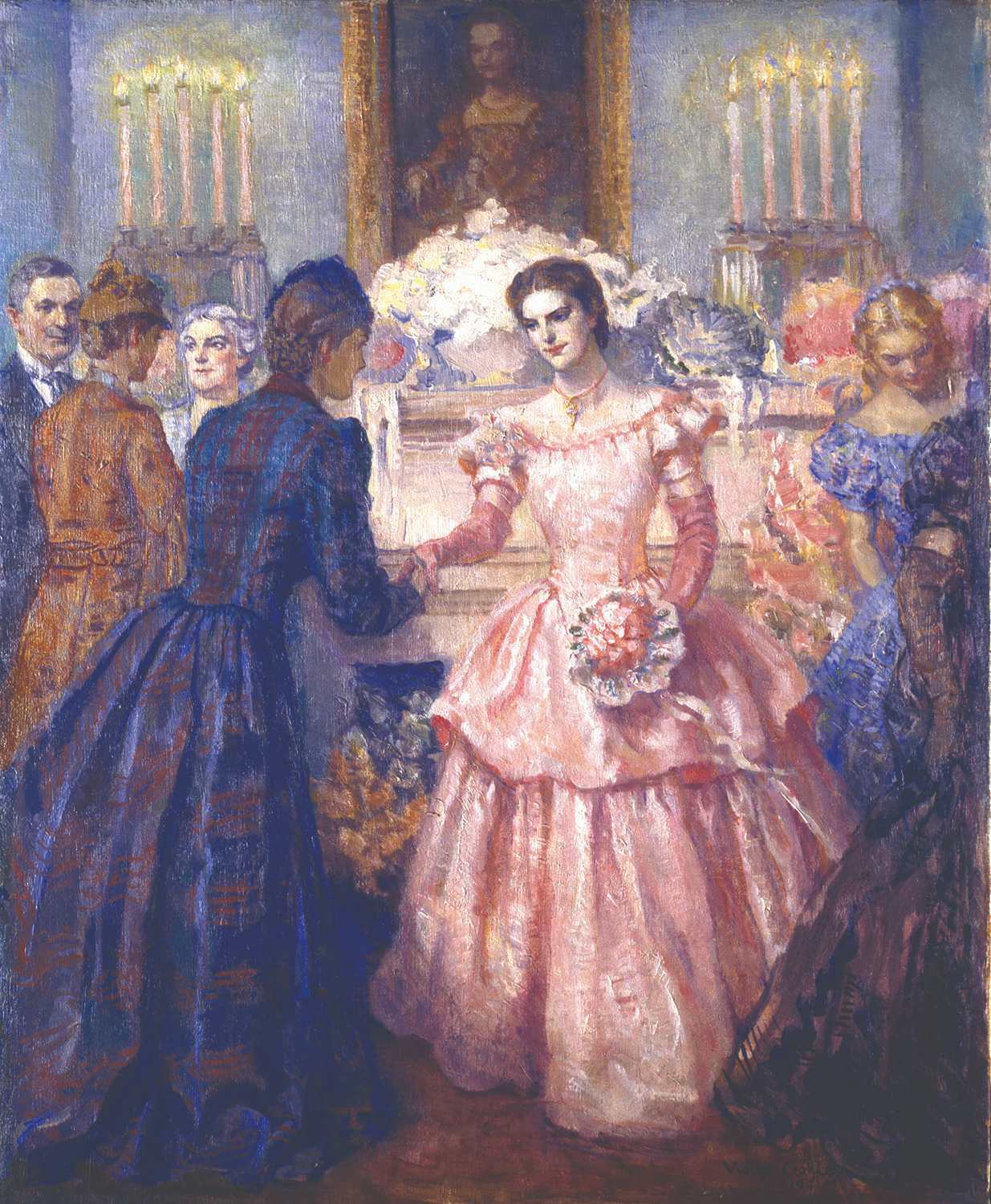
Violet Oakley (1874-1961)
Introduction
1941, oil on canvas
30" x 25", signed and dated lower right
Oakley developed a highly individual style informed by mural painting, symbolism and the decorative arts. Its measured arrangement, luminous color and ceremonial atmosphere differ markedly from the rugged adventures elsewhere in the exhibition. Pyle’s most enduring lesson was not imitation, but finding a personal visual language.
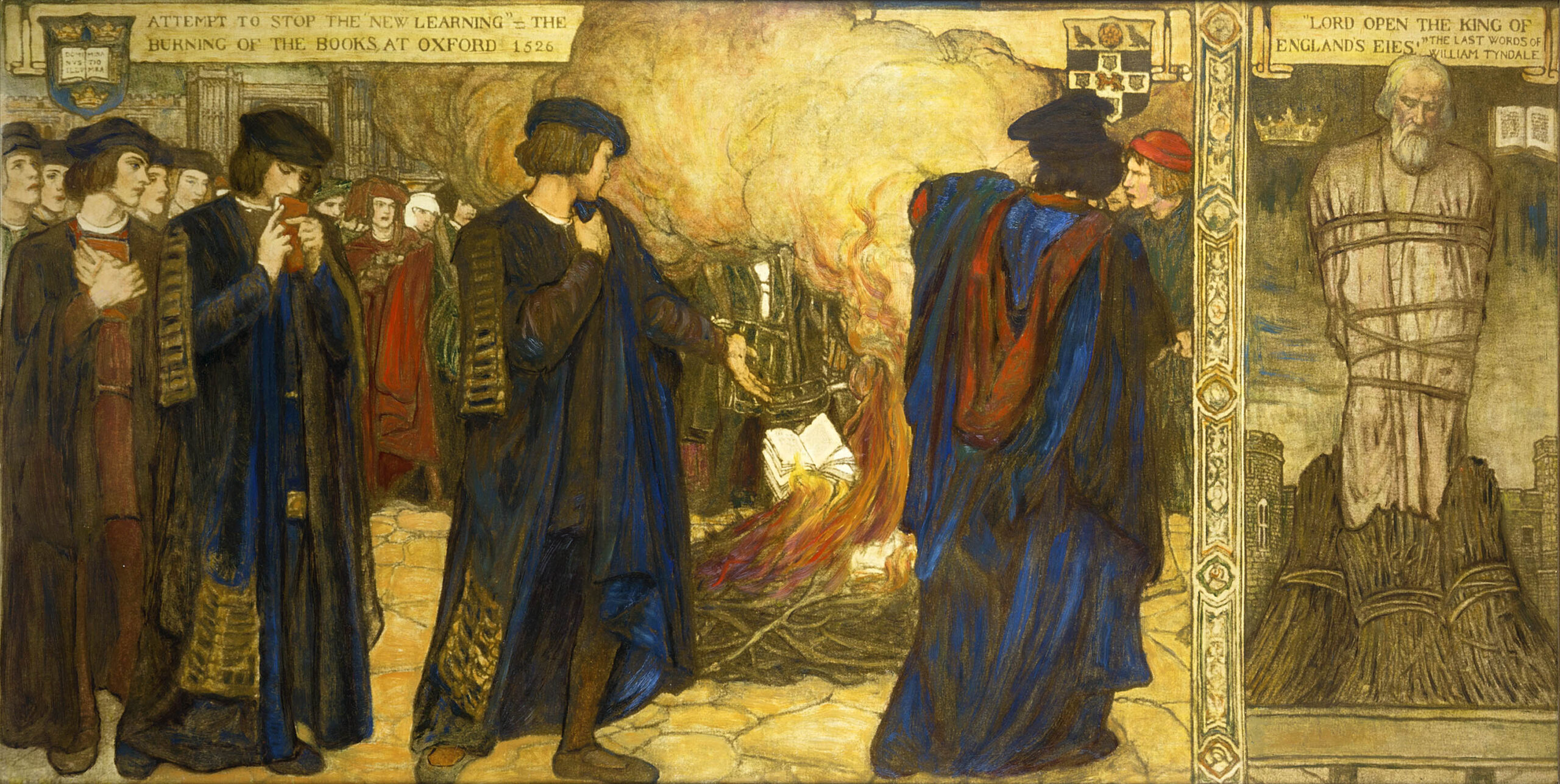
Violet Oakley (1874-1961)
Burning the Books at Oxford
c. 1900, oil painted over a printed base
54" x 27"
Oakley depicts an episode associated with the persecution of those who translated and circulated the Bible in English. The solemn arrangement and burning books turn history into a moral drama about knowledge, conscience and authority. Pyle recognized Oakley’s gift for large-scale composition and encouraged her pursuit of mural painting.
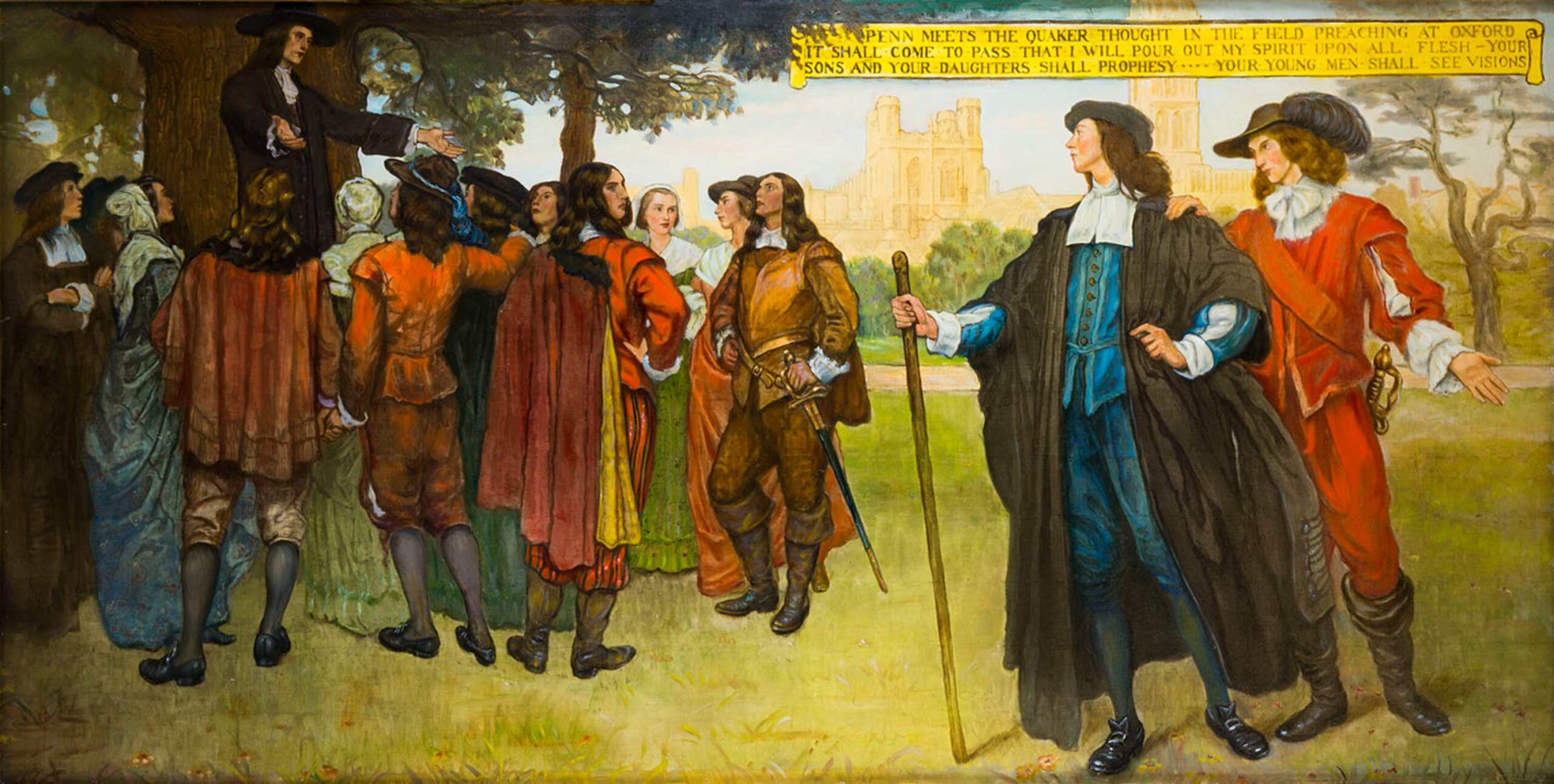
Violet Oakley (1874-1961)
The Holy Experiment - Penn Meets the Quaker
1912, oil painted over a printed base
24 1/2" x 37 3/4"
The Holy Experiment, by Violet Oakley, 1912
This work relates to Oakley’s monumental mural cycle celebrating William Penn’s vision of religious tolerance and enlightened government. Rather than depict history as spectacle, she presents it as the meeting of people and ideas. Symbolic color and orchestrated gesture give philosophical belief a visible form.
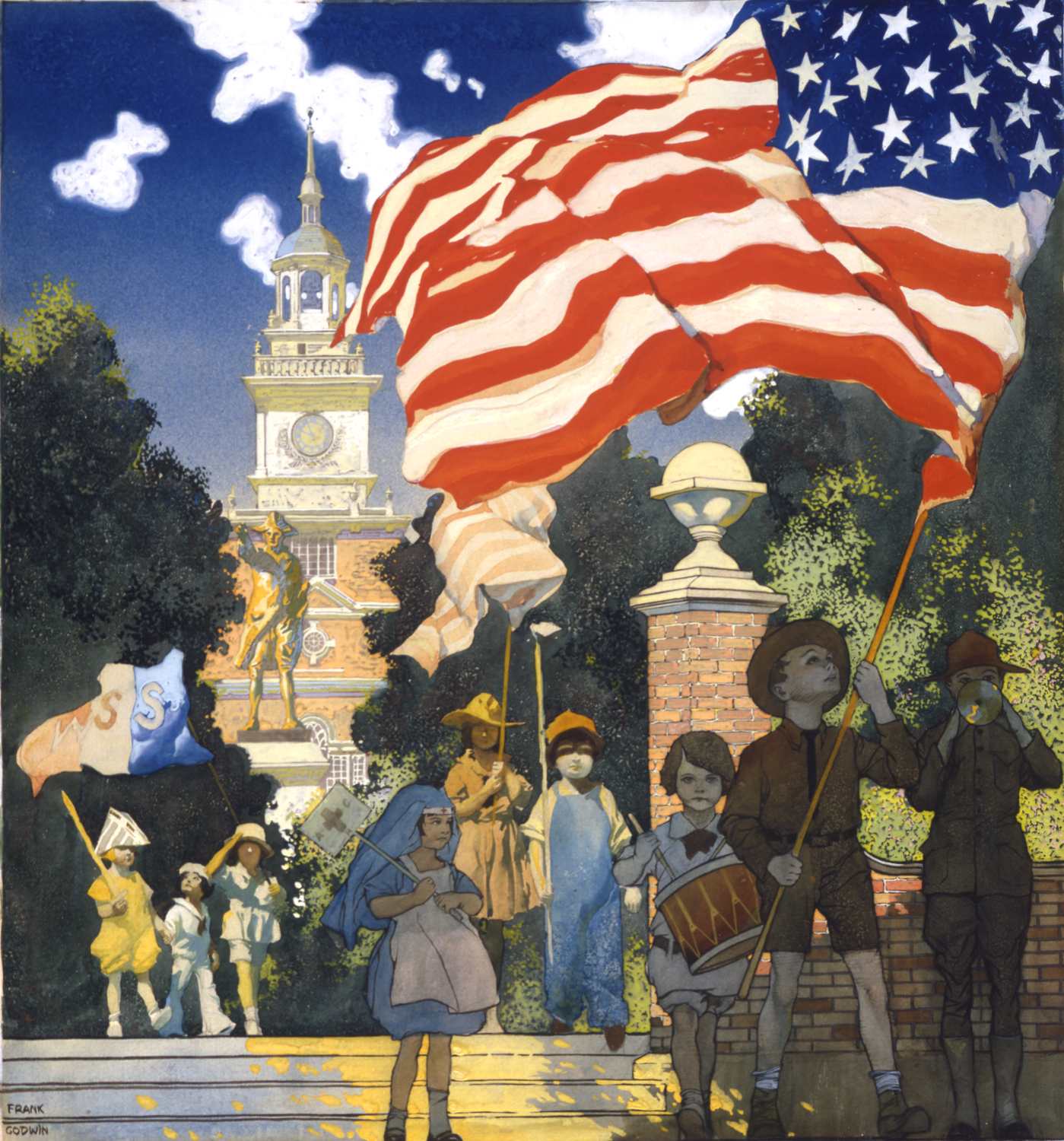
Frank Godwin (1889-1959)
Philadelphia Patriotic Scene
1917, gouache on board
18 1/2" x 17", signed lower left
WWI Poster - War Savings Stamps Drive
Created during the First World War, this image connects patriotism to civic participation. The American flag dominates the composition while gathered figures represent a public united around national purpose. Godwin makes an abstract idea immediate through recognizable people, symbols and actions.
Beyond Adventure:
New Worlds and Everyday Life
Howard Pyle is often associated with pirates, battles and dramatic history, but his influence extended far beyond adventure. Jessie Willcox Smith found emotional and narrative depth in childhood. Elizabeth Shippen Green explored imagination and independent thought. Violet Oakley translated civic ideals into monumental symbolism. Maxfield Parrish invented luminous worlds, while later artists discovered stories in family life, humor and quiet observation. The Pyle effect was not a single style or subject. It was a way of seeing narrative possibility everywhere.
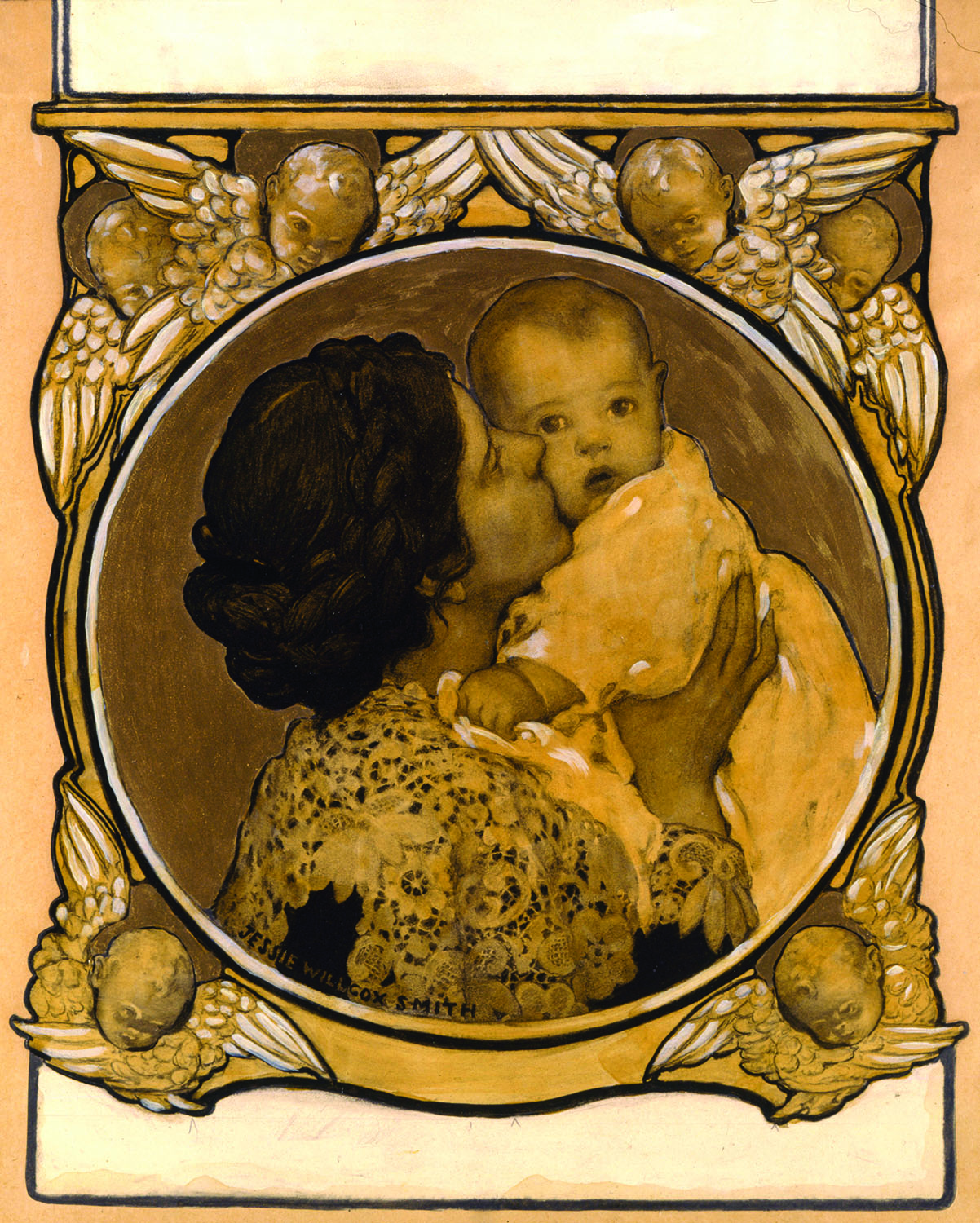
Jessie Willcox Smith (1863-1935)
Mother Kissing Baby
1904, charcoal and oil on board
21 3/4" x 20", signed lower left
Ladies' Home Journal, October 1904 cover
Smith transformed the relationship between mother and child into a subject worthy of serious artistic attention. The circular design concentrates the gaze on their intimate exchange, while the decorative border gives an everyday gesture a timeless quality. Smith applied Pyle’s emphasis on emotional identification to experiences too often dismissed as merely domestic.
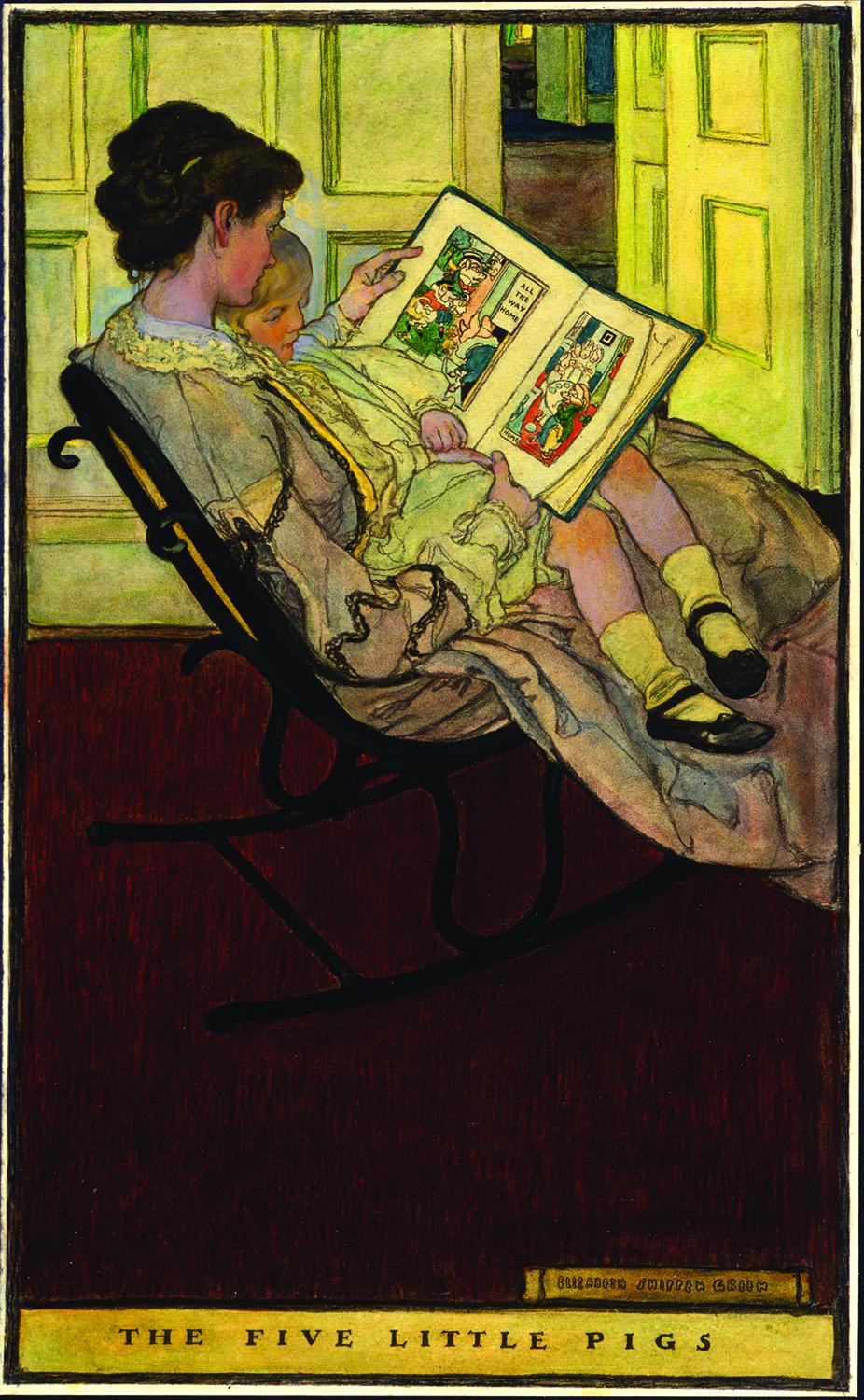
Elizabeth Shippen Green (1871-1954)
The Five Little Pigs
1905, watercolor and charcoal on board
27" x 16 1/2", signed lower right
"Mistress of the House," August 1905
"A Song Set to Five Fingers" in One Thousand Poems for Children, 1920
Absorbed in her book, the child occupies a private world shaped by pictures, words and imagination. Green’s tall composition, restrained palette and decorative patterns direct attention toward reading. She turns Pyle’s lesson inward, depicting not an external adventure but the moment when a child’s imagination begins to create one.
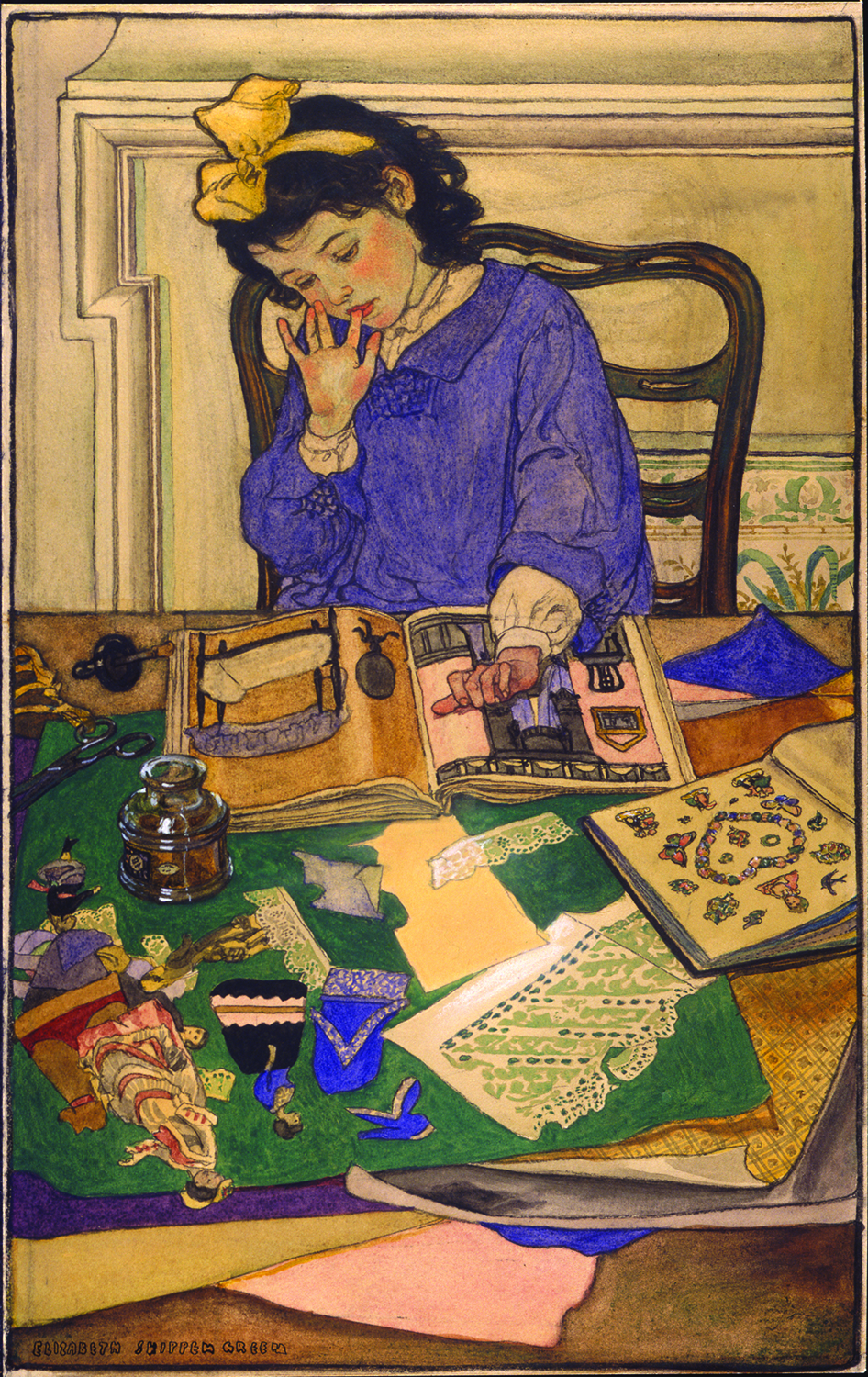
Elizabeth Shippen Green (1871-1954)
Paper Doll Books #2
1906, watercolor and charcoal
23" x 14 1/2", signed lower left
"The Mind of a Child," by Edward S. Martin, Harper's Monthly, December 1906
Surrounded by paper dolls, pictures and scattered materials, the girl is absorbed in imaginative creation. Green’s organized details invite viewers to explore the scene as the child explores the world she is making. Childhood is presented not as passive innocence, but as concentration, invention and independent thought.
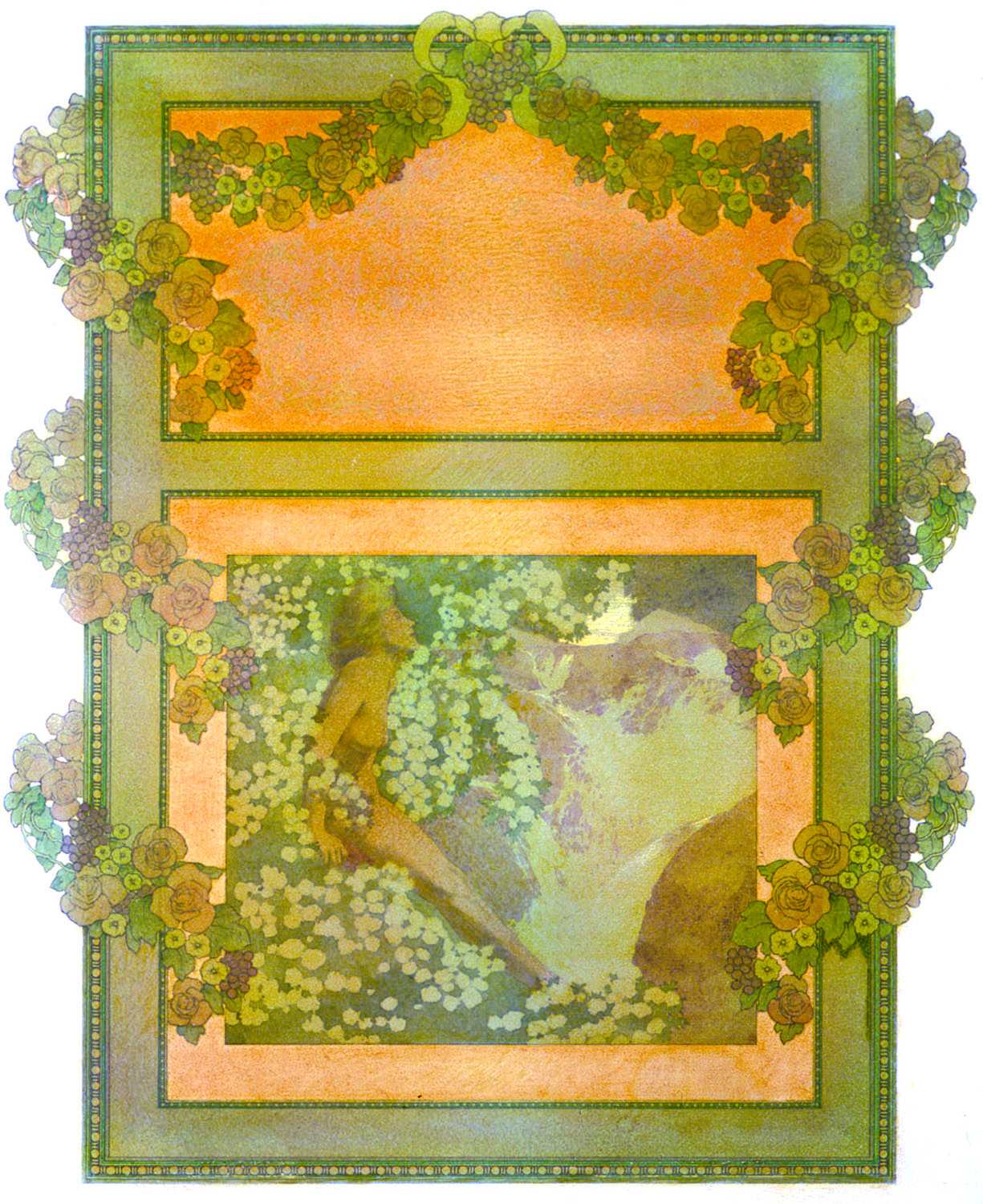
Maxfield Parrish (1870-1966)
April
1908, oil on stretched paper
22 1/8" x 16 1/4"
Collier's Magazine, April 8, 1911, pg. 12
Parrish transforms spring into a world of decoration, fantasy and theatrical beauty. Architectural design is integral to the composition, blurring distinctions among illustration, painting and decorative art. He shared Pyle’s belief that an artist must create a convincing imaginative world into which the viewer can enter.
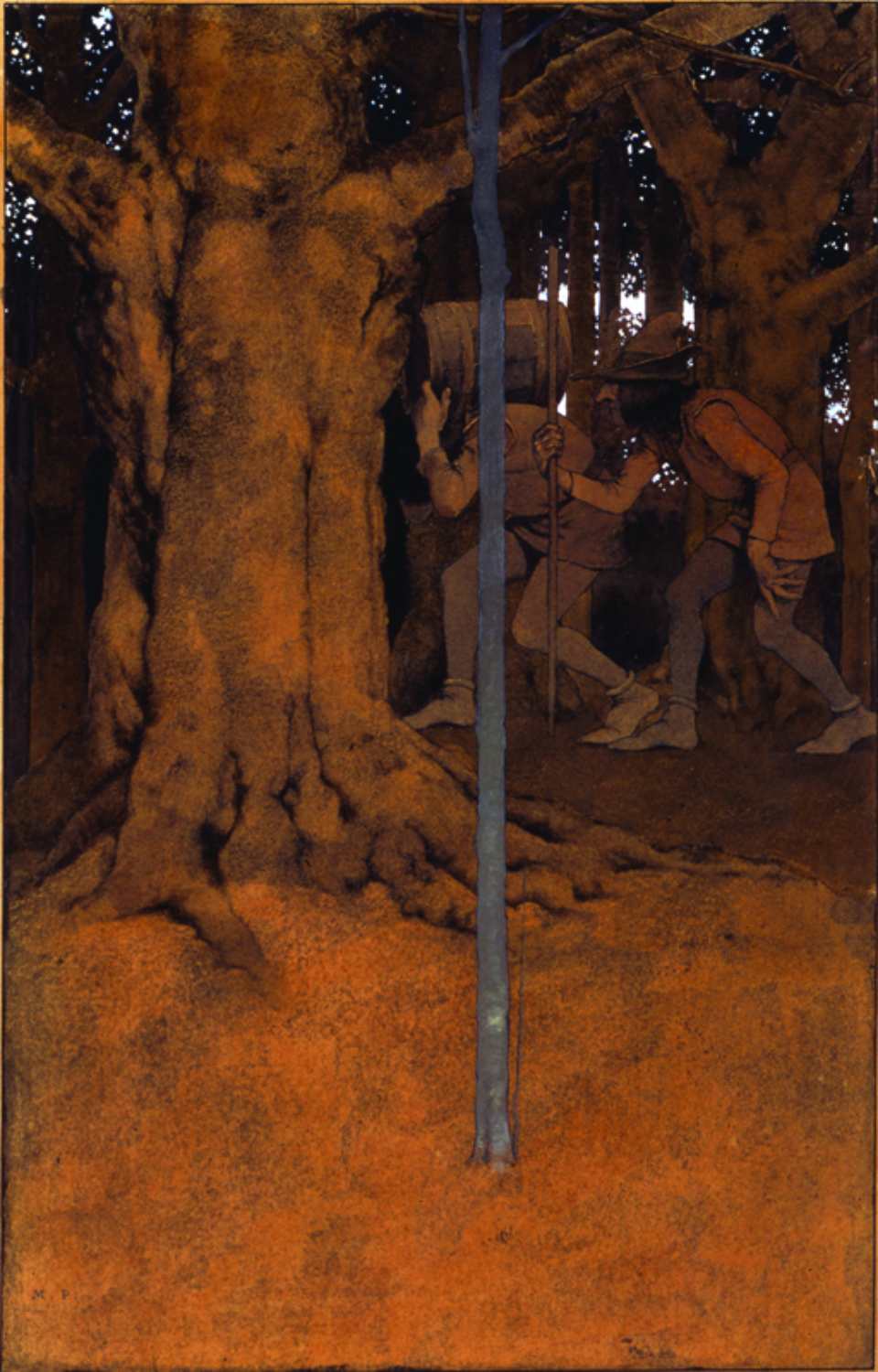
Maxfield Parrish (1870-1966)
The Olympians
1899, watercolor, oil and ink on paper
11" x 7", initialed lower left
The Golden Age, by Kenneth Grahame, 1899
Parrish transforms childhood recollection into an enchanted realm. His design suggests a world simultaneously domestic, classical and fantastical. The work demonstrates how illustrators could do more than represent written description: they created visual worlds with moods and identities entirely their own.
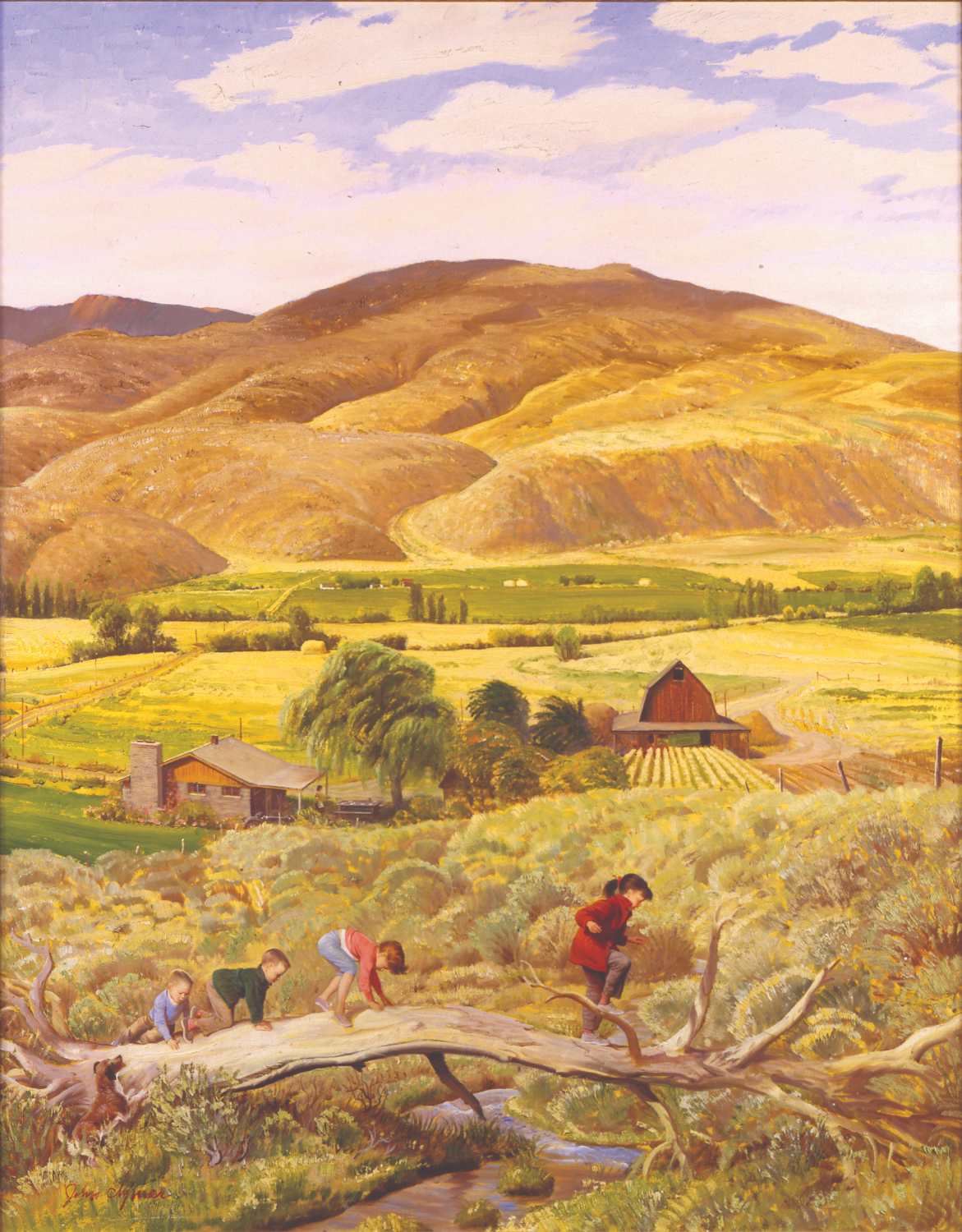
John Clymer (1907-1989)
Follow the Leader
1957, oil on board
34" x 27", signed lower left
Saturday Evening Post, September 27, 1958 cover
Children balancing along a fallen tree turn a familiar pastime into a small-scale adventure. The landscape establishes place and season while the children’s poses carry movement across the composition. Pyle’s narrative principles transform an ordinary experience into a story of challenge, imitation and discovery.
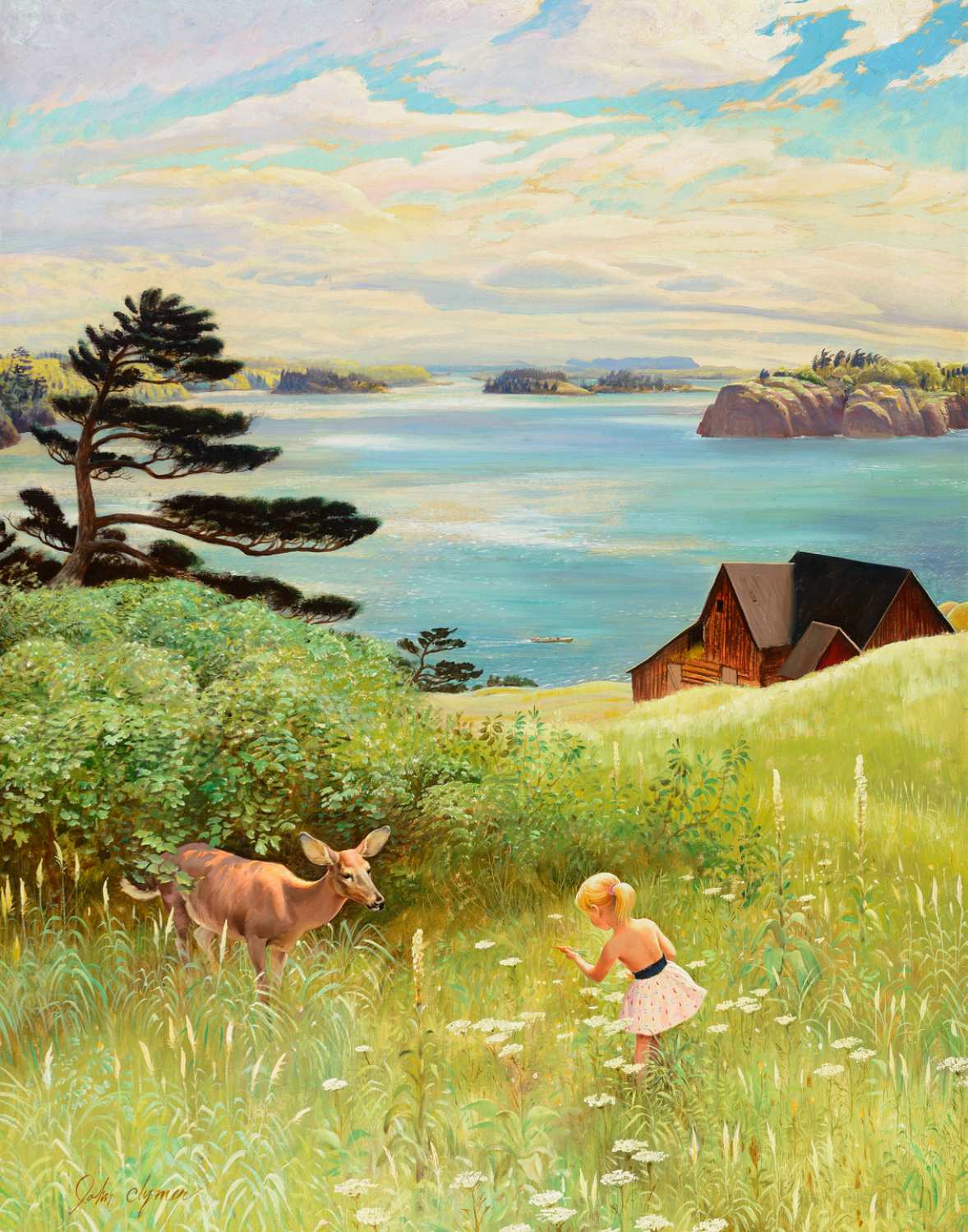
John Clymer (1907-1989)
Two Little Dears
1956, oil on board
30" x 23 1/2", signed lower left
Saturday Evening Post, August 25, 1956 cover
Clymer builds the scene around quiet recognition between a child and a wild animal. Their separation preserves the delicacy and uncertainty of the encounter. Stillness, scale and the child’s absorbed attention create an emotional narrative in which suspense arises from wonder rather than danger.
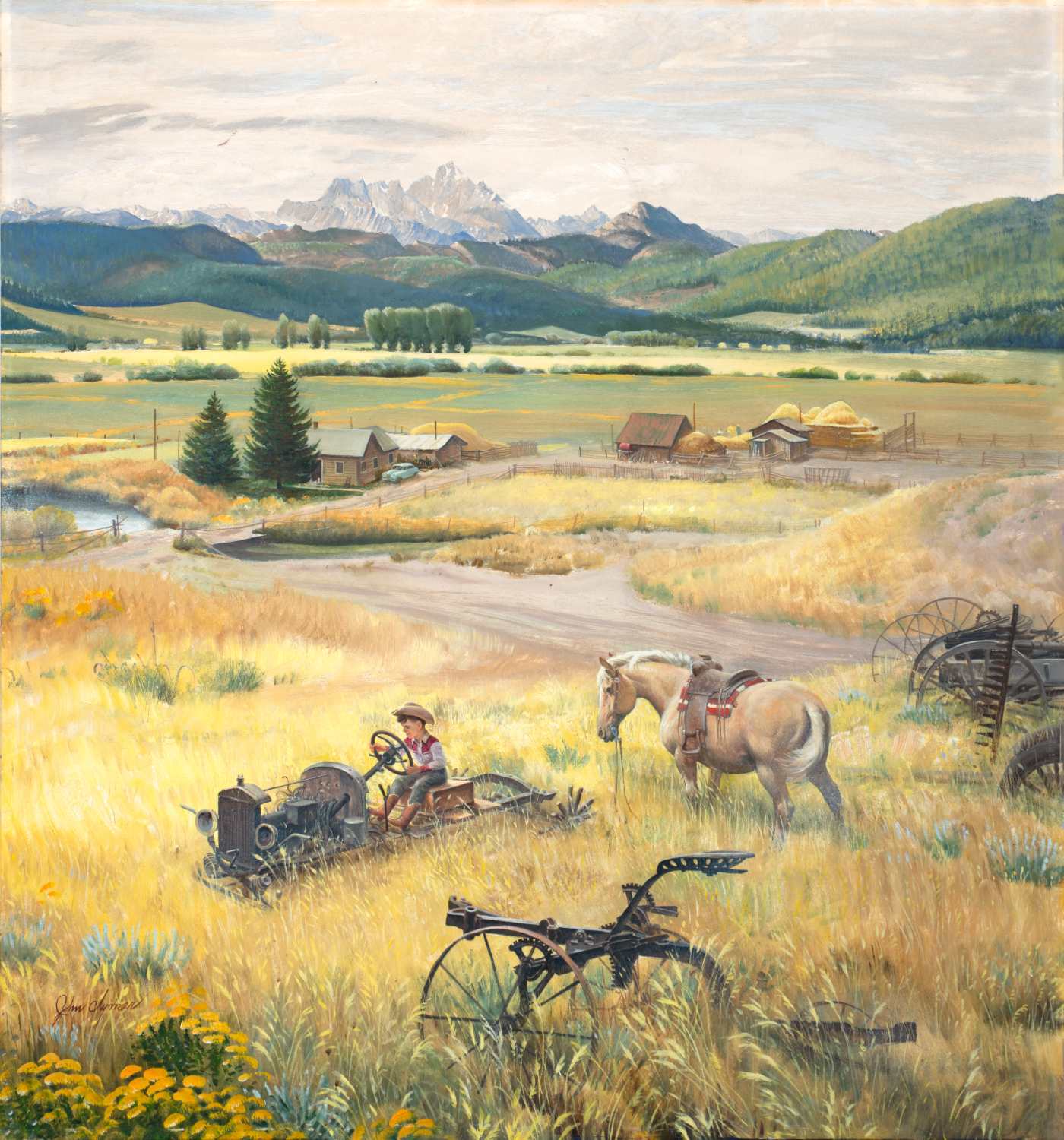
John Clymer (1907-1989)
Rustic Daydreams
1959, oil on board
30" x 28", signed lower left
Saturday Evening Post, May 23, 1959 cover
Abandoned machinery rests within an expansive landscape, prompting the viewer to imagine the labor and aspirations once connected to it. Clymer turns physical remnants into a meditation on time and memory. The story emerges from our attempt to reconstruct what has disappeared.
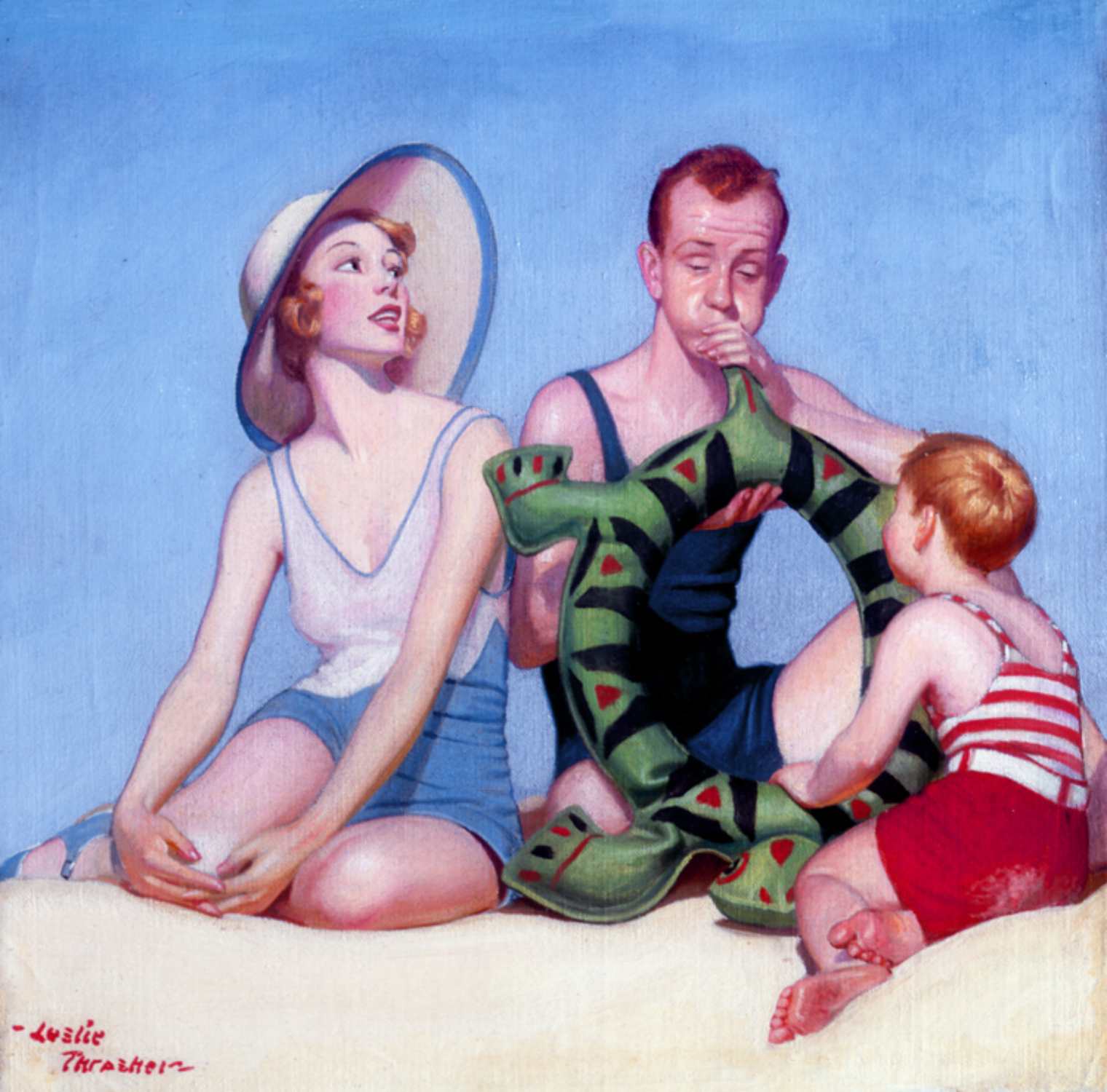
Leslie Thrasher (1889-1936)
Dad Blowing Up Green Turtle Tube
1931, oil on canvas
15 3/4" x 16", signed lower left
Liberty Magazine, September 5, 1931 cover
Thrasher found narrative potential in minor triumphs and frustrations of family life. An inflatable toy, an attentive child and a father’s effort create affectionate comedy. The subject is far from Pyle’s pirates, but character, gesture and a carefully chosen moment make the situation immediately understandable.
The Ripple Effect:
A Legacy Beyond the Classroom
Howard Pyle died in 1911, but his approach continued to flourish. His students became celebrated artists and influential teachers, passing his principles to artists who had never entered his studio. Others absorbed his influence through books, magazines, film and the visual culture his work helped create. By the middle of the twentieth century, Pyle’s way of telling a story had become so deeply embedded in popular culture that audiences could recognize its effects without knowing its source.
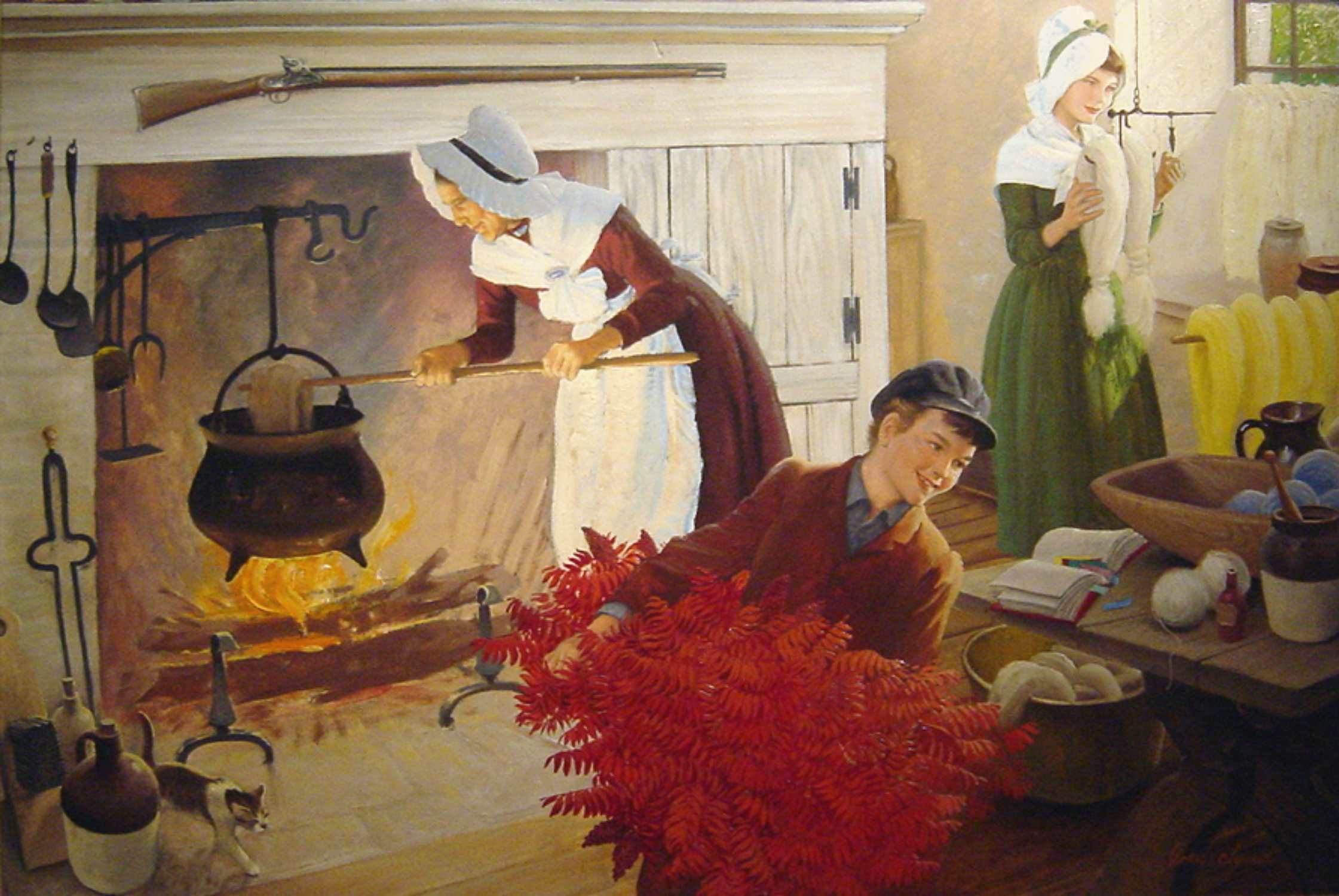
John Clymer (1907-1989)
Early Home Dyeing in New England
1954, oil on panel
26" x 38", signed lower right
American Cyanamid corporate calendar, 1954
Clymer transforms a domestic process into a staged historical narrative. Vivid dyed wool draws the eye through the composition, while the figures’ gestures explain the activity without requiring extensive text. Research, clarity and human interest demonstrate Pyle’s continuing legacy.
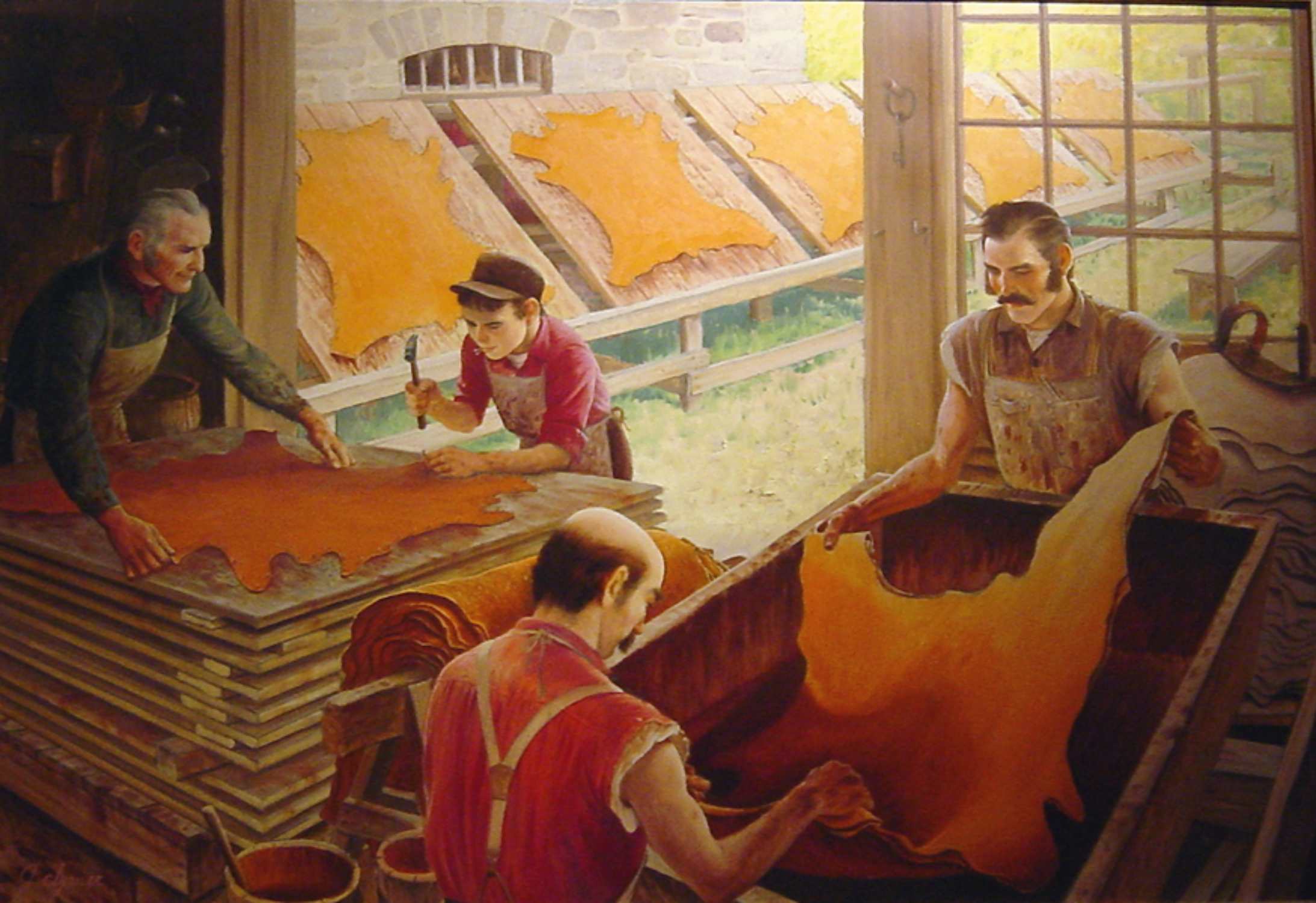
John Clymer (1907-1989)
Early Leather Dyeing in America
1955, oil on panel
27 1/2" x 39", signed lower left
American Cyanamid corporate calendar, 1955
Clymer makes an early industrial process understandable without sacrificing atmosphere or human interest. Careful research establishes historical credibility, while composition and gesture transform instruction into narrative. He encountered Pyle’s legacy through Pyle’s former students in Wilmington.
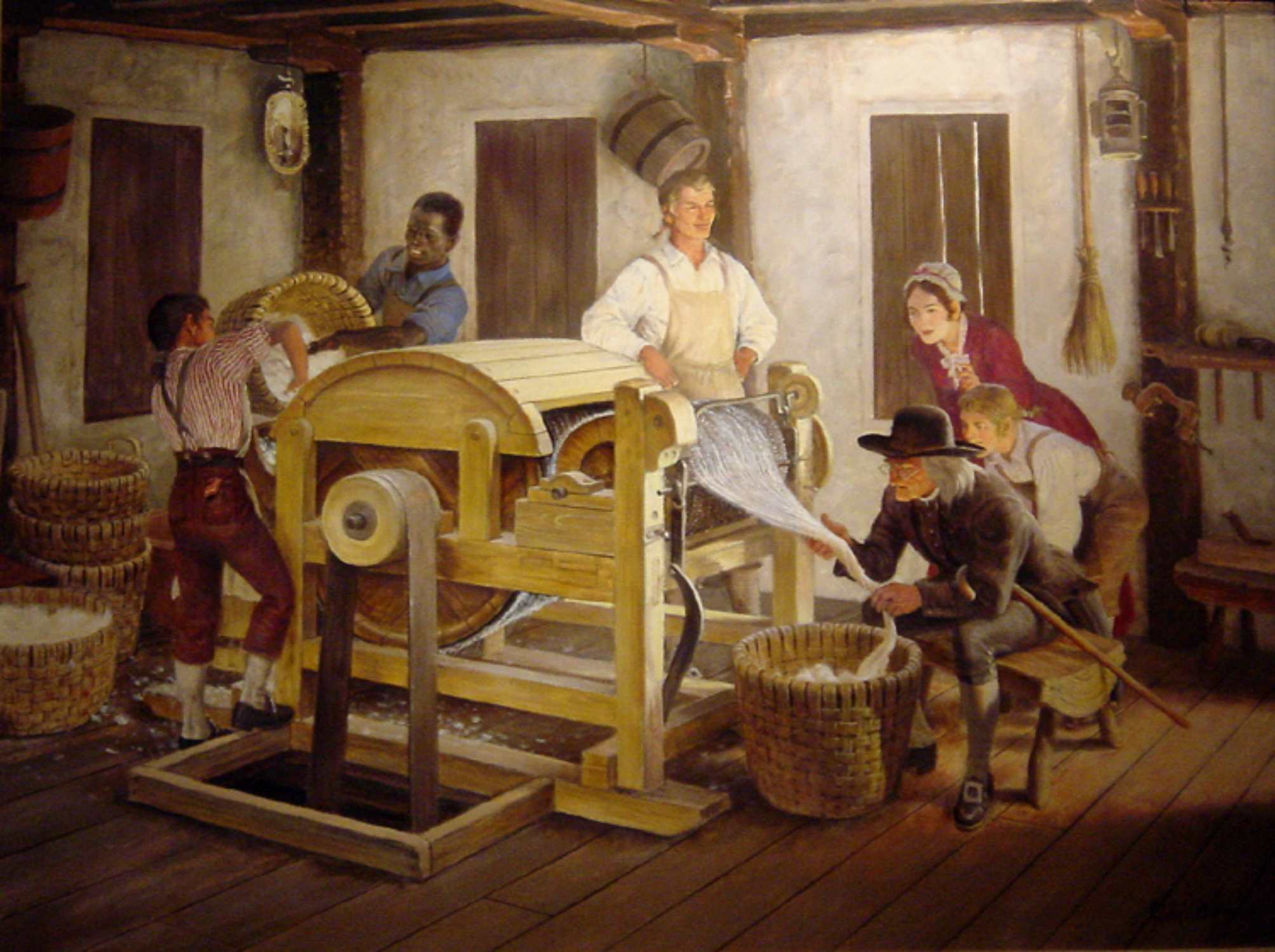
John Clymer (1907-1989)
Samuel Slater Demonstrates the First Successful Textile Machinery
1969, oil on panel
30" x 40", signed lower right
American Cyanamid corporate calendar, 1969
Clymer carries Pyle’s emphasis on research, clarity, and human experience into a later generation, transforming technological history into a consequential encounter among people and ideas.
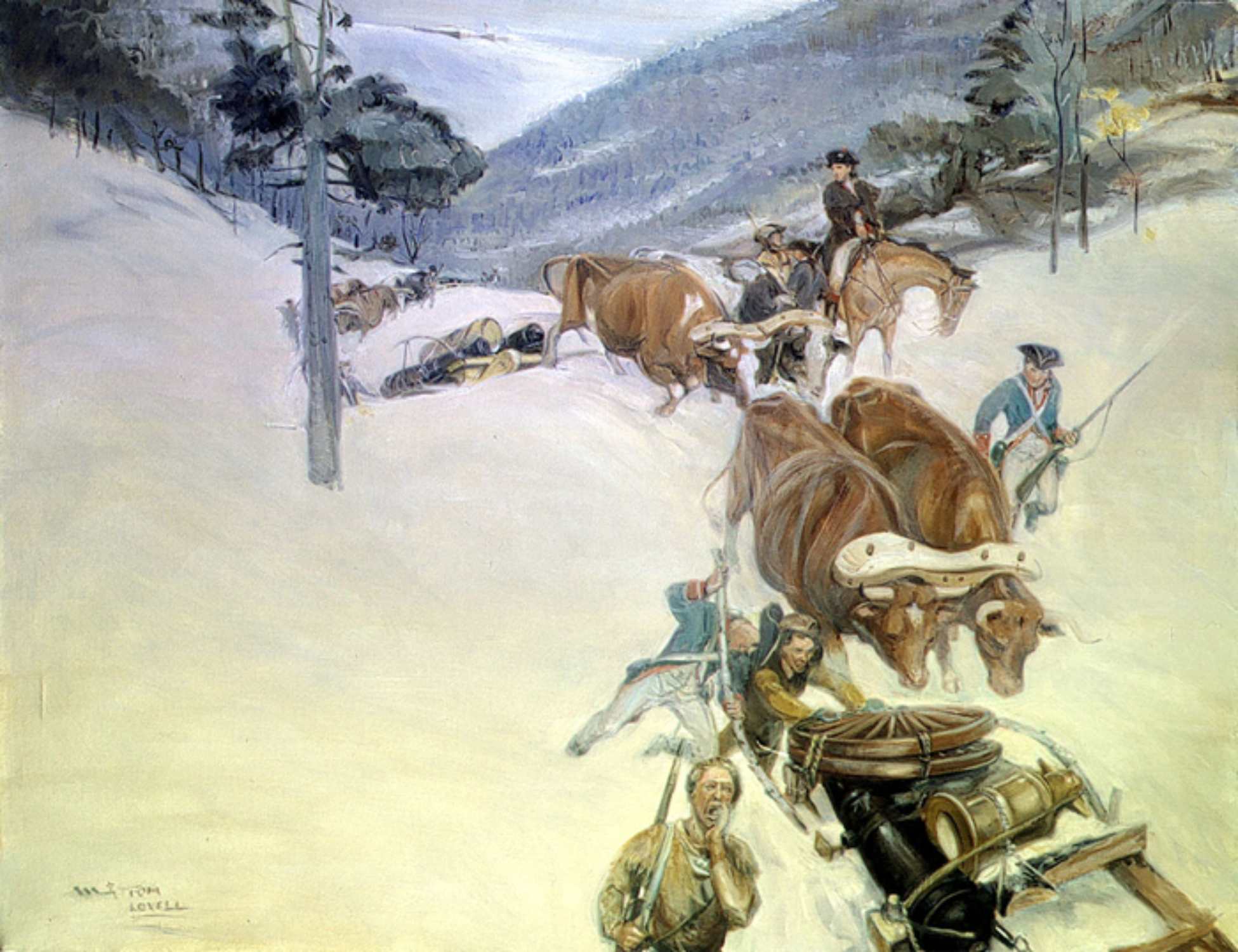
Tom Lovell (1909-1997)
The Noble Train of Artillery - Study
Oil on canvas
33" x 42", monogrammed and signed lower left
Study for "Famous American Paintings" calendar, printed by U.S. Information Agency, 1960
Pyle’s principles reached Lovell through his teacher Harvey Dunn, demonstrating how one artist’s approach to storytelling passed from classroom to classroom and continued to shape the visualization of American history.
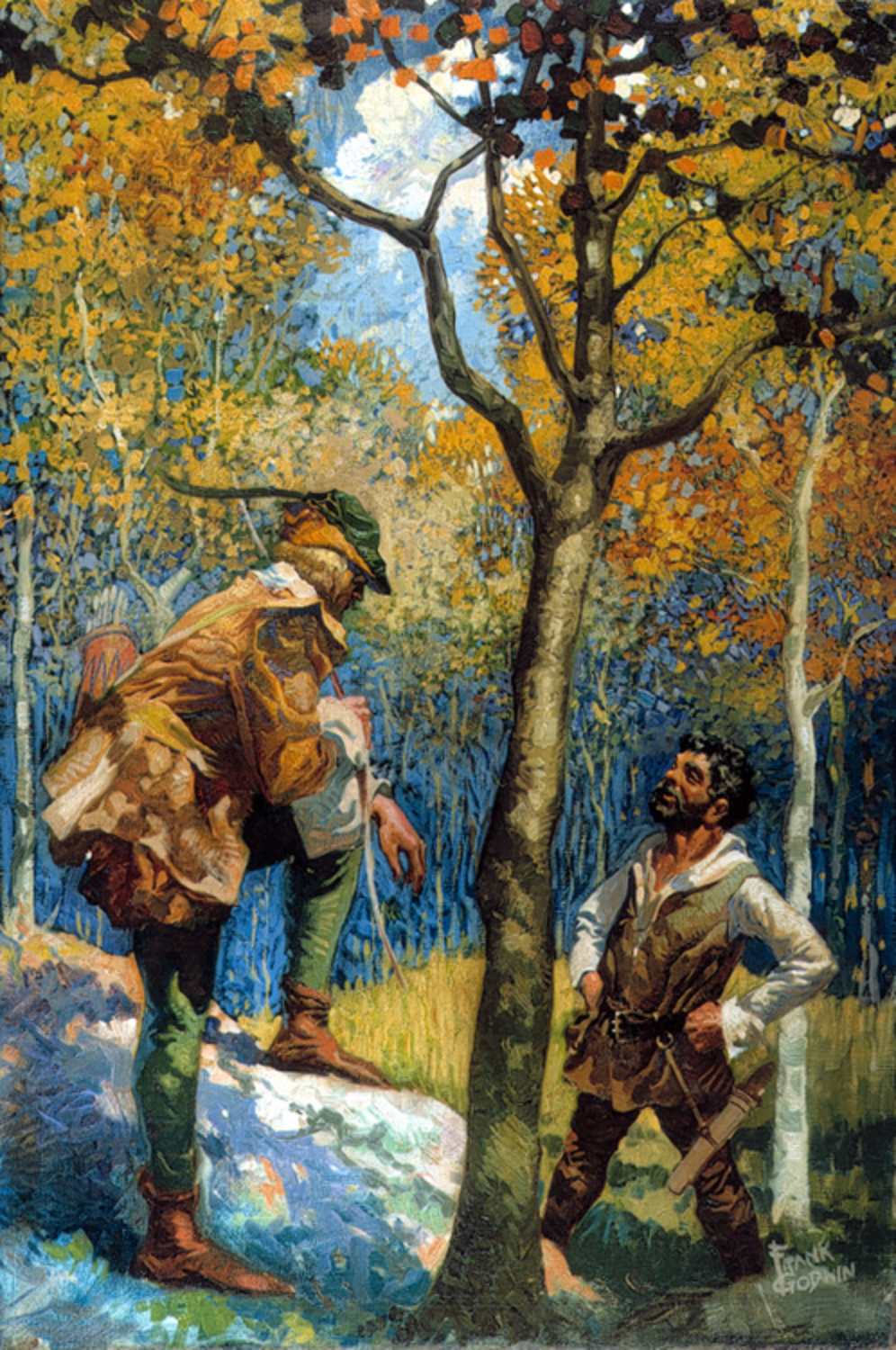
Frank Godwin (1889-1959)
Robin Hood
1932, oil on canvas
44" x 29", signed lower right
Robin Hood, by Henry Gilbert, David McKay Company, 1932, cover
Although Godwin did not study directly with Pyle, his interpretation of Robin Hood demonstrates the lasting influence of the visual world Pyle created for the legendary hero.
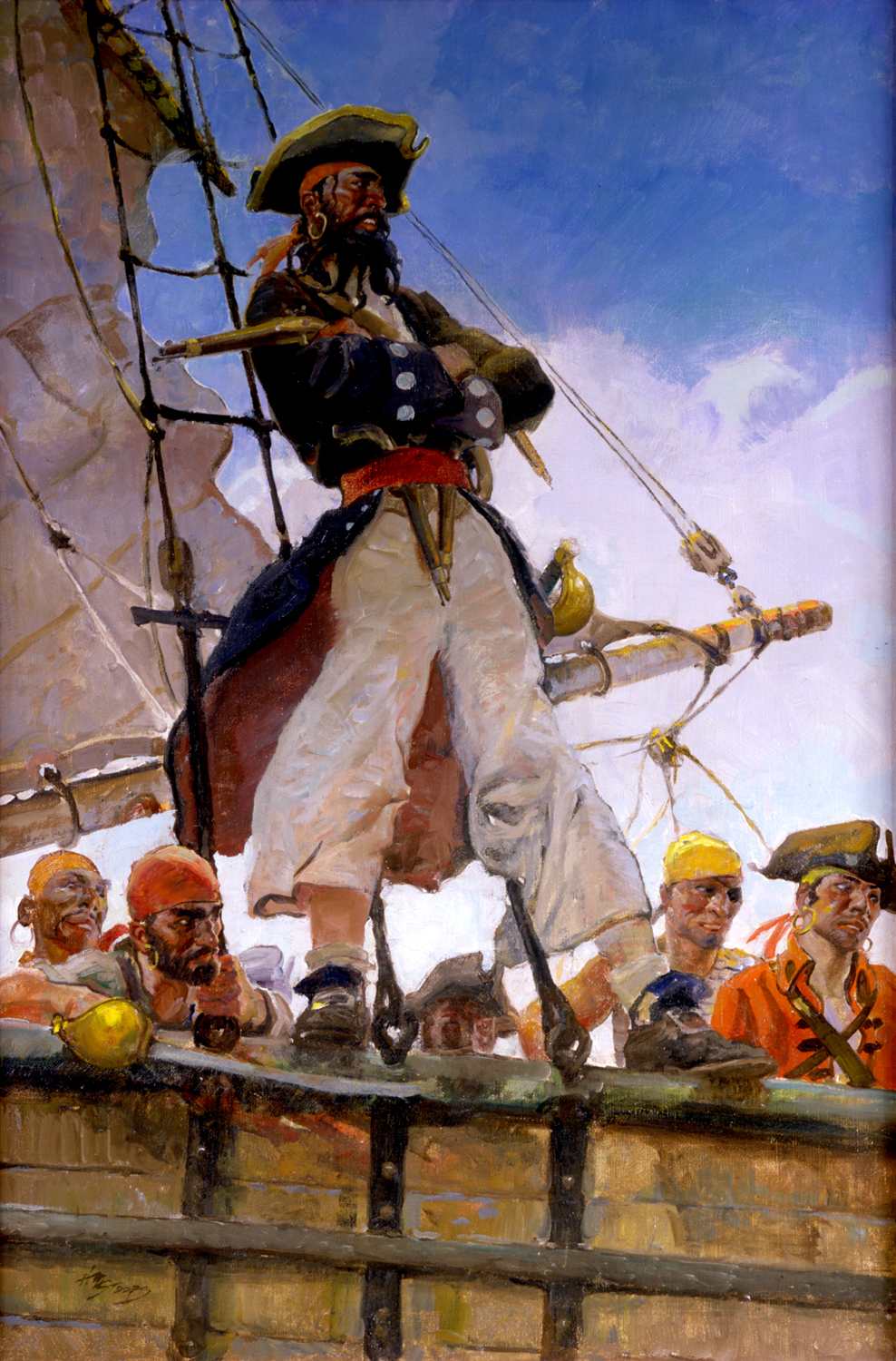
Herbert Morton Stoops (1888-1948)
Blackbeard and the Pirates
1939, oil on canvas
36" x 24", signed lower left
Blue Book magazine, July 1939 cover
Stoops carries Pyle’s influential image of the pirate into the pulp-magazine era, using heightened action and bold silhouettes to reach a new generation of readers.