

Throughout the history of American illustration, nighttime has provided artists with a compelling setting for exploring atmosphere, emotion, and narrative. Far more than a backdrop, darkness becomes an integral element of the composition, allowing artists to manipulate light and shadow to establish mood, direct the viewer's eye, and heighten the drama of a scene.
In celebration of America's 250th anniversary, the National Museum of American Illustration presents After Dark: Nighttime in American Illustration, an exhibition examining how some of America's most celebrated illustrators interpreted the world after sundown. From the luminous moonlit landscapes of Maxfield Parrish to the intimate domestic scenes of Norman Rockwell and the dramatic storytelling of Howard Pyle, these works demonstrate the remarkable versatility of nighttime as an artistic subject. Through carefully orchestrated contrasts of illumination and darkness, artists transform familiar settings into scenes of romance, mystery, tranquility, and suspense.
Spanning literary illustrations, magazine covers, and commercial imagery, After Dark explores how American illustrators employed light, color, and composition not simply to depict the night, but to make it an active participant in the stories they sought to tell.
By the Light of the Moon
For centuries, moonlight has offered artists a distinctive means of transforming familiar subjects through light and shadow. In these illustrations, the moon serves not simply to establish a nighttime setting, but as an important compositional device—illuminating figures and landscapes, directing the viewer’s eye, and creating dramatic contrasts against the surrounding darkness. Whether atmospheric, mysterious, or theatrical, moonlight becomes an active presence within each scene and an essential part of its narrative.
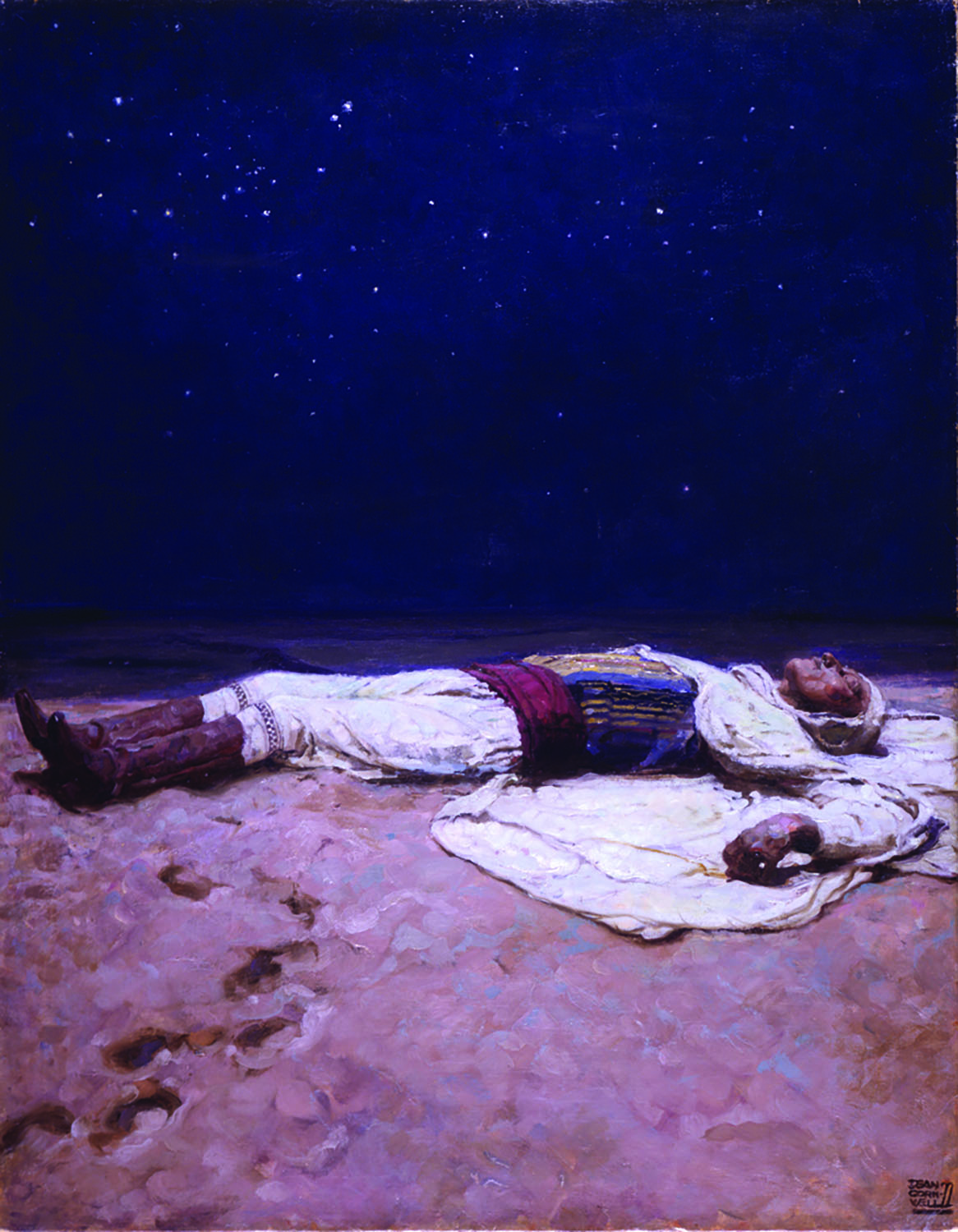
Dean Cornwell (1892-1960)
Hour After Hour, Carew Lay Motionless
1922, oil on canvas
36" x 28", signed and dated lower right
"The Desert Healer," by E.M. Hull, Cosmopolitan, 1922
Night itself plays an essential role in this composition. Cornwell creates a striking contrast between the illuminated foreground, where the figure lies against the warm desert sand, and the vast, dark sky above. The foreground appears almost aglow, bringing the figure into sharp focus, while the deep blue-black expanse of the night is punctuated by stars. By dividing the composition between these areas of light and darkness, Cornwell emphasizes the figure’s isolation and vulnerability within the immense desert landscape. The darkness is therefore more than a description of time or place: it becomes an active element of the narrative, heightening the sense of stillness, distance, and drama that surrounds the scene.
Dean Cornwell studied at the Art Students League in New York City in 1915, where he met illustrators Charles Chapman and Harvey Dunn, later attending their summer school in 1916. Dunn, a student of Howard Pyle and an important inheritor of the Brandywine tradition, became a significant mentor to Cornwell, particularly in the areas of color theory and composition. The vibrant palette, vigorous brushwork, and dramatic interpretation seen in Hour After Hour, Carew Lay Motionless, created for E. M. Hull’s The Desert Healer and published in Cosmopolitan in 1922, reflect both Cornwell’s developing individual style and the influence of this tradition.
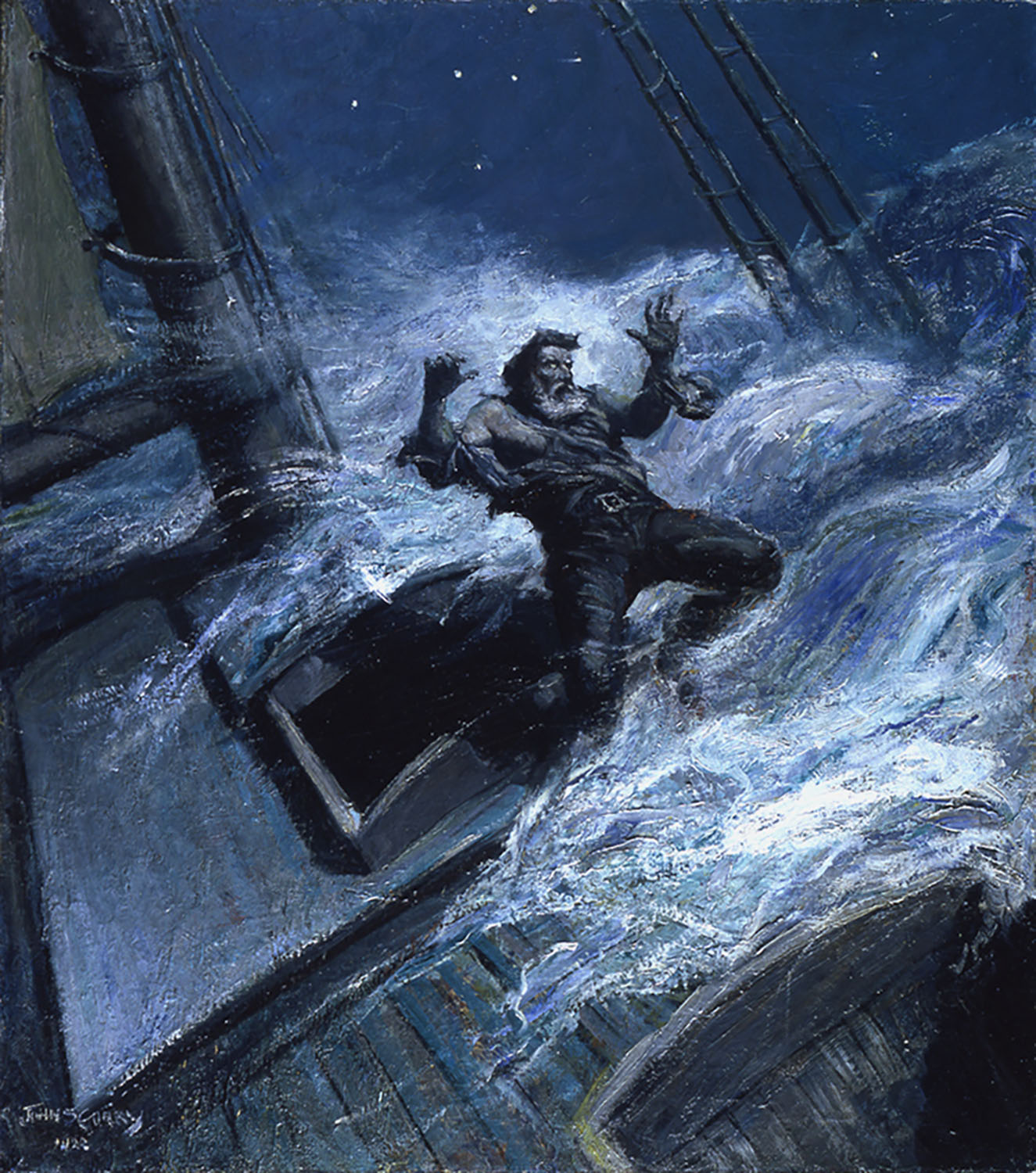
John Steuart Curry (1897-1946)
Battling the Storm
1922, oil on canvas
34" x 30 1/8", signed and dated lower left
John Steuart Curry is best known for his depictions of rural life in his native Kansas and, along with Thomas Hart Benton and Grant Wood, became a leading figure of American Regionalism. His artistic production extended beyond painting to include prints, posters, and book illustrations. Like Benton, Curry also undertook commercial illustration work to supplement his income, particularly early in his career.
Painted in 1922, Battling the Storm demonstrates Curry’s interest in dramatic narrative and the forces of nature. Deep blues and blacks dominate the scene, while selective areas of illumination reveal the struggling figure and turbulent water. Strong diagonals created by the pitching boat, figure, and driving rain heighten the sense of movement and instability. With the surrounding landscape obscured, darkness becomes an active element of the composition, intensifying the uncertainty and danger of the storm.
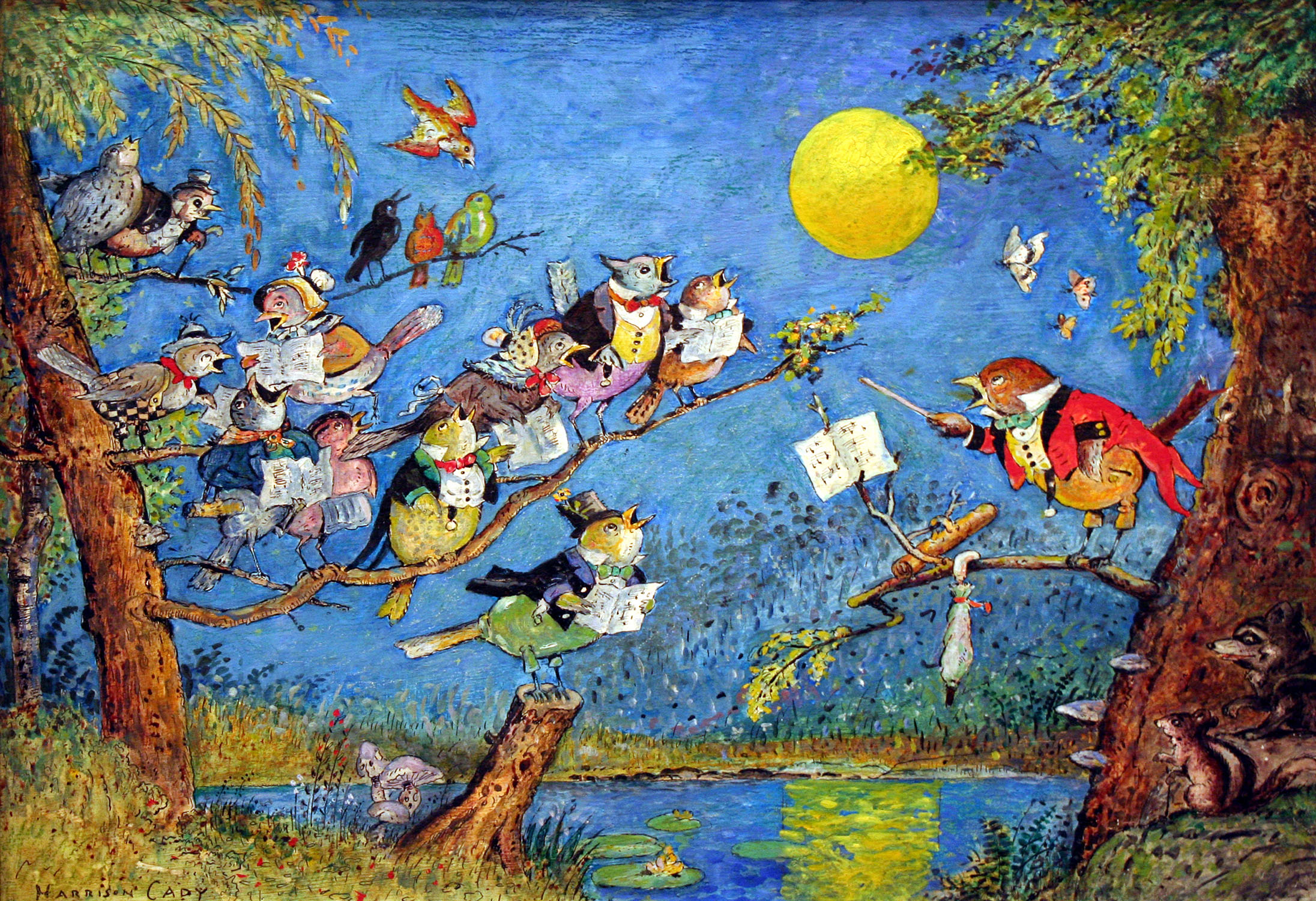
Harrison Cady (1877-1970)
Moonlight Sonata
1925, oil on masonite
15 1/2" x 22 1/4", signed lower left
Harrison Cady enjoyed a long and prolific career as an illustrator and cartoonist, achieving particular success with his Peter Rabbit comic strip for the New York Herald Tribune syndicate, which he wrote and illustrated for nearly three decades. Animals became the defining subjects of Cady’s work, appearing as expressive characters engaged in distinctly human activities and adventures.
In Moonlight Sonata, Cady brings this imaginative approach to a nocturnal woodland scene, where animals gather beneath the glow of a full moon. The brilliant moon provides both the visual and narrative focus of the composition, illuminating the central figures while the surrounding trees and foliage recede. Cady’s contrast of warm yellow moonlight against the cool blue forest creates a theatrical atmosphere, transforming the nighttime landscape into a stage for his animal characters.
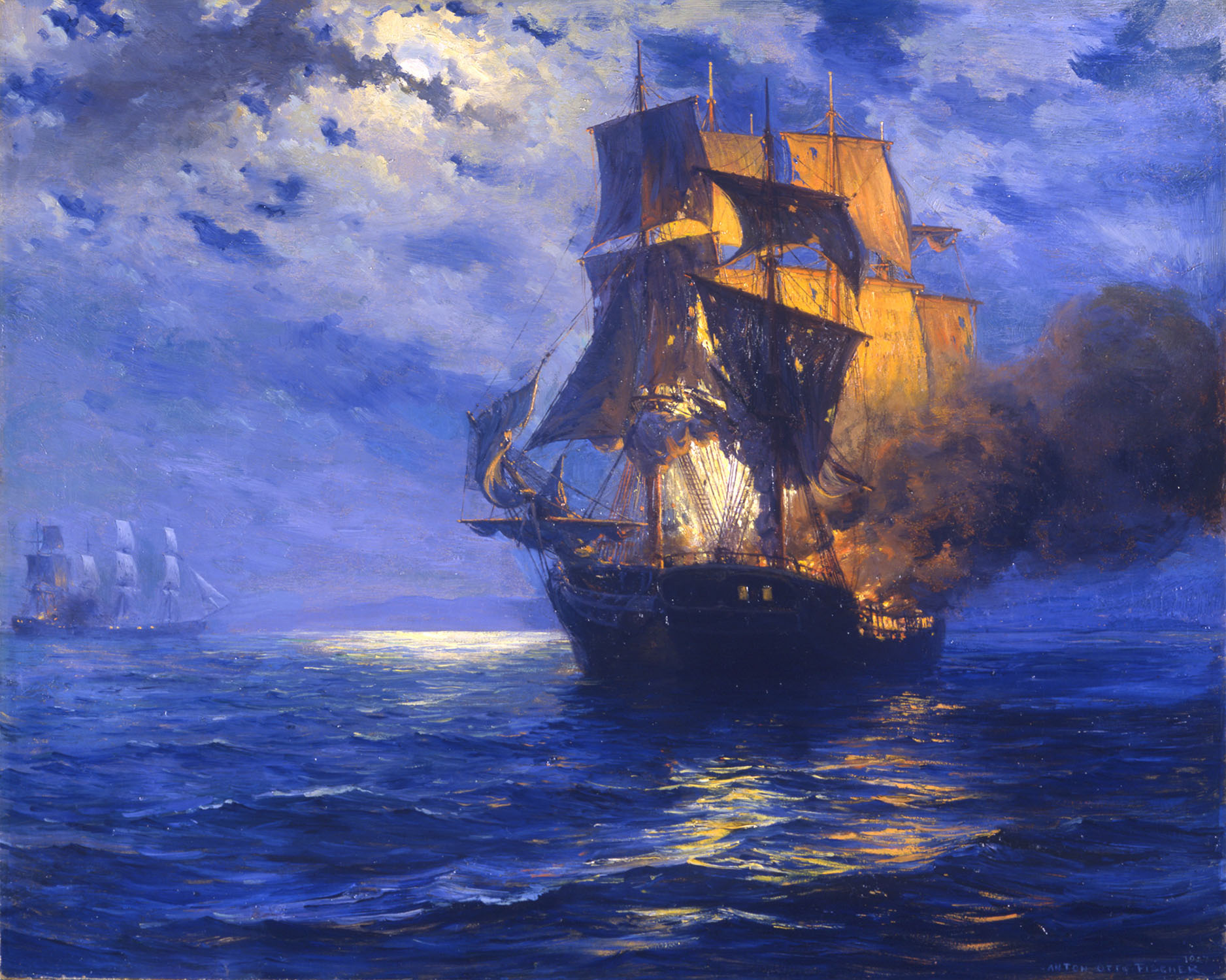
Anton Otto Fischer (1882-1962)
Battle Between Bonhomme Richard and the Serapis, September 23, 1779
1927, oil on canvas
24" x 30", signed lower right
Anton Otto Fischer was celebrated for his maritime illustrations, drawing upon his own experience at sea to create convincing images of ships, sailors, and life on the ocean. In this 1927 painting, Fischer depicts the famous Revolutionary War encounter between the Bonhomme Richard and the Serapis.
Fischer uses the nighttime setting to heighten the drama and uncertainty of the approaching confrontation. The moon breaks through the clouds and casts a pale light across the water, silhouetting the distant enemy ship against the horizon. By surrounding the vessel with darkness while selectively illuminating the sea and clouds, Fischer directs the viewer’s attention toward the approaching threat and gives the moonlight an essential role in establishing the tension of the scene.
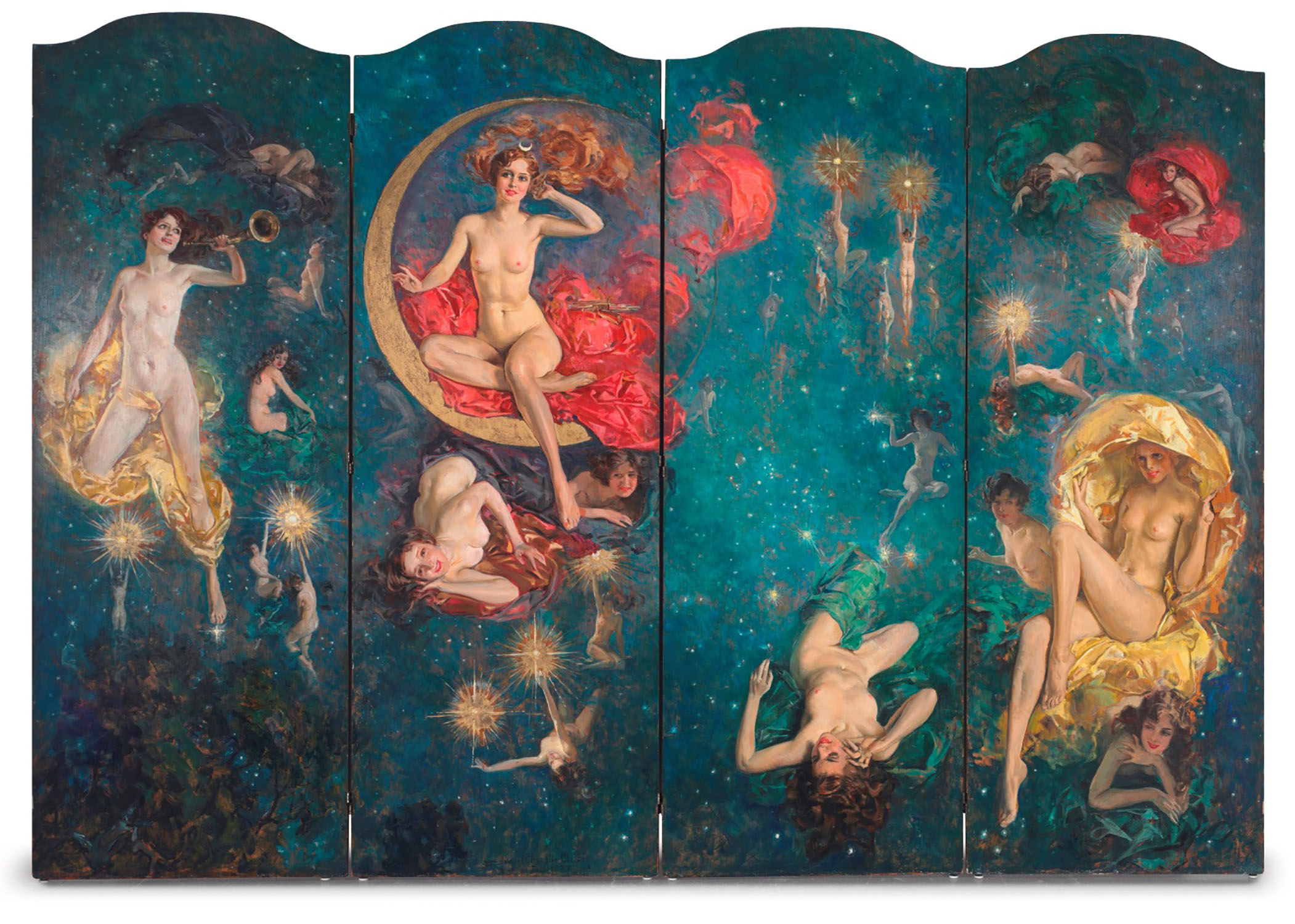
Howard Chandler Christy (1873-1952)
Goddess Diana in the Moonlight
1929, oil on canvas
84" x 120", signed and dated on second panel from left, lower right
Howard Chandler Christy created this monumental four-panel screen for his own home and studio at New York City’s Café des Artistes. Christy painted a number of decorative screens to separate the living area from the working studio, embellishing them with the idealized female figures and nudes for which he became renowned. In Goddess Diana in the Moonlight, celestial figures float across the four panels against a sweeping nighttime sky.
Here, night provides both setting and atmosphere. Christy contrasts the luminous bodies of the figures with the deep blues of the surrounding sky, allowing them to appear almost illuminated from within. The moon and clouds further dissolve the boundary between figure and landscape, creating an ethereal composition in which the darkness of the night becomes an essential backdrop for Christy’s celestial vision.
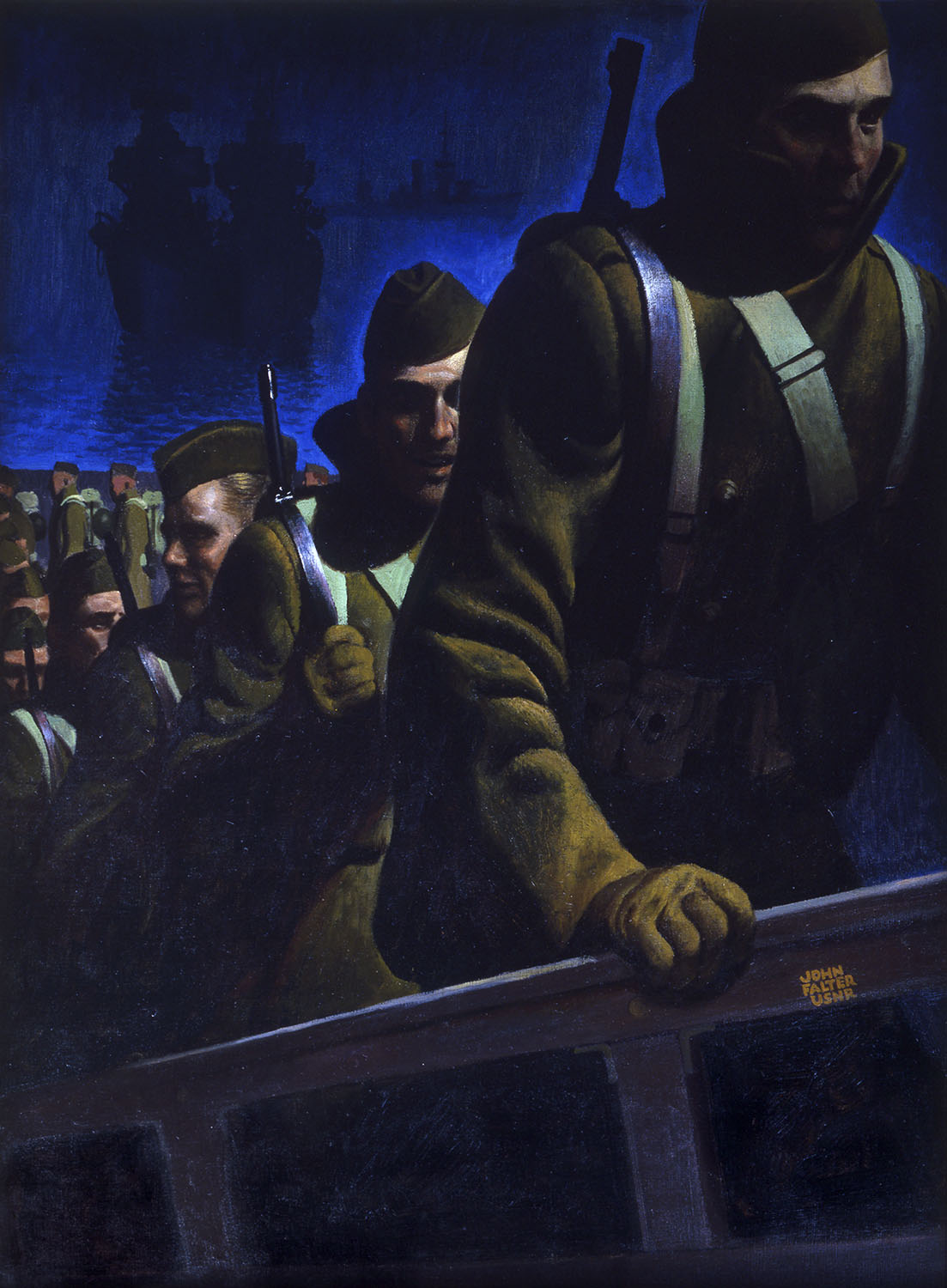
John Falter 91910-1982)
Put Them Across! The Toughest Job is Still Ahead!
1943, oil on canvas
32" x 25", signed lower right
Official Navy Poster, U.S. Government Printing Office, 1943
Created as an official U.S. Navy poster during World War II, John Falter’s Put Them Across! accompanied a message from Admiral Ernest J. King, Commander in Chief of the United States Fleet and Chief of Naval Operations, urging Americans on the home front to continue supporting the war effort: “Let’s waste no time...put them across with ships, planes and guns...stay on the job and deliver the goods—Gangway for Victory.”
Falter uses the nighttime setting to reinforce the gravity and urgency of the message. Sailors ascend the gangway in near darkness, their figures silhouetted against the intense lights of the ship ahead as they prepare to depart for war. The contrast between the darkened foreground and brilliant artificial light focuses attention on their purposeful movement toward the vessel, while the surrounding darkness conveys the uncertainty of what awaits them at sea.
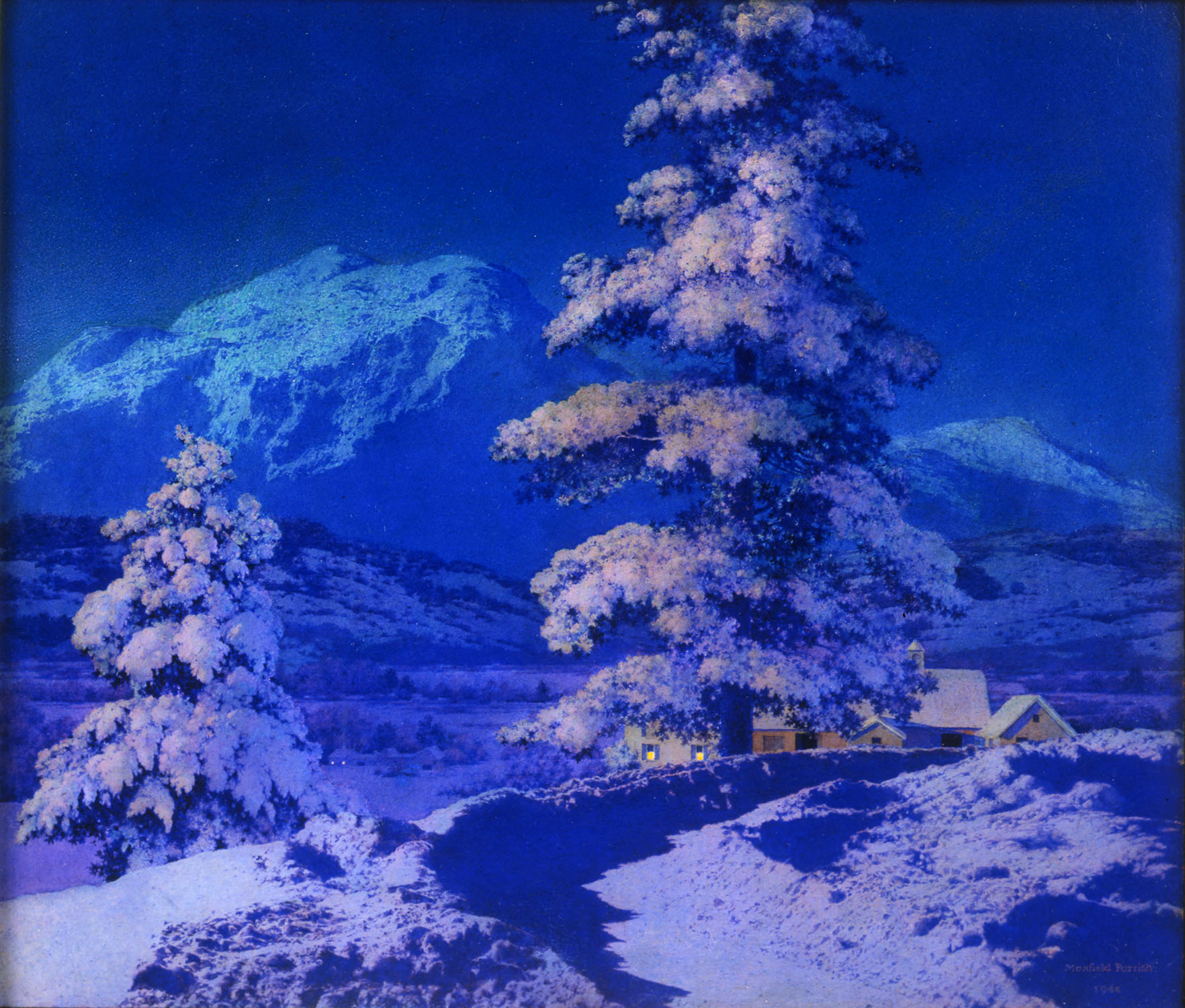
Maxfield Parrish (1870-1966)
Moonlight - Deep Snow
1944, oil on panel
13 1/2" x 15 1/2", signed lower right
Moonlight – Deep Snow is an important example of the winter landscapes that became among Maxfield Parrish’s most popular works. His landscapes created for Brown & Bigelow calendars proved so successful that the company eventually commissioned two landscapes each year—one specifically a winter scene and another of Parrish’s choosing. Painted in 1944, Moonlight – Deep Snow exemplifies the luminous, idealized approach that made these winterscapes so appealing.
Parrish transforms the winter night through the contrast of cool moonlight, deep shadows, and brilliant snow. The building was modeled after Parrish’s own studio, and the two illuminated windows offer a small but meaningful point of warmth within the otherwise cold, moonlit landscape. Parrish included the lights as a personal reference to himself working late into the night, quietly introducing the artist’s presence into a landscape otherwise defined by stillness and solitude.
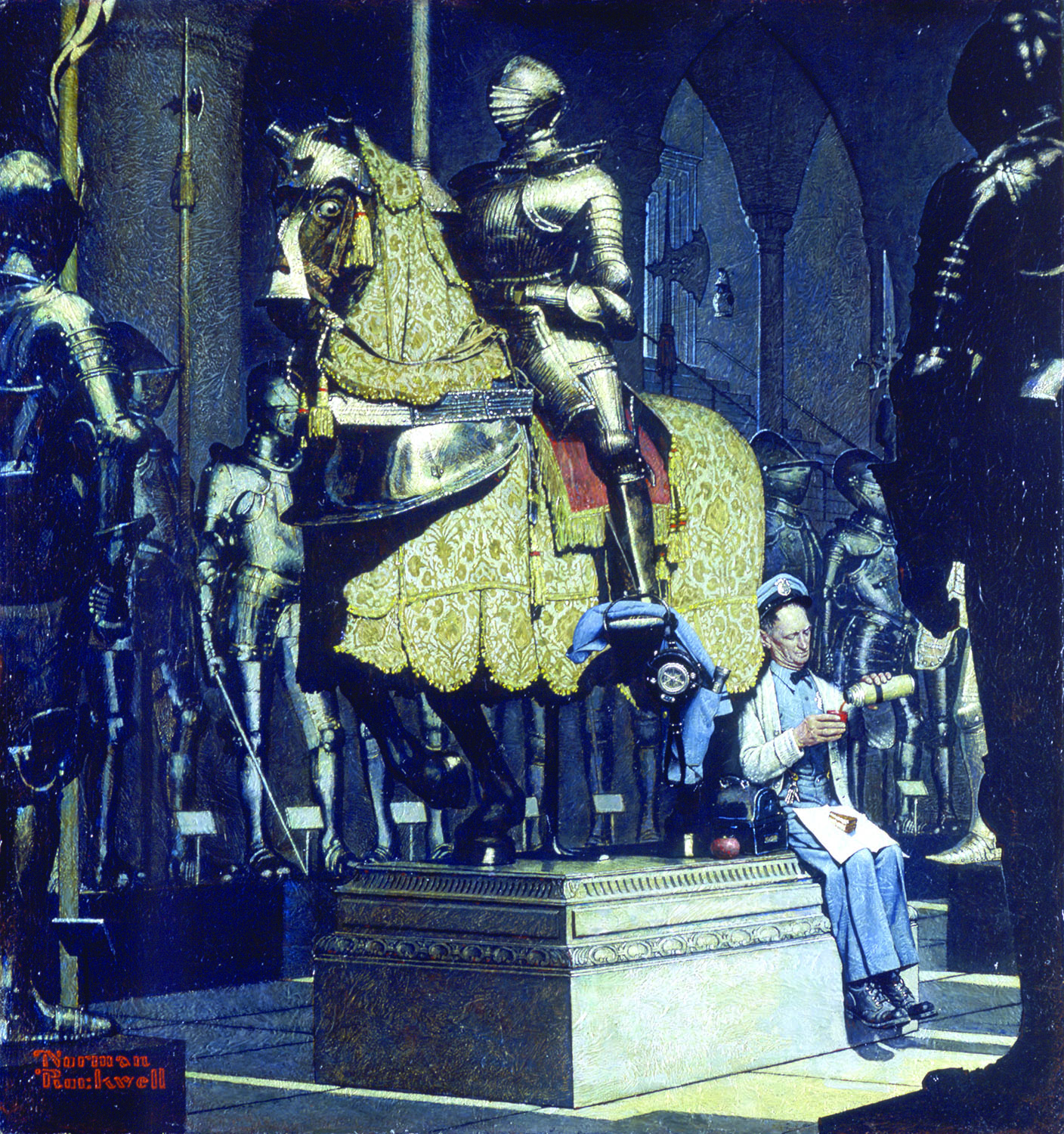
Norman Rockwell (1894-1978)
Lunch Break with Knight
1962, oil on canvas
34" x 32", signed lower left
Saturday Evening Post, November 3, 1962 cover
Norman Rockwell conceived Lunch Break with Knight after visiting the Higgins Armory Museum in Worcester, Massachusetts, home to an extensive collection of arms and armor. Created for the November 3, 1962 cover of The Saturday Evening Post, the painting playfully disrupts the austerity of a Medieval Great Hall. A museum guard relaxes casually on a pedestal, having turned the suit of armor beside him into an impromptu coat rack, while the armored horse appears to direct an impossibly animated and disapproving stare toward him.
Rockwell uses nighttime illumination to heighten both the composition and its humor. Moonlight streams through the tall, peaked Gothic windows, cutting through the shadowed hall and falling like a theatrical spotlight upon the unsuspecting guard. The contrast isolates him within the vast interior and draws immediate attention to his breach of museum decorum, while the surrounding darkness allows the imposing armor—and its silent judgment—to emerge dramatically from the shadows.
Socializing at Night
As artificial illumination extended the hours of the day, nighttime became an increasingly important setting for American social life. Dances, parties, dinners, theatergoing, and evenings spent with friends offered illustrators a rich range of subjects through which to depict contemporary manners and relationships. In these works, light does more than establish the time of day: it creates intimate spaces within the darkness, directs attention toward social interactions, and contributes to the sense of spectacle and occasion associated with a night out.
Night also allowed illustrators to portray a world distinct from the routines of daytime. Through elegant interiors, crowded dance floors, romantic encounters, and informal gatherings, these artists captured the anticipation, humor, glamour, and occasional awkwardness of American social life after dark.
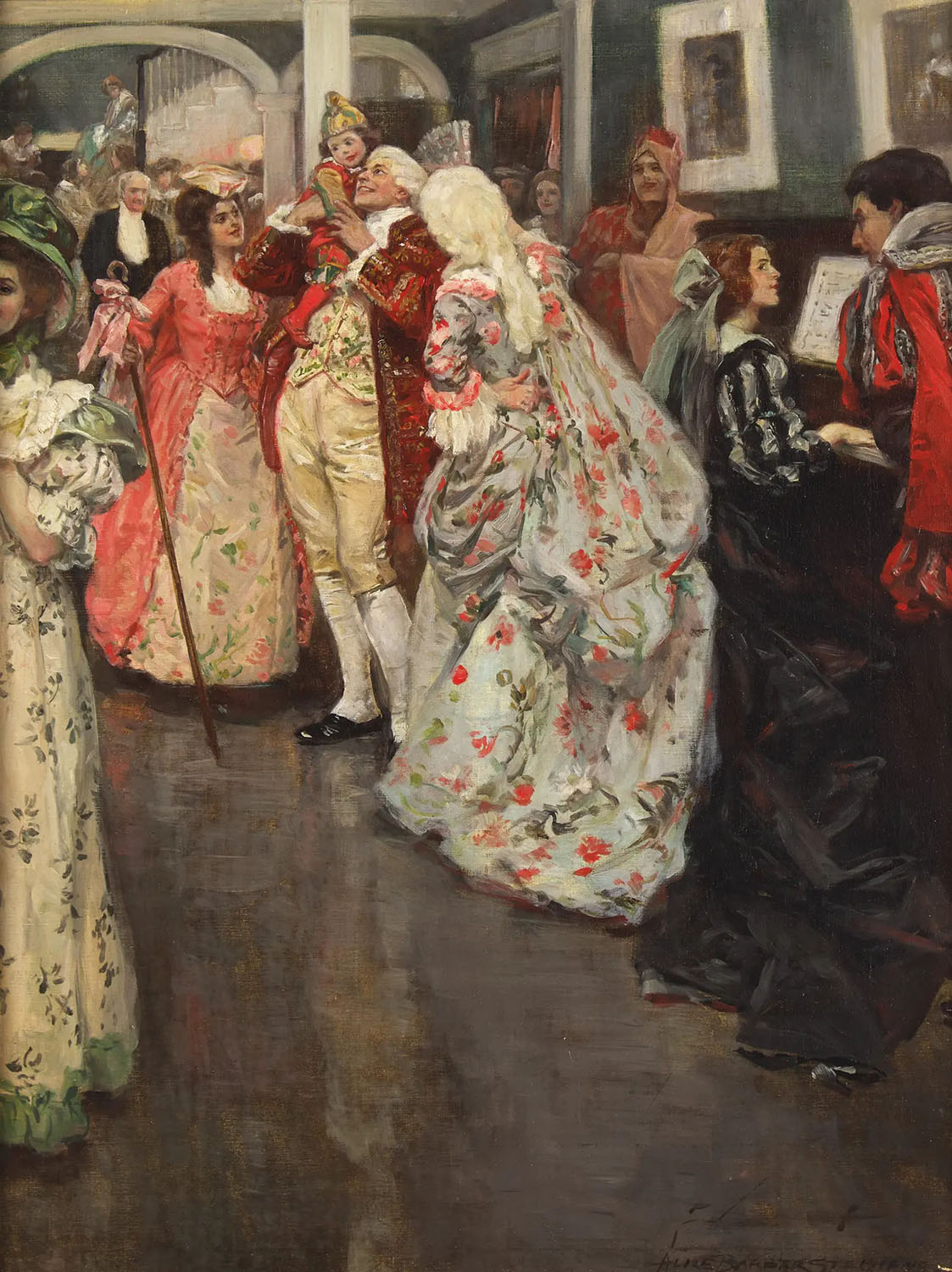
Alice Barber Stephens (1858-1932)
Fancy Dress Ball
c. 1890, oil on canvas
19 5/8" x 15 1/8", signed lower right
Alice Barber Stephens captures the excitement and spectacle of an elegant costume party in a Gilded Age home. Amid the formally dressed guests and lively celebration, a young child has escaped the watchful eye of a nanny to investigate the festivities, introducing a playful narrative into the sophisticated social scene.
The warmly illuminated interior emphasizes the nighttime setting and the sense of occasion. Stephens uses the crowded composition to convey the energy of the gathering, while the child provides a more intimate story within the larger celebration. The scene reflects the social rituals of an evening spent entertaining at home, while capturing the irresistible excitement of a party observed through a child’s eyes.
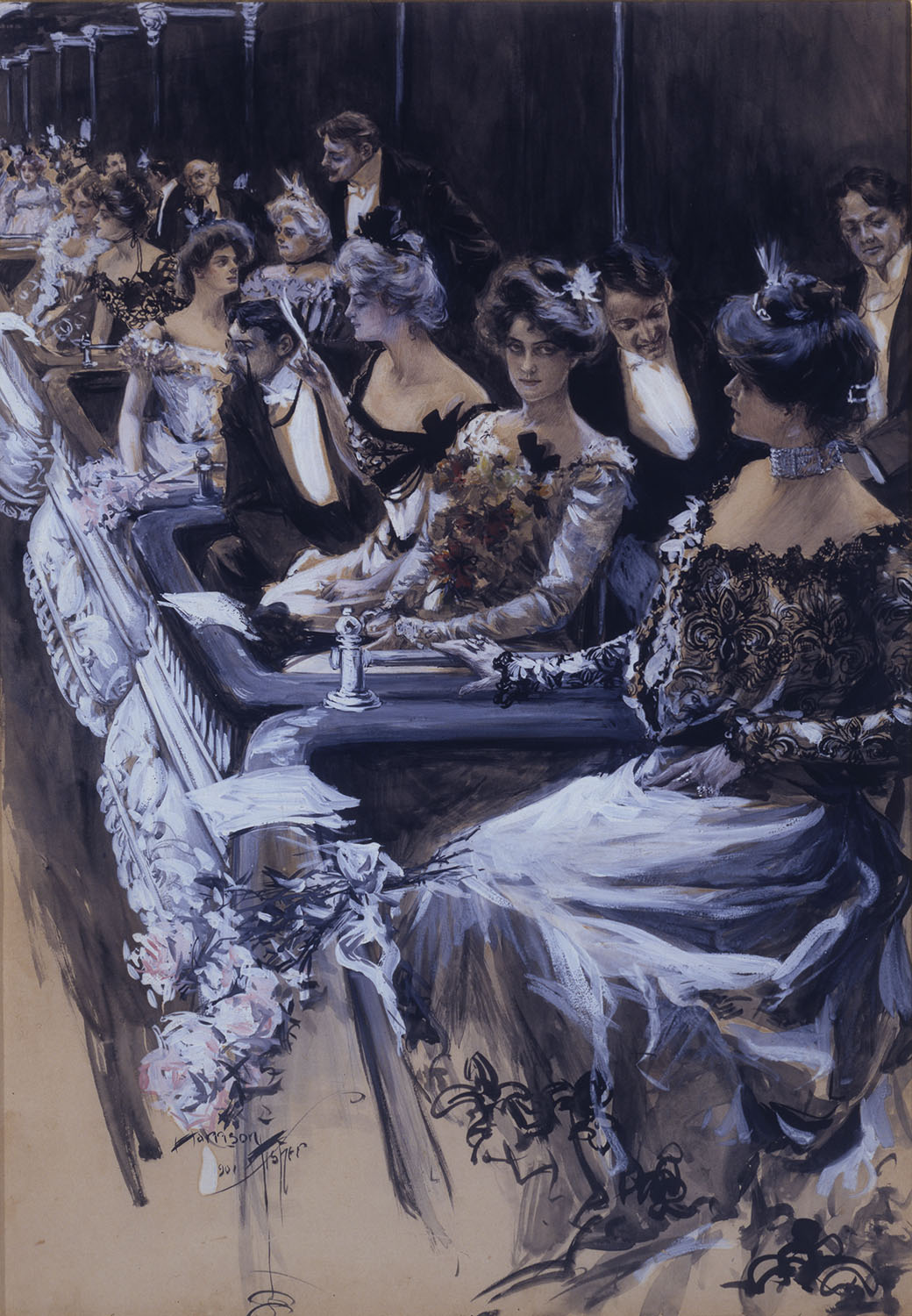
Harrison Fisher (1875-1934)
At the Opera
1901, watercolor on board
27 1/4" x 19 1/2", signed and dated lower left
Harrison Fisher made his name in American illustration through his depictions of beautiful, fashionable women. His celebrated “Fisher Girl,” and particularly his vision of the “American Girl,” helped define an ideal of feminine beauty during the first quarter of the twentieth century—elegant and refined, yet also independent and self-assured. Fisher’s work appeared on more than eighty covers of The Saturday Evening Post, and he created covers for Cosmopolitan from 1913 until his death in 1934.
In At the Opera, Fisher captures the social theater surrounding a Gilded Age evening at the opera. Rather than focusing on the performance, he directs our attention toward a row of elite theater boxes and the elegantly dressed women observing one another across the space. His carefully chosen viewpoint emphasizes that the audience itself could be part of the spectacle, transforming a night at the opera into an occasion for fashion, observation, and social display.
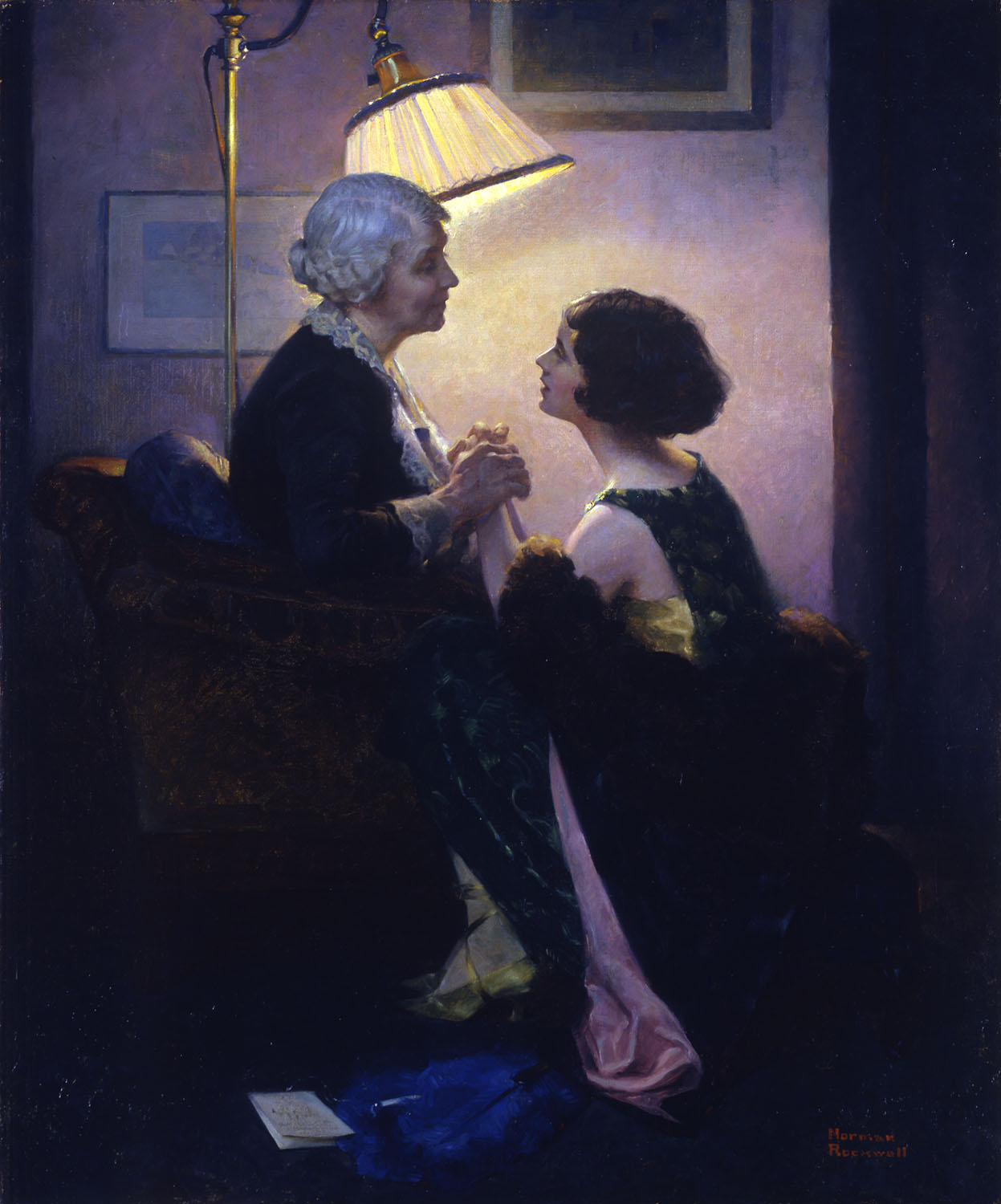
Norman Rockwell (1894-1978)
The Party After the Party
1922, oil on canvas
30" x 26", signed lower right
Edison Mazda advertisement, 1922
Norman Rockwell created The Party After the Party for an Edison Mazda light bulb advertisement in 1922. The company made illumination central to its advertising, using illustrations featuring electric light in widely distributed calendars and promotional materials. Here, Rockwell depicts the quieter aftermath of an evening out: a young girl enthusiastically recounts the events of a party to an older woman who listens attentively.
A single lamp provides the scene’s soft, warm illumination, surrounding the two figures with an intimate pool of light against the darker room. Rockwell arranges the figures along a strong diagonal, emphasizing their close interaction while simultaneously directing the viewer’s eye toward the glowing lamp. Light thus functions as both the subject of the advertisement and the organizing element of the composition, transforming a single electric bulb into the source of warmth and intimacy within the nighttime scene.
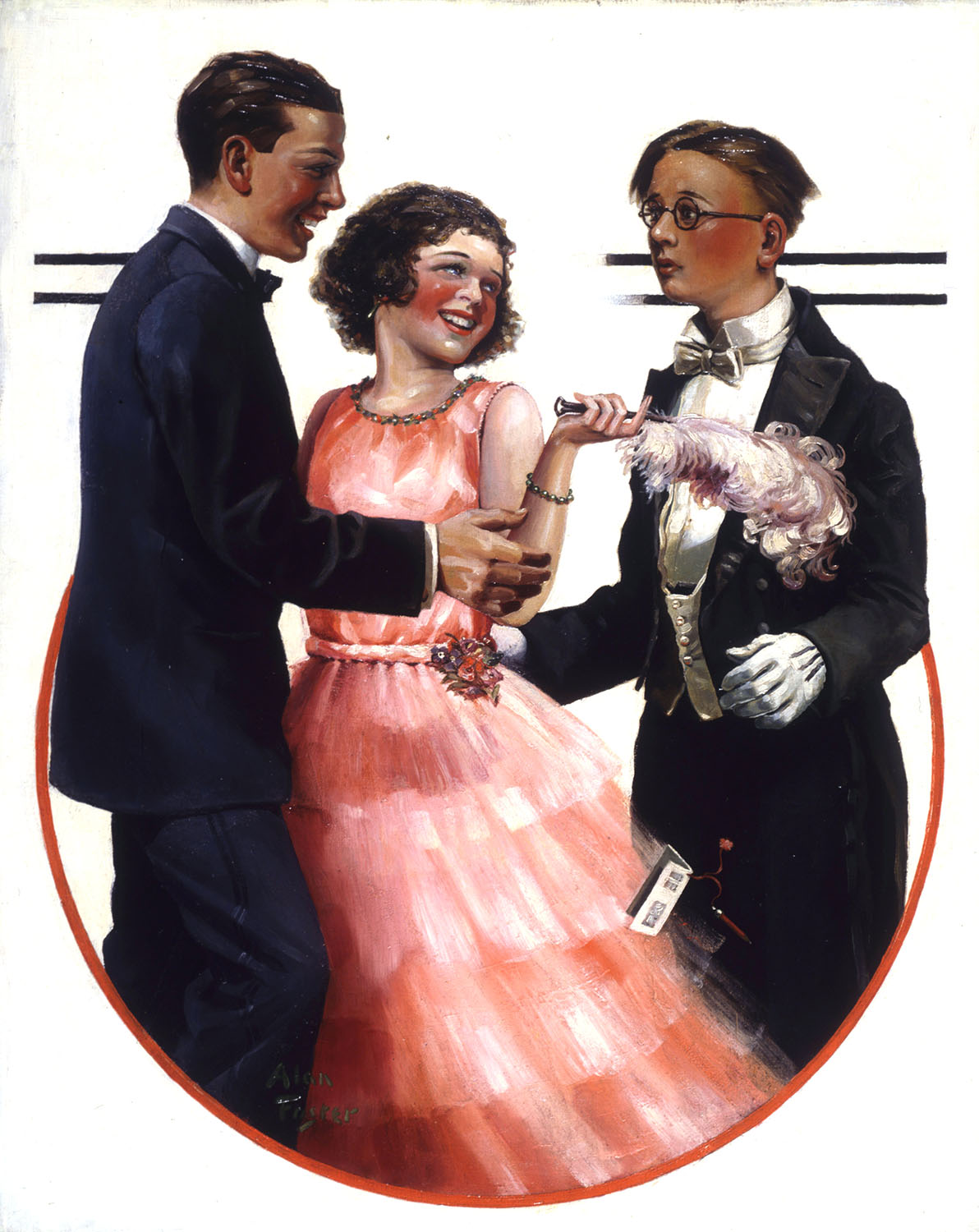
Alan Stephens Foster (1892-1969)
The Dance Card
1923, oil on canvas
26" x 21", signed lower left
Saturday Evening Post, September 15, 1923 cover
Created for the September 15, 1923 cover of The Saturday Evening Post, Alan Stephens Foster’s The Dance Card humorously captures the social conventions of a formal evening dance. A young man approaches a dancing couple, expecting his turn with the young woman according to her dance card. Rather than honor the arrangement, she deliberately drops the card and continues dancing with her current partner.
Foster turns this breach of social etiquette into a playful narrative. The couple laughs together as they dance away, while the rejected young man looks on in shock. Through gesture, expression, and the interaction of the three figures, Foster captures both the rituals of 1920s social life and the humor that arises when those conventions are ignored.
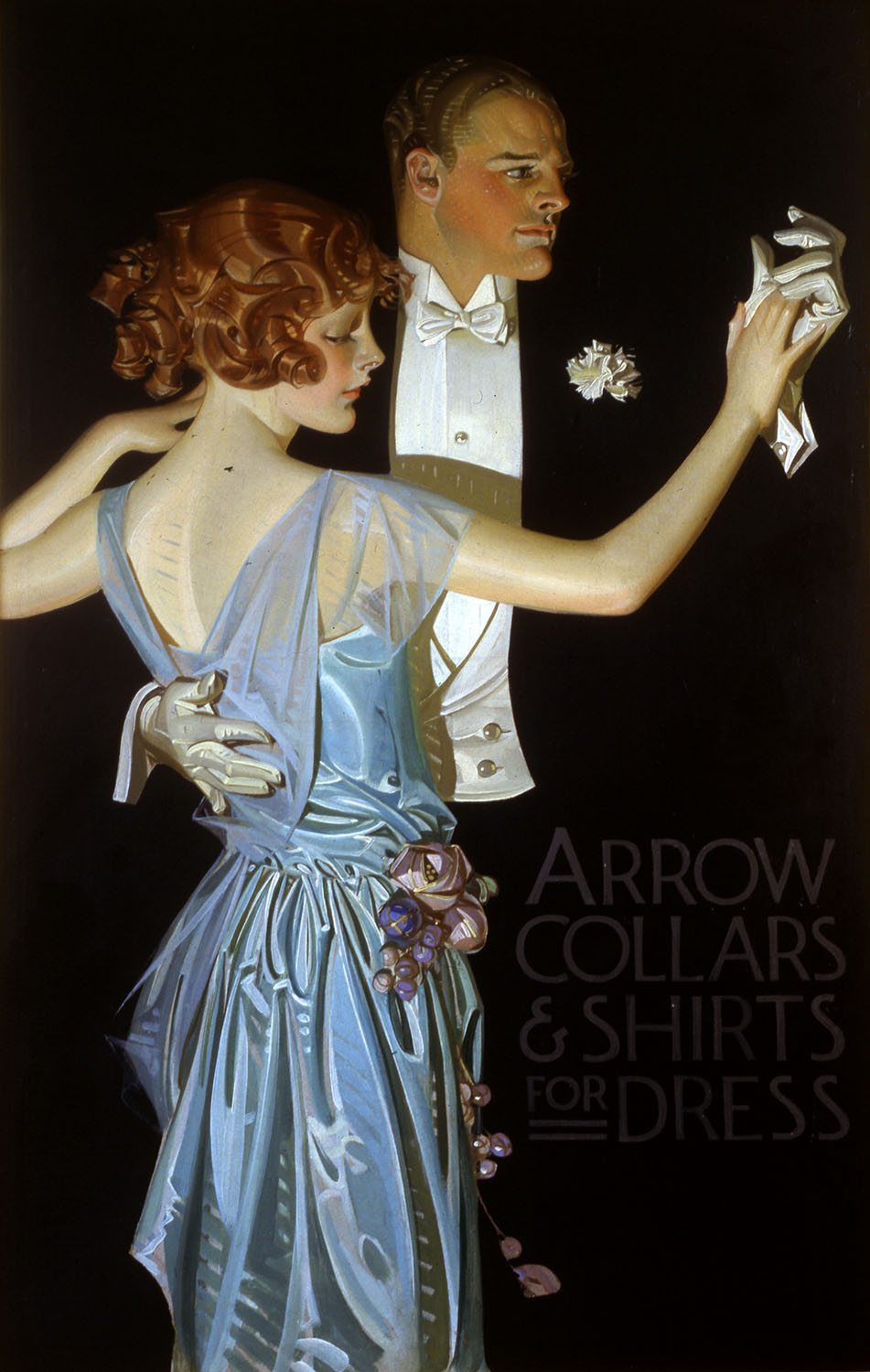
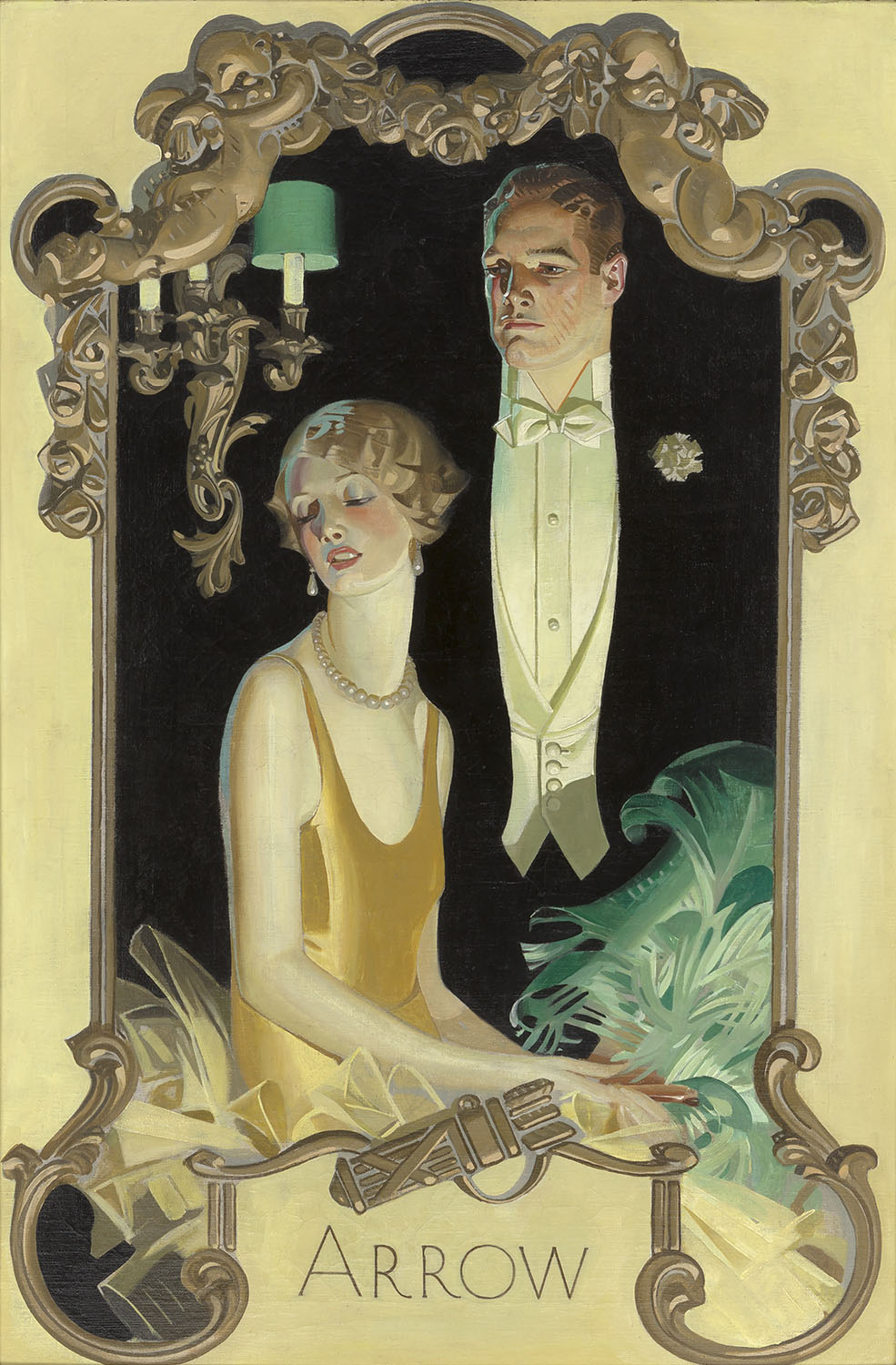
J.C. Leyendecker (1874-1951)
Man and Woman Dancing
1923, oil on canvas
39 3/4" x 26 1/8"
Arrow Collar advertisement
Man with Seated Lady
1929, oil on canvas
51" x 33"
Arrow Collar advertisement, printed in Saturday Evening Post, November 16, 1929, pg. 244
These two large-scale paintings represent the height of J.C. Leyendecker’s fashion advertising for Arrow Collar during the 1920s. In both, Leyendecker employs a dramatic “blackout” technique, allowing the men’s dark evening jackets to merge seamlessly into the black background. Against this darkness, the crisp white shirtfronts and collars emerge with striking clarity, focusing attention precisely on the products being advertised.
Leyendecker sold more than a collar; he created an aspirational image of the modern American man. Elegantly dressed and accompanied by beautiful women in sophisticated evening settings, his Arrow Collar men embody confidence, refinement, and social success. The advertising message is implicit but unmistakable: men were invited to imagine themselves as the enviable figure depicted, while women were encouraged to see him as the desirable ideal.
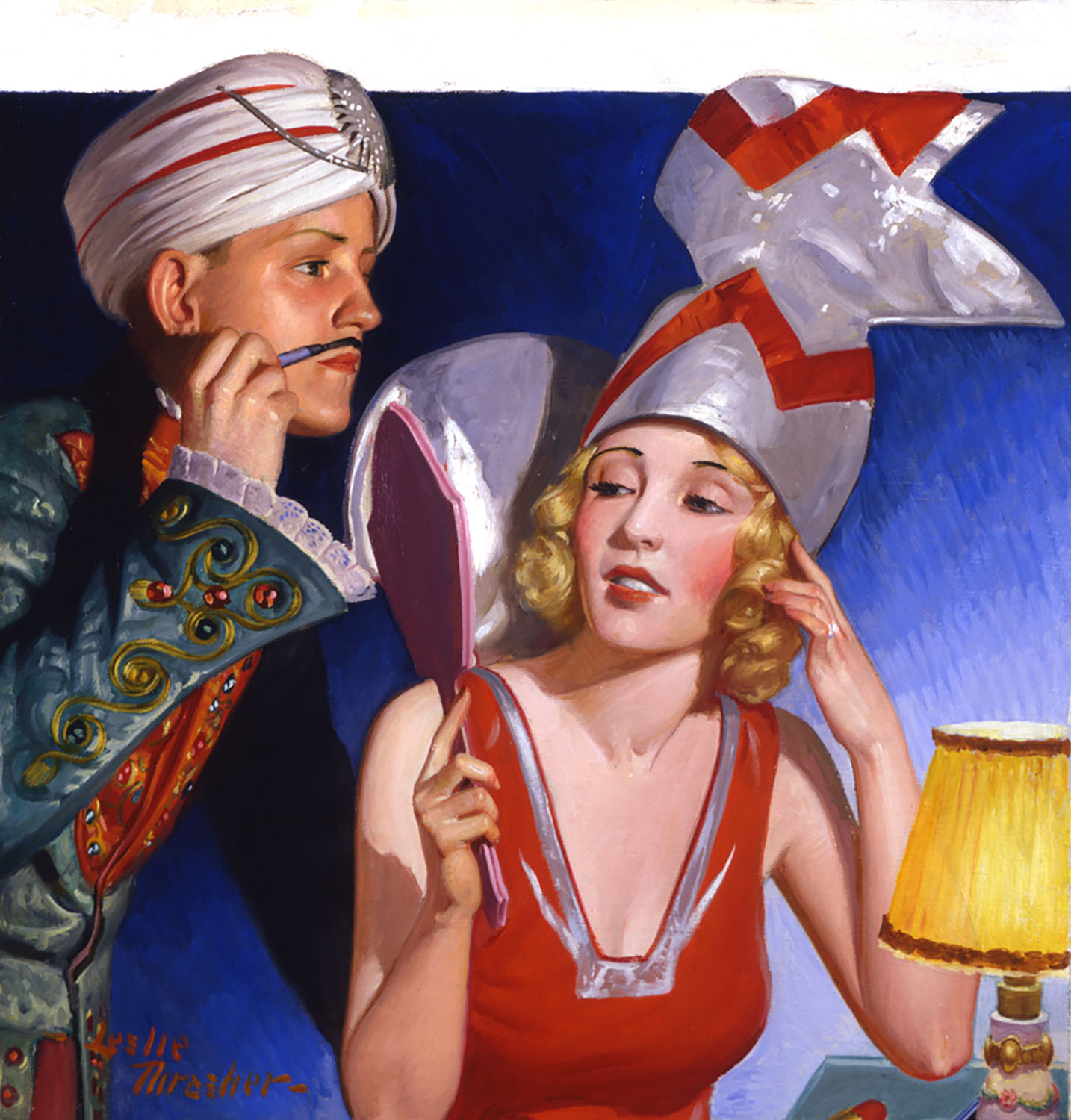
Leslie Thrasher (1889-1936)
The Costume Ball
1932, oil on canvas
18" x 18", signed lower left
Liberty Magazine, February 20, 1932 cover
Created for the February 20, 1932 cover of Liberty magazine, Leslie Thrasher’s The Costume Ball was part of his popular ongoing “Love o’ Lil” series. The series followed the romantic adventures and misadventures of a recurring young couple, allowing Thrasher to develop humorous narratives around courtship and contemporary social life.
Here, Thrasher places his familiar characters amid the festivities of a costume ball, using elaborate dress and exaggerated expressions to heighten the comedy of the scene. The masquerade setting offered an especially playful variation on the rituals of an evening out, where costumes and assumed identities could temporarily disrupt the usual conventions of courtship and social behavior.
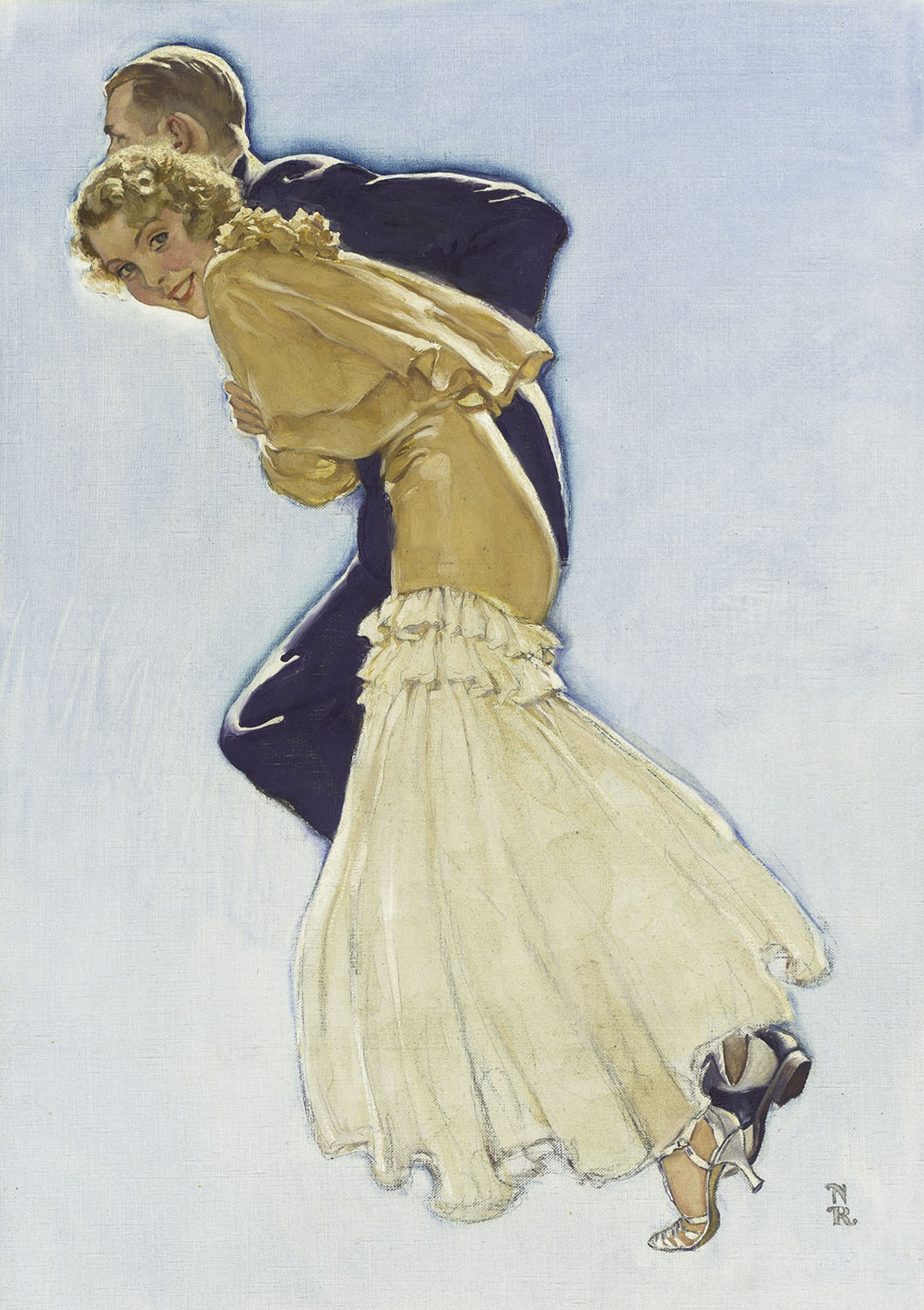
Norman Rockwell (1894-1978)
When Youth is Beautiful
1933, oil on canvas
32" x 25", initialed lower right
"When Youth is Beautiful," by Booth Tarkington, Women's Home Companion, November 1933, pg. 28
Norman Rockwell created this illustration for Booth Tarkington’s “When Youth is Beautiful,” published in the November 1933 issue of Women’s Home Companion. The accompanying passage captures the hurried excitement of a young woman heading out for the evening: “She cried out, ‘He’s-go’-take-me-out-don’t-sit-up-g’night-darl’n’-Miss-Adelaide!’”
Rockwell transforms this brief moment into a study of youthful anticipation and the social ritual of going out at night. The young woman, dressed for the evening and poised to leave, embodies the excitement and independence associated with a night away from home. Rather than depicting the evening’s destination, Rockwell focuses on the moment just before departure, allowing the viewer to share in the expectation of what the night ahead might hold.
John Falter (1910-1982)
Evening Picnic
1949, oil on canvas
34" x 26 1/8", signed lower left
Saturday Evening Post, June 4, 1949 cover
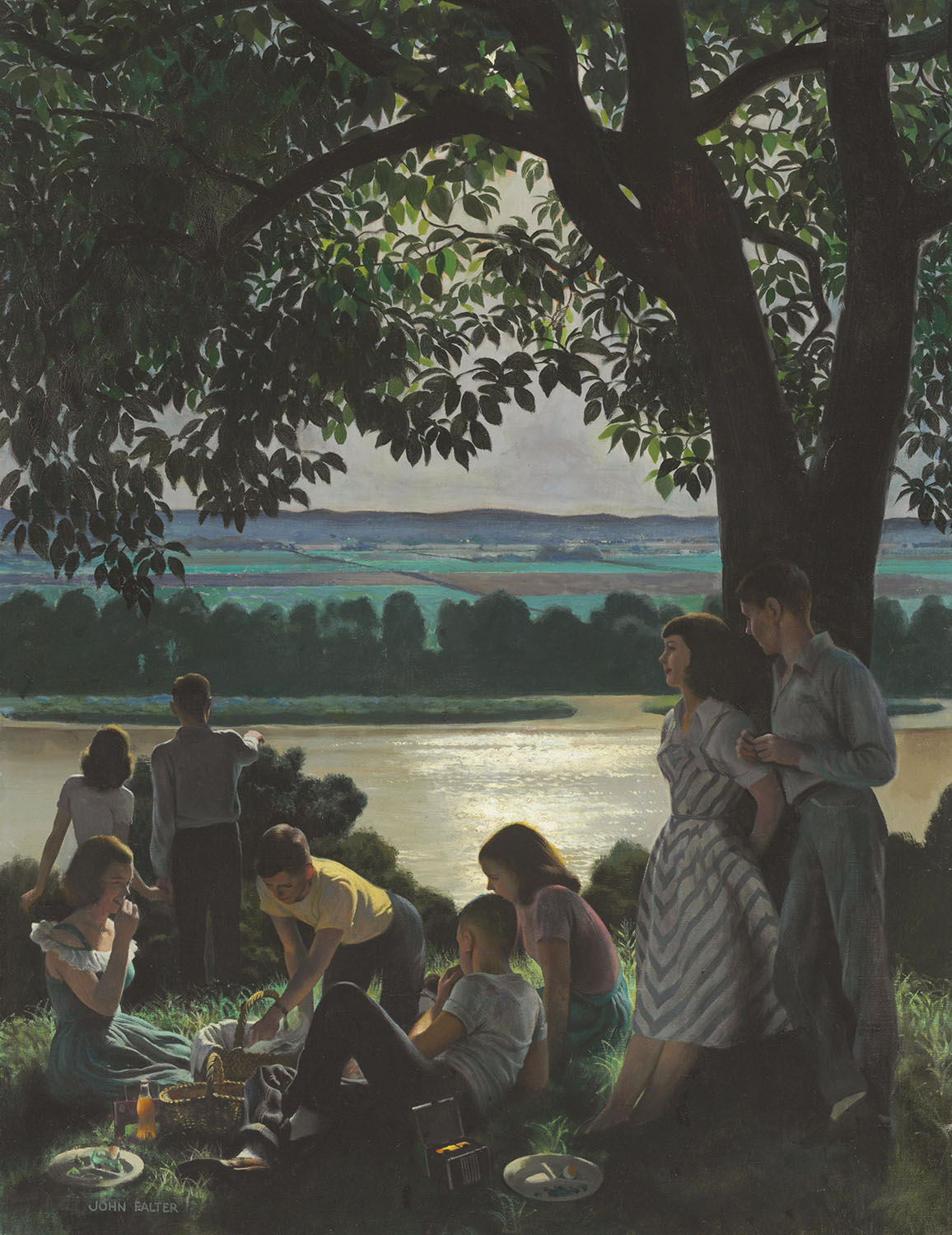
Painted for the June 4, 1949 cover of The Saturday Evening Post, Evening Picnic was inspired by a visit to John Falter’s hometown of Atchison, Kansas. Falter persuaded local high school students to stage a picnic along the Missouri River as models for the scene. He ultimately transformed the gathering into an idyllic moonlit evening, capturing young people enjoying food, conversation, and one another’s company against the expansive landscape.
Falter’s use of moonlight elevates the everyday gathering into a nostalgic vision of postwar American life. Soft illumination spreads across the countryside while the Missouri River shimmers in the distance, creating an atmosphere of warmth and tranquility. More idealized than documentary, the scene celebrates youthful friendship, leisure, and the simple pleasure of a summer evening spent outdoors.
George Hughes (1907-1990)
The Critics Look On
1950, oil on panel
28 1/2" x 28 1/4", signed lower left
Saturday Evening Post, August 5, 1950 cover
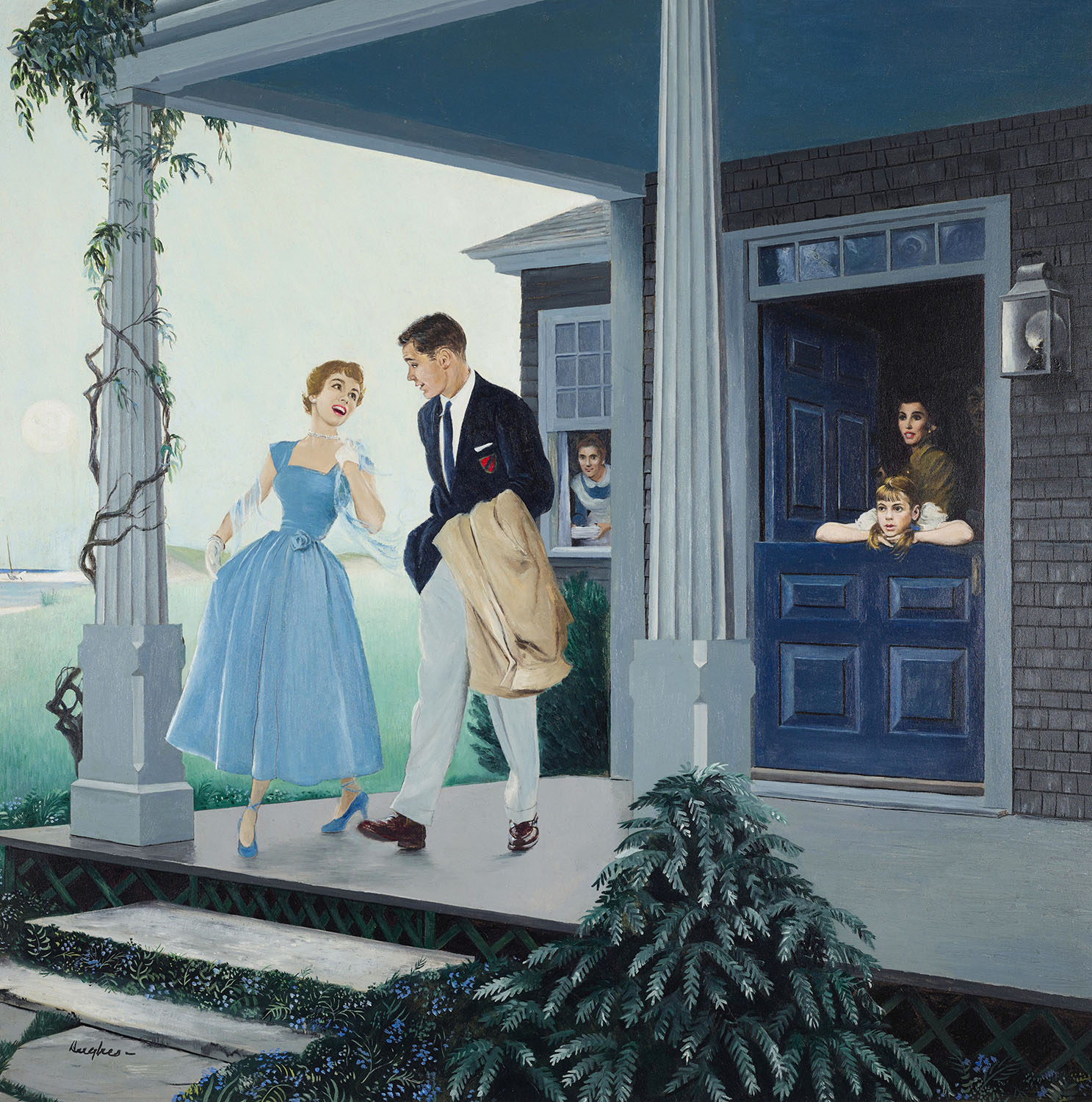
Created for the August 5, 1950 cover of The Saturday Evening Post, George Hughes’s The Critics Look On captures a familiar moment of mid-century American life: a young woman stepping out for an evening with her smartly dressed date. From windows and doorways, younger siblings eagerly observe the couple, their curious and amused expressions making them the affectionate “critics” of the title.
Hughes finds both humor and significance in this small domestic drama. The young woman stands at the threshold between the family home and a growing social independence, while the rising moon visible in the distance establishes the beginning of the evening ahead. Framed against the nighttime sky, the moon subtly reinforces the sense of anticipation and transition as the couple departs and the younger children remain behind to watch.
John Held Jr. (1889-1958)
Couple Kissing in a Car
1952, ink wash and watercolor on paper
29" x 23", signed lower right
Held's Angels, by Frank B. Gilbreth, Thomas Y. Crowell Co., 1952, pg. 128
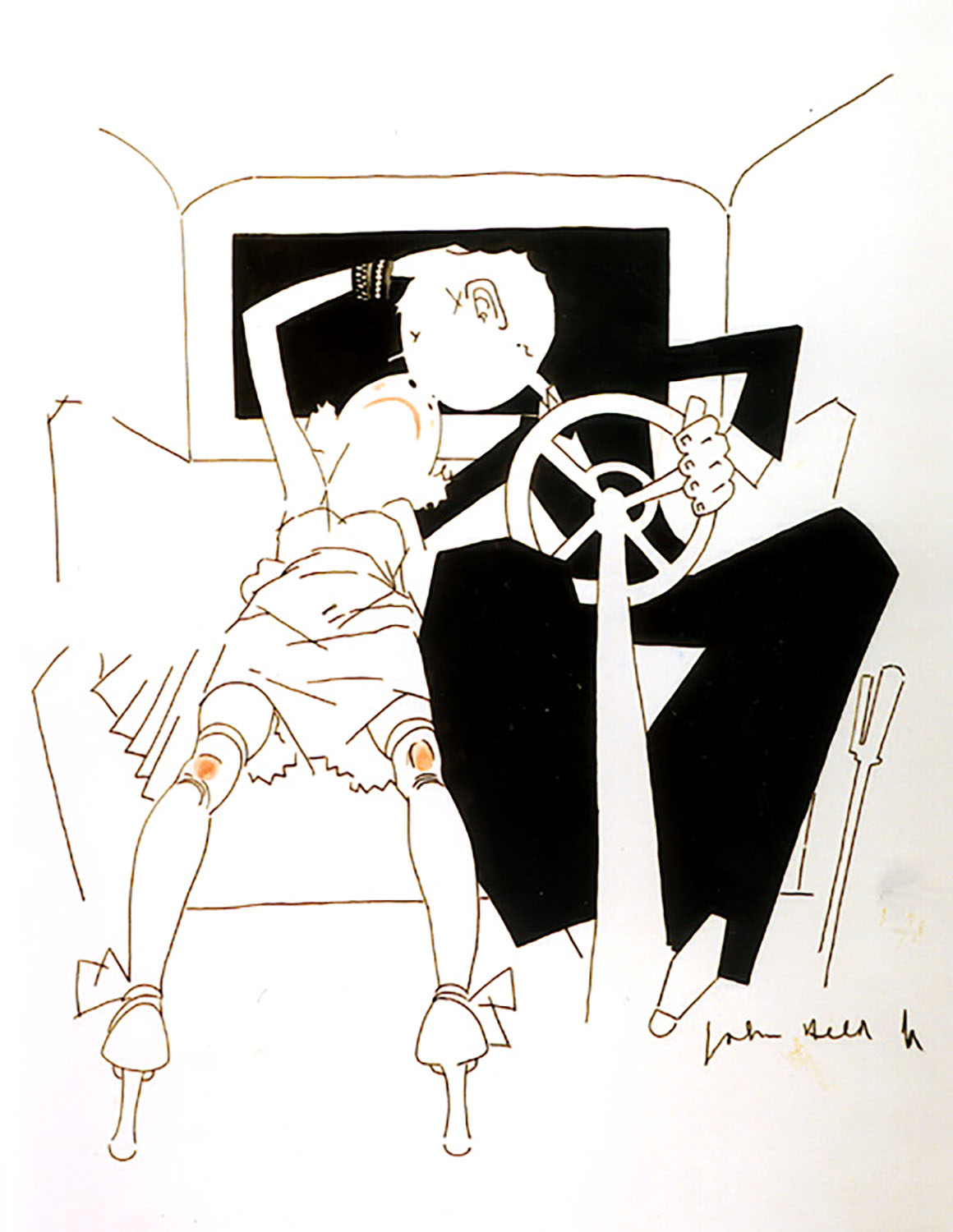
John Held Jr. created Couple Kissing in a Car for Held’s Angels, a humorous 1952 book featuring more than one hundred of his cartoons alongside a nostalgic story recalling college life and the Jazz Age of the Roaring Twenties. Held became closely associated with the youthful social culture of the era, capturing its fashions, courtship, automobiles, and changing attitudes with wit and playful exaggeration.
Here, a couple embraces inside a parked automobile, turning the car into a private space for romance after dark. The subject reflects the automobile’s important role in the social lives of young Americans, providing new freedom and independence away from the watchful eyes of home. Held treats the nighttime encounter with characteristic humor, capturing another aspect of the rituals—and occasional improprieties—of going out at night.
Amos Sewell (1901-1983)
Family Scene (Formal Hug)
1957, oil on board
36" x 28", signed lower right
Saturday Evening Post, February 15, 1958 cover
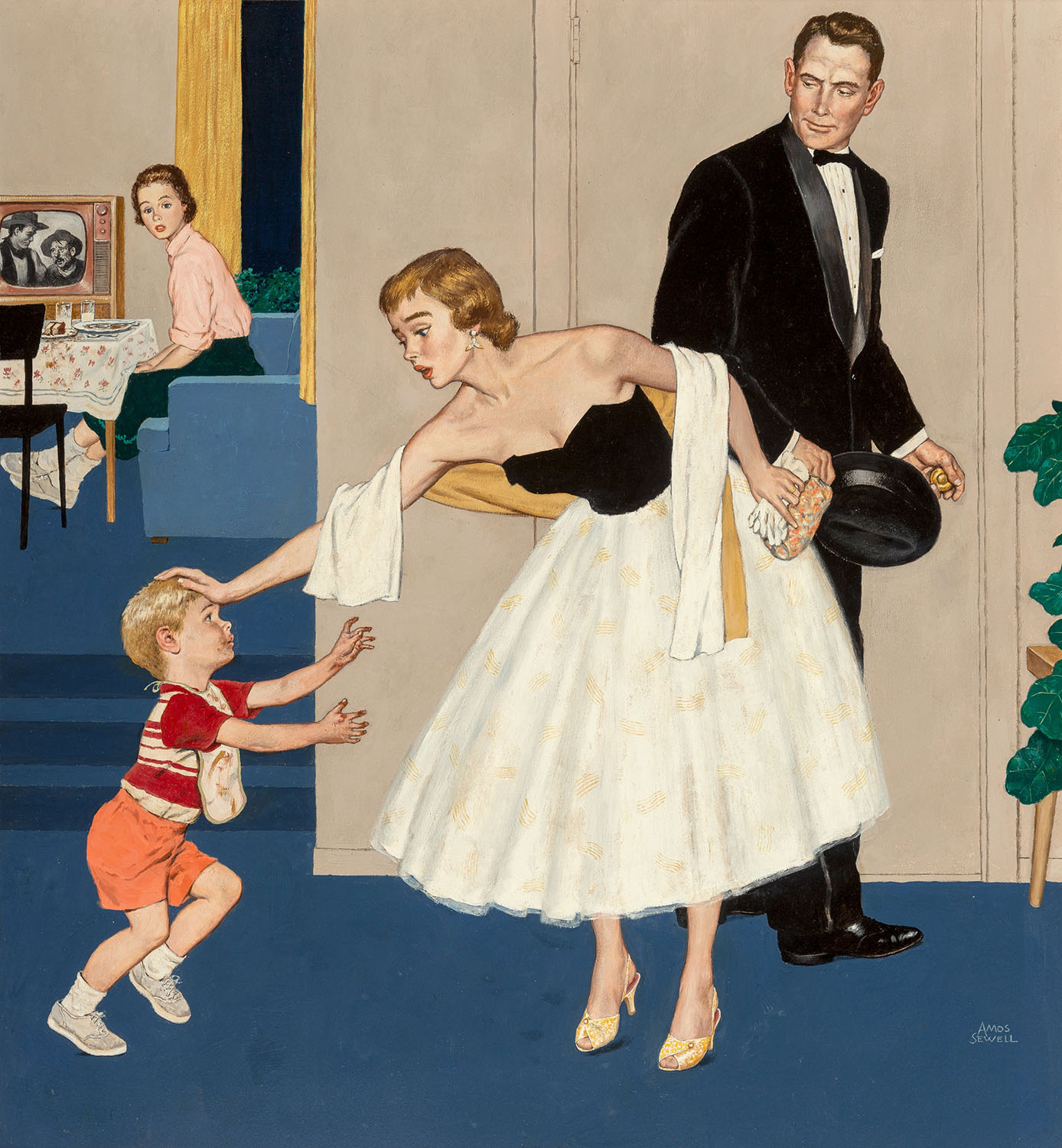
Created for the February 15, 1958 cover of The Saturday Evening Post, Amos Sewell’s Family Scene humorously captures the complications of a married couple attempting to leave home for a formal evening out. Their young son has been settled with his babysitter at a folding table in front of the television, watching a cowboy program, but decides that his mother cannot leave without one final hug and kiss.
The problem is immediately apparent: the boy runs toward his elegantly dressed mother with chocolate covering his fingers, face, and bib. Knowing exactly what awaits her pristine white skirt, she keeps him at a distance with one outstretched arm. Sewell turns a familiar family predicament into a comic scene, contrasting the parents’ aspirations for a sophisticated night out with the messy realities of leaving a young child at home.
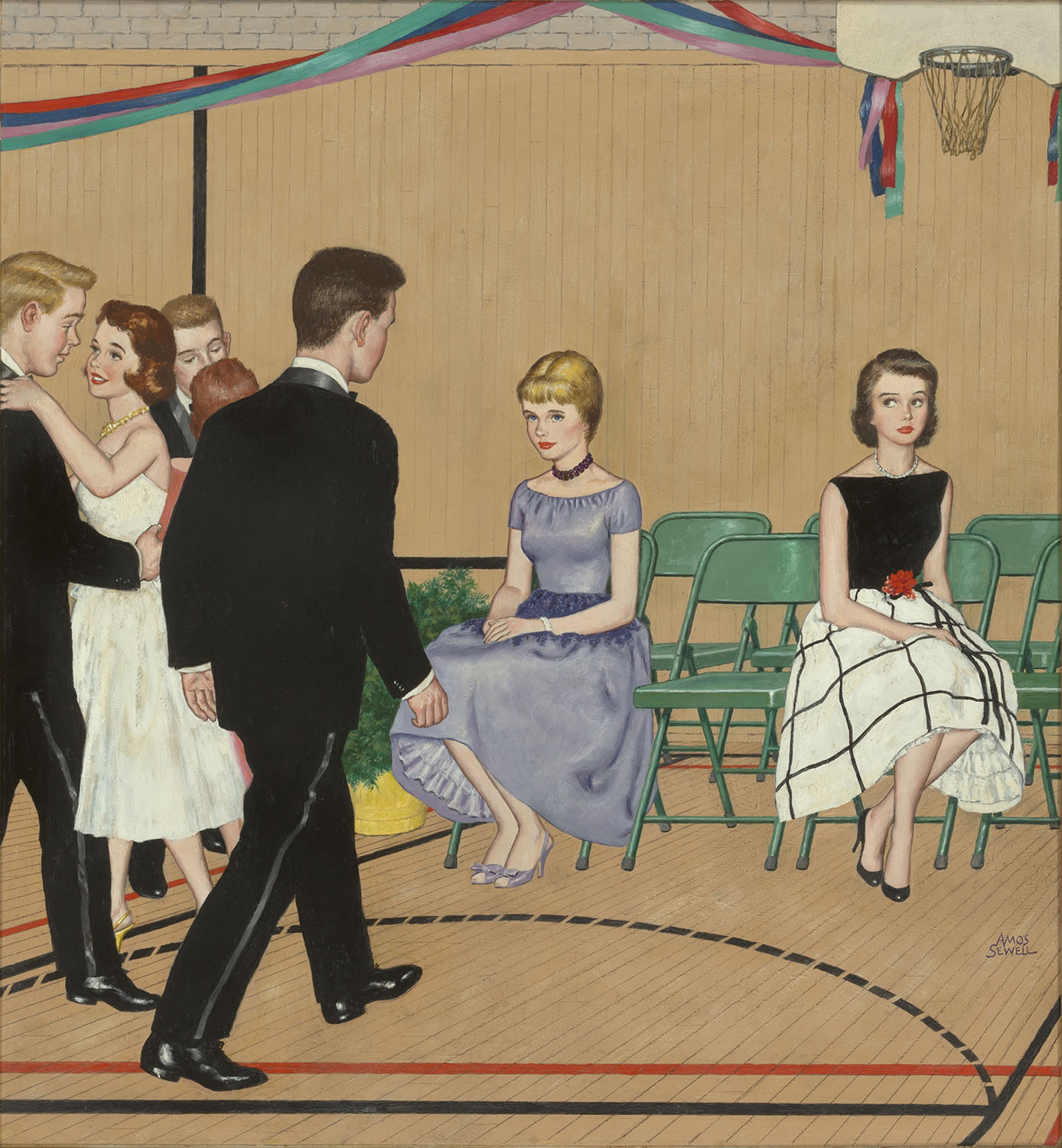
Amos Sewell (1901-1983)
The Dance (Who Will He Ask?)
1959, oil on board
26 1/2" x 24 1/2", signed lower right
Saturday Evening Post, January 30, 1960 cover
Created for the January 30, 1960 cover of The Saturday Evening Post, Amos Sewell’s Who Will He Ask? captures the anticipation and uncertainty of a school dance. Sewell focuses on a familiar social ritual, using the expressions and body language of the young people to build a narrative around the all-important question of who will be asked to dance.
Rather than emphasizing the glamour of an evening out, Sewell finds humor and tension in the awkwardness of adolescent social life. The dance becomes a stage for youthful self-consciousness, expectation, and courtship, demonstrating how even an ordinary nighttime gathering could provide illustrators with rich material for observing American social customs.
Stories After Dark
For illustrators, nighttime offered a powerful means of advancing a story and intensifying its drama. Darkness could conceal information, create uncertainty, isolate a figure, or heighten a moment of danger, mystery, or suspense. In these works, night is not simply the setting in which the narrative occurs, but an essential element in shaping how the viewer experiences the scene.
Through dramatic contrasts of light and shadow, selective illumination, and figures emerging from darkness, artists could direct attention toward a story’s most important details while leaving others deliberately obscured. These illustrations demonstrate how the visual qualities of night became a narrative device in their own right, adding atmosphere and emotional tension to the stories they were created to illustrate.
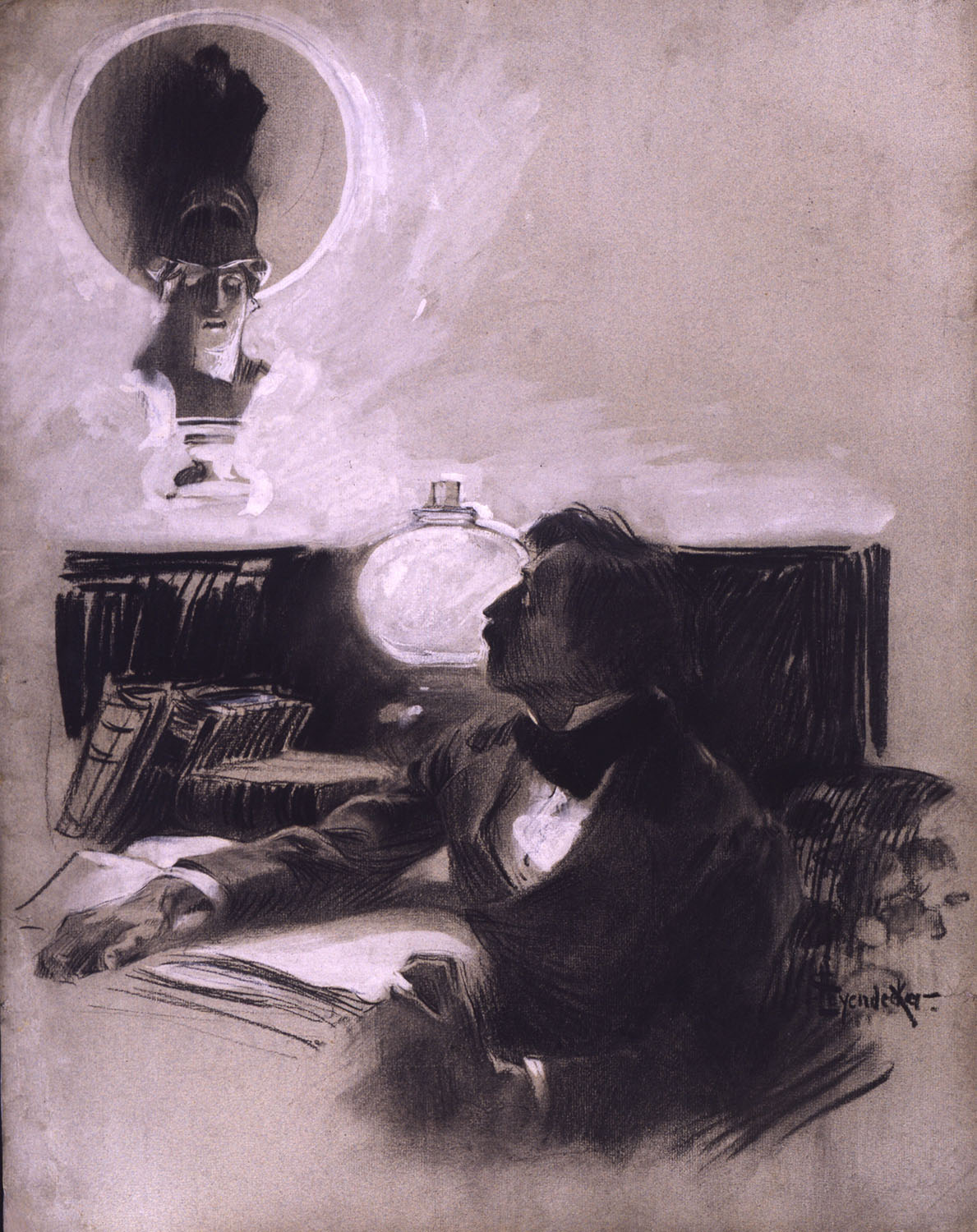
J.C. Leyendecker (1874-1951)
Edar Allan Poe's "The Raven"
1898, charcoal, pencil and gouache on paper
23 1/2" x 18", signed lower right
"Best Poems" series, Saturday Evening Post, c.1898
J.C. Leyendecker created this illustration of Edgar Allan Poe’s The Raven for the “Best Poems” series published in The Saturday Evening Post around 1898. Rather than simply illustrating an episode from the poem, Leyendecker illustrates the experience of Poe actually writing the poem, using the nighttime setting and dramatic lighting to evoke an unsettling psychological atmosphere.
Deep shadows obscure much of Poe’s face, while the raven perched atop the bust is similarly absorbed into the surrounding darkness. Leyendecker allows only selected forms to emerge from the shadows, creating ambiguity about what is seen and what remains concealed. This deliberate use of darkness heightens the eerie, mysterious quality of the scene, making night an essential part of the illustration’s interpretation of Poe’s haunting poem.
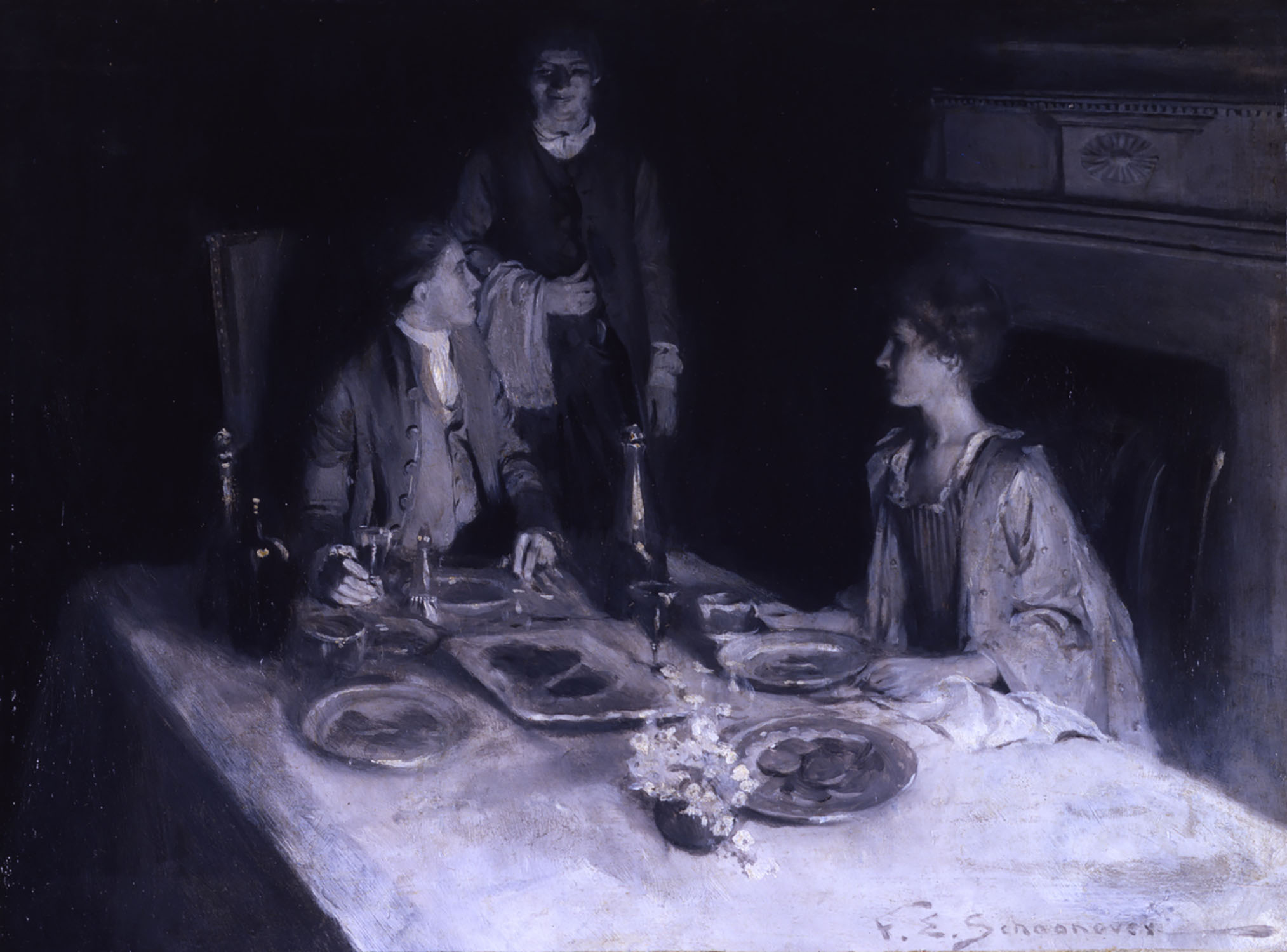
Frank E. Schoonover (1877-1972)
Cardigan
1901, oil on board
12" x 16 1/2", signaed lower right
Cardigan, by Robert W. Chambers, Harper & Brothers Publishers, 1901, frontispiece
Frank E. Schoonover created Cardigan as an illustration for Robert W. Chambers’s novel of the same name, published by Harper & Brothers in 1901. The painting appeared as the book’s frontispiece with the caption, “The Dunce loitered, casting sidewise looks at me.”
Schoonover uses the darkness of night to heighten the tension implicit in the encounter. The figures emerge from a shadowed background lit by an unseen lightsource, their limited visibility reinforcing the sense of uncertainty suggested by the furtive “sidewise looks” described in the text. By obscuring the surrounding environment, Schoonover focuses attention on the figures and their interaction, using darkness to create an atmosphere of secrecy and suspense.
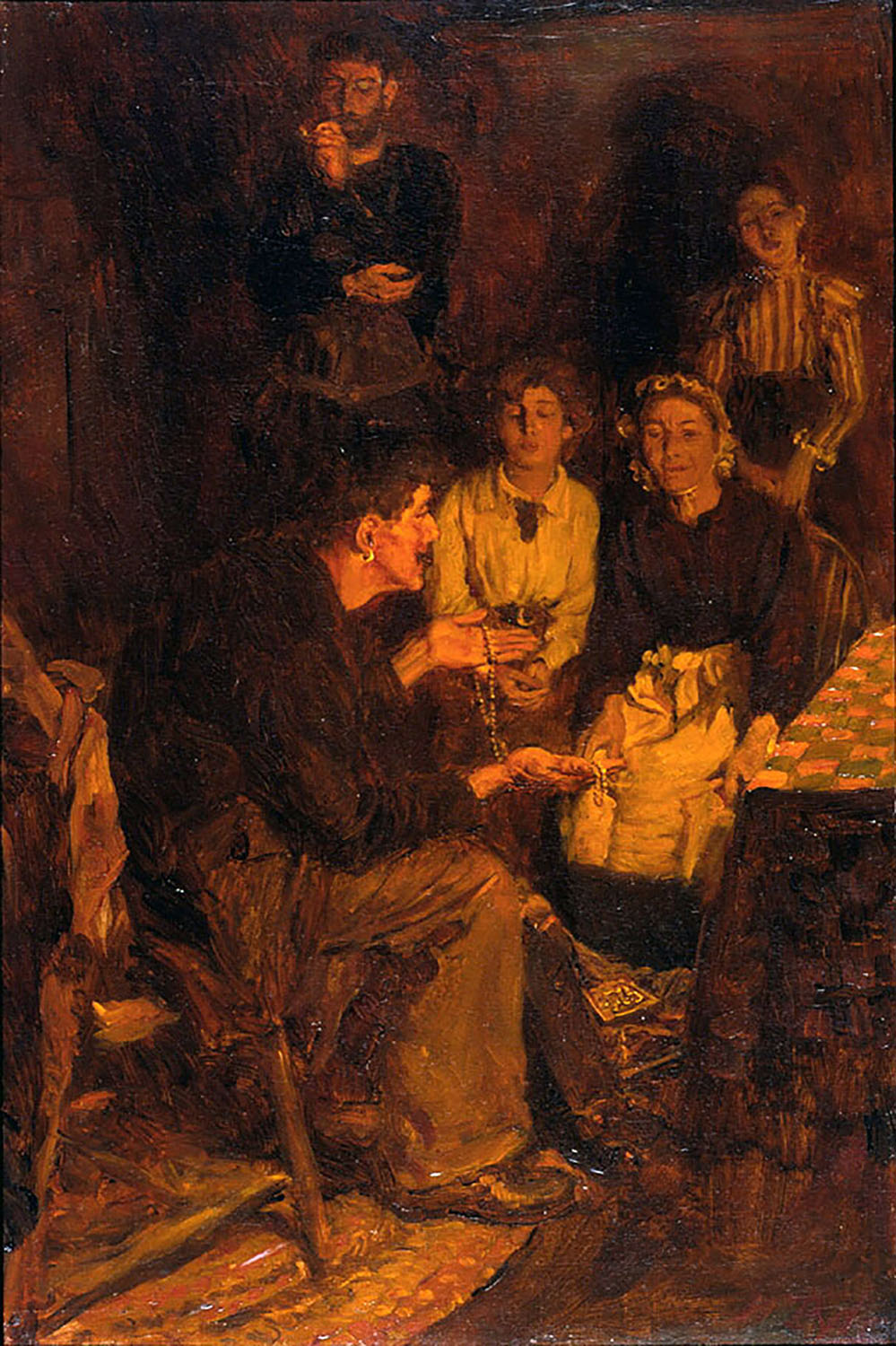
Howard Pyle (1853-1911)
Dark, Smiling Salim with His Magic Pack
1908, oil on canvas
23 1/2" x 15 3/4", signed lower right
The Minstrel by Norman Duncan, Harper's Monthly Magazine, June 1908
Howard Pyle created Dark, Smiling Salim with His Magic Pack for Norman Duncan’s The Minstrel, published in the June 1908 issue of Harper’s Monthly Magazine. Pyle, whose influential approach to illustration emphasized the dramatic moment of a story, places the mysterious figure of Salim within a darkened nighttime setting.
Pyle uses the limited visibility of night to heighten the mystery surrounding the character and his “magic pack.” Salim and the surrounding figures are lit by an unseen fire, concentrating the viewer’s attention on the figures and expressions. The surrounding shadows withhold information from the viewer, reinforcing the sense of intrigue already suggested by the story and demonstrating how darkness could become an effective tool for visual storytelling.
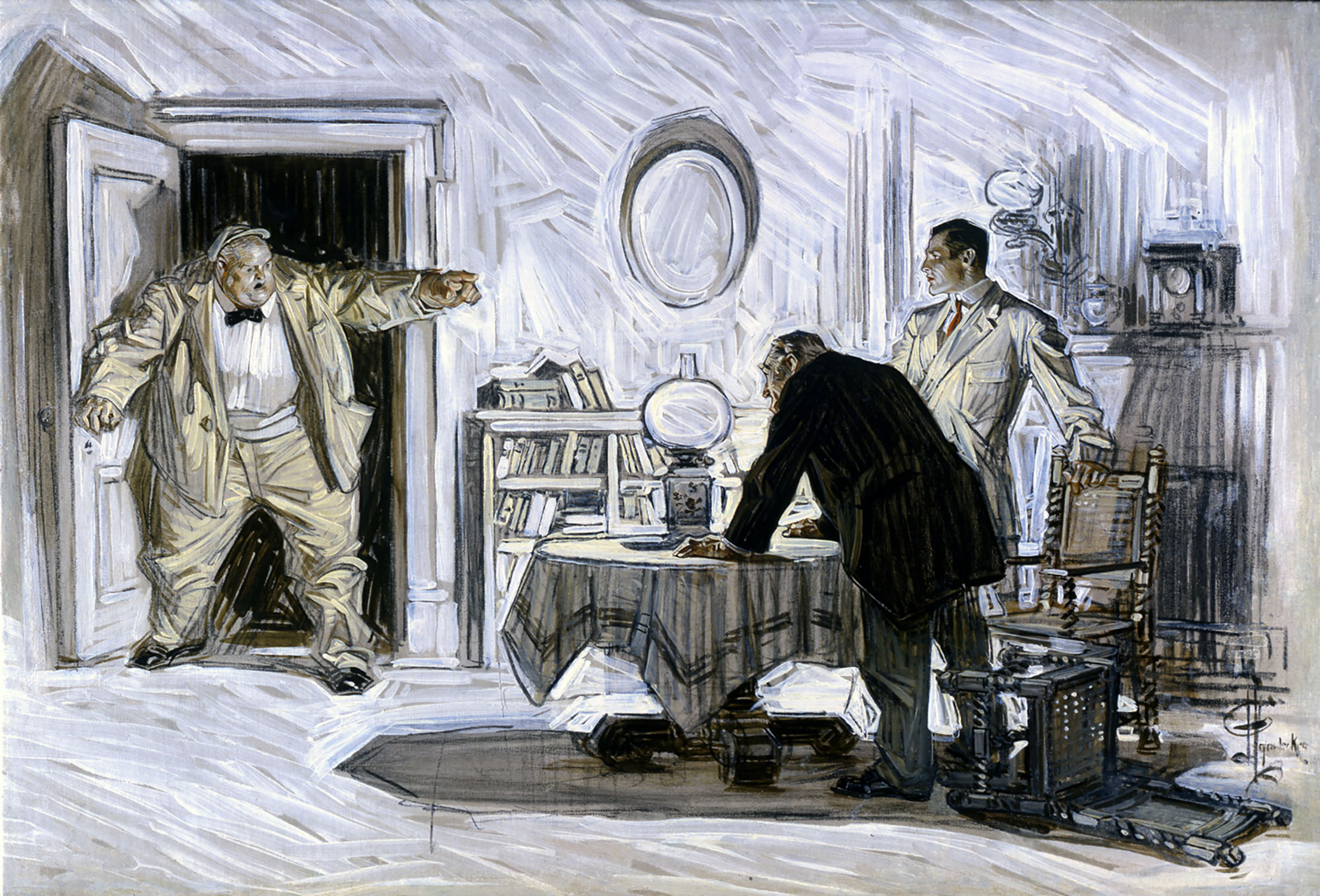
J.C. Leyendecker (1874-1951)
Caught in the Act of the Plan
1909, oil on board
19" x 28", signed lower right
The Voice in the Rice, by Gouverneur Morris, Saturday Evening Post, 1909
J.C. Leyendecker created Caught in the Act of the Plan for Gouverneur Morris’s The Voice in the Rice, published in The Saturday Evening Post in 1909. The story draws upon mystery, memory, and the supernatural, and Leyendecker responds with an illustration centered on a moment of discovery and suspense.
Leyendecker uses nighttime to make the encounter more dramatic, placing the figures within an environment dominated by light, darkness and deep shadow. The focused illumination concentrates attention on the figures and their actions, leaving the viewer uncertain about what may exist beyond the visible scene. Like the story itself, the composition relies upon concealment and revelation, using darkness to heighten the sense of secrecy and unease.
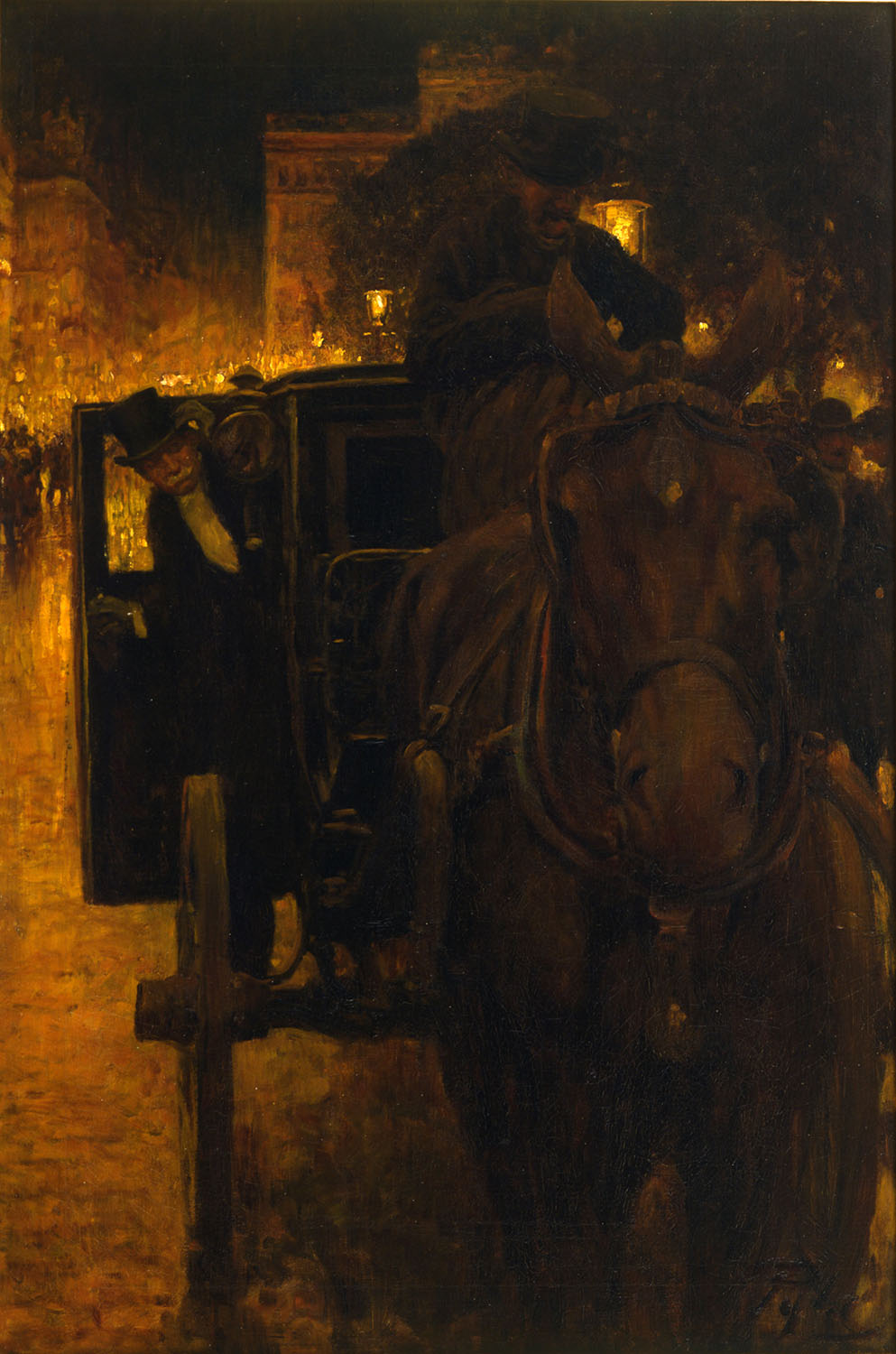
Howard Pyle (1853-1911)
Herr Vellmer
1911, oil on canvas
29 1/2" x 20, signed lower right
"Huntford's Fair Nihilist," by Howard Pyle, Harper's Magazine, June 1913
A central principle of Howard Pyle’s teaching was to draw and paint from direct observation, using real models, costumes, and objects whenever possible. For an illustration such as Herr Vellmer, Pyle would have studied an actual horse and carriage to understand their scale, perspective, and relationship in space. This careful observation contributes to the convincing perspective of the composition, placing the viewer almost directly before the carriage as the gentleman steps into the street.
The nighttime setting heightens the immediacy of the scene. Pyle allows the horse and carriage to dominate the composition while the surrounding street is aglow in the ambient light from street lights. The viewer feels positioned within the shadowed street, as though witnessing the gentleman’s arrival firsthand. Darkness therefore reinforces both Pyle’s carefully constructed perspective and the narrative suspense of the moment.
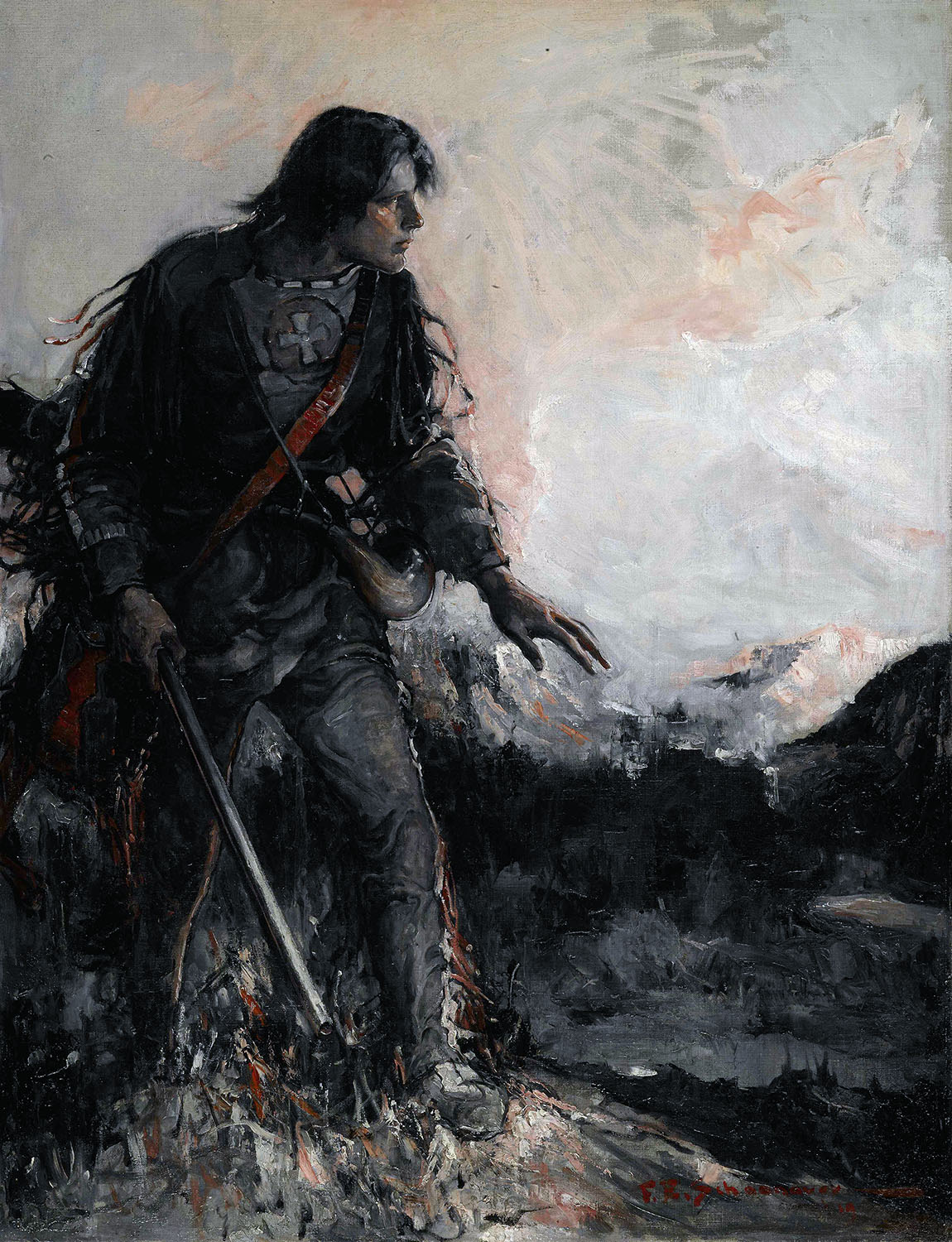
Frank E. Schoonover (1877-1972)
The Deerstalker
1919, oil on canvas
39 1/4" x 30", signed and dated lower right
"The Warring Tribes," by James W. Schultz, American Boy Magazine, January 1920 cover
Frank E. Schoonover painted The Deerstalker for James Willard Schultz’s “The Warring Tribes,” appearing on the January 1920 cover of The American Boy. The image was later published as the dust jacket and frontispiece for Schultz’s Red Crow’s Brother in 1927, where it carried the caption “Rising Wolf.”
Schoonover uses the nighttime setting to heighten the sense of vigilance and uncertainty central to the scene. The figure stands prominently against the dark landscape, while the limited illumination reveals only portions of his surroundings. By allowing much of the environment to disappear into shadow, Schoonover suggests what may lie unseen beyond the picture plane, using darkness to create suspense and reinforce the watchful stance of the central figure.
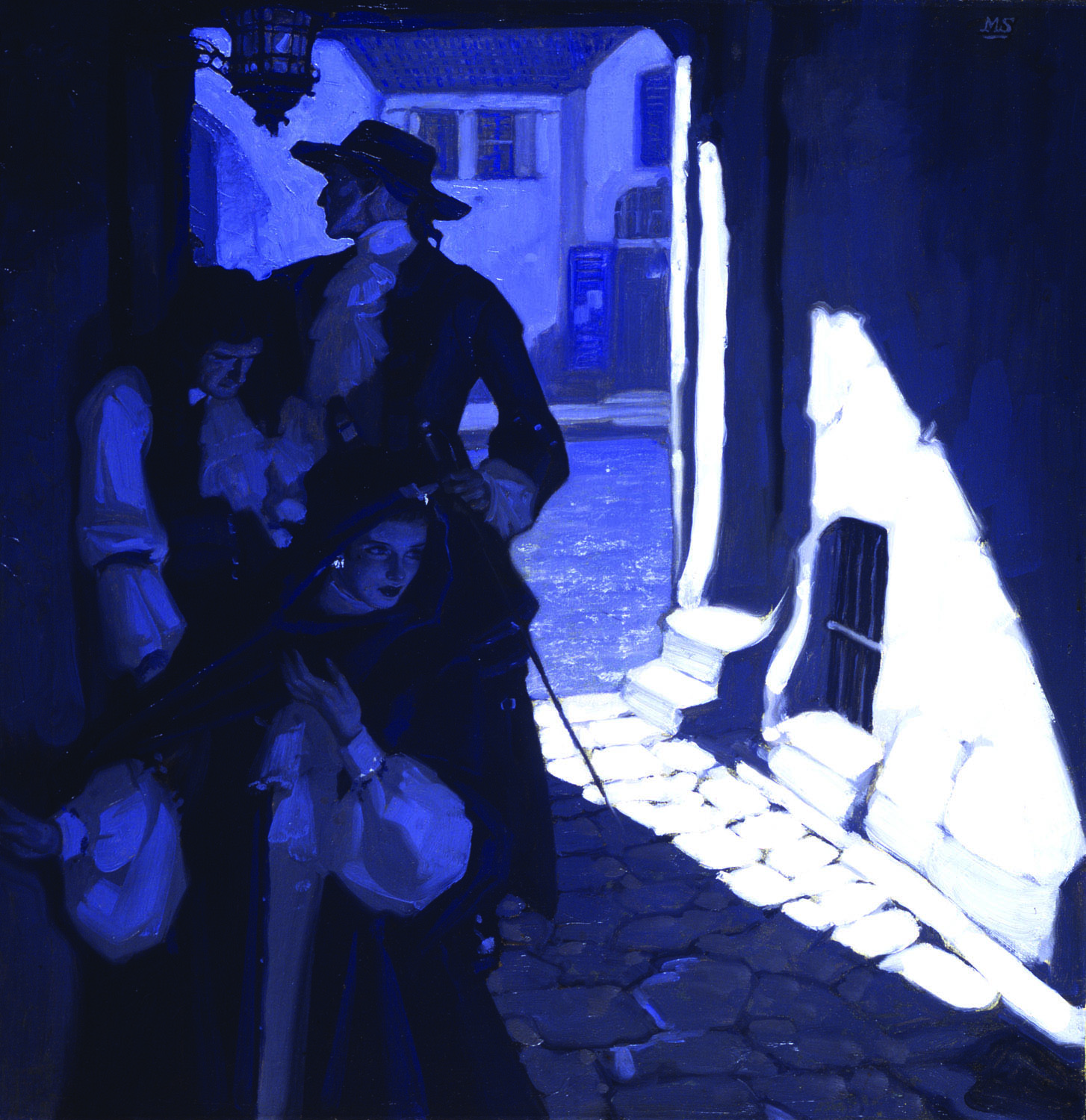
Mead Schaeffer (1898-1980)
Blood Money
1922, oil on canvas
29" x 28", initialed upper right
"Blood Money" by Rafael Sabatini, Cosmopolitan Magazine
Mead Schaeffer created this dramatic illustration for Rafael Sabatini’s “Blood Money,” published in Cosmopolitan. The accompanying passage reads, “‘Quick! To the boat!’ cried the woman, as the wounded man slumped against Captain Blood.” Schaeffer captures this moment of danger by placing the three central figures deep within the shadows of a narrow alleyway.
Nighttime becomes essential to the suspense of the scene. The figures cower in darkness, temporarily concealed, while moonlight spills into the alley just beyond them. This sharp division between shadow and light creates a visual boundary between safety and discovery: the darkness offers protection, while the approaching light threatens to expose them. Schaeffer thus uses moonlight not simply for illumination, but as a narrative device that intensifies the urgency of their escape.
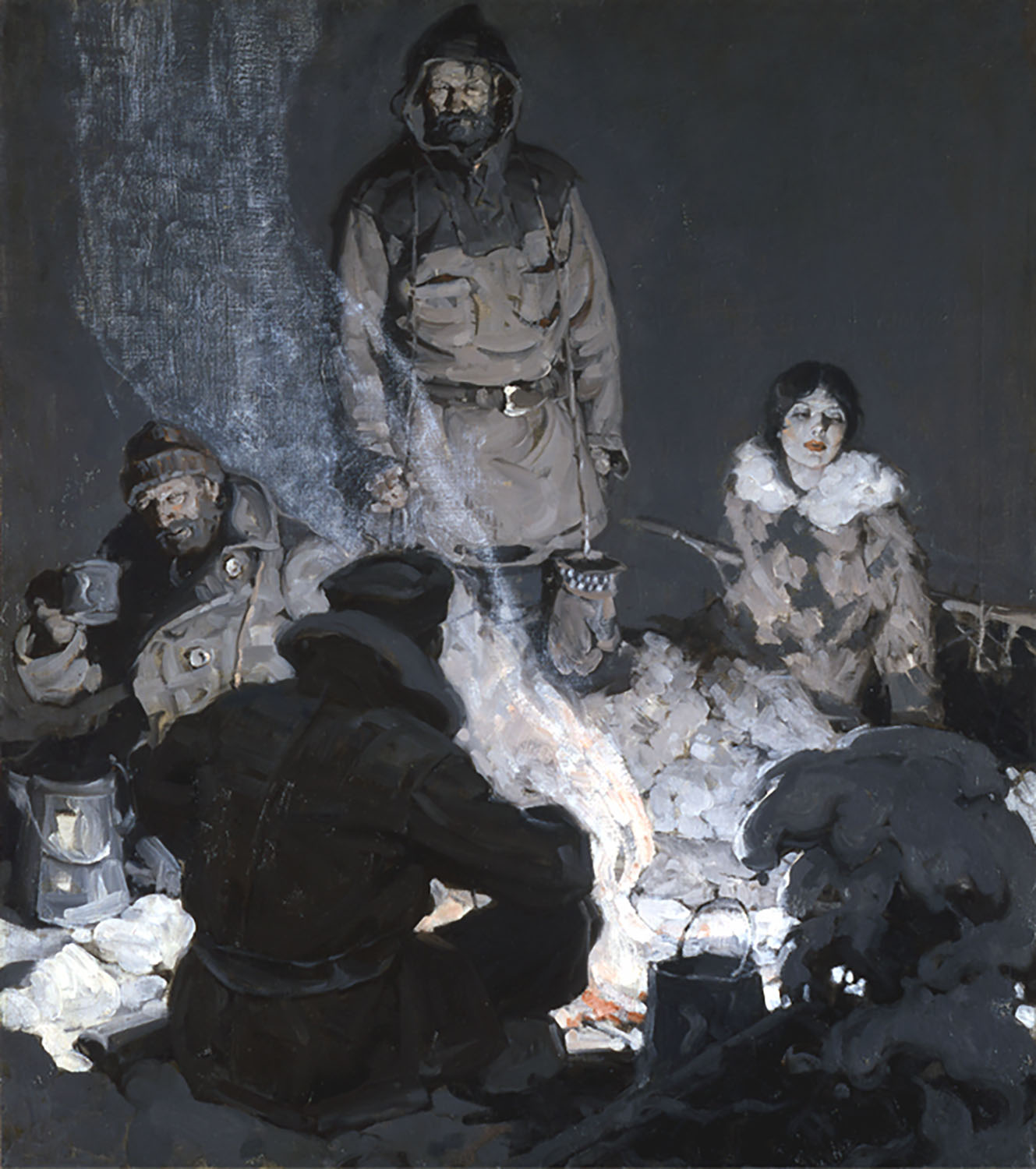
Mead Schaeffer (1898-1980)
Alaska IV
1927, oil on board
34" x 30", signed, dated and titled on reverse
"A Woman's Story of the Gold Rush," by Josephine De Mott Robinson, McCall's Magazine, January 1928, pg.29
Mead Schaeffer created Alaska IV for Josephine De Mott Robinson’s “A Woman’s Story of the Gold Rush,” published in the January 1928 issue of McCall’s Magazine. The accompanying text underscores the desperation of the scene: “But I begged them to stop thinking about food and just drink lots and lots of tea.” Schaeffer depicts the lost and starving characters huddled closely together, isolated within the vast darkness surrounding them.
Light becomes a powerful symbol of life and safety within the composition. A warm glow surrounds the central figure and the small group, while the background dissolves into a featureless expanse of dark gray. Schaeffer’s stark contrast between illumination and emptiness emphasizes their vulnerability: the light represents the only source of warmth, sustenance, and security available to them, while the darkness beyond suggests the cold, uncertainty, and danger of the wilderness in which they are lost.
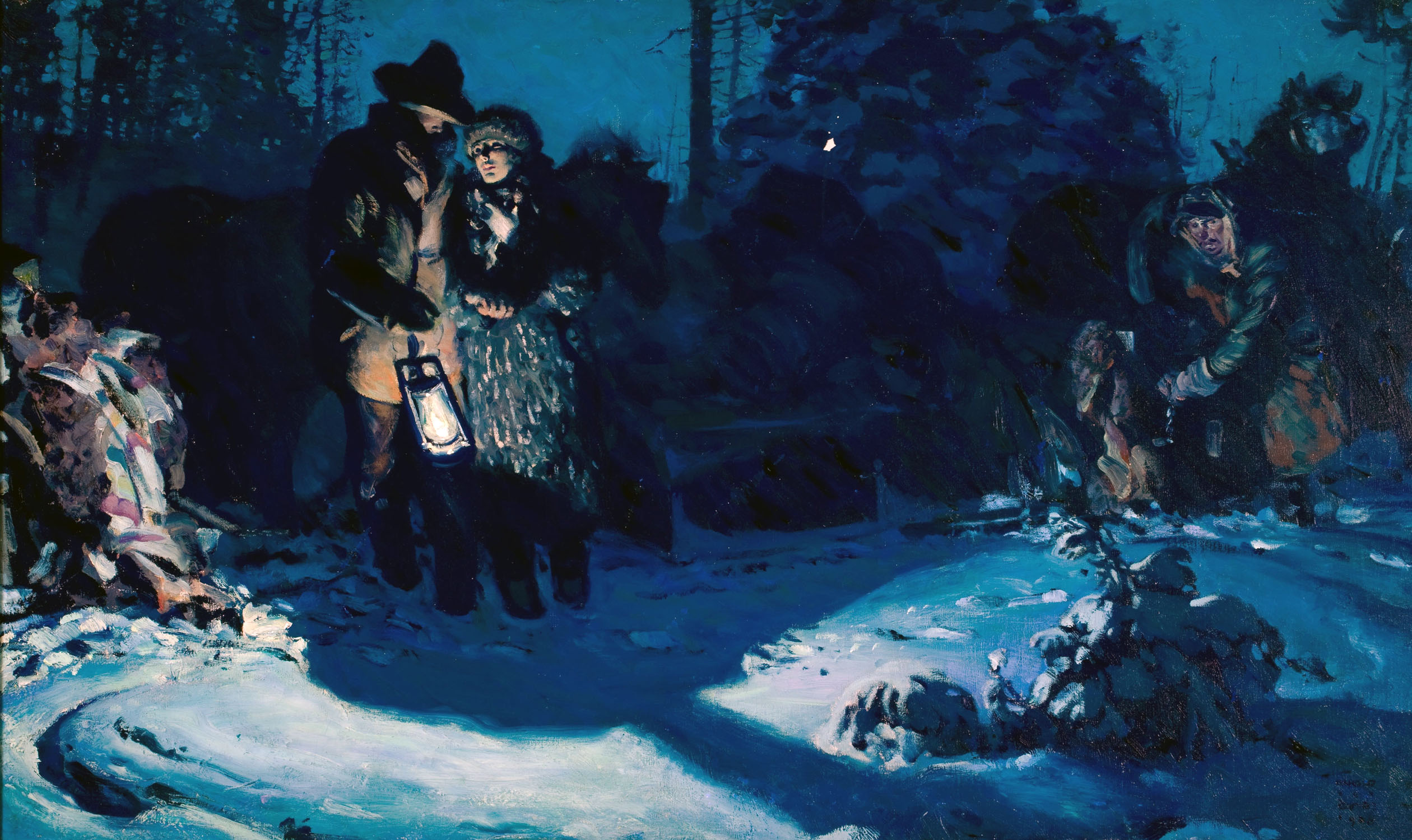
Harold von Schmidt (1893-1982)
You Are Very Kind
1928, oil on canvas
30" x 50", signed and dated lower right
Harold von Schmidt’s You Are Very Kind depicts a nighttime encounter in a stark winter landscape. The inscription on the reverse provides a glimpse into the narrative: “As it was, he got the impression of all manner of eyes and features turned on him from out of a deep fur collar.” Even without the larger context of the story, von Schmidt’s composition communicates the circumstances of the scene through its dramatic treatment of light, color, and atmosphere.
Against the cold blues and deep shadows of the surrounding landscape, the warm illumination around the figures immediately suggests shelter, human presence, and safety. Beyond this concentrated area of light, the landscape recedes into an indistinct darkness that conveys isolation and uncertainty. Von Schmidt allows the contrast itself to tell much of the story: warmth and security exist within the light, while the cold, empty night waits just beyond it.
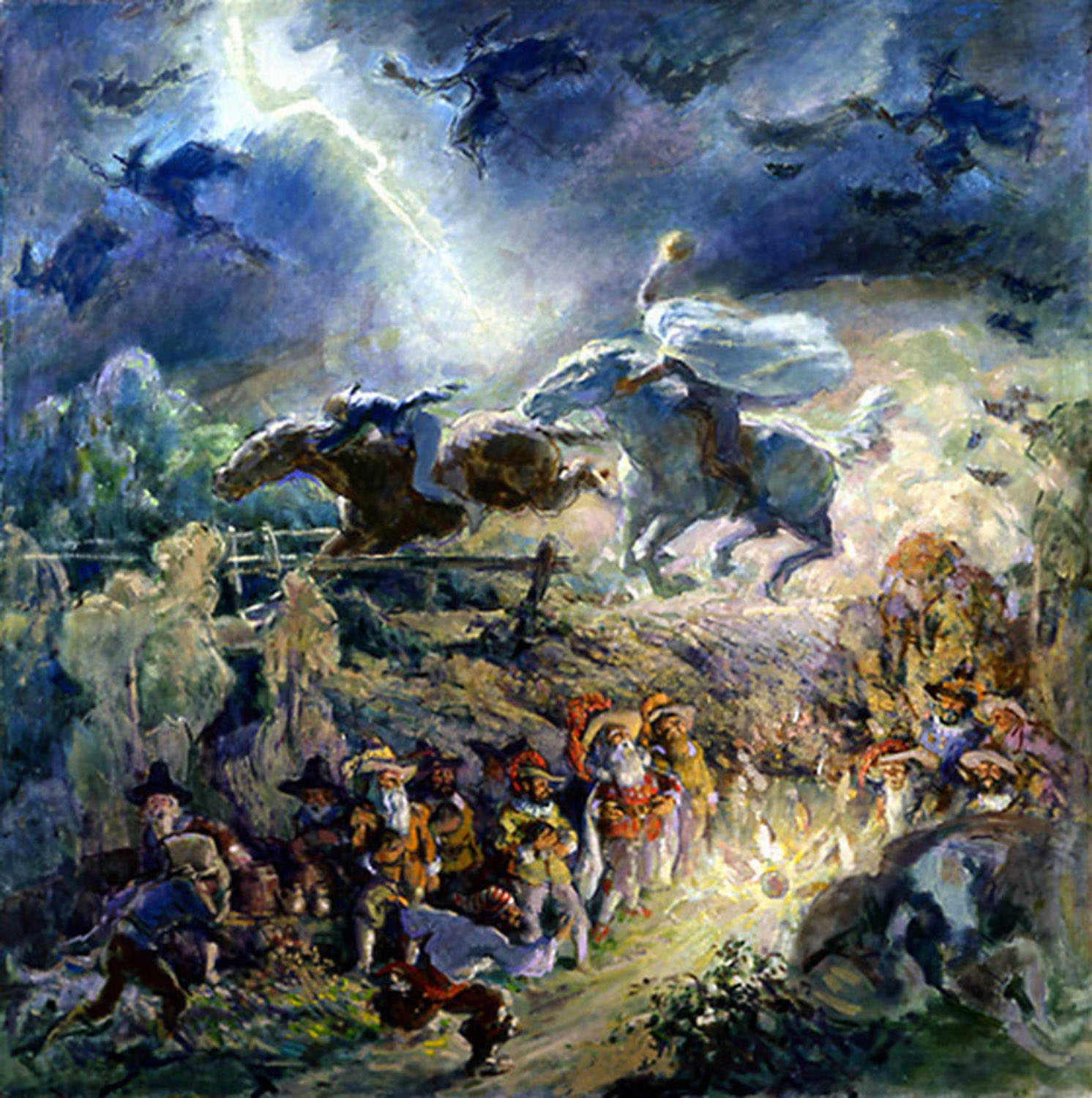
Edmund Franklin Ward (1892-1991)
Study for "Hudson Valley Legends" Mural
1976, oil on canvas
36" x 36", estate stamp
This is a study for the mural in the east wing of the White Plains Public Library, White Plains, New York.
Edmund Franklin Ward created this painting as a study for his Hudson Valley Legends mural, now installed in the east wing of the White Plains Public Library. The mural brings together characters and episodes from Washington Irving’s legendary career, most recognizably The Legend of Sleepy Hollow and Rip Van Winkle. Across the stormy sky, the Headless Horseman pursues the fleeing Ichabod Crane, while below, the mysterious bearded figures recall the spectral crew encountered by Rip Van Winkle in the Catskill Mountains. Rather than illustrating a single episode, Ward combines these familiar characters with other ghostly figures into a dreamlike panorama of the supernatural world associated with Irving’s Hudson Valley tales.
Ward’s composition relies heavily upon light to unite these different narratives. A brilliant shaft of supernatural illumination breaks through the dark sky above, while smaller pools of light reveal figures and episodes below. Between them, deep blues, grays, and shadows allow characters to emerge and disappear throughout the landscape, echoing Irving’s world of apparitions, haunted places, and nighttime superstitions. Light becomes the organizing force of the mural, directing the viewer from one legend to another and transforming the darkness into a setting where history, folklore, and imagination seem to coexist.
Halloween!
Few American traditions are as closely associated with nighttime as Halloween. Darkness transforms familiar streets and neighborhoods into settings for disguise, mischief, and the supernatural, providing illustrators with subjects that range from playful to mysterious. In these works, nighttime is essential to the imagery of Halloween, creating the atmosphere in which ordinary surroundings can briefly become strange, theatrical, and unexpected.
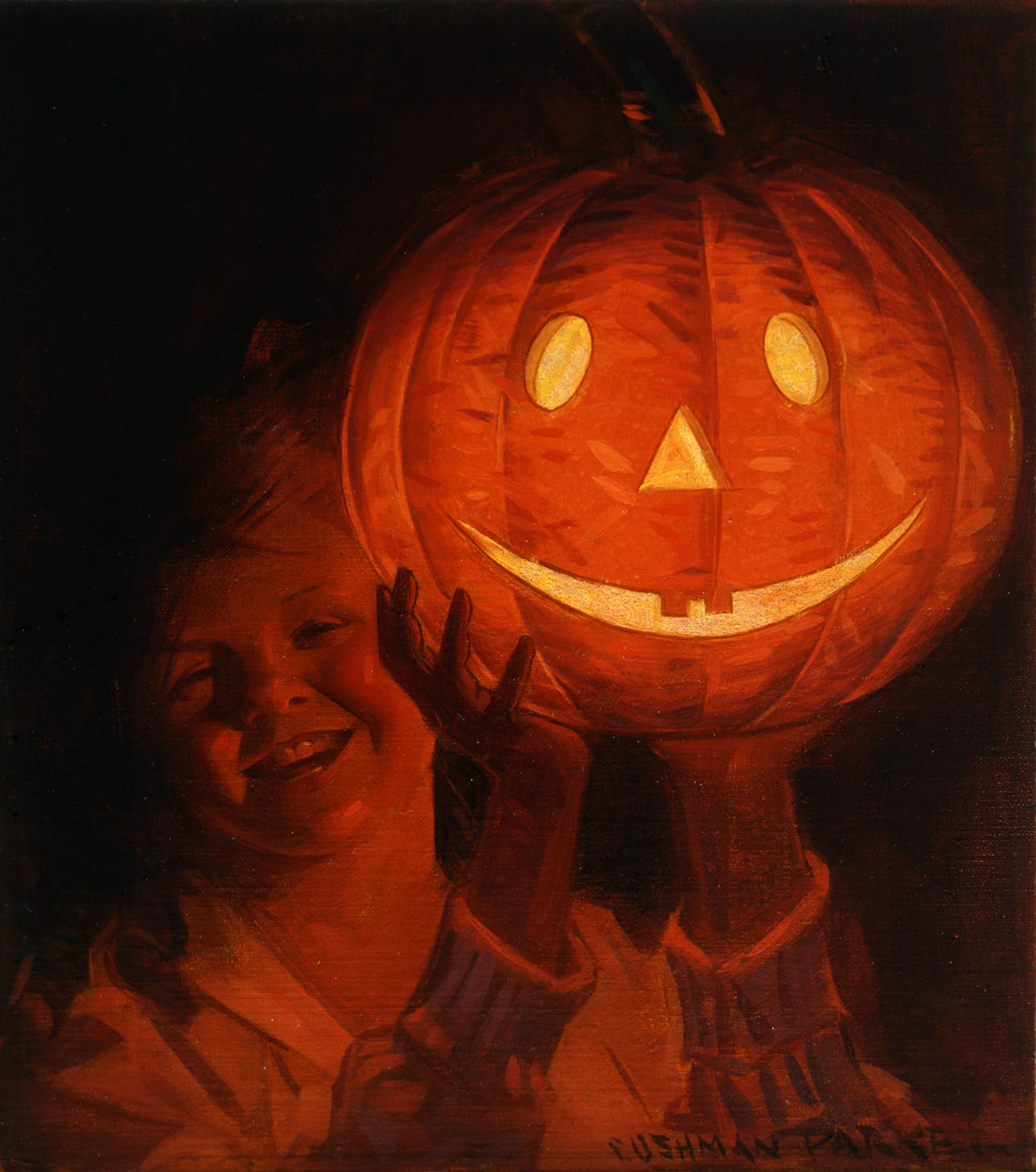
Cushman Parker (1881-1940)
Pumpkin
1915, oil on canvas
12 3/8" x 11 1/8", signed lower right
The Sunday Star: Sunday Magazine, October 31, 1915 cover
Cushman Parker created Pumpkin for the October 31, 1915 cover of The Sunday Star: Sunday Magazine. Appropriately published on Halloween, the image focuses on a young girl illuminated by the glowing jack-o’-lantern she holds before her, transforming a familiar holiday tradition into an intimate study of light and expression.
Parker makes the jack-o’-lantern the sole source of illumination, bathing the girl’s face, clothing, and hands in a warm orange glow while the surrounding space disappears into darkness. The upward light gives her features an appropriately eerie quality, yet the warmth of the palette keeps the image playful rather than frightening. Light is both the subject and the organizing element of the composition, capturing the mixture of warmth, mystery, and mischief associated with Halloween night.
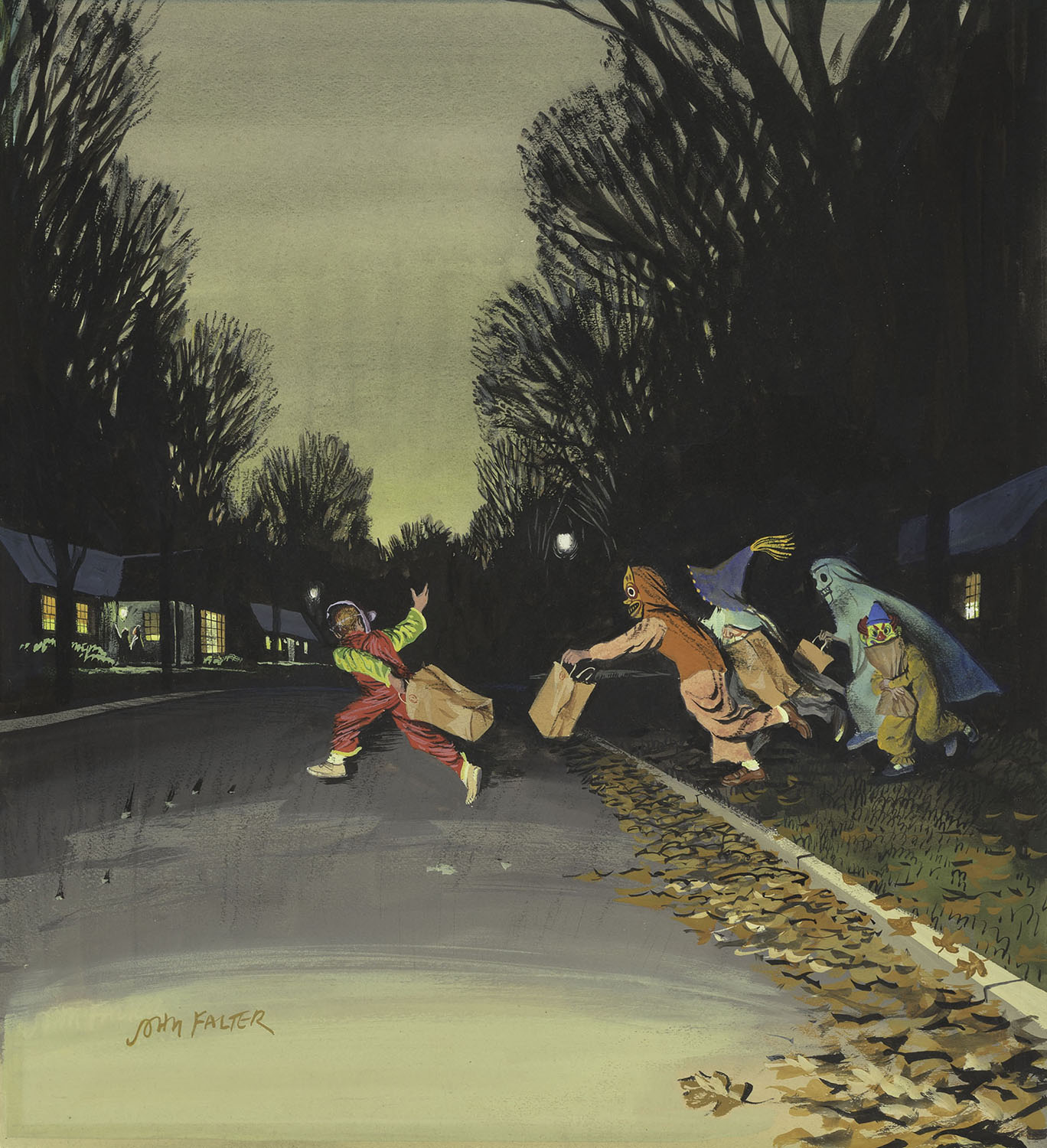
John Falter (1910-1982)
Halloween
1963, watercolor and gouache on paper
16 3/4" x 14 3/4", signed lower left
U.S. Royla Master Tire advertisement, c. 1963
John Falter created Halloween for an advertising campaign promoting U.S. Royal Master Tires. The series depicted the kinds of unexpected hazards a driver might suddenly encounter on the road—from a dog darting into traffic to, in this instance, trick-or-treaters rushing across the street in search of their next treats. The campaign emphasized the need for drivers—and their tires—to react quickly when the unexpected appeared directly in their path.
Falter makes the viewer an active participant in the scene by placing us directly in the driver’s seat. The children emerge suddenly from the dusky darkness, illuminated by the headlights of the car from which we appear to be observing them. The headlights create a concentrated field of light surrounded by darkness, replicating the driver’s limited nighttime visibility and making the danger feel immediate. Rather than observing the incident from a distance, we experience it from behind the wheel, confronting the trick-or-treaters at the same instant as the imagined driver. Nighttime and artificial light therefore become essential to both the drama of the composition and the advertising message: an unexpected hazard can appear out of the darkness in an instant.
Bedtime After Dark
Bedtime reveals two very different sides of nighttime. For some artists, the darkness surrounding a child’s bedroom creates an intimate world of warmth, affection, and security, where bedtime stories and familiar rituals offer reassurance at the end of the day. For others, that same darkness becomes a source of uncertainty, allowing shadows, dreams, and an active imagination to transform familiar surroundings into something strange or frightening.
In these works, the contrast between light and darkness often reflects the child’s experience of bedtime itself. The warm glow of a lamp can represent comfort and protection, while the darkness beyond it suggests the mysterious world that emerges once the lights go out. Night thus becomes both comforting and unsettling—a setting equally suited to tenderness, imagination, dreams, and fear.
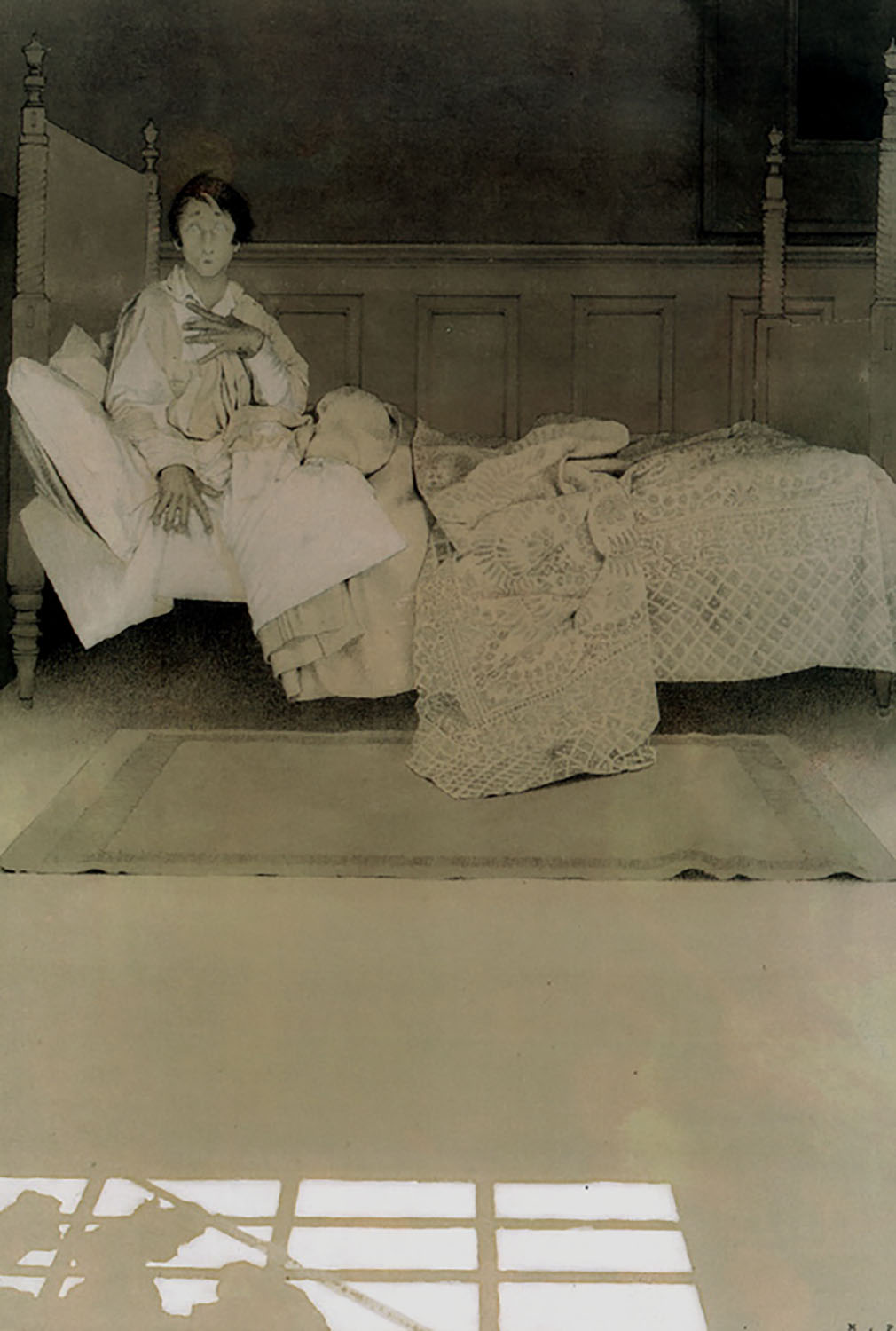
Maxfield Parrish (1870-1966)
The Blue Room
1899, pencil and gouache on paper
13" x 9", initialed lower right
Golden Age, by Kenneth Grahame, John Lane Company, 1899
Maxfield Parrish created The Blue Room for Kenneth Grahame’s The Golden Age, published by John Lane Company in 1899. The illustration accompanies the evocative passage, “The procession passing solemnly across the moon-lit Blue Room...” Parrish transforms the familiar domestic setting of a child’s bedroom into an imaginative nighttime world, capturing the way ordinary surroundings can take on an entirely different character after dark.
Moonlight is essential to this transformation. Rather than offering the warmth and security of lamplight, its cool illumination gives the room a dreamlike and slightly mysterious quality. Parrish captures the imaginative uncertainty of bedtime, when the boundary between reality and fantasy can become less distinct and a familiar room can suddenly seem populated by figures, stories, and possibilities that exist only at night.
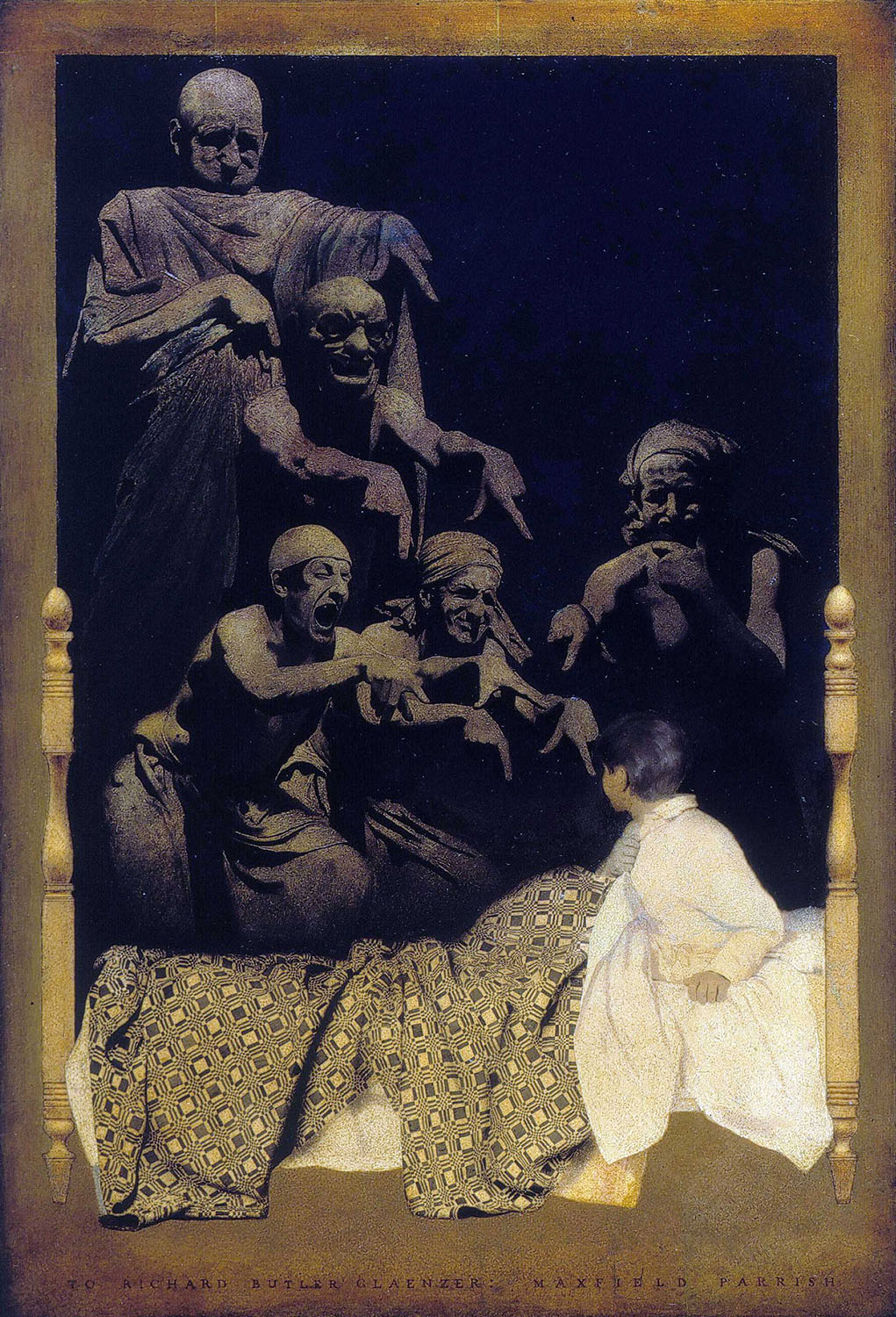
Maxfield Parrish (1870-1966)
Seeing Things at Night
1903, oil on paper
21 1/4" x 14 3/4", signed and inscribed at bottom
Poems of Childhood, by Eugene Field, Charles Scribner's Sons, February 1903, pg. 3
Maxfield Parrish created Seeing Things at Night for Eugene Field’s Poems of Childhood, published by Charles Scribner’s Sons in 1903; the image also appeared on the February 1903 cover of Ladies’ Home Journal. Here, Parrish explores a familiar childhood experience: the way a darkened bedroom can transform ordinary surroundings into the imagined creatures and threats of a child’s fears.
Parrish uses darkness not to reveal an actual danger, but to visualize the power of a child’s imagination. In the uncertain light of night, shadows and familiar forms become frightening and ambiguous, blurring the distinction between what is real and what the child believes might be lurking nearby. The work captures the more unsettling side of bedtime, when the security of the familiar world gives way to uncertainty and the darkness itself provides a canvas upon which childhood fears can take shape.
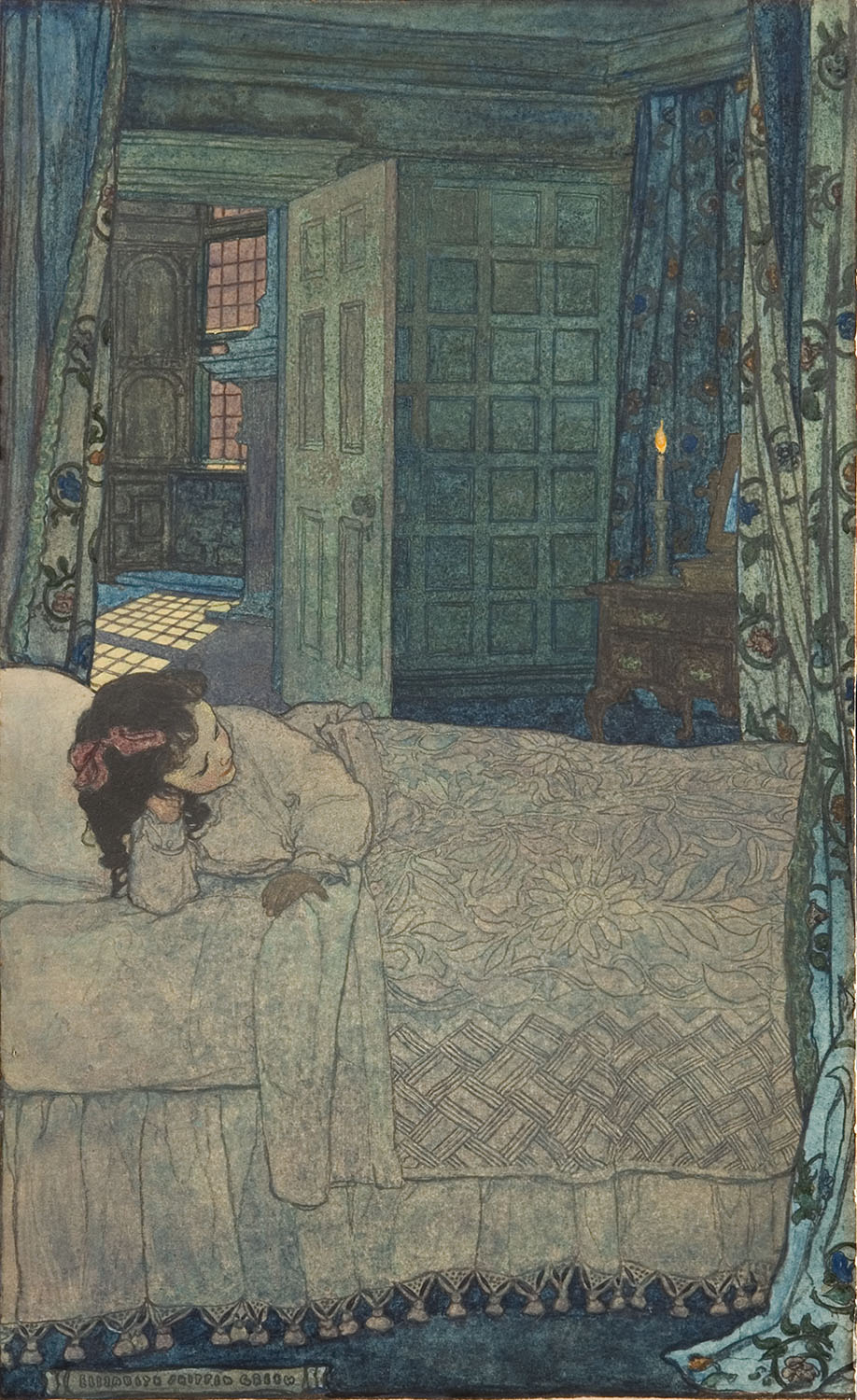
Elizabeth Shippen Green (1871-1954)
Candle-Light
1908, watercolor and gouache
23 1/2" x 14", signed lower left
The Book of the Little Past, by Josephine Preston Peabody, Houghton Mifflin Company, New York, 1908, fp. 36
Elizabeth Shippen Green created Candle-Light to accompany Josephine Preston Peabody’s poem of the same name in The Book of the Little Past, published by Houghton Mifflin Company in 1908. The poem describes a child reluctantly leaving the stars and gathering darkness outdoors for bedtime, only to discover another point of wonder inside when a candle is lit. As the child observes, “Then it makes a Star,” transforming the small domestic light into an indoor counterpart to the first star of evening.
Green translates this poetic idea into a tender study of childhood at bedtime, making candlelight the emotional and visual center of the composition. The warm flame illuminates the child within an otherwise darkened interior, turning the surrounding shadows from something potentially frightening into a source of intimacy and wonder. Here, darkness does not threaten the child as it does in Parrish’s Seeing Things at Night; instead, it allows the candle to become more luminous, offering comfort and fascination as the child settles in for the night.
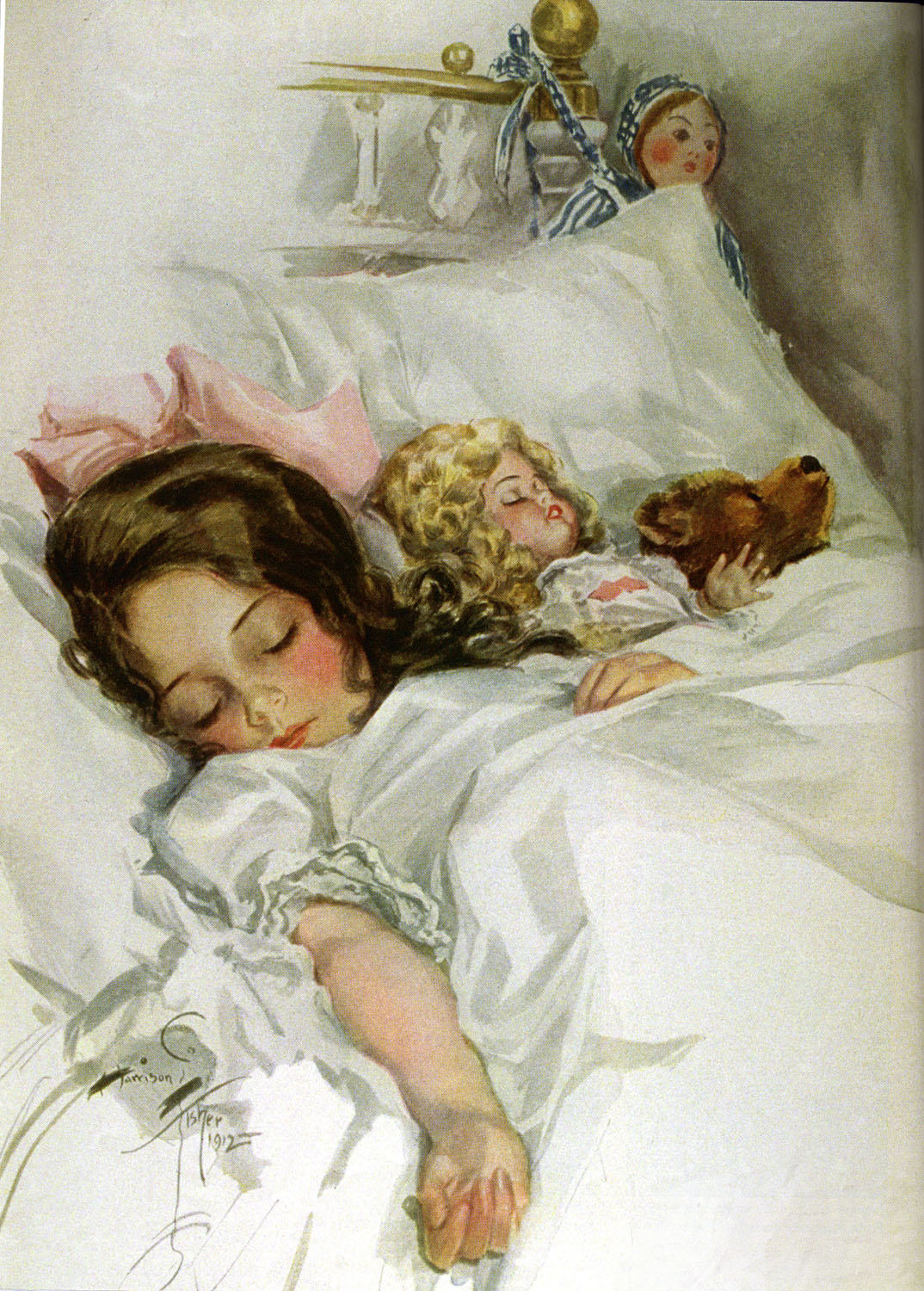
Harrison Fisher (1875-1934)
Sweethearts Asleep
1912, watercolor on board
23 1/2" x 17", signed lower left
Ladies' Home Journal, October 1912, interior illustration
The Little Gift Book by Harrison Fisher, Charles Scribner's Sons, September 6, 1913
Harrison Fisher created Sweethearts Asleep for the October 1912 issue of Ladies’ Home Journal, where it appeared as an interior illustration titled Asleep. The image was later reproduced in The Little Gift Book by Harrison Fisher, published by Charles Scribner’s Sons in 1913. Fisher presents a young girl tucked securely into bed, with her doll and teddy bear carefully arranged beside her as equal participants in the nighttime ritual.
Here, bedtime represents the most peaceful and reassuring side of night. The girl and her beloved companions lie together in a quiet row, all seemingly fast asleep, transforming the bed into a small world of comfort and security. After the imagined fears, shadows, and uncertainties that nighttime can inspire in a child, Fisher closes the exhibition with an image of complete tranquility: darkness has finally become a time for rest, companionship, and the safety of sleep.