

Celebrating the Release of
Judy Goffman Cutler’s Memoir
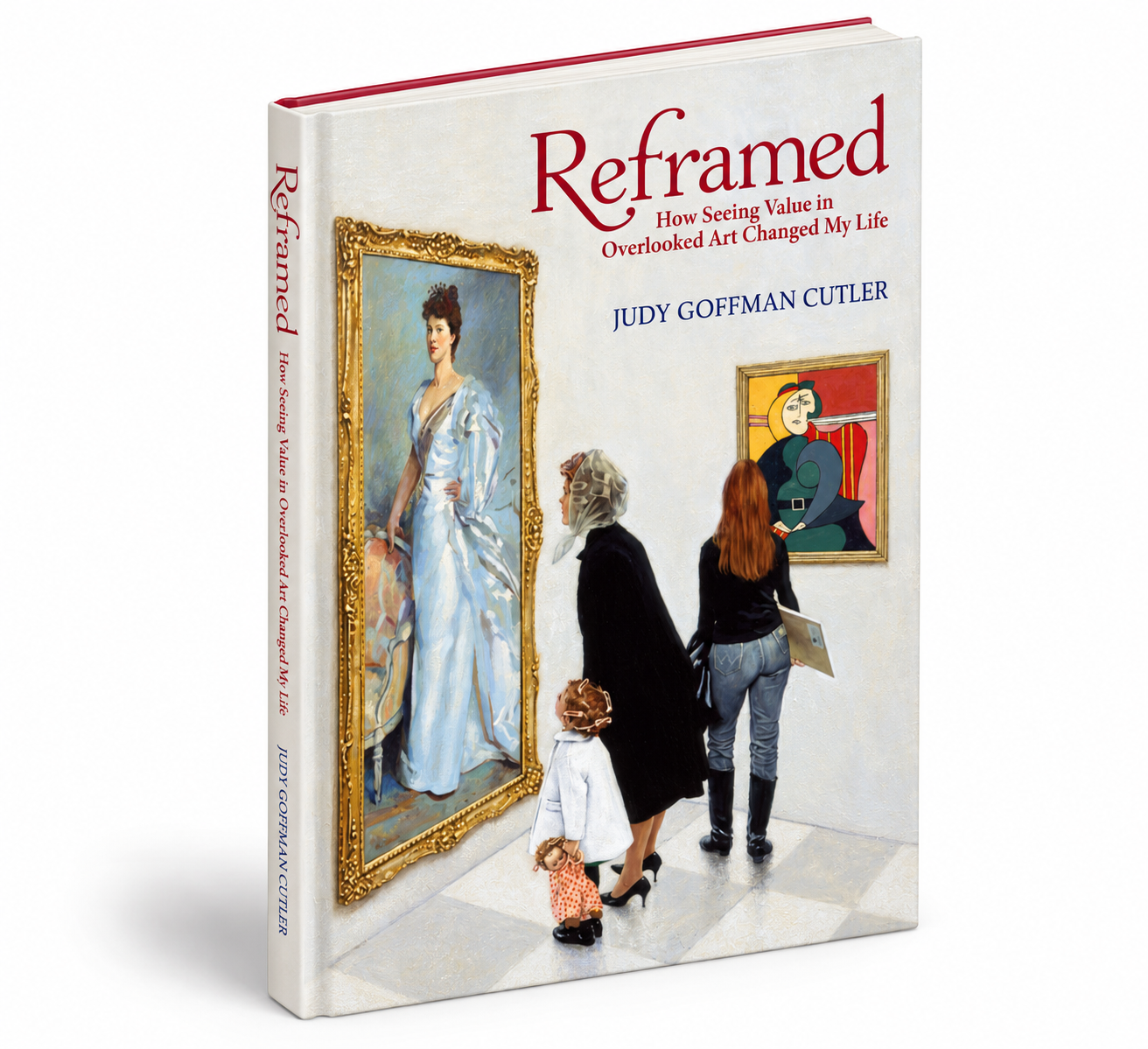
The National Museum of American Illustration is delighted to announce the publication of
Reframed: How Seeing Value in Overlooked Art Changed My Life,
the remarkable memoir of its Founder and Co-Director, Judy Goffman Cutler.
From suburban housewife and middle school teacher to internationally recognized art dealer, collector, and museum founder, Judy's extraordinary journey is a story of determination, discovery, and a lifelong passion for American illustration.
What began as a modest home decorating project grew into a pioneering career that helped transform the market for American illustration. Through her vision and perseverance, Judy championed artists such as Norman Rockwell, Maxfield Parrish, J.C. Leyendecker, Howard Pyle, and N.C. Wyeth, helping restore their rightful place in American art history. Along the way, she built an extraordinary collection, established the National Museum of American Illustration in Newport, Rhode Island, and helped celebrated collectors discover the enduring beauty and significance of this uniquely American art form.
But Reframed is far more than a story about art. With candor, humor, and resilience, Judy recounts the personal triumphs, unexpected challenges, and unforgettable encounters that shaped her remarkable life.
For this special November virtual exhibition, we invite you to step inside the pages of Reframed. Through twelve carefully selected excerpts from the memoir, each paired with illustrations featured in the book, visitors can experience a glimpse of Judy's personal journey and the extraordinary artworks that helped define her career.
Together, these stories and images celebrate not only the rediscovery of America's great illustrators, but also the woman whose determination and vision helped bring their masterpieces back into the spotlight.
Discover the stories behind the art, and the remarkable life behind the collection.
Purchase Your Copy of Reframed on Amazon by Clicking Here


I wanted to do everything my brothers did, including play baseball. That was uncommon in the fifties when the prevailing attitude was that girls don’t play baseball. The word “don’t” definitely wasn’t in my vocabulary, so I stood there stubbornly until someone, probably one of my brothers, was forced to pick me for the team. Good news for them because I was one of the better players, and we usually won the game.
Girls do play baseball!
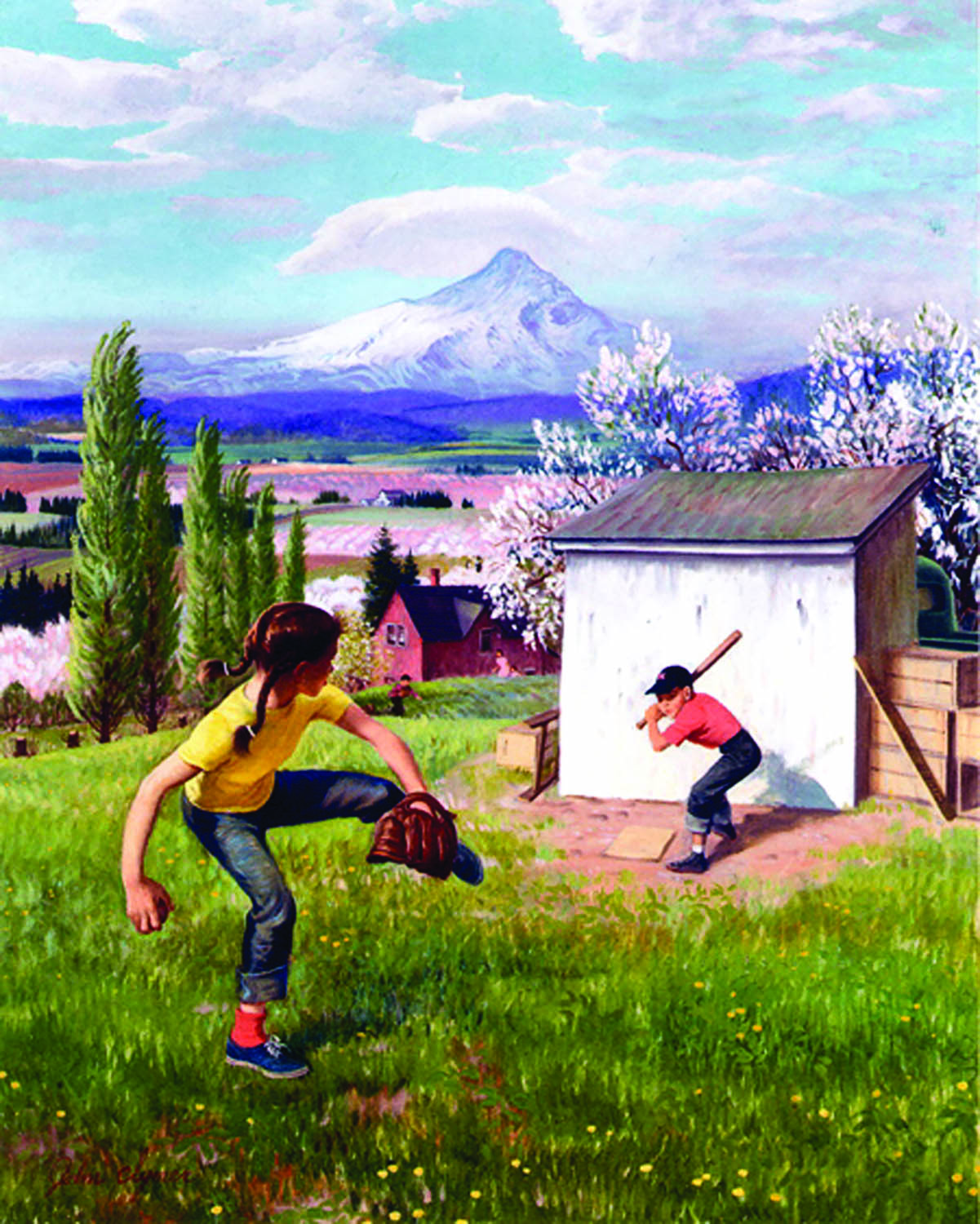
John Clymer (1907-1989)
Backyard Baseball
1951, oil on canvas
35" x 28 3/4", signed lower left
Saturday Evening Post, April 21, 1951 cover
John Clymer’s Backyard Baseball perfectly captures the spirit of Judy’s childhood in the 1950s, when neighborhood baseball games were a favorite pastime. Growing up with brothers, Judy was determined to join in the fun, refusing to accept the prevailing notion that baseball was a game for boys. Like the spirited scene depicted in Clymer’s painting, her memories evoke a simpler era of childhood, when neighborhood friendships, friendly competition, and afternoons spent outdoors were part of everyday American life.
John Clymer was one of America’s most celebrated illustrators, renowned for his nostalgic portrayals of small-town life, American traditions, and the natural world. His paintings frequently appeared on the covers of The Saturday Evening Post, where his warm, richly detailed scenes captured the character and charm of mid-century America. Created for the April 21, 1951 cover, Backyard Baseball celebrates the timeless pleasures of America's favorite pastime, reflecting the innocence, energy, and camaraderie of childhood.
I dated other boys, and my dance card was always full, but I was still trying to figure out the complicated game of boy/girl relationships. “From now on,” I told my diary, “I am going to flirt. I’m going to get worse and worse until I’m the worst!!! ... I am going to be sexier and sexier until I become sexiest…I’m going to give them something to talk about” Bold words for a fifteen-year-old high school student! And definitely more fantasy than reality.
The best part about keeping a diary is reading it today. My entries offer a vivid record of my activities and emotions when I was growing up, and I can read them now and remember exactly what I was feeling. How much I enjoyed my leisurely summers playing golf, tennis, and swimming at the Country Club while so many of my friends were shipped off to overnight camp. How exciting it was at sixteen years old to start my first real job as a salesgirl at Bohan-Landorf, a women’s dress shop on Chapel Street in downtown New Haven. I earned one dollar an hour, a significant step up from the fifty cents an hour I had been making babysitting for friends of my parents.
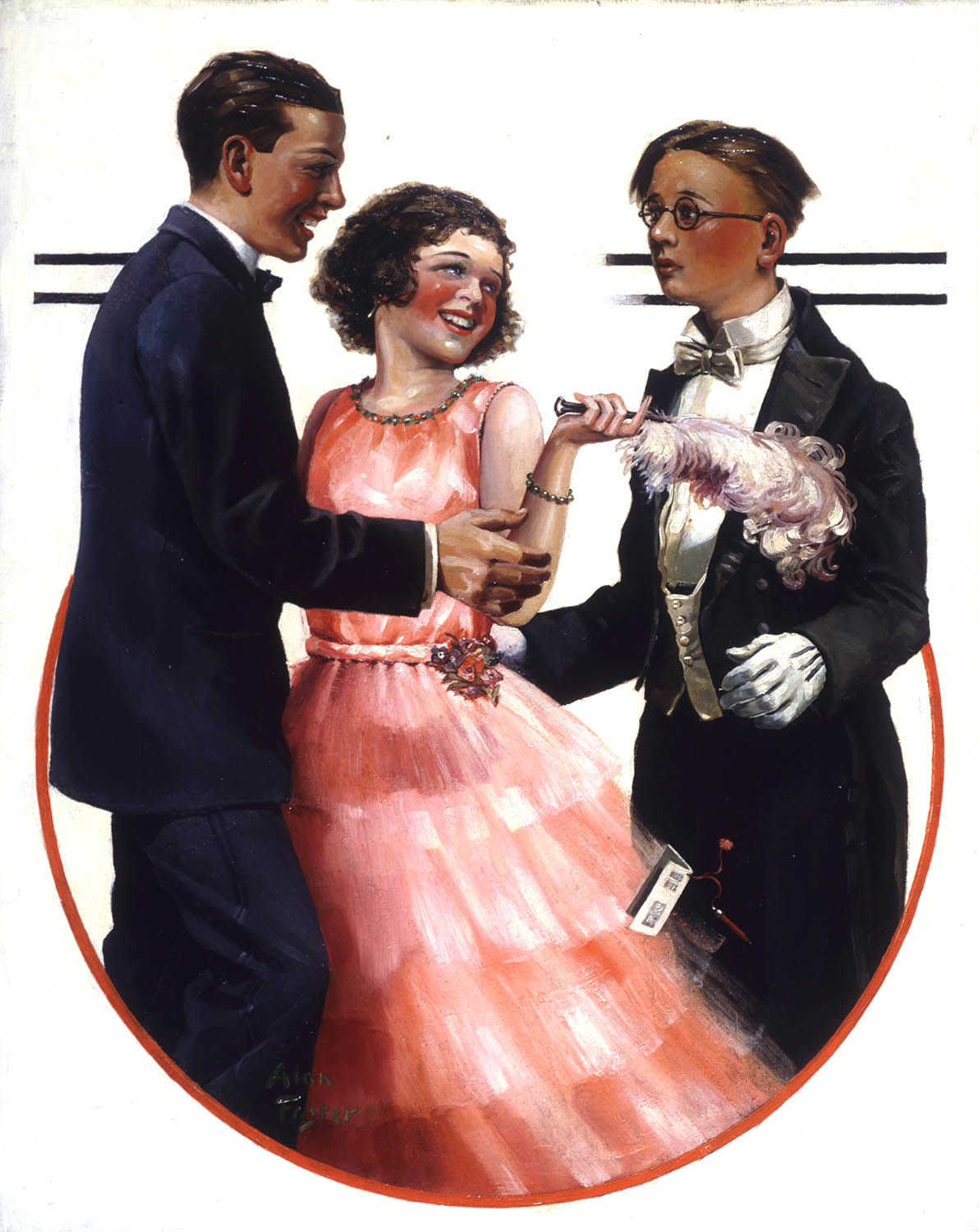
Alan Stephens Foster (1892-1969)
The Dance Card
1923, oil on canvas
26" x 21", signed lower left
Saturday Evening Post, September 15, 1923 cover
Alan Stephens Foster’s The Dance Card evokes the excitement, romance, and social rituals of a young woman’s teenage years. For Judy, growing up in New Haven, Connecticut, meant a busy social calendar filled with dances, dates, sports, and summer afternoons at the Country Club. Her teenage diaries, filled with amusing declarations, romantic ambitions, and candid observations, offer a delightful glimpse into her youthful personality. Looking back decades later, Judy reflects with humor and affection on these formative years, when she was beginning to discover her independence and find her place in the world.
Alan Stephens Foster was an accomplished American illustrator whose work appeared in many of the nation's leading magazines, including The Saturday Evening Post. Known for his engaging portrayals of everyday life, social interactions, and fashionable society, Foster brought humor and personality to his illustrations. Painted for the September 15, 1923 cover of The Saturday Evening Post, The Dance Card recalls the tradition of formal dances, when young women recorded their dance partners on small cards, a charming symbol of the courtship customs and social conventions of an earlier era.
Yes, it was challenging to take care of two small children, but I saw us as a fun-loving trio, and I never thought about what we didn’t have or couldn’t afford. I was resourceful and always figured out how to get what we needed. I was so frugal at home that I stored the ketchup bottle upside down so we could use every drop and even dried and reused paper towels instead of throwing them away. I sewed patches on my children’s clothes. If I was absolutely forced to get something new, I bought unisex clothes for Jennifer so she could pass them down to her brother. I’d cut any corner if it meant saving a little money, and I was very good at it.
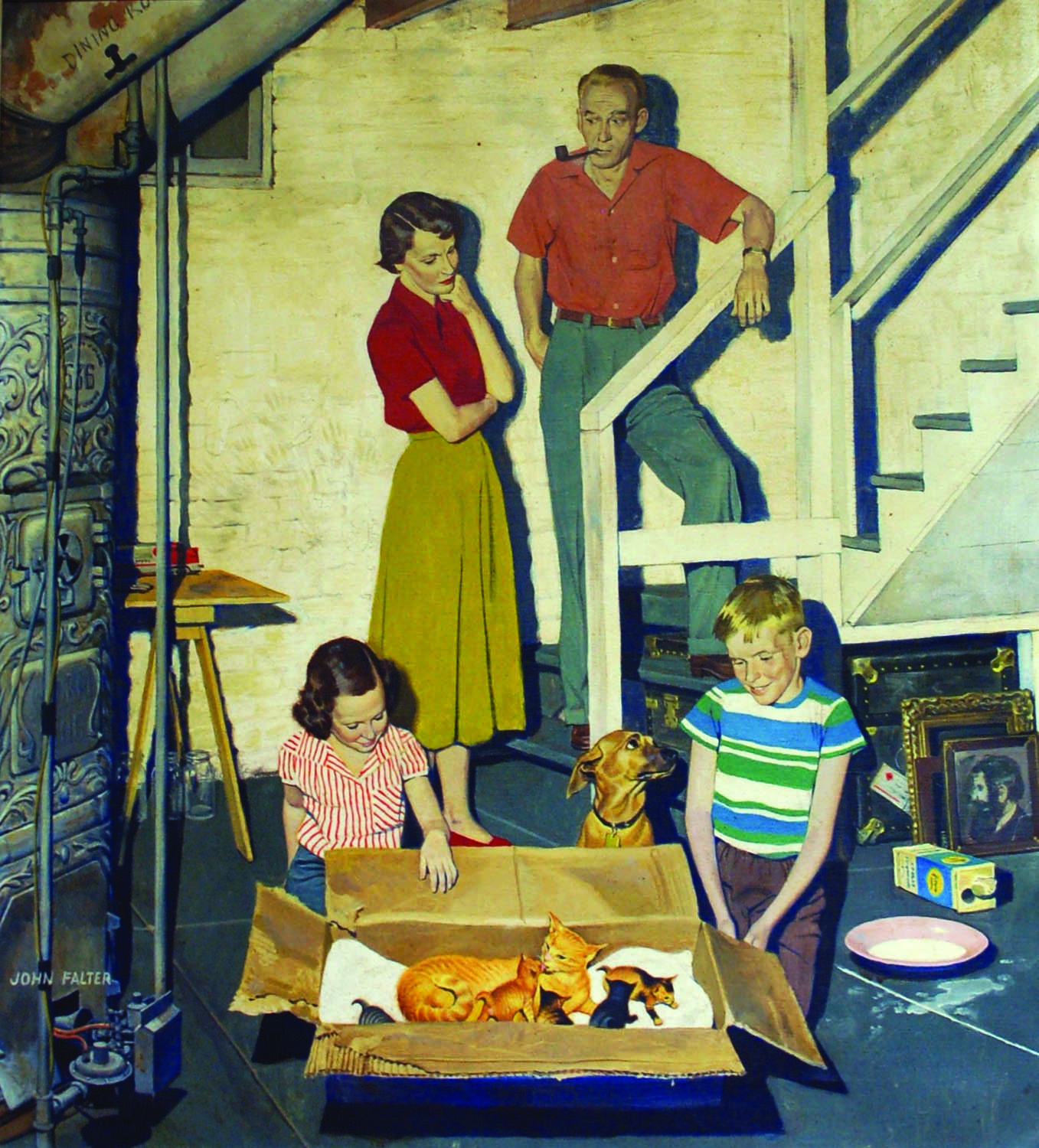
John Falter (1910-1982)
Kittens in the Basement
1954, oil on canvas
23 1/2" x 21 1/2", signed lower left
Saturday Evening Post, January 8, 1955 cover
John Falter’s Kittens in the Basement captures an idyllic scene of American family life in the 1950s, as a mother, father, daughter, and son gather together to care for their pet cat and her kittens. The warmth and simplicity of this domestic moment reflect the family life Judy had built with her own young children. Although financial circumstances were often challenging, Judy approached motherhood with resourcefulness, creativity, and optimism. Her determination to make the most of what they had, even when it meant saving every last drop of ketchup or reusing paper towels, reveals the ingenuity and perseverance that would later serve her so well in her career.
John Falter was one of the most prolific and beloved illustrators of the twentieth century, best known for his more than 120 covers for The Saturday Evening Post. His paintings celebrated the everyday experiences of American life, often depicting families, children, and small-town communities with warmth, humor, and an extraordinary attention to detail. Painted in 1954 for the January 8, 1955 cover of The Saturday Evening Post, Kittens in the Basement exemplifies Falter’s ability to transform an ordinary family moment into a charming and timeless image of domestic happiness.
I found a few pieces of furniture that looked promising, then spotted some frames leaning against the back wall. I pulled them out: law degrees, certificates, awards, and then ... something completely different! A framed image.
I wiped the dust off the glass to have a better look. It was an etching of a man, a debonair Casanova type from the 18th century, dancing with a woman dressed for a costume ball, her head thrown back in an ecstatic pose. Primarily black and white, except for the woman’s cascading red hair and the coy pink heel of her shoe. And wait, was that a naked breast peeking out from her bodice? I saw the artist’s signature in the lower corner. Louis Icart.
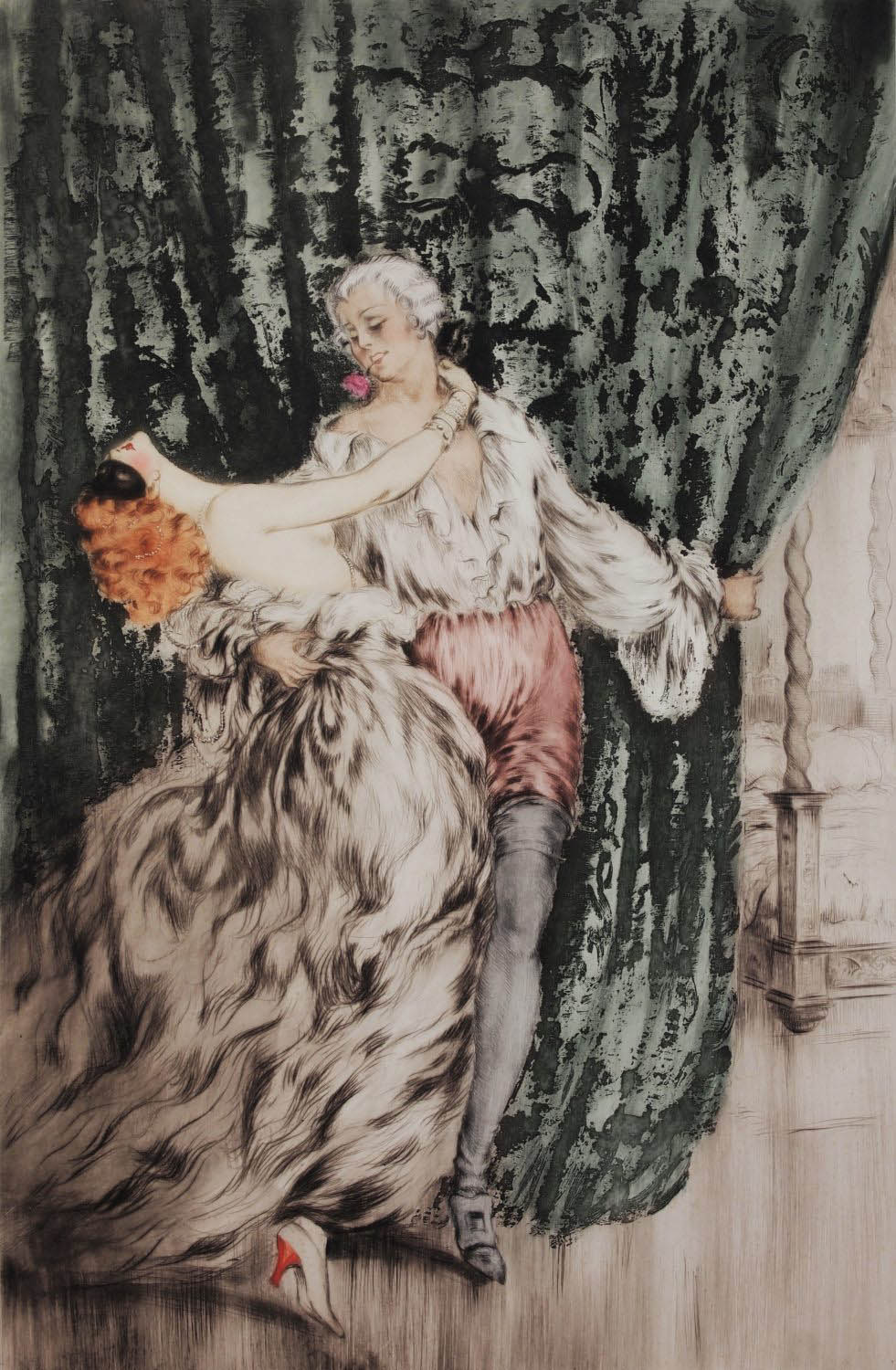
Louis Icart (1888-1950)
Casanova
1928, etching
A chance discovery at her in-laws would become a turning point in Judy’s life. While searching for inexpensive furnishings, she stumbled upon an intriguing framed etching by French artist Louis Icart. Captivated by its elegance, playful sensuality, and distinctive style, Judy recognized something special in an artwork that might otherwise have been overlooked. This unexpected encounter sparked a curiosity about art that would ultimately lead her far beyond home decorating and into the world of collecting and dealing in fine art.
Louis Icart was a celebrated French painter and printmaker whose elegant, romantic images epitomized the glamour and sophistication of the Art Deco era. Particularly renowned for his finely executed color etchings, Icart frequently depicted fashionable women in theatrical, flirtatious, and sometimes provocative settings. Created in 1928, Casanova exemplifies his distinctive style, combining delicate linework, subtle touches of color, and a playful sense of romance. For Judy, this captivating image represented far more than an attractive decorative object: it was an early discovery that helped set the course for an extraordinary career in art.
Instead of being discouraged, I started thinking analytically. What if I did something original and claimed a market that wasn’t crowded? Or, if I created a market that didn’t yet exist? First, I thought I would try early American modern paintings. But, after purchasing a Max Weber for $7,500, that genre also proved to be difficult to acquire within my budget... I thought back to my scavenger hunts at flea markets, a time when I shuffled through pounds of paper, looking for prints. I’d come across other artists whose works spoke to me. Many of them were American illustrators, the artists who created popular images for the country’s leading magazines, newspapers, and book publishers. The original artworks for illustrations weren’t always easy to find; however, when I did locate them, or they were offered to me, I knew I could afford them.
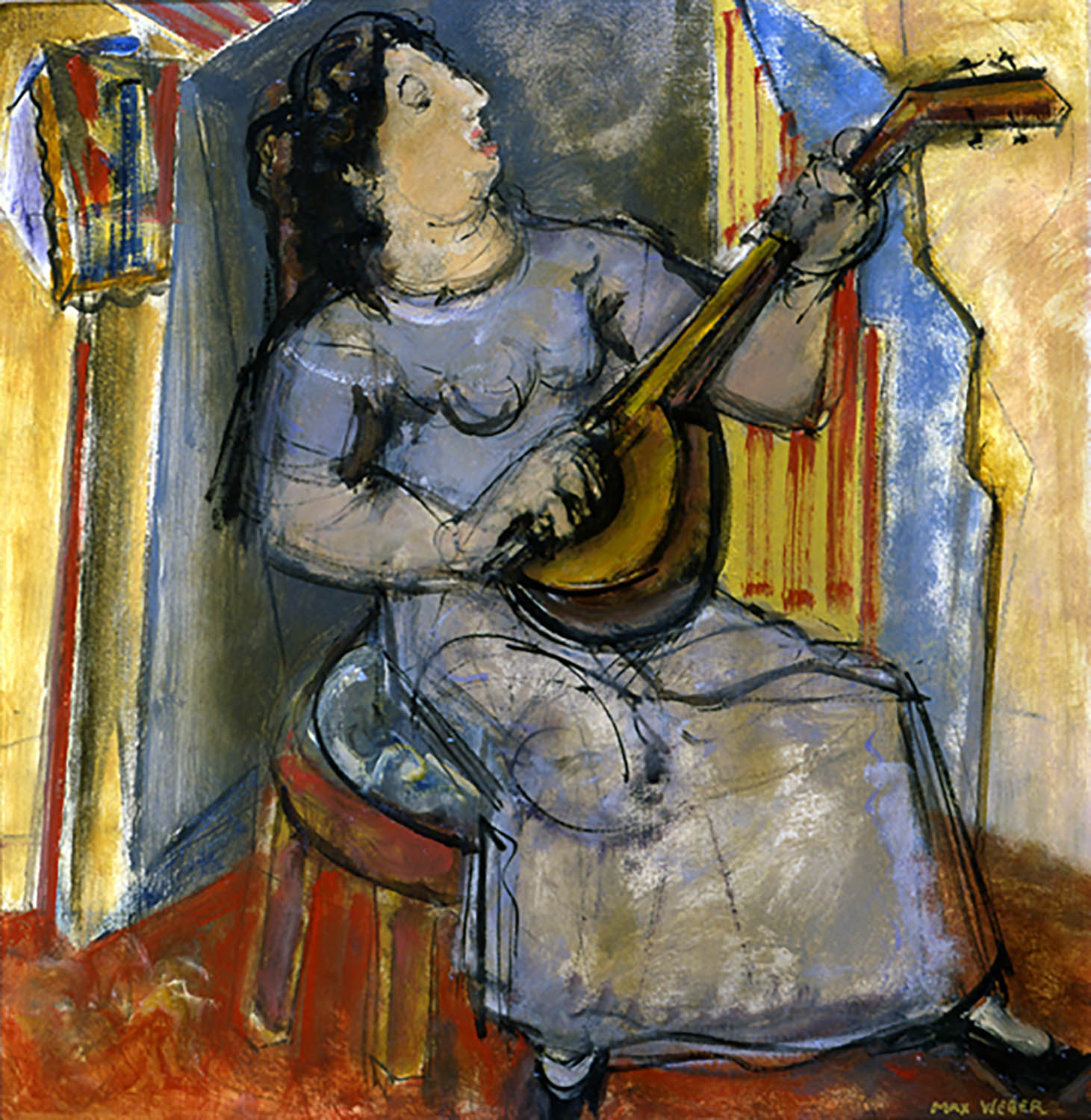
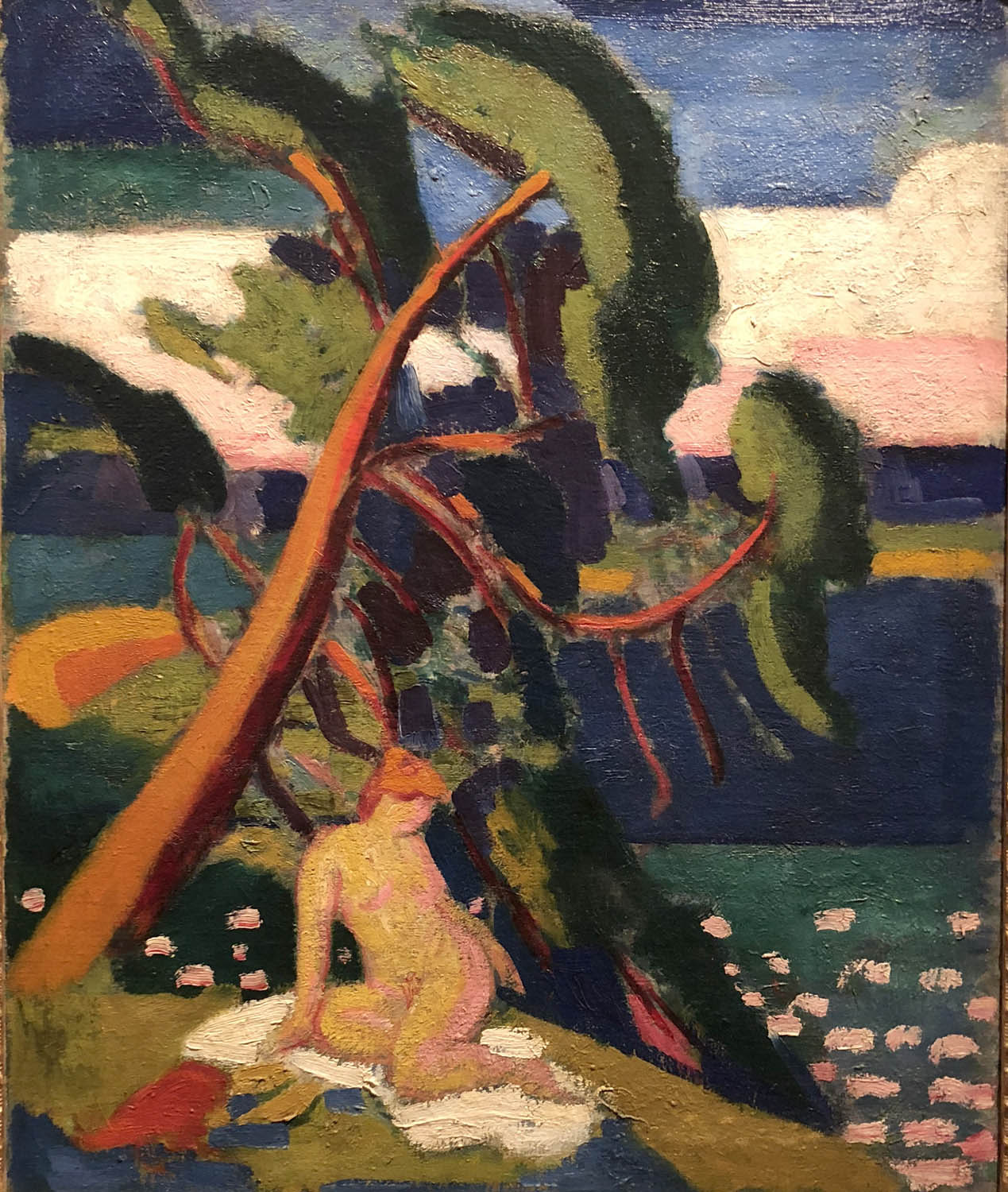
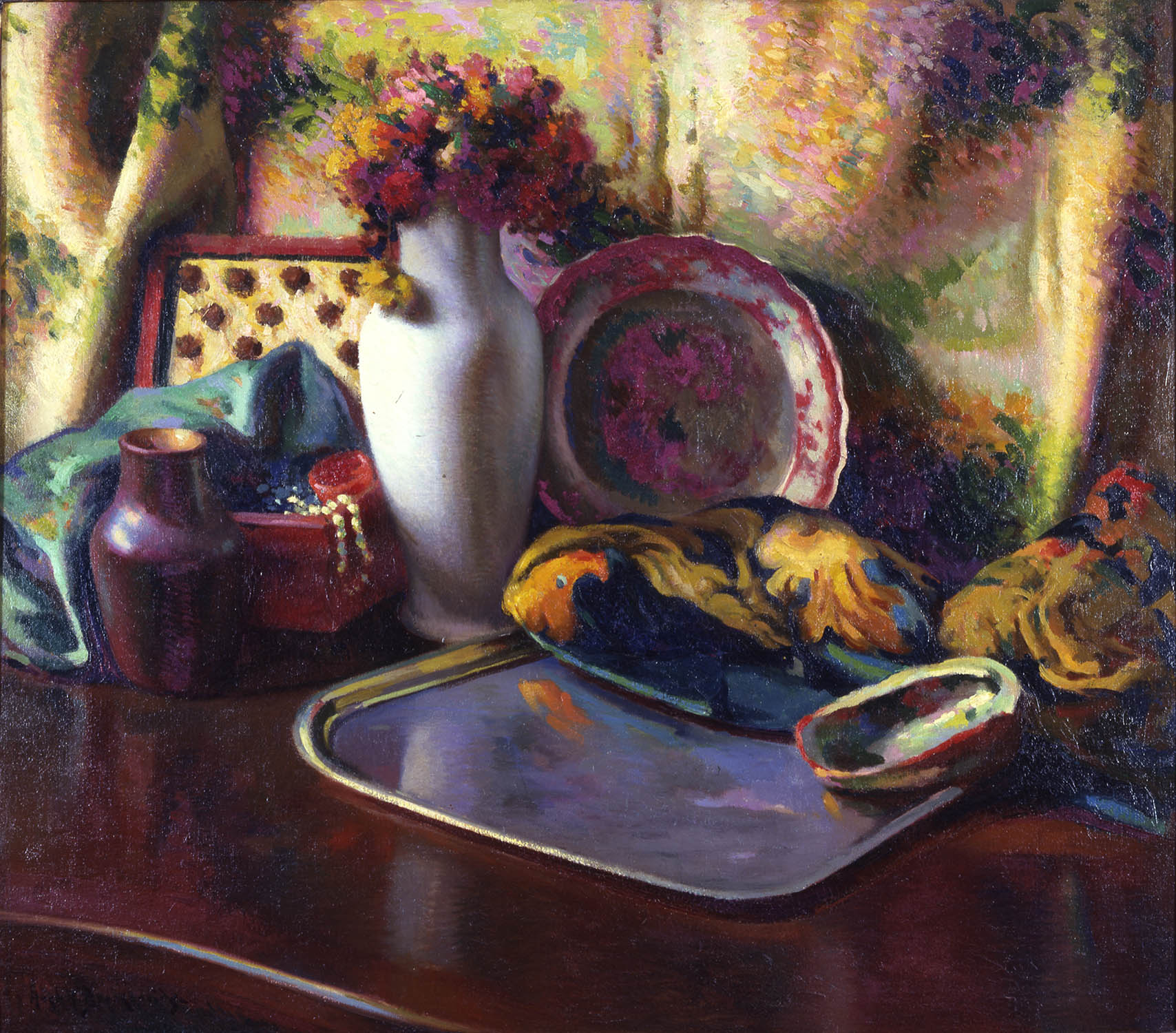
Max Weber (1881-1961)
Improvisation
oil on board
22" x 21", signed lower right
Carl Newman (1858-1932)
Nude Under Tree
1910, oil on canvas
32" x 26"
Hugh H. Breckenridge (1870-1937)
The White Vase
1913, oil on canvas
32" x 36", signed lower right
As Judy began establishing herself in the art world, she quickly recognized the challenges of competing in an already expensive market. Rather than being discouraged, she saw an opportunity to forge her own path. Her early interest in American modernism introduced her to artists such as Max Weber, Carl Newman, and Hugh H. Breckenridge, whose works reflected the experimentation and evolving artistic movements of the early twentieth century. Yet the difficulty of acquiring these paintings within her limited budget inspired a pivotal realization: instead of competing for artworks that were already highly valued, why not recognize the potential of those the art market had overlooked? This independent thinking would ultimately lead Judy to champion the forgotten masters of American illustration.
Max Weber, Carl Newman, and Hugh H. Breckenridge represent distinct approaches to American art during a period of remarkable artistic change. Weber was a pioneering American modernist whose work embraced abstraction and European avant-garde influences. Newman explored the human figure through expressive compositions, while Breckenridge was celebrated for his vibrant color, innovative technique, and contributions to American Impressionism and modernism. Together, Improvisation, Nude Under Tree, and The White Vase illustrate the range of artistic styles Judy encountered as she developed her eye as a collector and dealer. These early explorations helped shape her understanding of the art market and ultimately guided her toward the field in which she would make her greatest impact: American illustration.
I decided to begin my search with the artists Charles Dana Gibson, Howard Chandler Christy, and James Montgomery Flagg... The closer I looked, the more I was struck by the talent and artistry of these illustrators, whose works were dismissed as disposable because they usually appeared in newspapers and magazines. Because illustrators were commercial artists, meaning they were commissioned for jobs and actually got paid for them, they weren’t taken as seriously as “fine” artists. Flagg himself summed up the situation succinctly, saying: “The only difference between a fine artist and an illustrator is that the latter can draw, eats three square meals a day, and can afford to pay for them.” Norman Rockwell said: “We do ourselves a disservice by calling ourselves illustrators. We are artists first.” Andy Warhol ran into the same prejudice at the beginning of his career, when he made a remarkable income as a commercial artist—enough to own a brownstone in Manhattan—but, unfortunately, he could not earn the respect he deserved from the art world establishment of his day.
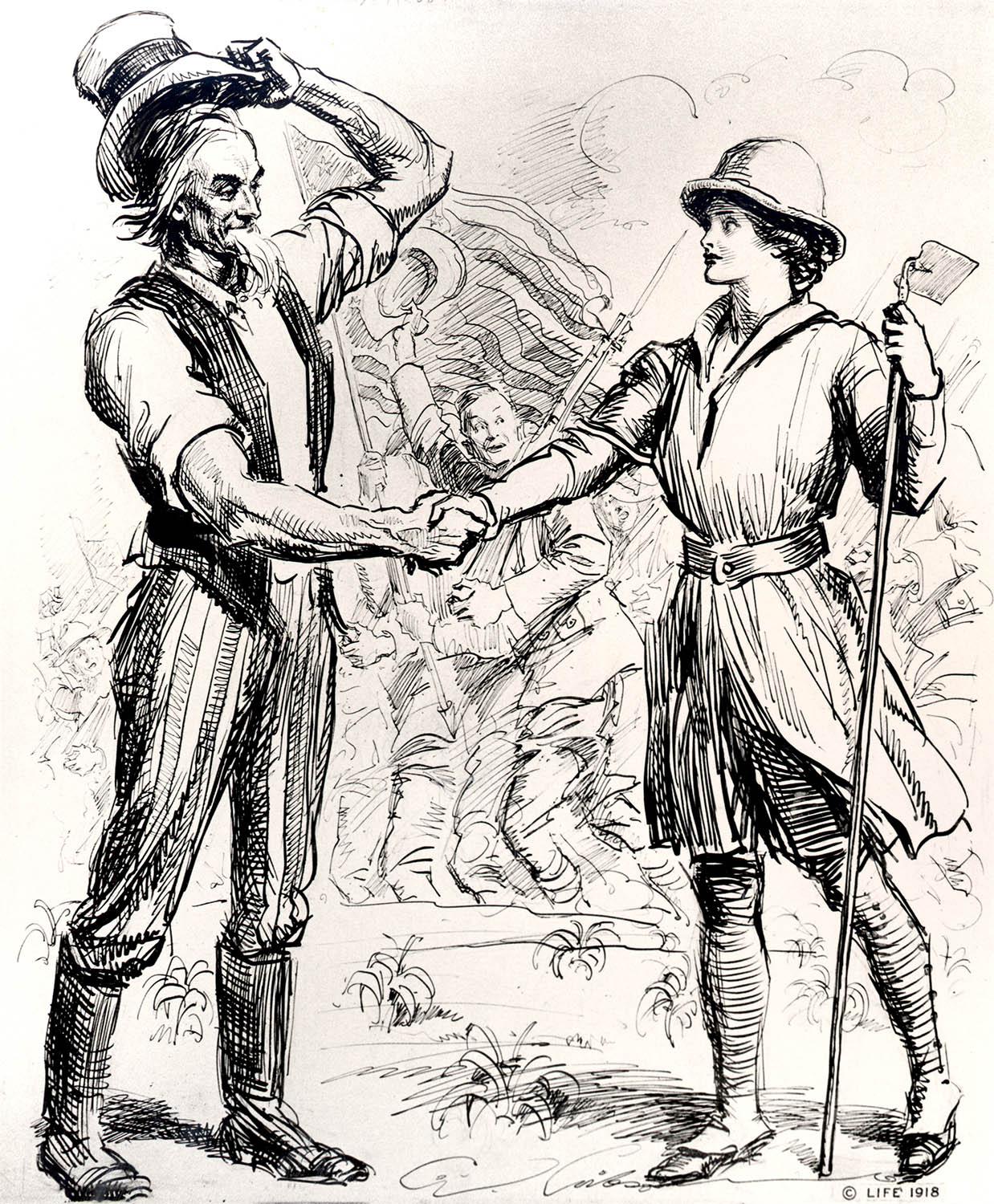
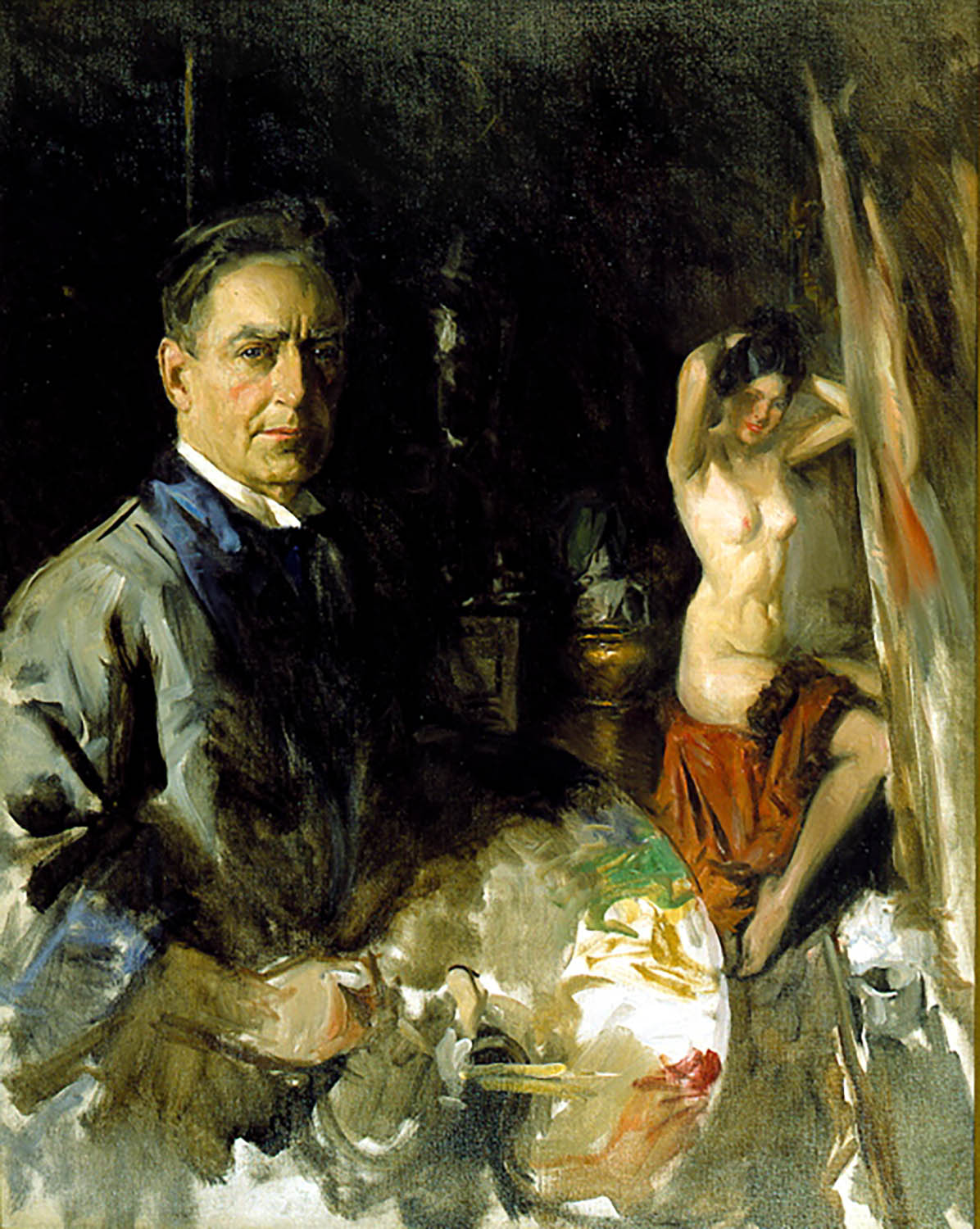
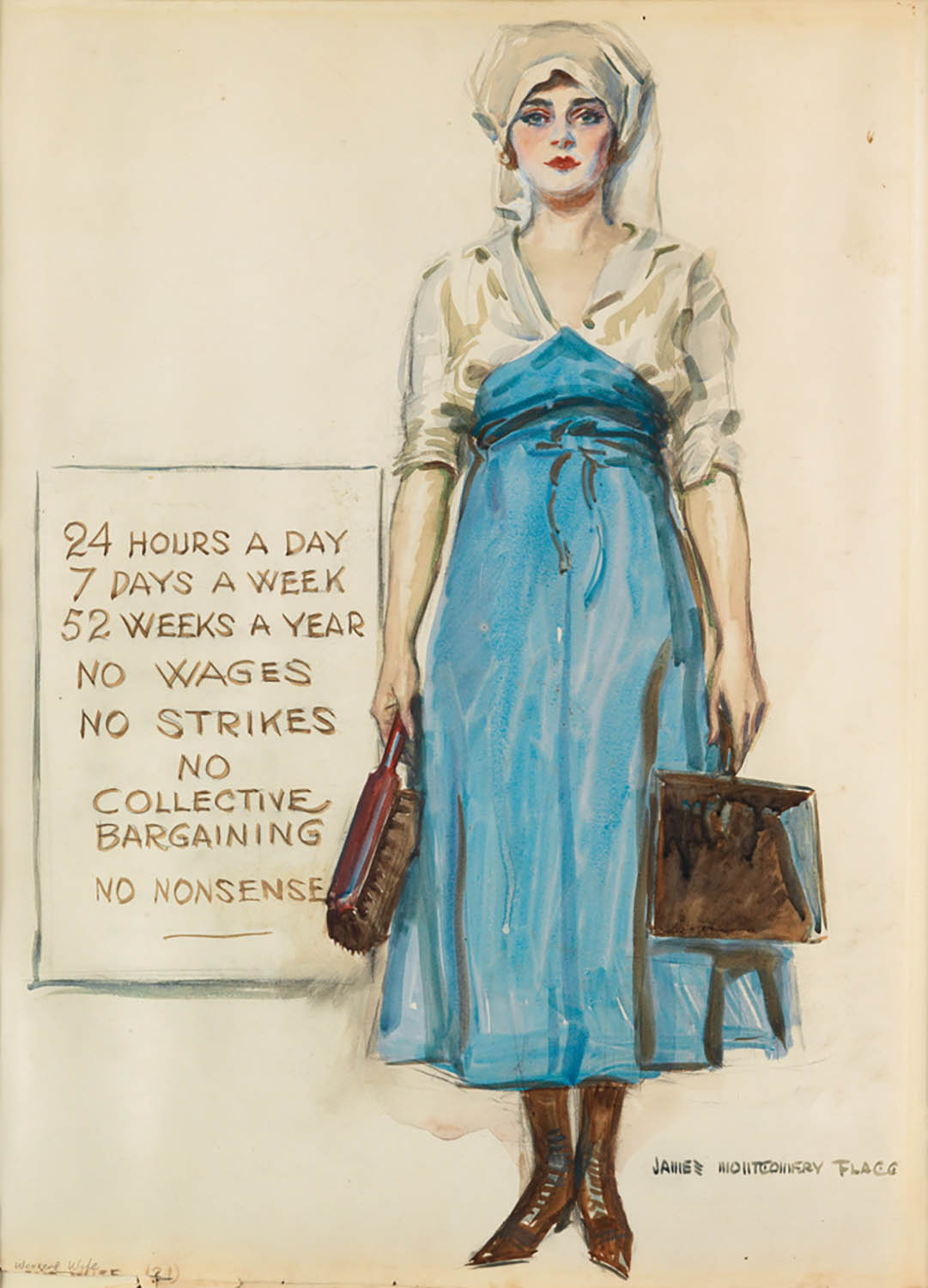
Charles Dana Gibson (1867-1944)
Help! The Women's Land Army of America
1918, pen and ink on board
23 1/4" x 19 1/4", signed lower center
Life Magazine, May 23, 1918 cover
World War I poster
Howard Chandler Christy (1873-1952)
Self-Portrait with Model, Elise
c. 1935, oil on canvas
50" x 40"
James Montgomery Flagg (1877-1960)
Friend Wife
1920, graphite and watercolor on paper
26 1/2" x 19 1/2", signed lower right
Judge Magazine, May 8, 1920 cover
As Judy began exploring the world of American illustration, she turned her attention to three of its most celebrated figures: Charles Dana Gibson, Howard Chandler Christy, and James Montgomery Flagg. Their extraordinary artistic abilities and widespread popularity stood in stark contrast to the art establishment’s dismissive attitude toward commercial illustration. Judy recognized that these artists, whose images had helped define American culture for generations, deserved the same appreciation and recognition afforded to traditional fine artists. What others saw as disposable commercial work, she saw as original masterpieces worthy of collecting, preserving, and exhibiting. This conviction would become the foundation of her pioneering career and her mission to elevate American illustration within the fine art world.
Charles Dana Gibson, Howard Chandler Christy, and James Montgomery Flagg were among the most influential illustrators of the Golden Age of American Illustration, each helping shape the nation's visual identity. Gibson became famous for his elegant portrayals of the independent American woman known as the "Gibson Girl," while Christy was celebrated for his glamorous portraits, patriotic imagery, and depictions of the idealized “Christy Girl.” Flagg, a prolific illustrator and portraitist, was renowned for his wit, expressive draftsmanship, and iconic wartime imagery. Gibson’s Help! The Women’s Land Army of America (1918), Christy’s Self-Portrait with Model, Elise (c. 1935), and Flagg’s Friend Wife (1920) demonstrate the remarkable versatility of these artists, from patriotic appeals and sophisticated portraiture to humorous observations of contemporary society. Together, they exemplify the artistic excellence and cultural significance that Judy recognized in American illustration long before the broader art market embraced it.
I came across a collection of paintings by Philip R. Goodwin, an illustrator who was best known for his depictions of hunting, fishing, and other manly activities in the American wilderness... I drove to Bristol to see the lot, which included a Bristol Steel Fishing Rod painting by N. C. Wyeth... I knew collectors were interested in his work, and I was certain I could sell the N.C. Wyeth fishing painting for a profit if I could come up with the money to buy the collection...
That was a big “if.” The heirs wanted about $7,000, more money than I had on hand. However, I knew it was a safe investment. I asked my father for a loan. He explained that it was time to take my business to the next level. If I needed financing, I should go to a bank and ask for more than the purchase price, so I would have funds for framing and other expenses. His advice seemed sound except for one detail: I had no collateral to guarantee the amount. My father helped me out this time by co-signing. But moving forward, when I had more inventory, I would be able to use the art I owned to obtain financing to purchase more art. It was a very valuable lesson from an experienced businessman.
I bought the Bristol collection, and, as I predicted, sold them for a profit. I tripled the amount I paid for the paintings, because the Wyeth alone sold for $10,000. This quick sale allowed me to repay the bank, relieving the debt and my obligation to my father, which gave me a great sense of accomplishment and relief.
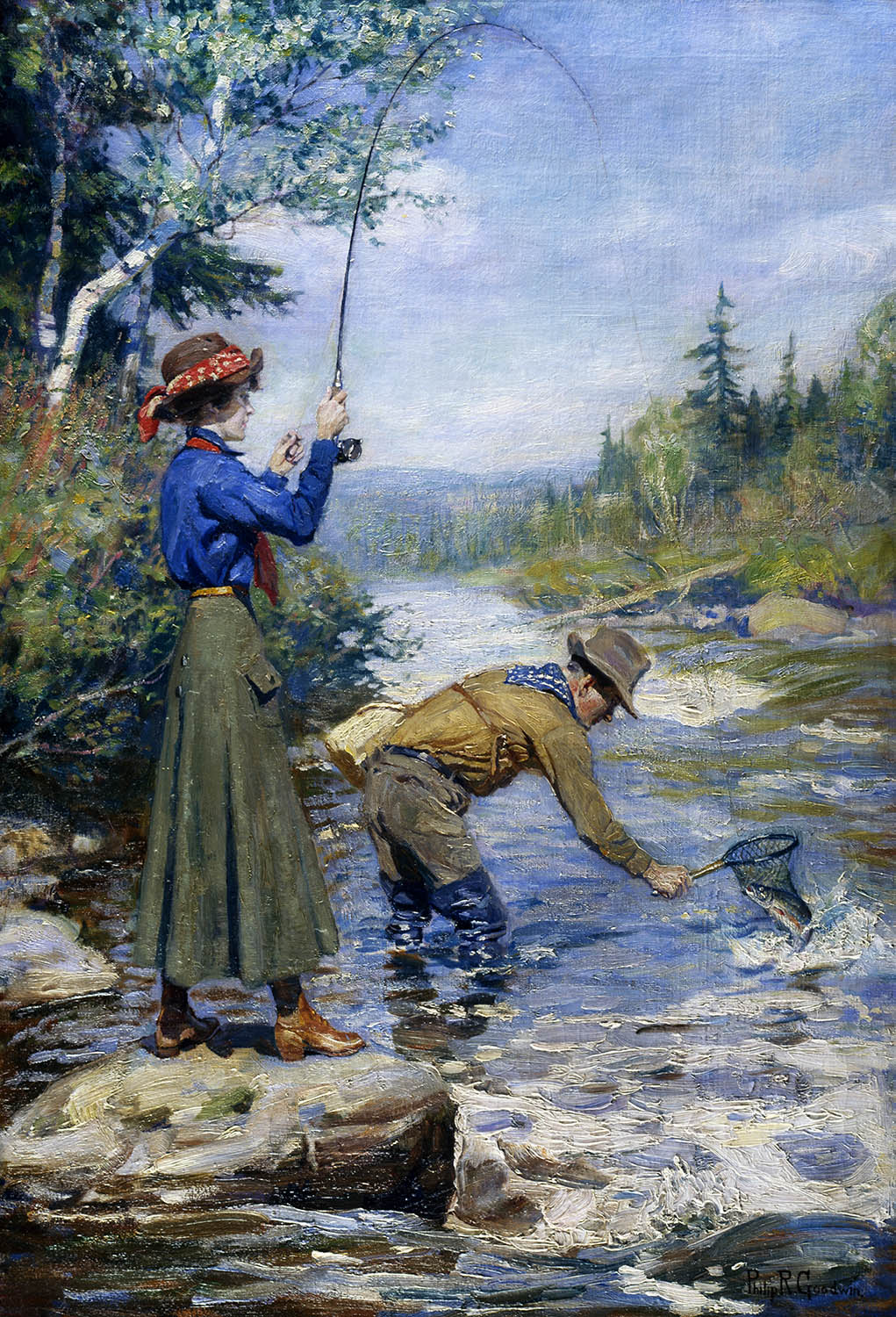
Philip R. Goodwin (1881-1935)
Lucky Catch
1910, oil on canvas
36" x 25", signed lower right
Horton Steel Fishing Rod advertisement
An opportunity to purchase a collection of sporting illustrations became an important milestone in Judy’s developing career as an art dealer. Among the paintings was a N.C. Wyeth, whose growing popularity convinced Judy that the collection represented a promising investment. Although she lacked the funds to make the purchase, her father encouraged her to approach a bank for financing, offering to co-sign the loan. His advice taught her an invaluable lesson about using borrowed capital to grow a business. Judy’s instincts proved correct: she sold the paintings for three times their purchase price, repaid the loan, and gained the confidence to pursue increasingly ambitious acquisitions.
Philip R. Goodwin was a prominent American illustrator celebrated for his dramatic depictions of hunting, fishing, wildlife, and outdoor adventure. His paintings appeared in leading magazines and advertisements, helping popularize the romantic image of the American wilderness during the early twentieth century. Goodwin was particularly admired for his ability to capture the excitement and rugged spirit of sporting life, often portraying hunters and fishermen in richly detailed natural settings. Created in 1910 for a Horton Steel Fishing Rod advertisement, Lucky Catch exemplifies the sporting imagery that made Goodwin so successful and represents the type of illustration that played an important role in Judy’s early discoveries as an art dealer.
My new acquisition inspired me to take on a new challenge, mounting my first exhibition at the gallery: Norman Rockwell: An American Tradition. The show would be my coming-out party. A chance to display works by the artist who was becoming my specialty, and an occasion to celebrate my newfound independence. “I’m nervous,” I confided to my diary late one night, adding: “It’s going to be expensive, but I know down the road it will be so good for me, so important.”
In my introduction to the catalogue, I paid tribute to Rockwell’s enduring genius, writing, “The combination of the unique and familiar in these works provide us with wonderfully vivid images of vanishing America. His views of American history, both political and social, spanning over fifty years, are indelibly etched in our memories.”
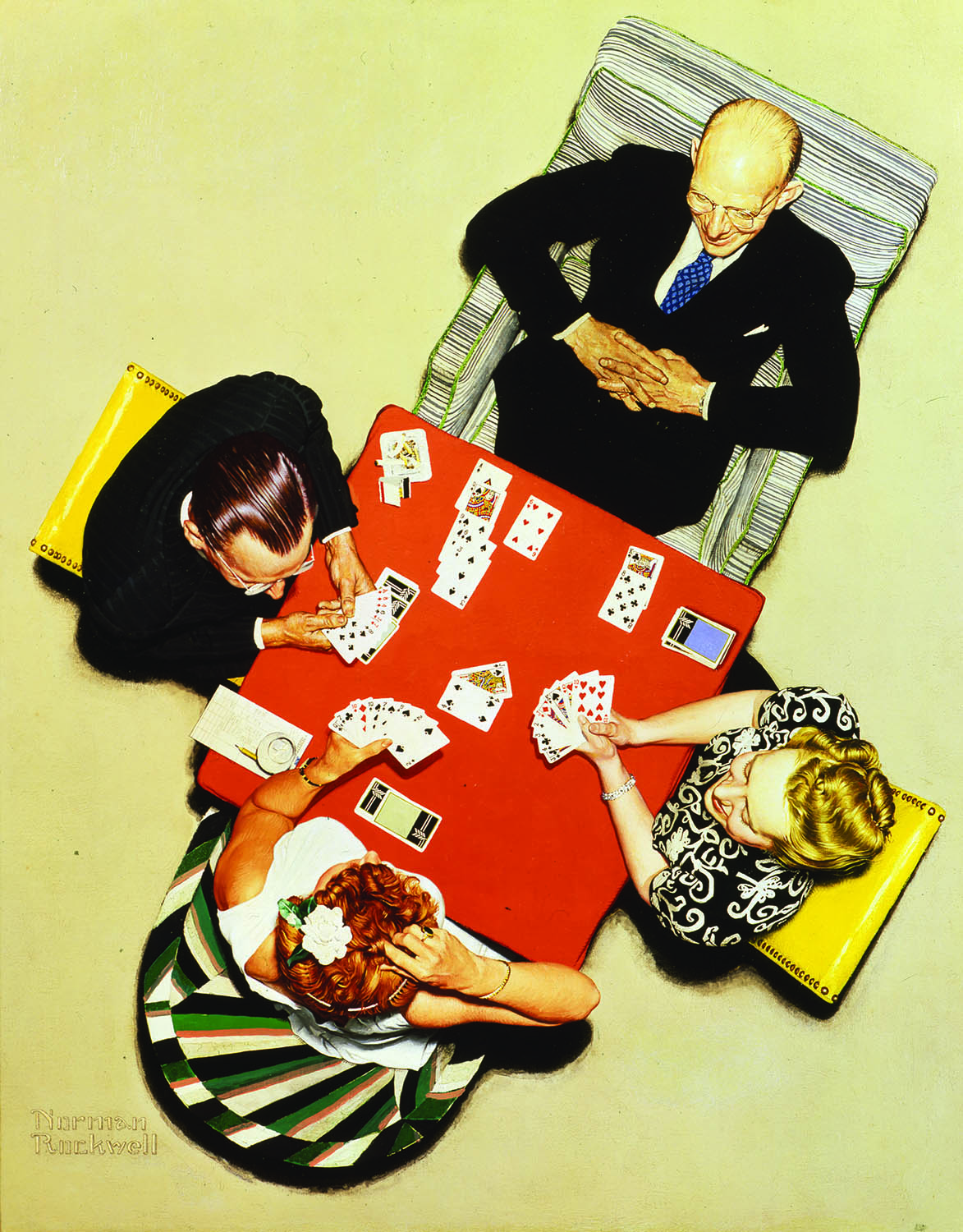
Norman Rockwell (1894-1978)
Bridge Game - The Bid
1948, oil on canvas
46 1/2" x 38 1/2", signed lower left
Saturday Evening Post, May 15, 1948 cover
Judy’s first gallery exhibition, Norman Rockwell: An American Tradition, marked a defining moment in her career as an art dealer. Having recognized Rockwell’s extraordinary artistic talent and cultural significance at a time when his work was still dismissed by much of the fine art establishment, Judy was determined to present his paintings with the recognition they deserved. The exhibition was both a professional milestone and a personal triumph, celebrating her growing expertise, entrepreneurial independence, and confidence in her vision. It also helped establish Rockwell as a central figure in Judy’s career and reinforced her commitment to elevating American illustration to its rightful place in art history.
Norman Rockwell was one of America’s most beloved and influential artists, celebrated for his remarkable ability to capture the humor, humanity, and everyday experiences of American life. Over nearly five decades, his illustrations graced more than 300 covers of The Saturday Evening Post, creating an enduring visual record of twentieth-century America. Painted for the magazine’s May 15, 1948 cover, Bridge Game – The Bid exemplifies Rockwell’s gift for visual storytelling, transforming a familiar social pastime into an engaging scene filled with personality, subtle humor, and expressive detail. His extraordinary attention to gesture and human expression invites viewers to imagine the unfolding drama, demonstrating the artistic mastery and narrative brilliance that Judy championed throughout her career.
I never imagined the American Illustrators would take me to the far corners of the world, but that is exactly what happened when a gentleman named Shabbata called to see if I would be interested in sending a Rockwell show to Japan. The idea immediately appealed to me because, again, I thought it paralleled what happened to nineteenth-century American artists when they had to establish their reputations in Europe before they won acceptance at home. My artists had to go all the way to Japan, but the distance was not a problem because my wanderlust was intense, and I was eager to introduce Rockwell to a new audience...
There was only one snag. When we were hanging the show, I warned Shabbata-san to leave a lot of room around Rockwell’s April Fools: Girl with Shopkeeper... It was one of the artist’s most popular works, and, as I had seen at the exhibition in Cortina, people loved to stand in front of it, searching for every one of the intentional mistakes. They stood so close to the painting—often excitedly reaching out to touch it—that we had to put a rope in front of it. However, at Isetan, Shabbata-san ignored my advice and placed the painting in a corner, where it was a literal showstopper, creating a constant bottleneck. Crowds gathered as people waited their turn to play detective.
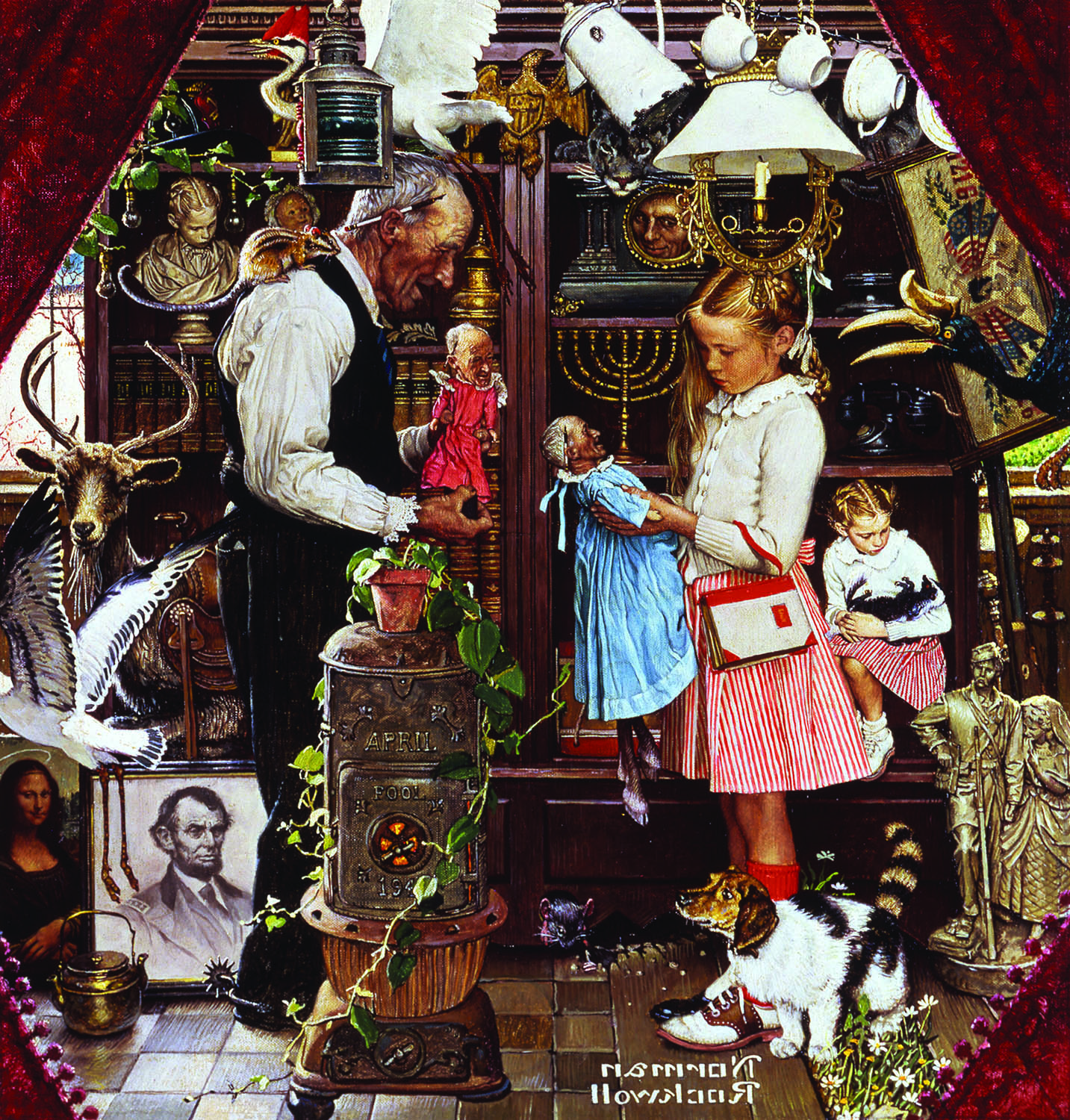
Norman Rockwell (1894-1978)
April Fools - Girl with Shopkeeper
1948, oil on canvas
18" x 17", signed lower center right
Saturday Evening Post, April 3, 1948 cover
Judy Goffman Cutler’s passion for American illustration soon carried her beyond the United States, as she began organizing exhibitions to introduce Norman Rockwell and other American illustrators to international audiences. One particularly memorable exhibition took her to Japan, where Rockwell’s beloved imagery captivated visitors and demonstrated the universal appeal of his storytelling. The enthusiastic response was especially evident in the crowds that gathered around April Fools – Girl with Shopkeeper, eagerly searching for the cleverly disguised mistakes hidden throughout the painting. What Judy had anticipated as a popular attraction became an unexpected logistical challenge, as visitors crowded into a corner of the gallery, determined to discover every visual trick.
Norman Rockwell delighted in creating his annual April Fools’ Day illustrations for The Saturday Evening Post, filling seemingly ordinary scenes with amusing impossibilities, unexpected details, and deliberate visual errors. Published on the April 3, 1948 cover, April Fools – Girl with Shopkeeper invites viewers to become detectives, carefully examining the composition to identify the artist’s many playful tricks. Rockwell’s extraordinary attention to detail and sense of humor transformed these illustrations into interactive experiences, encouraging audiences to look more closely and engage directly with his art. The painting’s tremendous popularity in Japan demonstrated how Rockwell’s wit and imagination could transcend language and cultural boundaries.
As soon as I walked into Vernon Court, I knew this was something special... Walking from one beautiful room to another, I realized it was the perfect backdrop for my vast collection of American Illustrators. I loved the expanse of empty walls. I was already planning on hanging the paintings “salon style,” as I had done in my Gilded Age home in New York.
Then I stepped into the light-filled North Loggia and realized it could house the jewel of my collection, Maxfield Parrish’s eighteen-panel mural, A Florentine Fete. He created the ten-foot-high panels for the Girls’ Dining Room in the Stanford White-designed Curtis Building in Philadelphia, and they embody all things Parrish—romance, fantasy, mystical figures, and magical landscapes, rendered in a stunning palate of colors.
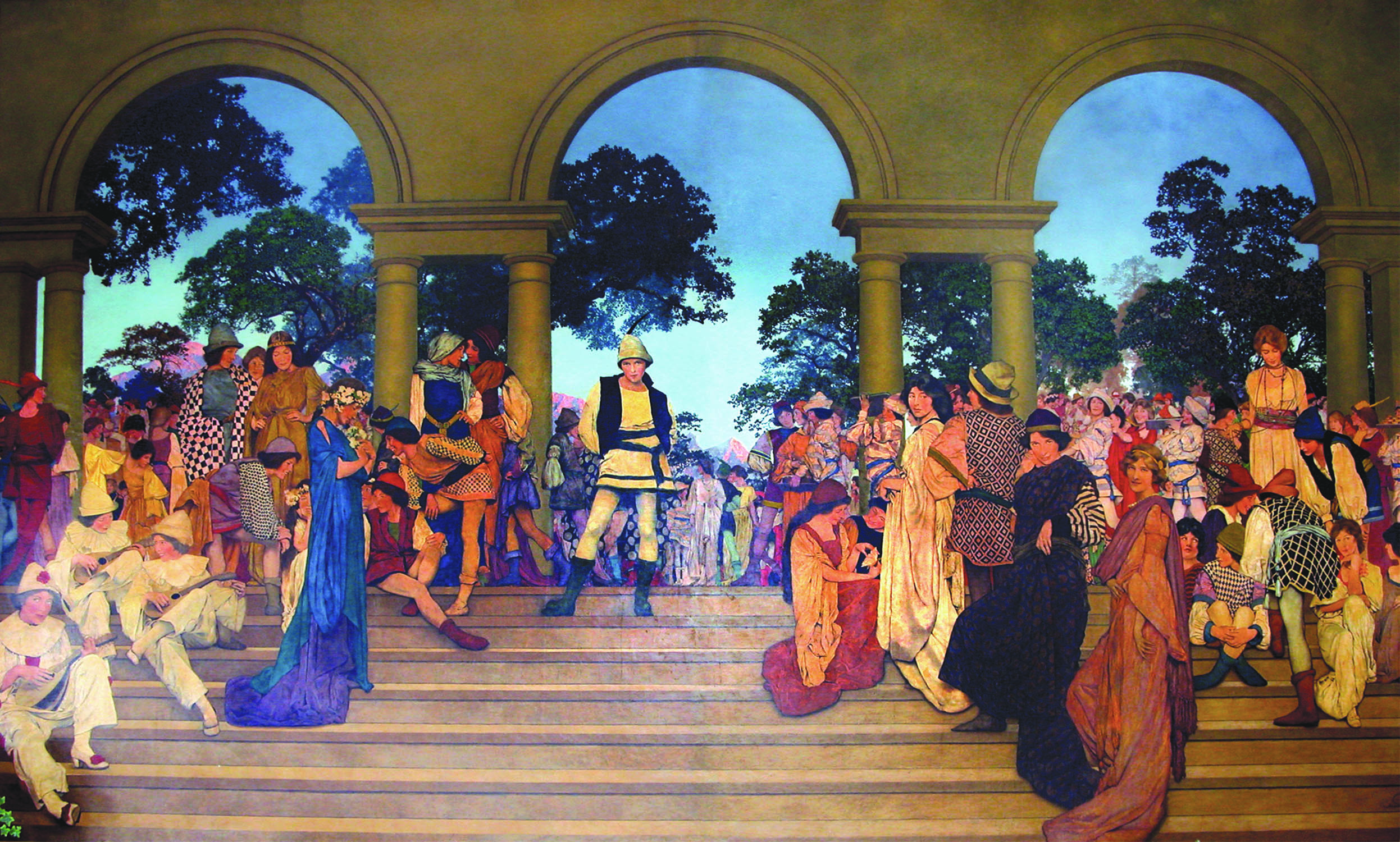
Maxfield Parrish (1870-1966)
A Florentine Fete
1916, oil on canvas
126" x 207", signed and dated lower right
Mural for Girls' Dining Room, Curtis Publishing Company, Philadelphia, PA
The discovery of Vernon Court, a magnificent Gilded Age mansion in Newport, Rhode Island, marked another extraordinary chapter in Judy’s journey. As she explored its grand rooms and expansive walls, Judy immediately envisioned a permanent home for her growing collection of American illustration. The mansion’s architectural splendor provided an ideal setting for the masterpieces she had spent decades acquiring and championing. Most exciting was the light-filled North Loggia, which offered the perfect space to display one of her collection’s greatest treasures, Maxfield Parrish’s monumental A Florentine Fete. Judy’s vision transformed Vernon Court into the National Museum of American Illustration, creating a lasting home dedicated to celebrating and preserving this important chapter of American art history.
Maxfield Parrish was one of the most celebrated American illustrators of the early twentieth century, renowned for his luminous colors, enchanting landscapes, and imaginative compositions. Commissioned in 1916 for the Girls’ Dining Room of the Curtis Publishing Company’s headquarters in Philadelphia, A Florentine Fete is an extraordinary eighteen-panel mural inspired by the pageantry and romance of Renaissance Italy. Its theatrical figures, elaborate architecture, and brilliant colors exemplify Parrish’s distinctive artistic vision. The monumental mural found a new home at Vernon Court, where its magnificent scale and fantastical imagery complement the grandeur of the historic mansion. Today, A Florentine Fete remains one of the National Museum of American Illustration’s most spectacular and treasured works of art.
The lawsuit centered around Norman Rockwell’s painting, Russian Schoolroom, which I bought in 1988. The suit was initiated by Jack Solomon, a gallery owner who claimed the painting was stolen from him in 1973. The FBI was investigating the theft. Few lawsuits are straightforward, but in the beginning of 2007, the battle over Russian Schoolroom turned into a veritable Russian Nesting Doll of a case, with complex layers of secrets, lies, and injustices. Unfortunately, I had to work my way through each and every layer before I would uncover the truth.
To make matters worse, there were parallel histories—surreal parallel histories—of what I knew as opposed to what Jack Solomon, my accuser, knew and concealed, and what the FBI knew and suppressed. This story is almost as difficult to tell as it was to live. The case had an ever-expanding cast of characters, locations spanning St. Louis, New Orleans, Newport, Hollywood, New York, England, and Las Vegas. And, incredibly, alleged ties to the assassination of Martin Luther King, Jr.
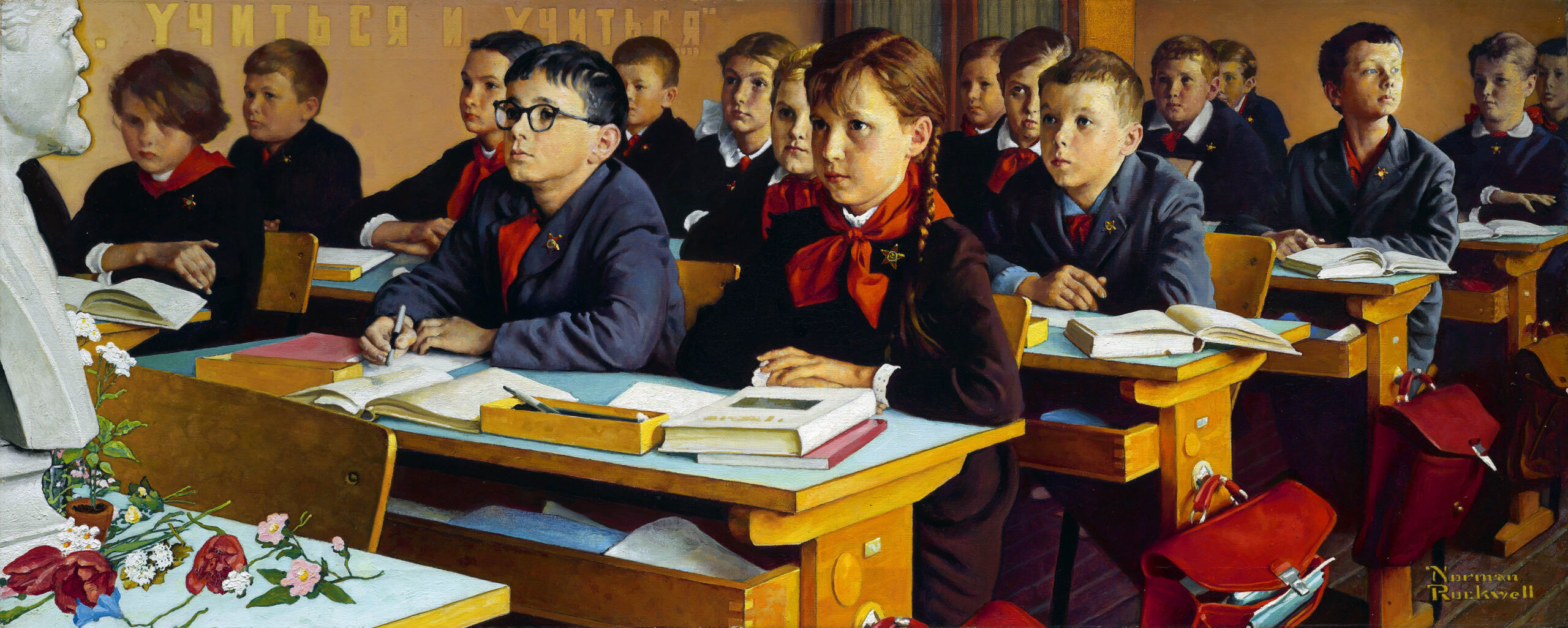
Norman Rockwell (1894-1978)
Russian Schoolroom
1967, oil on canvas
15" x 37", signed lower right
"Education," Look Magazine, October 3, 1967, pgs. 48-49
Not every chapter of Judy’s remarkable career was filled with artistic discoveries and professional triumphs. One of her most difficult experiences involved a prolonged legal battle over Norman Rockwell’s Russian Schoolroom, a painting she had purchased in 1988. Years later, a gallery owner claimed the artwork had been stolen from him in 1973, setting off a complicated dispute involving the FBI, conflicting accounts, and an extraordinary cast of characters. What began as a question of ownership developed into a tangled legal ordeal that tested Judy’s determination and resolve. In Reframed, she recounts the twists and turns of the case, revealing a side of the art world far removed from the beauty and tranquility of the paintings themselves.
Norman Rockwell painted Russian Schoolroom in 1967 for an article titled “Education,” published in the October 3 issue of Look magazine. The composition depicts a classroom of Soviet schoolchildren attentively engaged in their studies, reflecting Rockwell’s interest in portraying everyday human experiences beyond American borders. By the 1960s, Rockwell had expanded his artistic focus beyond the nostalgic scenes that made him famous, increasingly exploring social issues, international subjects, and the complexities of contemporary life. Russian Schoolroom exemplifies this evolution in his work, combining his extraordinary powers of observation and storytelling with a subject that offered American audiences a glimpse of life in the Soviet Union during the Cold War.
My life—with its many twists and turns, highs and lows—has been a great adventure. In good times and bad, I have been inspired and sustained by my devotion to my family and my passion for art.
Most of all, I just wanted to have fun doing what I loved, and I know now that I succeeded.
“Stop and smell the roses, Judy,” my father always urged. Looking back, I’m so very happy I followed his advice.
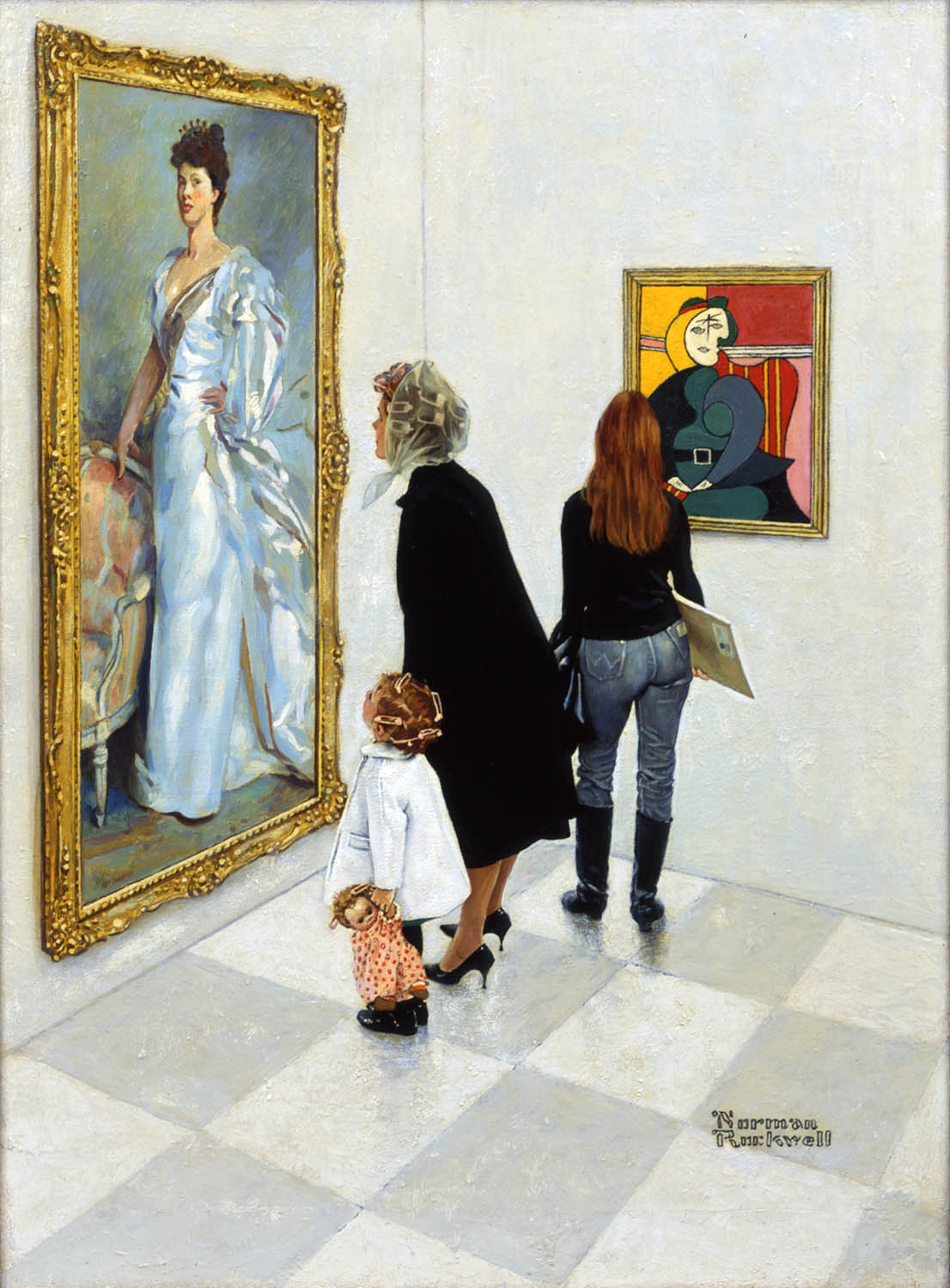
Norman Rockwell (1894-1978)
Picasso vs. Sargent
1966, oil on canvas
22" x 17", signed lower right
"Rockwell and Rollers," Look Magazine, January 11, 1966, pg. 25
As Judy reflects on her extraordinary journey, her story comes full circle, celebrating a life shaped by family, determination, and an enduring love of art. From her earliest discoveries at flea markets to establishing the National Museum of American Illustration, Judy followed her instincts, embraced unexpected opportunities, and remained true to her passions. Norman Rockwell’s Picasso vs. Sargent provides a fitting conclusion to this visual journey, reflecting the contrasting artistic traditions and questions of artistic value that Judy encountered throughout her career. Above all, her memoir is a celebration of the joy of pursuing what one loves, the resilience required to overcome life's challenges, and the importance of appreciating the beauty found along the way.
Norman Rockwell’s Picasso vs. Sargent was created for “Rockwell and Rollers,” published in the January 11, 1966 issue of Look magazine. The painting humorously contrasts two vastly different artistic approaches, represented by the modernist innovations of Pablo Picasso and the traditional realism of John Singer Sargent. Through this playful comparison, Rockwell explores the ongoing debate between modern and representational art, a subject particularly meaningful to an artist whose own work was often dismissed by critics despite its extraordinary popularity and technical mastery. For Judy, who devoted her career to challenging conventional definitions of fine art, the painting embodies a central message of Reframed: artistic value is not determined solely by prevailing fashions or critical opinion, but also by the lasting ability of art to inspire, engage, and bring joy to its audience.